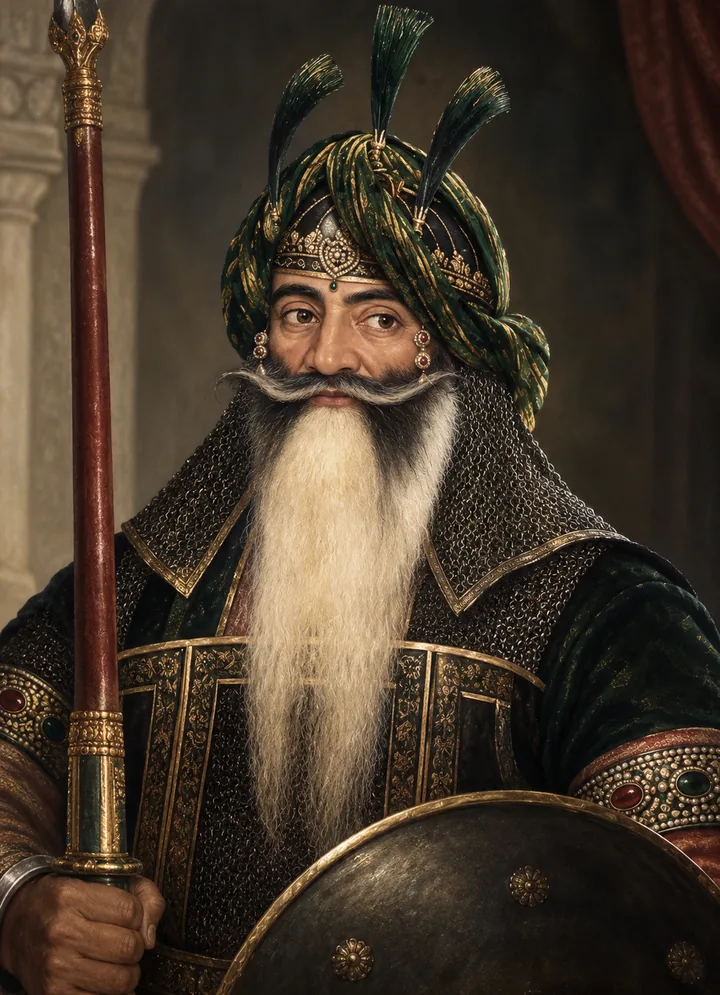
Hari Singh Nalwa
Governor of Kashmir for thirteen months, and the only man in Sikh history whose name attached itself to a currency — the Hari Singhee, still called that seventy years after he left the valley, and still not bearing his name on a single die.
Jarnail of the Khalsa Fauj · Baghmar · Commander on the Afghan Frontier29 April 1791 – 30 April 1837
I · Introduction
A Name in the Bazaar, Not on the Die
Hari Singh Nalwa governed Kashmir for a little over a year. He arrived in 1820 and was recalled in 1821, pulled back by the frontier policy that occupied the rest of his life. On the ordinary reckoning that is too short a tenure to leave a mark on anything.
Yet for the next seventy years the rupees of Kashmir were called the Hari Singhee. They were called that under Moti Ram, who both preceded and succeeded him. They were called that under every Sikh governor down to 1846, they went on being called that after Sikh rule in the valley ended, and travellers were still recording the name in 1890 — fifty-three years after Hari Singh had been killed at Jamrud.
Nothing else in Sikh numismatics works like this. Sikh coins name the Gurus and no one else; the convention is absolute, and this site has made the point on page after page. The Hari Singhee is the one case where a person’s name fastened onto a coinage anyway — not by being struck into the metal, but by being used. The die never carried his name. The bazaar did, and the bazaar kept it longer than the kingdom lasted.
II · Origins
Gujranwala, 1791
Hari Singh Nalwa
b. 29 April 1791, Gujranwala · d. 30 April 1837, Jamrud
- Family
- Uppal Khatri; originally of Majitha, near Amritsar
- Father
- Gurdial Singh, horseman and musketeer under Charat Singh and Mahan Singh
- Grandfather
- Hardas Singh, killed fighting Ahmad Shah Durrani, 1762
- Mother
- Dharam Kaur
- Service
- 1804–1837, Sikh Khalsa Fauj
- Governorships
- Kashmir 1820–21; Hazara 1822–37; Peshawar 1834–37
- Rank
- Jarnail; commander on the Afghan frontier from 1825
- Honour
- Izazi-i-Sardari
- Cognomen
- Baghmar, tiger-killer — the origin of “Nalwa”
- Sons
- Jawahir Singh and Arjan Singh Nalwa
He was born at Gujranwala in April 1791 into a family that had already given two generations to the Sukerchakia service. His grandfather Hardas Singh was killed fighting Ahmad Shah Durrani in 1762; his father Gurdial Singh rode with Charat Singh and Mahan Singh, Ranjit Singh’s grandfather and father. Hari Singh took amrit at about ten and entered the Maharaja’s service in 1804, at thirteen.
The name came from an animal. By the account preserved in the family and in every popular telling, he killed a tiger with a dagger and was given the cognomen Nalwa by Ranjit Singh; Baghmar, tiger-killer, attached at the same time. It is a story of exactly the kind this site normally flags as tradition, and it is flagged as tradition here. What is not traditional is the career it launched.
Note the symmetry of the frontier in his family. His grandfather died fighting an Afghan invasion coming east through the passes. Hari Singh spent his last twelve years pushing the Sikh boundary west to the mouth of the Khyber, and was killed holding it. Three generations of one Gujranwala household bracket the reversal of an eight-century pattern of invasion, and the middle one did not live to see it hold.
III · The Campaigns
Thirty-Three Years in the Field
Kasur, 1807. He commanded a regiment at the Maharaja’s final assault on Kasur and was rewarded with a substantial jagir — his first independent command, at sixteen. It is worth pausing on who else was at that siege: Akali Phula Singh’s Nihangs went in at the breach, and Fateh Singh Ahluwalia was there with his own contingent. Three of the lives published in this series began to matter at the same wall.
Attock, 1813. He fought at Haidru as second-in-command to Diwan Mokham Chand — the first Sikh victory in open field against an Afghan army, and the action that opened the road west.
Multan. He was present at four of the seven Lahore campaigns against the fortress: 1810, 1816, 1817 and the successful siege of 1818. Kashmir followed in 1814, when the expedition failed, and again in 1819, when it did not.
Nowshera, 1823. He was in the action in which Akali Phula Singh was killed — the battle treated at length on that page — and in the campaigns at Mankera in 1821 and Sirikot in 1824.
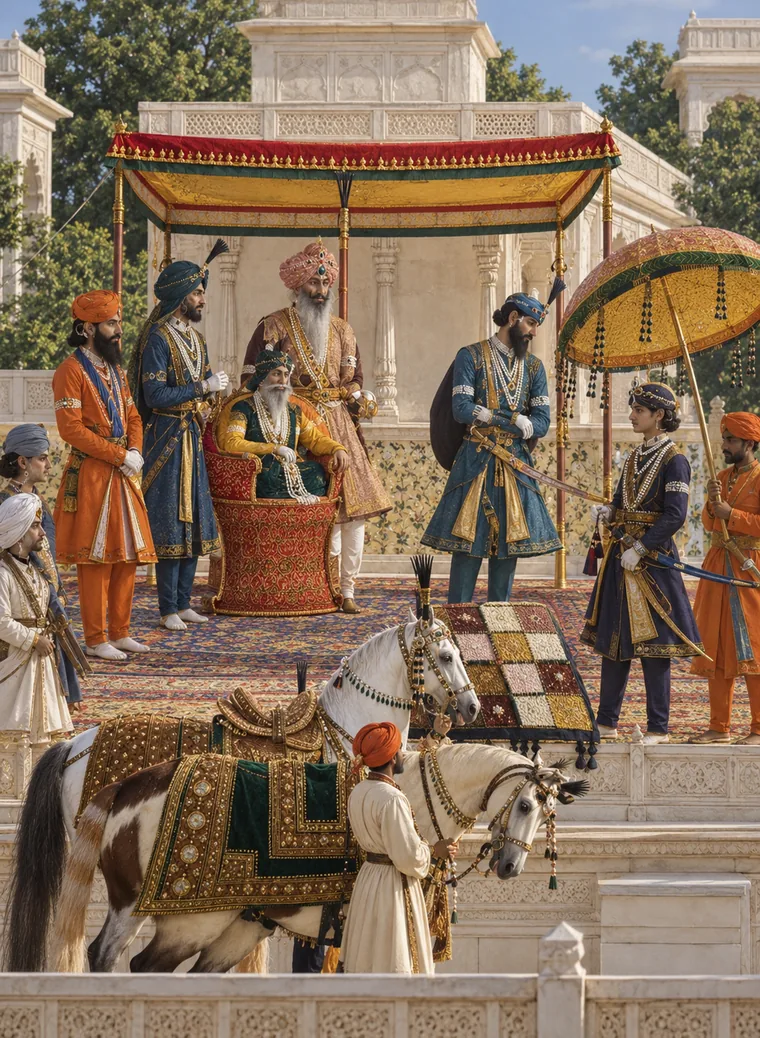
Plate · The Maharaja inspects his horsesRanjit Singh reviewing horses on a terrace of the Lahore Fort, with Hari Singh Nalwa in attendance among the courtiers. The Maharaja’s appetite for fine horses was notorious and politically consequential — the pursuit of the mare Laili cost a campaign — and a general’s standing at that court was measured partly by the mounts and jewelled trappings he could present. Digital art created for this site, worked up from Sikh court painting of the period and from surviving horse furniture and dress.
By 1825 he was commanding the whole north-western frontier of the kingdom, and from 1822 he governed Greater Hazara continuously for fifteen years. He founded Haripur in 1822, one of the few planned towns of the Sikh period, and built or rebuilt a chain of forts across country that had never previously been administered from the east.
IV · The Hari Singhee
Kashmir, 1820–21, and the Coin That Kept His Name
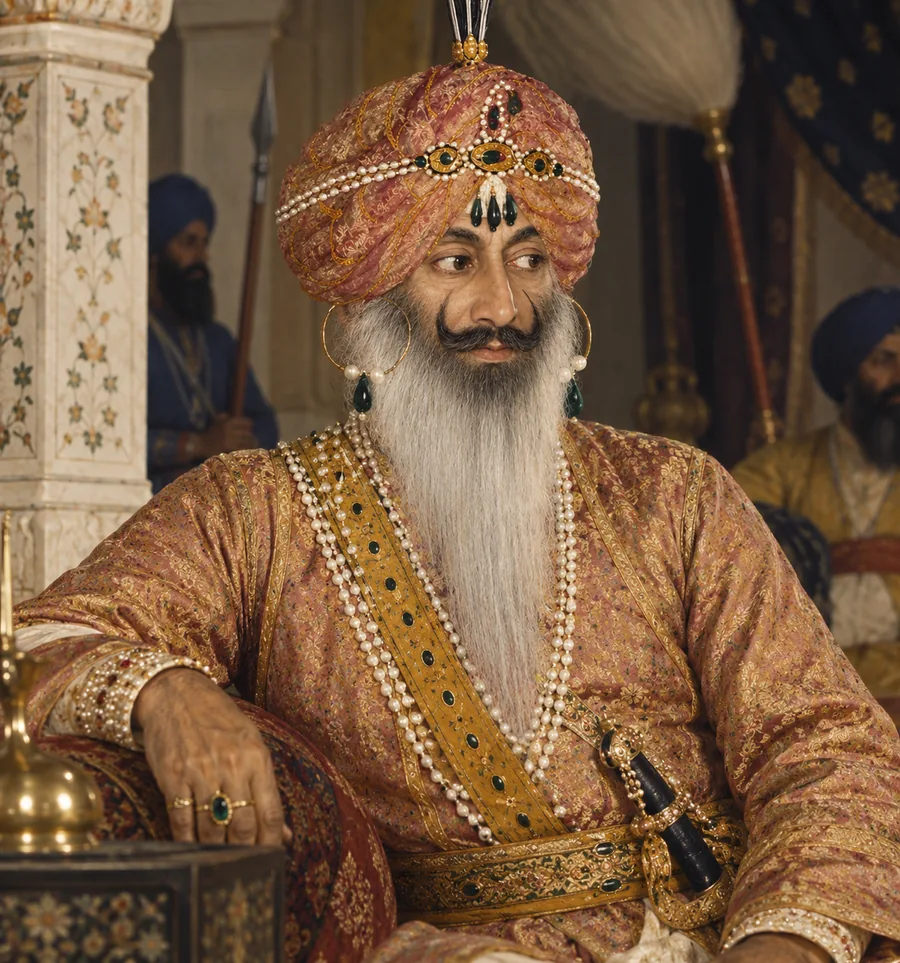
Plate · The governor at courtHari Singh Nalwa in court dress rather than armour — the aspect of him that governed three provinces, ran their revenue and opened their mints. Digital art created for this site, worked up from his known portraits and from surviving Sikh court dress and jewellery of the period.
He was appointed the first Khalsa governor of Kashmir in 1820, in succession to Diwan Moti Ram, and held the province for a little over a year. He divided it into parganahs under collectors, suppressed the robber bands in the forests, and set about the thing every Sikh governor of a distant province had to do first: making the revenue collectable.
Part of that was monetary. He established a mint in the valley on the empire’s behalf specifically to serve revenue collection, and the coins struck under his governorship carry, on the obverse beside the Gobindshahi couplet in Persian, the syllable Har in Gurmukhi. The published reading of that mark is administrative rather than personal: a marker to identify the issue for revenue purposes, not a signature.
Moti Ram returned as governor in 1821 and held the province until 1826. Coins struck in his second tenure — there is a documented example dated VS 1879, AD 1822 — were called Hari Singhee. So were those of every governor after him. So were the issues struck years after Hari Singh’s death at Jamrud. The name survived the man, the office, and eventually the kingdom.
The Hari Singhee was a below-standard rupee. It circulated at about ten mashas, in the 8–9 gram range, against the 11.0–11.35 grams the Nanakshahi held at Lahore and Amritsar. Kashmir had an established tradition of lighter rupees carrying recognised commercial identities, and the Hari Singhee is the most durable of them — Baron von Hügel found it circulating in the mid-1830s and it was still current in 1890. This site’s Coin, Commerce & Control sets it beside Kunwar Sher Singh’s VS 1889 issue at the Afghan trade weight; between them they show a province running its own monetary logic inside an empire that had a different one.
V · The Second Mint
Peshawar, 1834–1837
Peshawar was occupied in 1834 and Hari Singh was made governor. He did there what he had done in Srinagar: opened a mint to serve revenue collection in a province that had just changed hands and had no reason yet to trust the new administration’s money.
The Peshawar issues of his governorship are struck at about 8.4 grams — again well below the Lahore standard, and again for the same reason. A frontier province trading west towards Kabul and Bukhara needs a coin its own merchants will accept, not one calibrated to a treasury four hundred miles behind it. Hari Singh is the only Sikh commander associated with the establishment of two mints in two provinces, and in both cases the coin he produced was lighter than the empire’s.
That is the substance behind the legend, and it is more interesting than the legend. He is remembered as the man who terrified the frontier. What the numismatic record shows is an administrator who understood that holding a province meant getting its revenue into a form its own bazaars would take.
VI · Jamrud
30 April 1837
In the winter of 1836–37 he built a fort at Jamrud, at the eastern mouth of the Khyber. The position is the whole point: for eight centuries the pass had been the road into India, and a Sikh fort at its mouth closed it. Dost Mohammad Khan sent an army under his sons to take it back.
The battle was fought at the end of April 1837. The Sikh garrison held, the fort was not taken, and the Afghan force withdrew — and Hari Singh Nalwa was killed, on 30 April, the day after his forty-sixth birthday. His death was concealed from the garrison until the siege lifted, which is itself a measure of what his presence was worth.
The reinforcement question belongs here and has to be stated carefully, because it is one of the charges gathered in the Dogra study listed on the Personalities index. The Lahore court was occupied that spring with the wedding of Kunwar Nau Nihal Singh, and relief did not reach Jamrud in time. Whether that was the friction of a court distracted by a state occasion, or something deliberate on the part of the ministry, is exactly the sort of question that needs the evidence laid out rather than asserted. This page does not settle it. It records that the fort held, the pass stayed closed, and the man who had made both possible was dead.
VII · The Builder
Forts, Towns and Shrines
Two things carry his name today and neither is a coin die: the Hari Singhee rupee of Kashmir and the town of Haripur in Hazara. The second belongs to a side of the man that the battle narratives leave out. For the fifteen years he governed the frontier he built continuously — Vanit Nalwa, working from the record and from Baron Hügel’s observations of the 1830s, puts the total at more than fifty-five structures: forts, ramparts and towers, a planned town, gurdwaras, temples and mosques, tanks, gardens, havelis and sarais. What follows is the part of that list that can be placed with confidence, arranged by the ground it stands on.
Jamrud — Fatehgarh
Mouth of the Khyber · 1836–37The fort the battle was fought for. Jamrud was occupied in October 1836; the proposal to fortify it was opposed at Lahore and he built it anyway, laying the foundation on 18 December 1836 and completing the work in fifty-four days, with walls ten feet thick. He named it Fatehgarh. He was cremated inside it the following April, and the fort has been garrisoned without interruption since — Sikh, British, Pakistani — which is the plainest measure of whether the position was worth holding.
Sumergarh — the Bala Hissar
Peshawar · from 1834The citadel that dominates Peshawar today is substantially his. He rebuilt the ruinous Mughal-Afghan Bala Hissar after the city was taken in 1834 and renamed it Sumergarh; the older name outlived the Sikh one, but the fabric is the Sikh rebuild. It was the seat of the Peshawar governorship and of the mint discussed in section V.
The Peshawar valley chain
Shankargarh, Michni, Bara, Jehangira, NowsheraA ring of satellite forts covering the approaches to Peshawar from the tribal country. Shankargarh, at Shabqadar, sat where the Kabul, Hashtnagar and Gandab routes met, and was the largest, with a garrison of five hundred foot, three hundred horse and a dozen guns. Michni stood on the Kabul river under Nichhatar Singh, son of Dhanna Singh Malwai; Bara on the Bara river under Jhanda Singh Butalia. Jehangira and Nowshera held the two banks of the Kabul where the road from Attock crossed it. Shankargarh, Michni and Bara were begun under him and finished by the governors who followed between 1837 and 1849; all of them are still in military use.
Harkishangarh and Haripur
Hazara · 1822–23His base for the fifteen-year governorship of Hazara, on the left bank of the Dor near Salik Serai, on the road from Hasan Abdal into the hills. The fort was named for Guru Har Krishan; the 1907 Hazara Gazetteer gives its walls as four yards thick and sixteen high, behind a moat twenty feet deep, and calls it the enduring monument of his power. Around it he laid out Haripur, one of the very few planned towns of the Sikh period, watered by channels cut from the Dor — the first such water system in the region. The orchard to the north-east, Hari Singh ka Bagh, the British later turned partly into a cemetery. He also built a mosque in the town. Vestiges of the fort survive; the town is the one place on the map that still says his name.
Attock
The Indus crossing · after 1813Not his fort but his work: he strengthened Akbar’s fort on the left bank of the Indus with high bastions at each of the gates, making the river crossing that every Afghan army had used a fixed Sikh position.
Uri
Kashmir · 1820–21The fort at Uri on the Jhelum road into the valley belongs to his short Kashmir governorship, the same year as the coinage in section IV. He also laid out a garden at Srinagar.
Katas Raj
The Salt Range · residenceAt the sacred pool of Katas, among the Hindu and Buddhist temples, he built a fort and two large havelis on the water’s edge that served as his residence when he was not on the frontier. The fort still stands in the midst of the temple complex.
Gujranwala
Home · fort, haveli, mosqueIn the town where he was born he built a fort, his own haveli and a mosque. The fort was demolished by the British after annexation; the haveli survives. His samadhi is at Jamrud, where he was cremated, not here.
Hasan Abdal and Amritsar
Panja Sahib · the Akal TakhtHe built the Gurdwara Panja Sahib at Hasan Abdal, on the road between Attock and Haripur, at the site of Guru Nanak’s halt, and he gave the gold for the gilding of the Akal Takht dome at Amritsar. A second Hari Singh ka Bagh lay at Amritsar.
VIII · The Successors
Jawahir Singh, and Arjan Singh’s Last Stand
He left two sons who mattered, and their fates divide neatly along the fault line of the 1840s.
Jawahir Singh Nalwa
The elder sonHeld the family’s standing in the Khalsa army into the wars and was active at Chilianwala in January 1849 — the hardest-fought action of the Second Anglo-Sikh War and the one the British came closest to losing. He fought the war through the regular structure of the army his father had served.
Arjan Singh Nalwa
d. c. 1849–52 · the youngest sonDid not. A minor jagirdar at Gujranwala, he refused to submit when the war ended and the annexation was proclaimed. He fortified his estate with about a hundred men and beat off a party sent from the Lahore Darbar — by then acting under British direction — to bring him in. A squadron of Skinner’s Horse was sent next. He was gone before it arrived, and he died on the run some time afterwards. His property was confiscated. He is the subject of the song Arjan Vailly from the 2023 film Animal, which is how most people under thirty have now heard the Nalwa name at all — see this site’s Popular Culture page.
Set the two brothers side by side and you have the whole shape of 1849 in one family. One fought the war in uniform and survived the settlement. The other refused the settlement, held a house against the state his father had built the frontier for, and lost everything including the record of where and when he died.
The line did not end there. Arjan Singh’s grandson Narain Singh was given the title of Sardar Bahadur by the British and died in March 1934 — the grandson of a man the British had hunted, honoured by the same government eighty years later.
IX · What He Left
The Only Name the Coinage Ever Took
The series has now published two men who broke the rule that Sikh coinage names nobody, and they broke it in opposite directions. Fateh Singh Ahluwalia got his house into the legend by permission, once, in silver. Hari Singh Nalwa never appeared on a die at all — and got a whole province’s currency named after him for seventy years by the people who used it.
Of the two, his is the stranger achievement and the harder one to arrange. A coin legend is a decision taken by a sovereign and a die-cutter. A name in the bazaar is a decision taken by everybody, slowly, and it cannot be granted or revoked. Kashmir called its money the Hari Singhee under governors who had every reason to prefer their own names on it, and went on calling it that after the Sikhs had lost the valley altogether.
The frontier he closed stayed closed. The pass through which invaders had come east for eight hundred years was not used that way again. And the coinage that carried his name was, on the evidence, a light rupee designed to make a difficult province’s revenue collectable — which is a duller thing than a legend and a truer measure of what he actually did.
Sources
Sources and Further Reading
- Vanit Nalwa. Hari Singh Nalwa: “Champion of the Khalsaji”. The fullest modern study, by a descendant working from the archival record; the source for the Kashmir mint, the ‘Har’ marker and the persistence of the Hari Singhee name.
- Hans Herrli. The Coins of the Sikhs. On the mints established for revenue collection in Kashmir and Peshawar.
- Surinder Singh (2001), on the coinage of the Kashmir governorship and the speculation surrounding it.
- Ganeshi Lal (1846), the contemporary record that the Kashmir coinage was still called the Hari Singhee nine years after Hari Singh’s death.
- Baron Karl von Hügel, Travels in Kashmir and the Panjab, for the coin in circulation in the mid-1830s.
- Harbans Singh (ed.). The Encyclopaedia of Sikhism. Punjabi University, Patiala.
- Autar Singh Sandhu. General Hari Singh Nalwa, 1791–1837. Cunningham Historical Society, Lahore, 1935. For the foundation and fifty-four-day construction of Jamrud.
- Hazara District Gazetteer, 1907. For Harkishangarh and Haripur as the British found them.
- Prem Singh Hoti. Jivan Itihas Hari Singh Nalwa. 1937. For the mosques at Haripur and Gujranwala and the family’s building tradition.
- Vanit Nalwa, as above, section on construction, for the tally of more than fifty-five structures and the Katas Raj havelis.
- On the coinage see this site’s Coin, Commerce & Control; on the frontier campaigns, The Sikh Way of War.