Military History · Doctrine & Tactics · AD 1606–1849
The Sikh Way of War
From the Akal Sena of Guru Hargobind to the Fauj-i-Khas of Maharaja Ranjit Singh — two and a half centuries of answers to a single military problem
Akal SenaDhai PhatDal KhalsaFauj-i-Khas
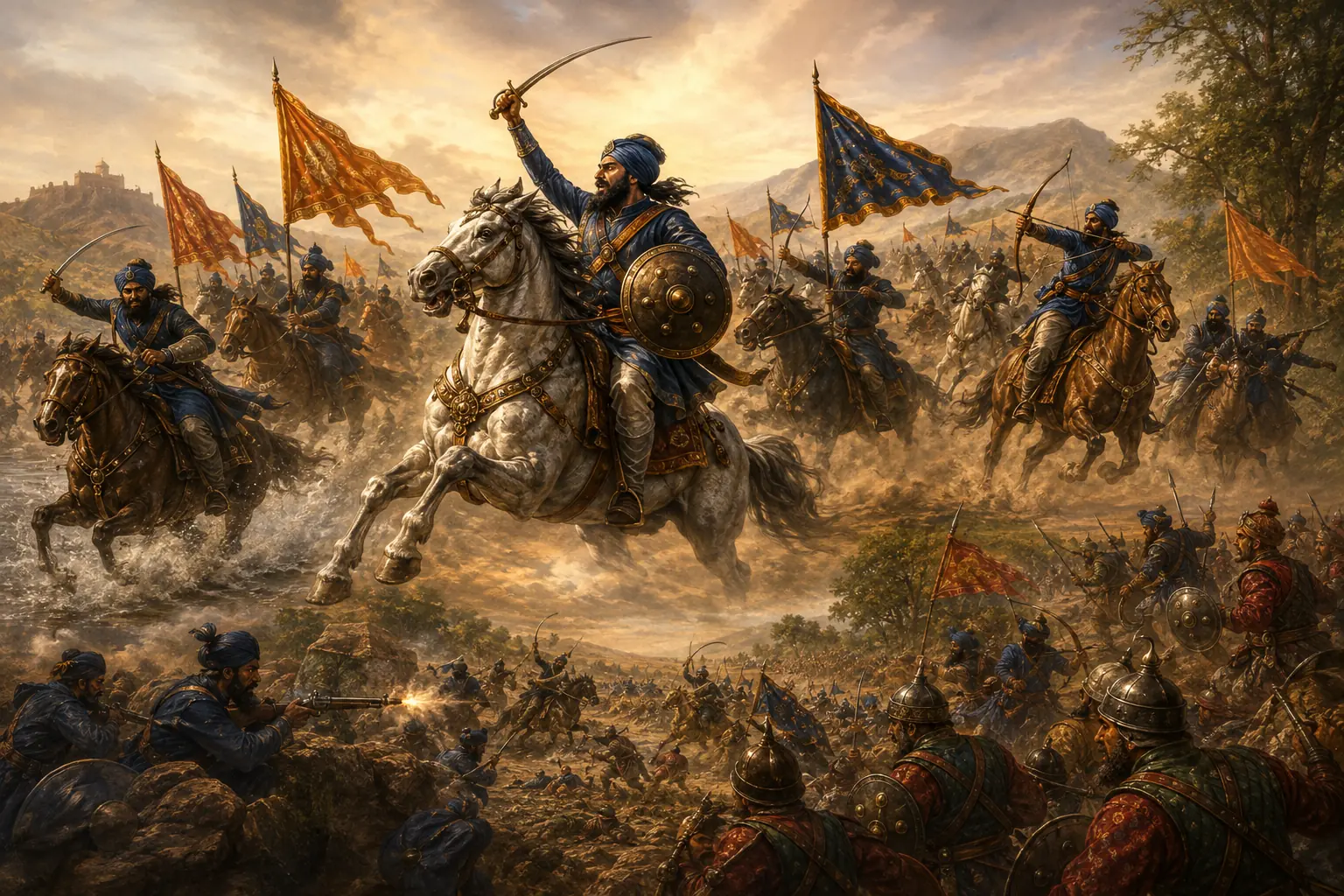
Artist’s reconstruction · Dal Khalsa cavalry in the field, mid-eighteenth century
Introduction
One Problem, Seven Answers
Sikh military history is usually written as a sequence of battles. Read that way it becomes a list — victories at Kartarpur and Sirhind, catastrophes at Gurdas Nangal and Kup, a long recovery, an empire, and then two wars against the British that ended it. What the list conceals is that the same question is being asked and re-answered throughout: how does a small force fight a much larger one, on ground the larger force already holds?
Every Sikh commander from 1606 onward faced some version of that problem. The Mughal provincial administration, the Afghan invaders under Ahmad Shah Durrani, and finally the East India Company were each, at the moment of contact, materially superior — more men, more money, better guns, secure bases. The answers arrived at differ so sharply from one another that they amount to distinct military doctrines, and the shift from one to the next is usually the result of a defeat rather than a victory.
What follows traces that thread. It is a companion to the period histories elsewhere on this site — Banda Singh Bahadur, the misl period, the Sikh Empire and the Anglo-Sikh wars — and does not repeat their narrative. It asks only how the fighting was actually done, and why the method changed when it did.
The recurring problem
Fight a materially superior enemy, on his ground, without a secure base to retreat to.
I · The Decision to Arm
Guru Hargobind and the Akal Sena
1606 – 1644
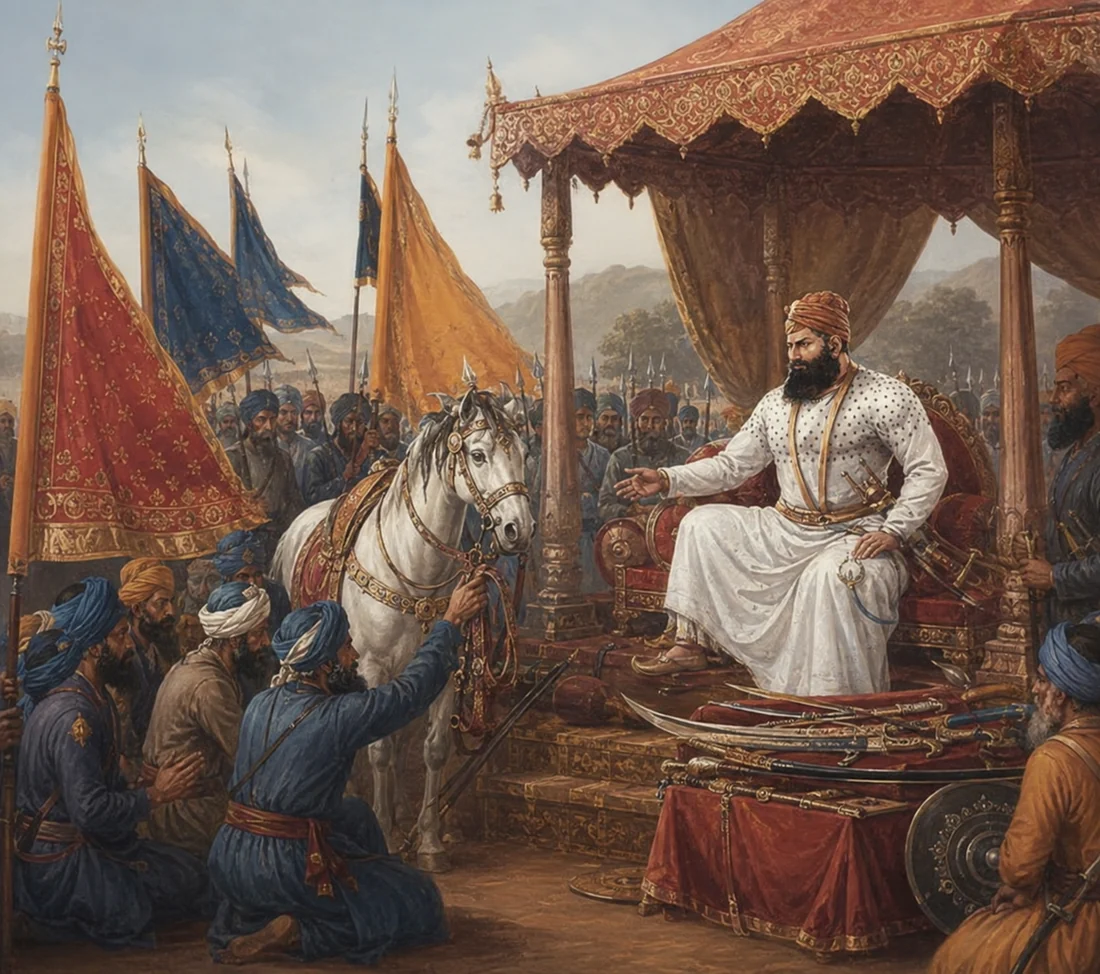
The martyrdom of Guru Arjan Dev in 1606 produced the first structural change in Sikh military capacity: his successor took the guruship wearing two swords, of miri and piri — temporal and spiritual authority held together rather than separated. The Akal Takht was raised facing the Harmandir Sahib as the seat of that temporal authority, and for the first time offerings were accepted in the form of horses and weapons.
The force that resulted was small. Contemporary and near-contemporary accounts give figures in the region of a few hundred horsemen with a body of retained soldiery, including a Pathan contingent under Painde Khan — who would later defect and die fighting against the Guru at Kartarpur. A mud fort, Lohgarh, was built on the outskirts of Amritsar. Martial vars were sung daily at the Akal Takht by dhadi players. None of this constituted an army in the Mughal sense; it constituted a community that could not simply be dispersed by a provincial faujdar.
Four or five engagements followed over roughly fifteen years. The striking feature is not that the Guru won them — the accounts agree that he did — but what he did afterwards. Amritsar was not held. After the fighting of 1634 the Guru withdrew to Kartarpur, and after Kartarpur to Kiratpur in the Shivalik foothills, beyond the effective reach of the Lahore administration. Victory was never converted into territory.
This is the earliest expression of a principle that recurs for the next two hundred years: the objective is the survival and cohesion of the Panth, not the holding of ground. A position defended successfully is still abandoned if holding it invites a larger force next season.
Offerings of horses and arms. After 1606 the sangat was asked to bring mounts and weapons rather than money alone. The change looks administrative and was in fact strategic: it converted a devotional network into a standing capacity to field cavalry, and it is the point at which Sikh military history begins.
Sept – Oct 1621
Rohilla / Sri Hargobindpur
Two actions in quick succession near Ruhela, arising from a local dispute over land at the new town of Hargobindpur, which escalated when the losing party obtained Mughal troops from the Jalandhar Doab. The first sustained armed encounter of the guruship.
14 April 1634
Amritsar
A large imperial force under Mukhlis Khan attacked the city. Warned in advance, the Sikhs evacuated Lohgarh but for a small garrison and fought over two days. The pattern of pre-emptive evacuation followed by engagement on chosen ground appears here for the first time.
Dec 1634
Lahira / Gurusar, near Mehraj
Fought in the Malwa tract, in the open country south of the Sutlej, over horses intercepted en route to the Guru. Notable as an action fought far from any Sikh centre, deep in territory the Guru did not control.
26–27 April 1635
Kartarpur
Provoked by the defection of Painde Khan, who brought imperial troops against his former commander and was killed in the fighting. The last major engagement of the guruship; the Guru withdrew afterwards to Kiratpur and fought no further pitched action.
Doctrine
Arm, but do not garrison. Fight when attacked, win locally, then move beyond reach. Ground is expendable; the community is not.
II · The Armed Peace
Deterrence Without Battle
1644 – 1675
Guru Har Rai is recorded as maintaining a substantial body of horsemen — the traditional figure is 2,200 — and fought no battle with them. That is a strategic posture rather than an absence of one. A retained cavalry force that is never committed still imposes a cost on any provincial authority contemplating action, and the Guru's tenure passed without a general confrontation.
The period matters to the argument for a negative reason. It demonstrates that the armed capacity established under Guru Hargobind was maintained across a generation in which it was not used, and therefore that it had become a permanent institution of the Panth rather than an emergency measure. When it was needed again it did not have to be rebuilt from nothing.
The execution of Guru Tegh Bahadur at Delhi in 1675 ended the equilibrium and set the terms for everything that followed.
III · The Fortified Line
Guru Gobind Singh and the Anandpur System
1675 – 1708
The tenth Guru attempted the opposite experiment: to hold ground. Anandpur was developed not as a single fort but as a system of mutually supporting positions — Anandgarh, Keshgarh, Lohgarh, Fatehgarh and Holgarh — sited across the broken ground where the Shivaliks meet the plain. Artillery was acquired. A war drum, the ranjit nagara, was beaten in deliberate assertion of sovereign authority. With the institution of the Khalsa in 1699 the force acquired a formal identity, a code, and a standing obligation to bear arms.
For roughly two decades the system worked. The Guru fought and won a series of actions against hill-state coalitions and Mughal detachments — Bhangani in 1688, Nadaun in 1691, and repeated engagements around Anandpur through the 1690s. A fortified base allowed him to accept battle on favourable terms and to refuse it otherwise.
What defeated it was not assault but investment. The final siege of Anandpur in 1704 combined the hill rajas with imperial forces from Sirhind and Lahore in a sustained blockade. A fixed position with a finite granary can be reduced by patience alone, and the evacuation, when it came, was catastrophic: the crossing of the flooded Sirsa, the loss of the Guru's family, and the deaths of the elder Sahibzade at Chamkaur and the younger at Sirhind.
Chamkaur is the doctrinal turning point. A small party held a mud haveli against a besieging force, and the decision reached there — that the Guru should leave rather than fall with the position — is the clearest possible statement of the principle Guru Hargobind had established. The fixed point was expendable. The leadership was not.
1688
Bhangani
Fought near Paonta against a coalition of hill rajas. The first major engagement of the guruship and a defensive victory won in the open.
1691
Nadaun
Fought alongside hill rulers resisting Mughal revenue demands — an instance of temporary alignment with the same powers that had opposed the Guru at Bhangani.
1700 – 1704
The Anandpur sieges
A succession of investments culminating in the sustained blockade of 1704 by combined hill-state and imperial forces. The fortress system held against assault and failed against starvation.
Dec 1704
Chamkaur
A rearguard action fought from a fortified dwelling by a party traditionally numbered at forty. The decision that the Guru should break out rather than hold defined the priority of leadership over position.
Dec 1705
Khidrana (Muktsar)
Fought at a scarce water source in the Malwa desert. The choice of ground — denying water to a pursuing force in dry country — is a return to mobile, terrain-driven warfare.
Doctrine
Fortify to choose your battles — but never let the fortress become the objective. When the position falls, the leadership must not fall with it.
The Misl Before the Misls
A battle formation, not yet a confederacy
The word misl is so firmly attached to the eighteenth-century confederacies that its earlier and quite different meaning is easily lost. Before it named a principality, it named a formation on the field.
The first recorded use is by Sainapati, the poet of Guru Gobind Singh's own darbar, in the Sri Gur Sobha. Describing Bhangani in 1688, he sets out a recognisable command procedure: the war drum is beaten, the horsemen assemble under their banners, the Guru rides the ground and examines the positions, and the several sectors of the battlefield — the morchas — are then allotted, one to each misl. Sainapati uses the term again of the gatherings at Nanded at the close of the Guru's life, once more in the sense of a body of men grouped under its own leader.
Read carefully, that passage describes a system rather than a crowd. There are standing sub-units, each with its own banner and its own commander; there is a reconnaissance of the ground before deployment; and there is a formal assignment of sectors, so that each unit knows the frontage it holds and who stands on its flanks. That is a battle formation in the proper sense of the term.
The organising principle is older than the word. The banner-groups that assembled at Amritsar under Guru Hargobind, and the reinforcement that came up from Kiratpur to relieve the Guru's party at Brahman Majra, imply the same structure — identifiable contingents under their own leaders, capable of being committed or held back as separate bodies. Banda Singh Bahadur's rapid combinations at Samana, Sadhaura and Sirhind, absorbing fresh contingents as he advanced without losing the ability to manoeuvre, are difficult to explain unless the incoming groups arrived and fought as units.
The etymology carries the same sense. Misl derives from the Arabic for equal or like — hence a body of equals, its leader first among them rather than above them. J. D. Cunningham preferred a derivation from maslahat, glossed in Steingass as a frontier garrison or border post, and armed or warlike men. Both readings point to a military unit rather than to a territory.
The eighteenth-century meaning is a development of this one, not a replacement for it. Sita Ram Kohli noted a third and later sense: the misl as the file or register — maintained, by some accounts, at the Akal Takht — recording each sardar's fighting strength and his territorial acquisitions. The same word therefore travels from a sector of a battlefield, to the body of men holding it, to the written record of that body's strength and gains, and finally to the principality itself. The confederacies of the misl period did not invent the unit. They inherited a formation that had been in use since at least Bhangani and gave it land.
The three senses of misl
One word, three meanings, in sequence — and the later ones grew out of the first.
A tactical sub-unit — a banner-group under its own leader, allotted a morcha or sector of the field. Attested by Sainapati at Bhangani, 1688.
A file or register — the record of a sardar's fighting strength and territorial acquisitions, kept for the Dal Khalsa. Noted by Sita Ram Kohli.
A principality — the territory that unit came to hold, and the confederacy that governed it. The sense in general use for the period after 1748.
IV · The Campaign of Movement
Banda Singh Bahadur
1709 – 1716
Banda Singh Bahadur arrived in the Punjab from the Deccan in 1709 with authority from the Guru, a small following, and no base whatever. Within eighteen months he had destroyed the Mughal administration of the Sirhind sarkar and struck coin in the name of the Gurus. The method was speed and sequence: Samana, then Sadhaura, then Sirhind itself, each objective taken before the next could be reinforced, and each success converting local peasantry and disaffected soldiery into fresh manpower.
The decisive action at Chappar Chiri in May 1710 was fought in the open against Wazir Khan's field army, and the victory delivered Sirhind — a provincial capital, its treasury, and with it the first territorial Sikh authority since the Gurus. That authority was expressed in the two things a sovereign does: he issued a seal, and he struck a rupee. Both are discussed in detail on the Banda Singh Bahadur page.
The reversal followed the same logic as Anandpur. Having taken territory, Banda had to defend it — and a defended place can be invested. He fortified Lohgarh in the Shivaliks and was besieged there in 1710, escaping only by a stratagem. He returned to the guerrilla ground of the hills, remained effective for five years, and was then trapped in the fortified village of Gurdas Nangal in 1715. The garrison held for months and was reduced by starvation, exactly as Anandpur had been. He was executed at Delhi in June 1716.
By 1716 the pattern is unmistakable across three generations. Sikh forces won while moving and lost while fixed. It took the following half-century to convert that observation into an explicit method.
Doctrine
Strike in sequence, faster than the enemy can concentrate. Territory taken becomes territory that must be held — and holding is what defeats you.
V · The Doctrine of Dispersal
Dhai Phat — Two and a Half Strikes
1716 – 1765
The half-century after Banda's execution was the period of greatest danger and greatest doctrinal innovation. Imperial policy under successive Lahore governors aimed at extermination; prices were placed on Sikh heads. The response was to abandon territory altogether — to withdraw into the Lakhi jungle, the Shivalik foothills and the deserts of the Malwa, and to accept a form of war in which nothing was defended and nothing was permanently held.
Two organisational measures made this survivable. In 1734 Nawab Kapur Singh divided the fighting strength into the Buddha Dal and the Taruna Dal — the veteran and the young — allowing one to fight while the other recovered. In 1748 these were consolidated as the Dal Khalsa, with decisions taken by gurmatta at the Akal Takht at the biannual gatherings of Baisakhi and Diwali. Command was elective and dispersed. There was no headquarters to capture.
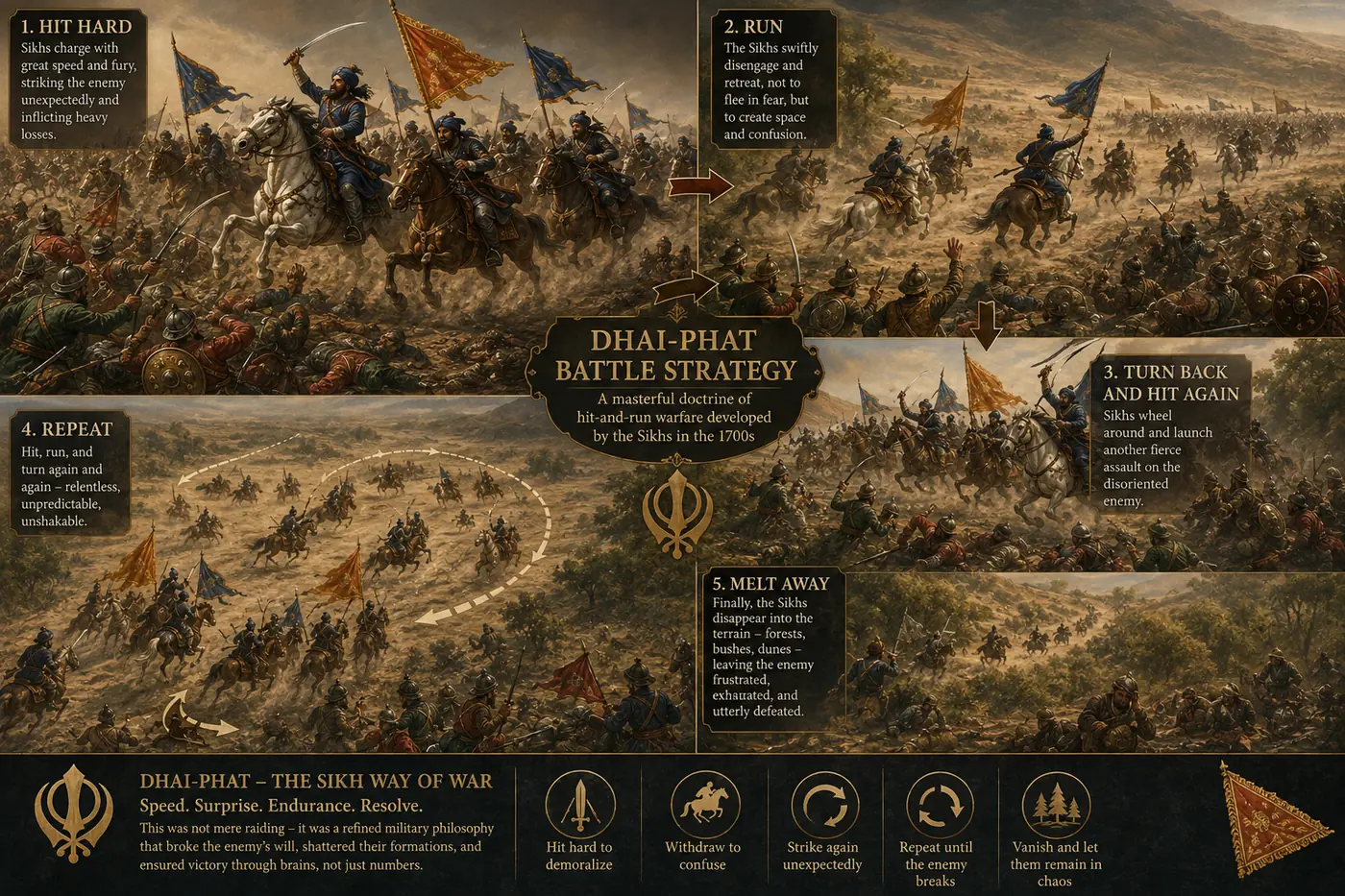
The tactical doctrine that emerged was named. Dhai phat — two and a half strikes — is recorded by Rattan Singh Bhangu in the Prachin Panth Prakash, drawn from the testimony of a veteran who had fought under it.
Hit the enemy hard enough to kill, run, turn back and hit him again; run again, hit and run till you exasperate the enemy, and then, melt away.
A veteran of the misl wars, recorded by Rattan Singh Bhangu
The cycle, as the maxim describes it.Bhangu's veteran states the sequence in five movements; the doctrinal count of two and a half strikes is a different way of weighing the same actions, and is set out below.
The three components were counted deliberately. The first full phat was the approach — everything that secured surprise, reckoned at some forty per cent of the whole action. The half phat was the shock itself, the brief violent contact intended to unbalance rather than to destroy. The second full phat — equal in weight to the approach — was the withdrawal, executed at speed and in order to ground the enemy could not follow onto.
That accounting is the conceptual breakthrough. In eighteenth-century warfare a retreat was a rout and dispersal was defeat. The Dal Khalsa made dispersal a manoeuvre — scattering by design, with an understood rendezvous, and reassembling at a time of its own choosing. An enemy who has driven the Sikhs from the field has not beaten them; he has merely watched them execute the second half of the doctrine.
Against Ahmad Shah Durrani's returning columns the method was refined further. Detachments appeared against the baggage and the rearguard and vanished when the main force turned; sections of the enemy were lured into pursuit, cut off and encircled. George Forster, travelling in the period, remarked that the Sikh mode of attack differed from that of any other cavalry in Asia — a rolling fire in which a party galloped forward, halted to discharge its matchlocks, then wheeled away to make room for the next.
The doctrine had one unavoidable weakness, and both great catastrophes of the century exploited it. Guerrillas must occasionally concentrate, and a force encumbered by its vahir — the baggage train carrying families and possessions — cannot disperse. At Kup-Rahira on 5 February 1762, Ahmad Shah covered some two hundred kilometres and two river crossings in under forty-eight hours and caught the Dal Khalsa encumbered in exactly this way. Unable to melt away, they formed square around the baggage and fought a pitched battle on the enemy's terms. The Wadda Ghallughara that followed was the price of being caught concentrated.
Lahore, 1739: The Doctrine Described by the Enemy
Sri Gur Panth Prakash, Episodes 94–96
Rattan Singh Bhangu devotes three consecutive episodes to the invasion of Nadir Shah, and together they form the single most valuable passage in the eighteenth-century Sikh sources on how the Sikhs were fighting — because the description is given by the man whose job it was to stop them.
Episode 94 sets the scene. Zakariya Khan — whom Bhangu calls Khan Bahadur, and the Sikhs called Khanu — had persecuted the Singhs on a scale the poet says cannot be counted, Bhai Mani Singh among them. When Nadir Shah reached Lahore, the governor collaborated and paid a ransom. The Singhs, far from being crushed, seized the moment: they waylaid traffic on the roads to Kabul, Kandahar, Lahore and Delhi, and stripped the invader's columns. Nawab Kapur Singh is recorded telling the Singhs that the destined hour had come. Bhangu reckons Nadir Shah's plunder of Delhi in the thousands of crores, itemising the Peacock Throne, the great diamond, and seventy thousand of the defenceless killed in Delhi alone.
Episode 95 is titled, in the translation, "Question-Answer Session Between Nadar Shah And Khan Bahadur." Returned to Lahore, Nadir Shah demands to know who robbed his baggage, and threatens to reduce their country to dust and ashes. The governor's reply is the passage that matters.
His plunderers belonged to no specific country. They fed themselves and rested while on the move, and had no fixed place of stay. They minded neither the taste of food nor pain under torture, neither thirst in the peak of summer nor cold in the depth of winter. Each one of them would fight a hundred, being not scared of death at all.
Zakariya Khan to Nadir Shah · Panth Prakash, Episode 95, verses 4–6
Read it as a military assessment and every element of the doctrine is there, stated by the opposition: no territory to invade, no base to burn, no supply line to cut, no fixed point at which the enemy can be made to stand. The governor is not describing fanaticism. He is explaining to a superior who wants results why a campaign built on catching and counting cannot work against an enemy who has given up holding ground. The Mughals, he adds, had exhausted themselves in exterminating the Singhs and could not reduce their numbers at all.
Nadir Shah then asks whose followers these people are — whether the sect grew of itself or converted from another. Khan Bahadur traces the whole descent from Guru Nanak, and recounts the executions: Guru Tegh Bahadur, the Sahibzadas. And Bhangu gives the invader the closing verdict, which is worth more than any Sikh chronicler's praise: the Mughals had reaped what they had sown, and how was one to conquer people whom God Himself had come to protect?
Episode 96 supplies the consequence, and it is the hinge of the whole period. Bhangu is explicit that it was the namoshi — the disgrace — of that exchange that drove what followed. Nadir Shah left for Kandahar; Khan Bahadur, humiliated, resolved that no one with unshorn hair would be allowed to live in his country. The Singhs were now hunted in batches, in the poet's phrase, as game is killed in a hunt. Instant rewards were given for information, and a rate is named: five rupees to whoever pointed out a Singh, with letters sent to neighbouring territories to publicise it. The Singhs moved by night and lay hidden by day, in thickets, in other men's houses, or across the frontier.
So the bounty system was not simply cruelty. It was a governor's answer to having been humiliated in front of an invader by an enemy he could not produce.
Delhi, c. 1732: The Impersonators
Giani Gian Singh, Naveen Panth Prakash, Uttarardh
The most remarkable episode of the persecution years is not in Bhangu at all. It is in Giani Gian Singh's Naveen Panth Prakash, and it turns on precisely the problem the bounty system created.
The scene is the imperial court at Delhi. Reports have come from the governor at Lahore that the Singhs are growing stronger, and the emperor demands of his Wazir an explanation: what is this business, and how has this people multiplied so? The Wazir's answer runs for eighty verses. He traces the Panth to Guru Nanak; he describes the preparation of amrit in exact ritual detail — the five Singhs, the khanda, the iron vessel, the water of Amritsar; he sets out the rahit; and he explains its effects, that cowards become brave and goats become lions, that heat and cold do not touch them, that wounds heal without dressing. "That is why they do not die though they are killed," he says, "and day by day they increase without limit."
Then he adds the sentence on which everything turns. They are worth seeing, he tells the emperor — but only in war. And since Your Majesty cannot see the real thing:
If you cannot see the real, then look upon the imitation.
The emperor consents, and the Wazir summons the professional mimics of the court — the bhands, the nakalias, the bahurupias, the "takers of many forms." Show me the imitation of the Singhs, the emperor orders.
And the mimics are terrified. Their objection is the heart of the episode, and they state it before a costume is put on:
An imitation without the real will not convince. But if we make it real, we shall not come out alive.
They plead that a good imitation of such people cannot be made; that if the Shah takes offence they will be crushed with their children; that there is great danger in mimicking men who wish him ill. The emperor pardons them in advance. They ask for three days, and go away to prepare.
What they bring back is exact. Some make themselves up as Nihangs in blue, some as Bhujangis in white; loose dumalas swinging like a lion's tail, torn kachhehras, grey blankets and ragged cloth, broken and rust-eaten weapons, chakkars and khandas bound on their heads, each man carrying maunds of iron. They come into the court roaring "Fateh! Akal! Akal!" and raise an uproar in the hall.
Then they announce their names — names, the poet says, that nobody had heard even in a dream. Bakhera Singh and Jhera Singh, Takra and Lakra, Baghar and Khaghar, Dilli-Tor Singh (Delhi-breaker), Mugal-Mar Singh (Mughal-killer), Khan-Mar Singh, Turak-Mar Singh. The court is scandalised and then helpless with laughter. They perform the Khalsa bole, the Singhs' own coded battle-argot, which Gian Singh sets out at length — boiled chickpeas called almonds, days of starvation called a full deg, a stick called a swift horse, grinding at the quern called going for a ride. They taunt the Mughal and Sayyid women. They declare that they will now take charge of the throne of Delhi. And they recite Raj Karega Khalsa.
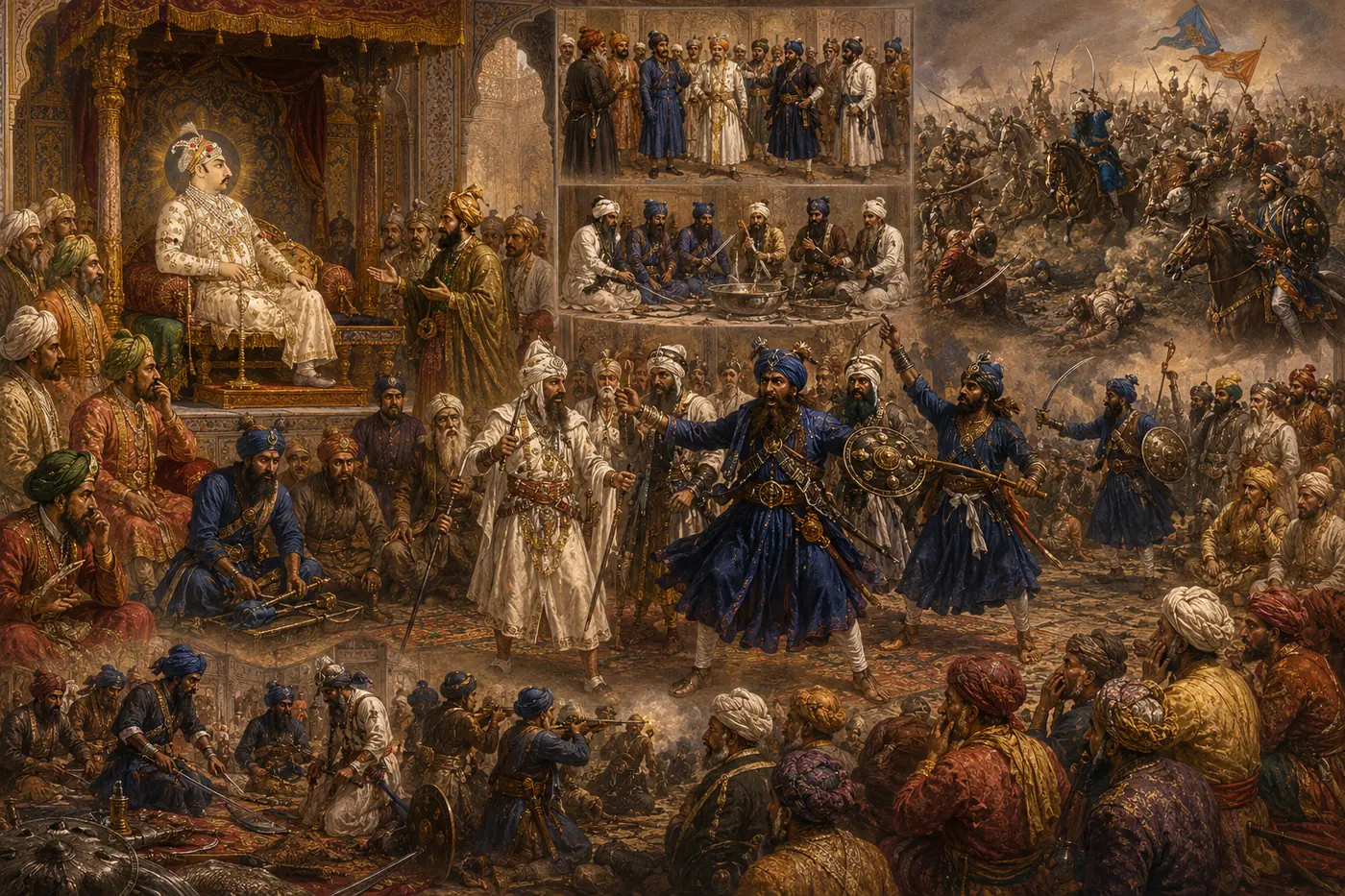
The court, the performance, and what it became.The emperor enthroned at the left, the Wazir presenting; the hired bhands in the centre, costumed as Nihangs in blue and Bhujangis in white; and at the right the mock engagement that stopped being a mock engagement. In Gian Singh's account ten of the “Turks” and two of the “Singhs” were dead by the end of it.
Then the same troupe changes costume and performs the other side: Turkistanis and Hindustanis, Mughals, Pathans and Duranis, Sayyids and Sheikhs, in fine pashmina, bright sharpened weapons, iron helmets and gauntlets, mounted on horses of their own countries. A great host advances. The "Singhs'" lookout calls that dust has risen and the Turks are coming — and the poet says the Singhs' hearts rejoiced.
And then the performance stops being one. The hair of the mimics playing Singhs stands on end; their bodies swell; their eyes go red and terrible. They fasten their broken tack — rope for stirrups, a torn saddle — and two and four men together drag rusted swords out of the scabbards and scour them with sand and stone. Some load their muskets backwards, ball before powder, and when this is pointed out reply that the Guru will set it right.
The two sides close, and the Singhs overcome the Turks. The sharpened Turkish blades strike and do not cut a hair. The more wounds they take, the more the lion-rage wakes in them. They strike with rusted swords scabbard and all; they cut through armour; their broken-down horses run; they leap at the elephants. The reversed muskets fire straight. Barbers, water-carriers, calico-printers and carpenters, Brahmins, Baniyas and Jats, Sainis and goldsmiths — men the poet lists by caste, high and low alike, and says that those who had been like jackals were known for lions.
The butcher's bill is given precisely. About ten of the "Turks" killed and many wounded; two of the "Singhs" dead and six wounded — and they take the Turks' horses and plunge into the forest crying that the Satguru has given victory. In the houses of the bhands, Gian Singh adds, the widows raised the death-wail. These were performers, and they had killed one another in earnest.
The emperor bites his finger in astonishment, draws a long breath, and gestures to his ministers:
See the strange power of God — He makes hawks out of sparrows, and by them has the hawks torn.
The consequence is the point of the whole episode, and it is a political one. The Wazir observes that the Lahore governor's report understated the case tenfold; that Nadir Shah is threatening to come; and that a people like this should be bought rather than fought. A courtier advises that they are easily won — give them sweet bhang and halwa and they ask for nothing else — and that they will straighten out any province that troubles the empire.
So the emperor writes to Khan Bahadur at Lahore: never make enmity with the Singhs; keep them contented by whatever means, so that the country is not laid waste. A robe of investiture is sent, and a grant of twelve villages near Amritsar, with cash for expenses and grazing land for horses. The Singhs accept. The disturbances cease and the people are at peace. Gian Singh dates it VS 1789 — AD 1732–33.
That is the offer of the Nawabi: the khilat and jagir which the Khalsa accepted through Kapur Singh, who has been Nawab Kapur Singh ever since. Gian Singh's impostor episode is his explanation of why the Mughal court decided to conciliate the Sikhs instead of exterminating them — because at Delhi, in front of the emperor, hired actors put on the outward form of the Khalsa and it took hold of them.
The Man Taken for an Impostor
Bhangu, Panth Prakash, Episode 98
Bhangu has no impersonators, but he has the same question turned inside out. After the killing under Zakariya Khan, no Singh was seen for four months and people concluded the Khalsa was extinct. Someone then caught sight of Bota Singh in the open and could not believe it — a real Singh could not have survived. The verdict was that the man must be an impostor in the disguise of a Singh.
Stung by it as by a scorpion, Bota Singh set up a platform at a road junction near Sarai Nurdin, called it a fort, levied a toll of an anna on a cart and a paisa on a donkey, and wrote Zakariya Khan a letter calculated to be unbearable — sending word by way of the Nawab's wife, addressed as his sister-in-law. Troops came, as intended. Offered his life if he came quietly, he answered that the Singhs had never sought to save their lives.
Between the two chroniclers the whole question is framed. In Gian Singh, false Singhs become real ones. In Bhangu, a real Singh is called false and has to die to prove otherwise. Both are asking what the identity actually consists of — and both answer that it is not the costume but the willingness to fight in it.
Sources, and a note on Mastaney
The impersonator episode is Giani Gian Singh, Naveen Panth Prakash (1880), Uttarardh, at verses 79–172 of the section following the Wazir's account of the Khalsa — pages 445–456 of the standard edition. The renderings above are my own from the Gurmukhi. It is not in Rattan Singh Bhangu's Prachin Panth Prakash, whose Volume II I searched in full for every term of disguise and counterfeit; Bhangu's treatment of the same years is Episodes 94–98.
The film Mastaney (2023) moves the episode to Lahore in 1739, before Nadir Shah. Gian Singh places it at Delhi, before the emperor, in VS 1789 (AD 1732–33) — the reigning emperor at that date being Muhammad Shah, and Nadir Shah appearing in the text only as a rumoured future threat, which is one of the reasons the court decides to conciliate. The transposition merges Gian Singh's Delhi episode with the Nadir Shah confrontation that Bhangu records separately at Lahore seven years later.
Doctrine
Approach, strike, withdraw — and count the withdrawal as equal in value to the attack. Dispersal is a manoeuvre, not a defeat.
VI · The Confederate Cavalry
The Misls
1748 – 1799
The misl period represents the doctrine of dispersal converted into a political system. Eleven or twelve confederacies, each under its own sardar, operated independently for most of the year and combined under the Dal Khalsa when a common threat required it. The military characteristics follow directly from the tactics.
It is worth recalling what the word had meant sixty years earlier. As set out above, a misl at Bhangani was a banner-group allotted a sector of a battlefield. The confederacies are that unit given ground to keep. The continuity is not merely verbal: the elective leadership, the standing of the sardar as first among equals rather than as a lord over vassals, and the expectation that separate units would combine for a common action and disperse afterwards are all carried over intact from the formation to the polity. What changed was that the sector became a territory.
The misl armies were cavalry. Infantry was negligible and artillery almost absent — both are encumbrances to a force whose principal asset is the ability to disappear. The horseman was self-equipped, rode light, carried a matchlock and sword, and expected to live off the country. There were no depots to lose and no siege train to slow a march.
Revenue was raised by rakhi — a protection agreement under which villages paid a share of produce, customarily a fifth, in return for security against raiders including other misls. Its significance is that it funded cavalry without requiring occupation. A misl could draw income from a tract without garrisoning it, keeping the fighting strength mobile and the administrative burden near zero. It is the fiscal expression of the same doctrine.
Between 1764 and 1783 this system took Sirhind, occupied Lahore, and rode to Delhi. Its limitation was equally structural: a confederacy of self-interested cavalry commanders could conquer widely but could not easily hold, administer, or coordinate a sustained campaign against a modern army. The misl period page treats the confederacies and their coinage in full.
Why the misl armies looked as they did
Each characteristic follows from the requirement to disperse at will.
Cavalry almost exclusively — infantry cannot break contact fast enough to execute the withdrawal that the doctrine treats as half the battle.
Little or no artillery — guns fix a force to roads, require draught animals, and cannot be abandoned without loss of honour and capital.
No fixed depots — supply came from the country and from rakhi; there was nothing an enemy could capture to compel a battle.
Elective, dispersed command — decisions by gurmatta at Amritsar twice yearly; no single headquarters whose loss would decide a war.
Revenue without occupation — the rakhi system converted territory into income without converting it into a garrison commitment.
VII · The Regular Army
Ranjit Singh and the Great Inversion
1799 – 1839
Maharaja Ranjit Singh reversed every one of the principles above, and did so deliberately. The reasoning was sound. A state that holds Multan, Kashmir, Attock and Peshawar cannot defend them with cavalry that disperses on contact; fortresses must be taken, which requires siege artillery, and held, which requires garrisons and disciplined infantry. The doctrine of dispersal is the doctrine of a people without a state. From 1799 the Sikhs had one.
Regular recruitment began around 1805, initially with deserters from the East India Company's service — an experiment abandoned when it became clear that many remained in contact with their former employers. The decisive step came with the arrival of the Napoleonic veterans. In 1822 the Fauj-i-Khas was raised under Jean-Baptiste Ventura and Jean-François Allard — four infantry battalions, two cavalry regiments and a troop of artillery, drilled to French practice, carrying a battle standard inscribed in Gurmukhi. Its performance so impressed the Maharaja that in 1835 he ordered the whole regular establishment reorganised on its model. These officers, and the others who followed them, are treated on the Foreign Officers page.
The scale of the transformation is best seen in the figures. By 1838–39 the Fauj-i-Ain, the regular army, stood at some sixty thousand men — of whom around forty-five thousand were infantry. The artillery park had grown to roughly 180 heavy guns, twenty howitzers and sixty light pieces, served by five thousand gunners and organised into batteries of ten guns apiece under their own commandants. Matchlocks had given way to smoothbore muskets.
The ghorchurra — the misl-descended horseman who had been the whole of Sikh military power for a century — survived as the Fauj-i-Be Qawaid, the irregular arm. By the Maharaja's death the infantry had become the preferred service. In a little over three decades the Sikh army had been turned inside out.
Period
Principal arm
Artillery
Base
Answer to a stronger enemy
Gurus
Retained horse and foot
Minimal
Temporary; abandoned after victory
Win locally, then move
Banda Singh
Mobile field force
Captured only
Briefly territorial
Strike in sequence
Dal Khalsa
Light cavalry
Effectively none
None — jungle and hills
Disperse and return
Misls
Self-equipped horse
Negligible
Rakhi income, no garrisons
Combine only when necessary
Sikh Empire
Regular infantry
~260 guns, 5,000 gunners
Fixed garrisons and arsenals
Meet him in line and out-shoot him
Doctrine
A state must defend its frontiers where they lie. Trade mobility for firepower, and irregular cavalry for disciplined infantry.
VIII · The Verdict
What the Anglo-Sikh Wars Tested
1845 – 1849
The army that met the British on the Sutlej in December 1845 was the most formidable indigenous force the Company had encountered in India. Its artillery was served with a skill British officers acknowledged without qualification; its infantry stood in line and delivered volleys under fire. Ferozeshah was, by Hardinge's own private account, very nearly a British defeat. At Sobraon and Chilianwala the Khalsa inflicted casualties on a scale the Company had not previously sustained in the subcontinent.
And it lost. The reasons most often given are political rather than military — the Darbar in disorder after the murders of 1840–43, commanders whose loyalty to the army they led was doubtful, a court that had reason to fear its own soldiery. All of that is true and is treated on the First and Second Anglo-Sikh War pages.
The doctrinal observation is narrower, and worth stating carefully. The Khalsa fought the British in precisely the manner at which the British were most practised. Entrenched positions, artillery duels, infantry in line: this was the European way of war, and the Company's armies had spent a century perfecting it in India. The one method that had never failed the Sikhs — refusing battle, dispersing, striking the baggage and the line of communication, and returning at a time of their own choosing — was no longer structurally available. An army of sixty thousand with fixed arsenals, siege trains and provinces to garrison cannot melt into the Lakhi jungle.
This is not an argument that the modernisation was a mistake. Without it there would have been no empire to defend, no Multan, no Kashmir, no Peshawar, and very probably no Sikh state at all by 1830. It is an argument that the transformation carried a cost that was invisible until the moment it was tested — and that the cost was the doctrine which had kept the Panth alive through the fifty years when it possessed nothing else.
It is worth adding that the older method did surface once more. In 1848–49 the risings that opened the second war spread through exactly the channels the misls had used — local sardars, dispersed commands, and a countryside that supplied and concealed them. By then the Company held the arsenals.
The trade
An empire cannot fight like a guerrilla band — and a guerrilla band cannot hold an empire. Each doctrine solved the problem the other created.
Note
On Dates, Numbers and Sources
Two cautions apply to any account of this material, and are stated here rather than repeated throughout.
Dates for the earlier engagements are contested. The battles of Guru Hargobind in particular are variously dated in the sources — the Amritsar action appears as 1628 and as 14 April 1634 in different traditions, and Lahira is placed in both 1631 and 1634. The dates given above follow the Bhatt Vahi entries where these exist, but a reader will encounter other years in reputable works and should not assume error.
Numbers in circulation are frequently unusable. Figures of fifty to a hundred thousand imperial troops at Kartarpur, with casualties to match, appear in widely reproduced tables and cannot be reconciled with what the Mughal administration could field against a local disturbance, or with the logistics of the ground. Where this page gives strengths it does so sparingly and prefers the conservative figure. The nineteenth-century establishment returns for the Sikh Empire are of a different order of reliability, being drawn from the Khalsa Darbar's own pay records.
The dhai phat material derives from Rattan Singh Bhangu's Prachin Panth Prakash, composed in the 1840s from the testimony of participants — near-contemporary oral evidence rather than documentary record, and to be read as such. For the Sikh Empire, the establishment and artillery figures come from the Khalsa Darbar records catalogued by Sita Ram Kohli, and the accounts of the European officers are drawn from their own memoirs and from the Ludhiana Agency correspondence.
Principal reading
Rattan Singh Bhangu, Sri Gur Panth Prakash, Vol. II, Episodes 94–96 (Nadir Shah and Khan Bahadur) and 98 (Bota Singh) — trans. Kulwant Singh, Institute of Sikh Studies, Chandigarh.
Giani Gian Singh, Naveen Panth Prakash (1880), Uttarardh, pp. 445–456 — the impersonators at the Delhi court and the grant of the Nawabi, VS 1789.
Sainapati, Sri Gur Sobha — contemporary with Guru Gobind Singh; the earliest use of misl as a battle formation, in the account of Bhangani.
Rattan Singh Bhangu, Prachin Panth Prakash — the fundamental near-contemporary source for the misl period and for dhai phat.
Giani Gian Singh, Naveen Panth Prakash and Twarikh Guru Khalsa — preserves much that survives nowhere else, though to be used with more caution than Bhangu.
Hari Ram Gupta, History of the Sikhs (5 vols) — the standard narrative for the eighteenth century.
Sita Ram Kohli, Catalogue of Khalsa Darbar Records and Sunset of the Sikh Empire — the army establishment from the state's own papers.
J. S. Grewal, The Sikhs of the Punjab — the standard single-volume history.
Sohan Lal Suri, Umdat-ut-Tawarikh — the Lahore court chronicle; discussed on its own page.