Essays & Research
Essays on the history, numismatics, political economy, military history and material culture of the Sikh Empire and the Punjab — from the first coins of 1710 to the last mints of 1849.
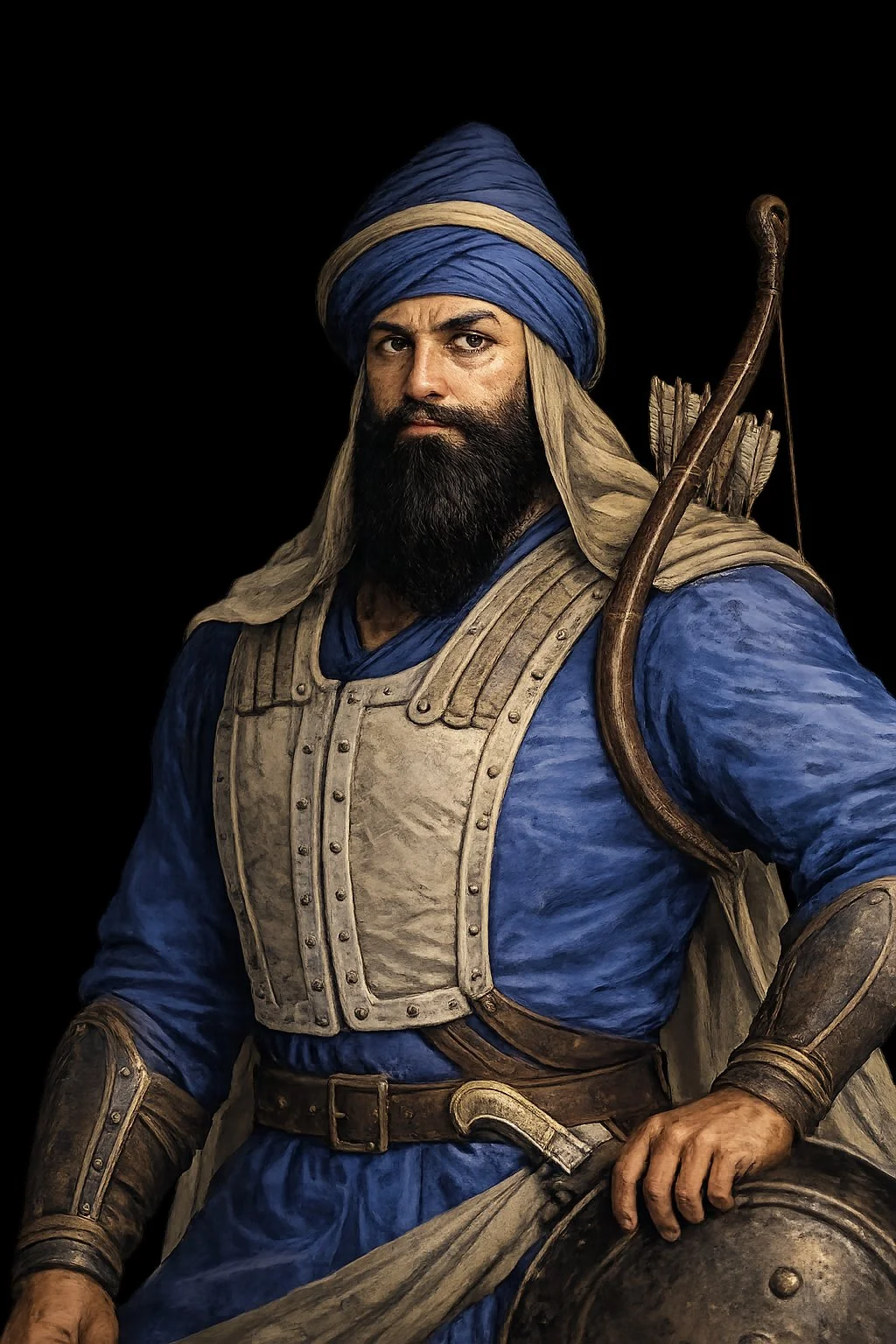
Banda Singh Bahadur
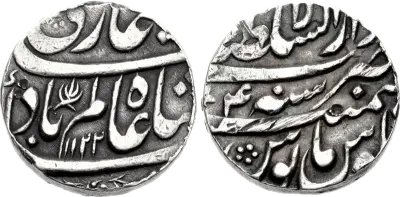
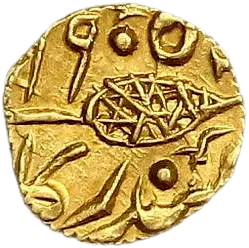
The disciple who struck the first coins ever issued in the name of the Khalsa — displacing the Mughal emperor from the coin of the Punjab for the first time. Two types survive from this period. The Year 2 rupee is unique. His execution in 1716 ended the first Sikh sovereignty; his coins and seal seeded every rupee that followed.
Read Essay → History · AD 1716–1799 · The Dal KhalsaThe Sikh Misls
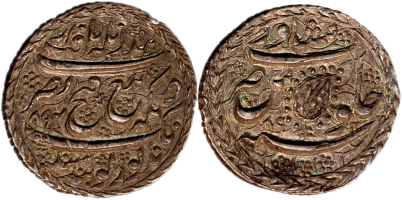
The eleven Misls of the Dal Khalsa confederacy and the most unusual collective coinage in Indian history — rupees struck in no king's name, only the couplets of Guru Nanak and Guru Gobind Singh. The declaration at Vaisakhi 1765 and the coins that embodied it: simultaneously the most republican and the most theocratic currency ever struck.
Read Essay → History · AD 1799–1849 · Sarkar-i-KhalsajiThe Sikh Empire
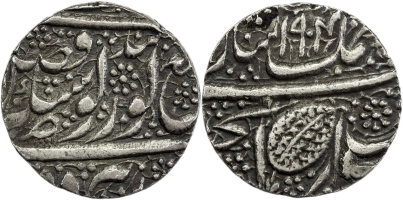
Ranjit Singh's empire at its height: fourteen mints from the Khyber to the Sutlej, from Kashmir to Sindh — all striking coins in the Gurus' names, never the Maharaja's own. Five Maharajas, fifty years, and the coinage that recorded every year of it in silver and gold.
Read Essay → History · AD 1839–1849 · The CollapseThe Fall of the Sikh Empire
How the most powerful state in South Asia outside British India dissolved within a decade of its founder's death — Dogra treachery, Army Panchayats, two Anglo-Sikh Wars, and the stolen bodies of Maharani Jindan and Maharaja Duleep Singh. Seetal, Khushwant Singh, and the post-colonial reading compared.
Read Essay → Military History · AD 1845–46The First Anglo-Sikh War
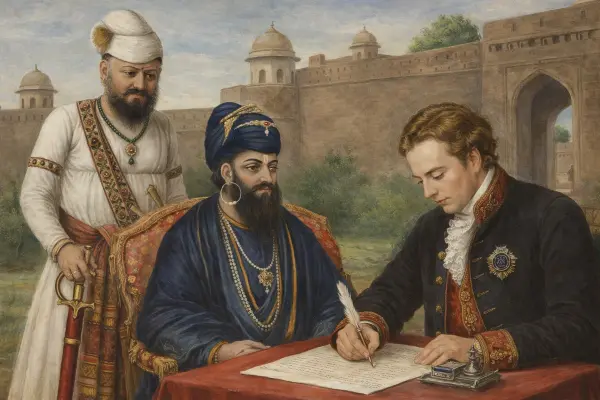
The war the Khalsa nearly won. At Ferozeshah, the British came closer to catastrophic defeat than at any engagement since Waterloo. Mudki, Ferozeshah, Aliwal and Sobraon — Lal Singh's betrayal before the crossing, Tej Singh's sabotage of the bridge at Sobraon, and the martyrdom of Sham Singh of Attari. Drawing on Dalhousie's private letters and Henty's contemporary narrative.
Read Essay → Original Scholarship · AD 1846–1849 · Political EconomyThe Bhairowal Interregnum
How the British East India Company dismantled Sikh sovereignty in the twenty-seven months between the Treaty of Bhairowal and the annexation — through seven interlocking instruments documented in the Punjab Papers, the Lahore Political Diaries, and the Board of Administration's own records. The Second War was the occasion; the interregnum was the structural cause.
Read Essay → Military History · AD 1848–49The Second Anglo-Sikh War
The war that closed the Sikh mints forever. Dalhousie's manufactured pretext, Chilianwala's catastrophe — the worst single-day British defeat in Asia since the First Afghan War — and Gujrat's three-hour bombardment of 94 guns. The annexation of 29 March 1849, Dalhousie's private letters, and the last coins of the fourteen imperial mints.
Read Essay → History · AD 1764–1948 · The Phulkian StatesThe Cis-Sutlej States
Patiala, Nabha, Jind and Kaithal — the Phulkian chiefs south of the Sutlej, striking coins in the name of Ahmad Shah Durrani from 1764, then under British protection from 1809, then carrying the Gobindshahi couplet for ceremonial use from VS 1893. Their rupees outlasted the Empire by a century, the last struck in 1948.
Read Essay →The empire was made and unmade by identifiable people, and this section follows them: the generals who won the frontier, the allies who put Ranjit Singh on the road to Lahore, the successors who could not hold what he left, and the court faction whose conduct in the decade after 1839 still needs weighing against the evidence rather than the polemic. Published studies appear below; the full series, with the subjects currently under research, is indexed on the Personalities page.
Personalities of the Sikh Empire
The index to the biographical series — generals, allies, successors and the court faction that outlived them all, admitted only where a mint, a coin type, a legend or a weight standard carries the mark of the person. Lists every life published and every subject under research, with the three tests each has to clear before it earns a page.
Open the Series → History · AD 1761–1823Akali Phula Singh
Jathedar of the Akal Takht for twenty-three years, and the only man in the Lahore Darbar whose authority ran the other way — in 1811 he summoned Ranjit Singh to answer for the Moran affair, and the Akal Takht's response withdrew a coin type from the Amritsar mint. He died leading the Nihangs at Nowshera in 1823.
Read Essay → Kanhaiya Misl · c. 1762–1832Sardarni Sada Kaur
She married her daughter to the son of her husband’s killer, led half the assault that took Lahore in 1799, and was dispossessed by the empire she built. The leaf mark on every imperial coin dates from the conquest she commanded a share of.
Read the Life → The Daftar · c. AD 1770–1834Diwan Bhawani Das
The Kabul revenue officer who arrived at Lahore in 1808 to find a state with no treasury and no accounts, and built the twelve daftars that recorded everything the Sarkar Khalsa took in and paid out. No coin type changed on his order — but the archive on which the fiscal history of the Punjab depends is the output of his filing system. The opening of the series’ second arc.
Read the Life → History · AD 1780–1849Women of the Lahore Darbar
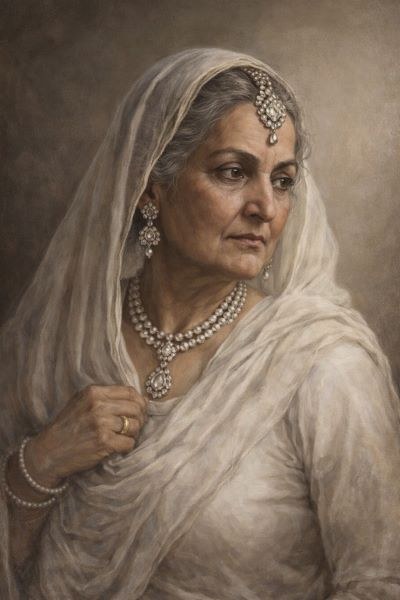
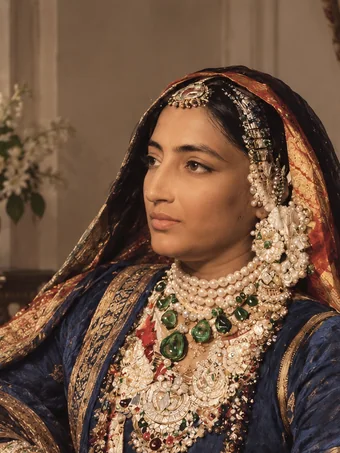
The queens, consorts and power-brokers who shaped the Sikh Empire — from Sada Kaur, who made Ranjit Singh's rise to power possible, to Rani Jindan, who governed as regent, resisted the British, was exiled from her own son, and died in London. The women the standard histories put in the margins were, in several cases, the story itself.
Read Essay → Ahluwalia Misl · AD 1784–1836Raja Fateh Singh Ahluwalia
Ranjit Singh’s sworn brother, and the only man permitted to put his own house into a coin legend. The Ahluwalia rupee of VS 1862 read face by face, the phantom Lahore issue of 1761 behind it, and the 1809 boundary that ran straight through his estate.
Read the Life → The Frontier · AD 1791–1837Hari Singh Nalwa
Governor of Kashmir for thirteen months, and the only man whose name a Sikh coinage ever took — the Hari Singhee, still called that in 1890 and never bearing his name on a die. With the mints he opened, Jamrud, and Arjan Singh Nalwa’s last stand at Gujranwala.
Read the Life → The Regency · AD 1817–1863Maharani Jind Kaur
A reassessment rather than a life. What she actually governed in the two years she held real power, what the treasury she inherited had left in it, and whether the charge that she marched the Khalsa to the Sutlej to be destroyed survives contact with the evidence — set against the army that murdered her brother in front of her.
Read the Study → Military History · AD 1822–1849Foreign Officers at the Lahore Court
The European and foreign commanders who modernised the Khalsa army — Allard, Ventura, Avitabile, Court, Van Cortlandt, Gardner. How soldiers of Napoleon built the force the British came closest to losing to, and why Général Court's coin collection vanished for a century before resurfacing at an English provincial book sale in 1994.
Read Essay → The Last Sovereign · AD 1838–1893Maharaja Duleep Singh & His Family
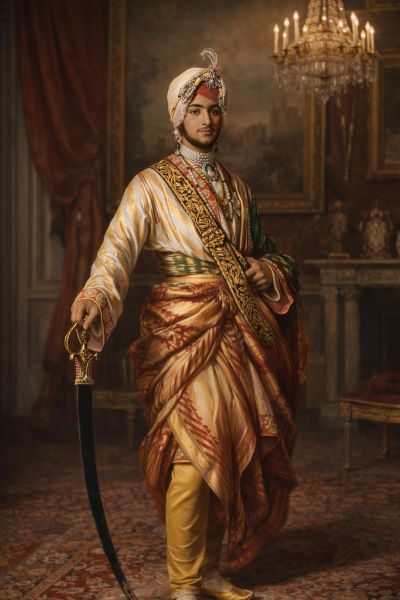
Sovereign at five, deposed at ten, and the ruler in whose name the final Sikh coinage was struck — none of which carries his name. With his two marriages, his eight children, and the extinction of the house of Ranjit Singh at Lahore in 1957.
Read the Study → History · AD 1839–1856Betrayal and Reward
The treachery charge graded by the strength of the evidence rather than repeated as a list — what the records carried at the time, what rests on tradition, and three names that do not belong. Then the ledger: of every mint the empire held, exactly one survived the fall, and it survived by changing owner in 1846.
Read the Study →The Morashahi Rupee
Between VS 1861 and VS 1868, the calligraphers of the Amritsar mint hid a peacock within the Persian legend on selected rupees — commemorating Ranjit Singh's relationship with the courtesan Moran inside the very text that acknowledged the Guru's sovereignty. Four types identified, including a previously undocumented VS 1868 specimen.
Read Essay → Original Scholarship · Numismatics · VS 1904–1905The Nimak Mint
The Nimak rupees (Herrli 03.01.04–03.02.04, 11.1g, VS 1904–1905) puzzled numismatists for over a century. This essay establishes through a chain of primary sources — the Lahore Political Diaries, Fleming's 1848 diary, the Punjab Papers — that the mint at Pind Dadan Khan was established by British direction, not Sikh initiative, to replace light Afghan-standard frontier silver with Amritsar Nanakshahis pegged to the Company's rupee.
Read Essay → Numismatics · Mint History · AD 1556–1948The Sarhind Mint
Twelve dynasties struck coin at one Punjab mint across four centuries — Akbar's copper dams, Aurangzeb's silver revival, six emperors of the post-Aurangzeb succession crisis, Banda Singh Bahadur's Khalsa rupees, Nadir Shah's brief suzerainty, Ahmad Shah Durrani's grant to Ala Singh after Panipat, and the Patiala Rajashahi rupees that continued until 1948. A complete numismatic record of Punjab's political history, coin by coin.
Read Essay → Numismatics · Tokens & Subsidiary CurrencySikh Tokens
The copper and brass tokens issued across the Sikh Empire and the Cis-Sutlej states — bazaar currency, commercial tokens, and the small-denomination pieces that circulated where the silver rupee did not reach. Includes the new attribution of the Bikramjit token published in JONS 261 (Autumn 2025).
Read Essay → Myths & Misreadings · Mughal CoinageThe Khanda That Wasn’t
An examination of the claim that a Khanda-like symbol on certain Mughal coins represents Sikh influence. The symbol is shown to be a standard decorative motif appearing across multiple reigns and mints — predating the modern Khanda emblem by over two centuries. A case study in numismatic myth-making.
Read Essay → Medals · Sikh Empire & Princely StatesSikh Medals
Medals and Orders awarded by the Sikh Empire & the Princely states of Faridkot, Patiala, Nabha and Jind; Medals awarded by the East India Company for the Anglo-Sikh wars.
Browse & Read → Philately · Princely States & RepublicSikh Stamps
Feudatory stamp issues of Faridkot, Patiala, Nabha and Jind; British India's commemoratives; Republic of India issues honouring the Gurus and Sikh figures; and worldwide issues from Canada, Pakistan, Malaysia, Uganda and beyond. The Sikh world rendered in postage.
Browse & Read → Authentication · Forgery & Detection · Collector GuidanceThe Counterfeit Coin
From 18th-century contemporary forgeries and sand-cast copies to modern CNC-milled fakes — a collector's guide to forgery in Sikh numismatics. Includes three documented case studies on coins that passed through major auction houses despite community identification, an eight-step detection guide, and a section on repaired and tooled coins, undisclosed mount removal, and condition grading.
Read Essay → Political Economy · NumismaticsCoin, Commerce & Control
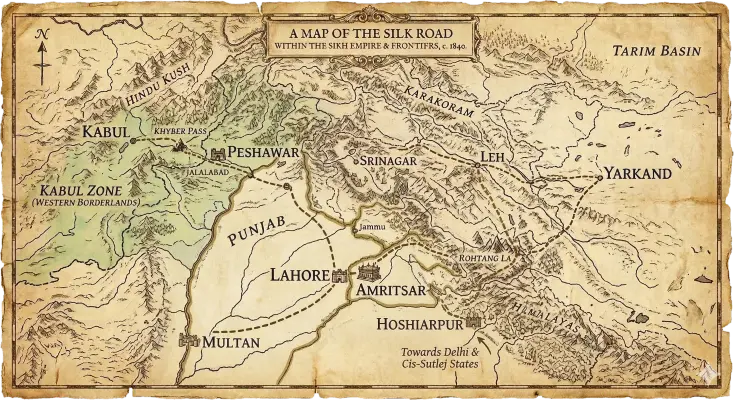
How the weight differentials of the Sikh Empire's mint network — from Amritsar's Nanakshahi to Peshawar's trade rupee — constitute a recoverable map of the late Silk Road corridor and the political economy of Sikh rule. The sarrafs of Gor Khatri, the Peshawar series weight sequence, and the exchange mechanisms of the Afghan frontier.
Read Essay → Document Study · AD 1850–51The Lahore Sales
The Sikh treasury sold at auction in Ranjit Singh’s own audience hall, over ten days, by Lattey Brothers and Mr Hayes. Read from the only two of at least eight catalogues that survive — including the condition of sale requiring payment in Company’s rupees only.
Read the Study → Diplomatic History · Material CultureGifts & Diplomacy
The exchange of gifts between the Lahore Darbar and the East India Company — from the silver bungalow at Ropar in 1831 and the grand review at Ferozepur in 1838, to the extraction of the Koh-i-Noor in 1849. Each object exchanged was a political statement; each gift carried a calculation.
Read Essay →The Sikh Way of War
Two and a half centuries of Sikh arms read as a single argument: how does a small force fight a much larger one, on ground the larger force already holds? From Guru Hargobind’s decision to accept horses and weapons as offerings, through Guru Gobind Singh’s fortified line at Anandpur and Banda Singh Bahadur’s campaign of movement, to the dhai phat doctrine that made dispersal a manoeuvre rather than a defeat — and finally to Ranjit Singh’s deliberate inversion of all of it. Includes the impersonators at the Delhi court, from Giani Gian Singh.
Read Essay → Reference · Numismatic Literature · 1849–PresentSikh Numismatic Scholarship
The succession of scholars who documented, classified and interpreted the coins of the Khalsa — from Cunningham and Rodgers in the colonial era through Herrli's die studies and the definitive Sidhu–Spink catalogue of 2022. A guide to the literature of Sikh coinage, with an account of the online archive of SikhCoins.in (founded 2003 as numis.in; registered 2009) and the published research of Jeevandeep M Singh.
Read Essay → Primary Sources · Persian Chronicle · Lahore DarbarUmdat-ut-Tawarikh
Sohan Lal Suri's Persian-language chronicle of the Lahore Darbar — compiled contemporaneously by the court's own official chronicler — remains the single most extensive eyewitness source for Ranjit Singh's reign and the Sikh Empire's final years. An examination of the chronicle as a primary source for Sikh history and numismatics.
Read Essay → Reception · Film, Fiction & LegendThe Empire in Popular Culture
Films, television, novels and legends of the Sikh Empire and Maharaja Ranjit Singh — from the 1974 French television series Le soleil se lève à l'est to George MacDonald Fraser's Flashman, the wanderings of the Koh-i-Noor, and the legend of the courtesan's rupee. How the Khalsa Raj has been remembered, retold and mythologised.
Read Essay →