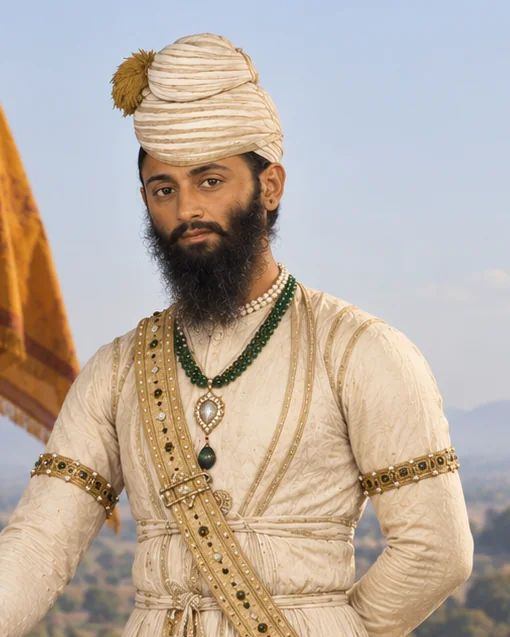
Raja Fateh Singh Ahluwalia
Ranjit Singh’s sworn brother, co-signatory of the first Anglo-Sikh treaty, and the only man the Maharaja ever permitted to put his own house into a coin legend — before the boundary of 1809 cut his estate in two and made him the vassal of two powers at once.
Chief of the Ahluwalia Misl · Raja of Kapurthala1784 – October 1836
I · Introduction
The Exception to the Rule
Everywhere else on this site the same point recurs: Sikh coinage does not name people. The legend belongs to the Gurus, the sovereign is absent from his own currency, and the last Maharaja of Lahore cannot be found on a single coin struck in his reign. It is the defining convention of the series and it holds with remarkable consistency for a century and a half.
There is one exception, and it belongs to Fateh Singh Ahluwalia. The rupee of VS 1862 carries, on its reverse, the words Sarkar Ahluwalia — the Ahluwalia government. It is the only Sikh coin known to name a specific family, and it was issued with Ranjit Singh’s personal permission at a moment when the Maharaja was systematically absorbing every misl in the Punjab.
That single fact is worth more than any battle honour, and it is why this life belongs in the series ahead of several better-known generals. A sovereign engaged in the elimination of rival chiefships allowed one of them to put its name into the metal. The biography has to explain why.
II · Origins
The Ahluwalia Inheritance
Raja Fateh Singh Ahluwalia
b. 1784, Kapurthala · d. October 1836
- House
- Ahluwalia, from the village of Ahlu near Lahore
- Father
- Bhag Singh Ahluwalia, killed at Phagwara, 1801
- Kinship
- Grand-nephew of Jassa Singh Ahluwalia
- Succeeded
- 1801, as chief of the misl and Raja of Kapurthala
- Capital
- Moved from Fatehabad to Kapurthala
- Bond
- Exchanged turbans with Ranjit Singh, 1802
- Treaties
- Signed the Anglo-Sikh treaty of 1806 as Ranjit Singh’s plenipotentiary; present at the Treaty of Amritsar, 1809
- Revenue
- 1,76,000 rupees a year in 1808; about 16,00,000 by 1836
- Death
- Usually given as October 1836; some references say 1837
He was born at Kapurthala in 1784, into the one misl whose name already meant something beyond its own territory. His grand-uncle Jassa Singh Ahluwalia had commanded the Dal Khalsa, had been proclaimed Sultan-ul-Qaum, and had presided over the Sikh capture of Lahore in 1761 — the occasion of the most storied coinage in the whole Sikh series, discussed below. By family tradition the news of Fateh Singh’s birth reached his father during an action at Kasur.
He came into the inheritance abruptly. Bhag Singh Ahluwalia was killed at Phagwara in 1801 and his only son succeeded at seventeen, taking both the chiefship of the misl and the hereditary title of Raja. He moved the capital from Fatehabad to Kapurthala, recovered Phagwara and Banga, and then faced the question that confronted every sardar of his generation: what to do about the young chief of the Sukerchakias, who in the same year had taken Lahore.
His answer was unusual, and it determined everything that followed. Where Ranjit Singh’s other neighbours were absorbed, dispossessed or fought, Fateh Singh allied. In 1802, at Fatehabad, the two men exchanged turbans — the Punjabi form of sworn brotherhood, a bond understood as permanent and binding on both parties. Fateh Singh was eighteen; Ranjit Singh was twenty-two. Neither of them was yet what he would become.
III · The Campaigns
Twenty Years in the Field
The turban exchange was not ceremonial. For the next two decades Fateh Singh was present at most of the campaigns that built the empire — not as a subordinate commander but as an allied chief bringing his own contingent, which is a materially different thing and explains a great deal about his later standing.
The list, compiled from the Kapurthala records, runs through Jamke and Kathua, Sujanpur in 1803, Kasur in 1804 and again in 1807, Amritsar in 1805, Jhang and Sialkot in 1807, the expeditions across the Sutlej between 1806 and 1808, Pind Dadan Khan in 1809–10, Jalandhar in 1810–11, Mandi and Kullu in 1811, Hazara in 1813, Kashmir in 1814, the Yusufzai country in 1824, and Multan and Mankera. He held independent command in the Bhimbar, Rajauri and Bahawalpur expeditions.
Two of those entries matter more than the rest for this page. Amritsar, 1805 is the year the city and its mint came under Ranjit Singh — and VS 1862, the date on the Ahluwalia rupee, is that same year. And Kasur, 1807 is the siege at which Akali Phula Singh’s Nihangs went in at the breach and Hari Singh Nalwa took his first independent command. The three figures published in this series so far who fought in the field were all at Kasur together.
IV · The Coin
Sarkar Ahluwalia, VS 1862
The specimen below shows both faces. Read them against each other and the whole political relationship is on the coin.
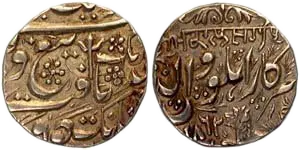
Obverse. In Persian, Deg Tegh Fateh Yafat az Nanak — the cauldron, the sword and victory obtained from Nanak — with a trident device. The standard Sikh legend, unchanged: the authority is the Guru’s, exactly as on every other coin of the period.
Reverse. In Persian, Sarkar Ahluwalia, the Ahluwalia government. In Gurmukhi, Akal Sahaya 1862 — by the help of the Timeless One. A lion device. This is the exception: a house named in the legend, on a coinage that names no one.
The division of labour between the faces is the point. The obverse concedes everything — the coin claims no sovereignty, invokes no ruler, and credits victory to Nanak in precisely the formula the Lahore mints used. Only on the reverse does the house appear, and even there it appears alongside Akal Sahaya, the same invocation of divine help that Ranjit Singh used on his own seal. Nothing about the coin challenges the Maharaja. It simply records that one family, uniquely, was permitted to be visible.
The date says the rest. VS 1862 is AD 1805: three years after the turban exchange, the year Amritsar came under Lahore control, and the height of the alliance. This was not a coin issued in defiance. It was issued in the confidence of a man who had just helped his sworn brother take the most important city in the Sikh world.
The Ahluwalia rupee belongs to the Sikh tradition of nazarana issues — presentation pieces on broad flans from sharp dies, given as marks of favour and worn on the turban or displayed at court rather than spent. This site’s Medals page argues that the Sikh empire drew no hard line between a coin and an honour, and that the whole nazarana practice of the Cis-Sutlej states descends from this court usage. The Ahluwalia rupee is the clearest single instance: a coin functioning as a decoration, and a political statement in silver.
V · The Phantom Behind It
Lahore, 1761, and Twenty-One Rupees
The VS 1862 issue does not stand alone. It looks back to something, and what it looks back to no longer exists.
When the Dal Khalsa took Lahore in 1761 it proclaimed Jassa Singh Ahluwalia Padshah and struck coins in his name. The chronicler Ghulam Ali Azad, writing within months and appalled, recorded that the Sikhs “blackened the face of the coin with his name.” The phrase is worth holding onto: to a Persian-educated observer, putting a Sikh chief’s name where a Mughal emperor’s belonged was not merely presumptuous, it was a defacement. Ganesh Das records that only twenty-one were struck. Not one authentic specimen is known to survive, and this site describes it as the most storied phantom in Sikh numismatics.
Set that beside the VS 1862 piece and the relationship becomes clear. Forty-four years after his grand-uncle’s coins announced a sovereignty that lasted weeks, Fateh Singh struck a piece naming the same house — but carefully, in the reverse field, under the Guru’s legend, with a sovereign’s permission. The 1761 rupee was a taunt aimed at Ahmad Shah Durrani. The 1805 rupee is a memorial to it, issued by a man who had learned what the Punjab now cost.
VI · The Two Treaties
1806, 1809, and a River Through the Middle of an Estate
In January 1806 the Company, pursuing the Maratha chief Yashwant Rao Holkar into the Punjab, needed an understanding with the Sikhs. The agreement that followed was the first Anglo-Sikh treaty, and it was concluded not by Ranjit Singh alone but by “Sardars Ranjit Singh and Fateh Singh” jointly, the Ahluwalia chief acting as plenipotentiary. That is the formal high-water mark of his career: at twenty-two he was a co-equal signatory with the man who would become Maharaja of the Punjab.
Three years later he was present at Amritsar for the treaty that undid him. The settlement of 1809 fixed the Sutlej as the limit of Ranjit Singh’s expansion and placed the chiefs south of it under British protection. Fateh Singh’s misfortune was to hold substantial territory on both banks.
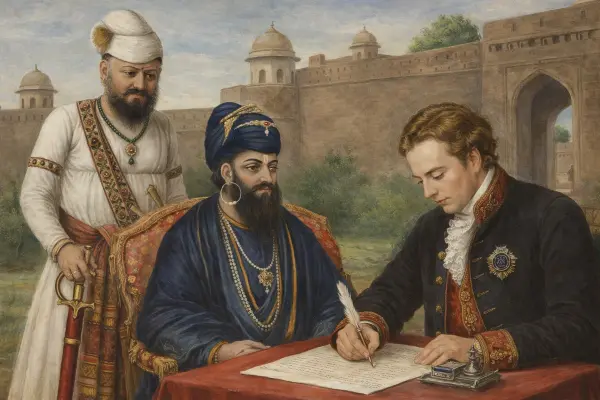
Plate · The Treaty of Amritsar, 1809Charles Metcalfe signing the treaty in the presence of Ranjit Singh. Fateh Singh Ahluwalia stands beside the Maharaja — a placing that records exactly what he was in 1809, and what the treaty was about to stop him being. The same composition appears in this site’s essay on Gifts & Diplomacy.
The Cis-Sutlej states page treats the consequences of that boundary for the coinage of the region — two monetary zones on either side of one river. Fateh Singh is the human illustration of the same division. His revenue in 1808 was a hundred and seventy-six thousand rupees a year; by 1836 his territories were reckoned at sixteen lakh. The growth is real, and so is the fact that it was drawn from two jurisdictions that were preparing, slowly, to fight each other.
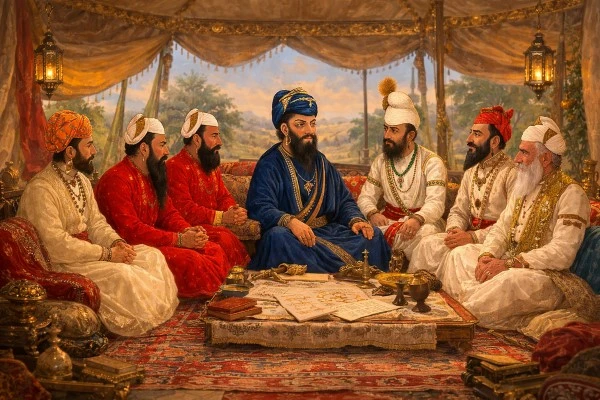
Plate · Ranjit Singh and the chiefsThe Maharaja with the chiefs of the Cis-Sutlej, Fateh Singh Ahluwalia among them. After 1809 a gathering of this kind was a meeting of men who were no longer all in the same jurisdiction — and he was the one who belonged to both. Reproduced from this site’s page on the Cis-Sutlej States.
VII · The Breach
Flight Across the Sutlej, December 1825
The friendship held for twenty-three years and then broke over exactly what the treaty had made inevitable. Fateh Singh dealt directly with the British over the Bhirog and Kotla chiefships, built a strong citadel at Isru, and repeatedly asked for British protection — each of which, from Lahore, looked like a vassal conducting his own foreign policy. In December 1825 Ranjit Singh sent two battalions towards Kapurthala. Fateh Singh did not wait for them. On 27 December he crossed the river into his own cis-Sutlej possessions at Jagraon, in British-protected territory, and formally sought the Company’s protection.
What happened next is a small masterpiece of the period’s politics, and nobody comes out of it badly. Ranjit Singh seized the trans-Sutlej estates at once — and simultaneously let it be known that his brother would be forgiven if he came back. The Governor-General confirmed Fateh Singh in his cis-Sutlej villages and declined to interfere north of the river. The Agent at Ludhiana quietly advised Ranjit Singh against confiscating Kapurthala outright. The troops were recalled, the invitation was issued, and Fateh Singh returned.
He was received with honour and his possessions were restored to him in full. The sources differ on the year of the return — 1826 in some, 1827 in others — but not on the outcome. He lived out his last decade at Kapurthala and died there in October 1836, still in possession of everything he had held, and still, formally, the Maharaja’s sworn brother.
VIII · What He Left
The Misl That Outlived the Empire
Fateh Singh is the answer to a question the rest of this series keeps raising. Every other misl was absorbed: the Kanhaiyas through Sada Kaur’s dispossession, the Bhangis by conquest, the Ramgarhias by attrition. The Ahluwalias were not. Kapurthala survived Ranjit Singh, survived the annexation of 1849 that ended every other Sikh polity north of the Sutlej, and continued as a princely state until 1948 — more than a century after his death.
It survived because he had contrived, by 1809, to hold a position on both banks of the river, and because he never quite forced either patron to choose. That was not heroism and the page does not present it as such. It was the judgement of a man who understood earlier than most of his contemporaries that the Punjab was going to be settled between two powers rather than one, and who declined to be entirely the property of either.
His descendants at Kapurthala went on issuing honours in a tradition that began with his rupee — the state’s elaborate decorations under Jagatjit Singh in the century following are, as this site’s Medals page notes, the continuation of exactly the practice the VS 1862 coin represents. And the coin itself remains what it was in 1805: the one place in the entire Sikh series where a family is allowed to say its own name.
Sources
Sources and Further Reading
- Harbans Singh (ed.). The Encyclopaedia of Sikhism. Punjabi University, Patiala. The standard entry, and the source for the campaign list, the revenue figures and the 1825 flight.
- Lepel H. Griffin. The Rajas of the Punjab. Lahore, 1870. Compiled from Company records; the British side of the Bhirog and Kotla disputes and of the Ludhiana Agent’s intervention.
- Hari Ram Gupta. History of the Sikhs. For the movement of Ranjit Singh’s battalions on Kapurthala in December 1825.
- Saran Singh and Dalwinder Singh, on the Ahluwalia rupee — the published reading of both faces, including the Gurmukhi Akal Sahaya 1862 and the lion device.
- Ganesh Das, Char Bagh-i-Panjab, on the twenty-one rupees struck at Lahore in 1761; and Ghulam Ali Azad, contemporary, on their reception.
- Records of Kapurthala State, for the succession of 1801, the removal of the capital and the campaign participations.
- On the coin itself see this site’s pages on the misl period, on medals and honours, and on fakes and forgeries.