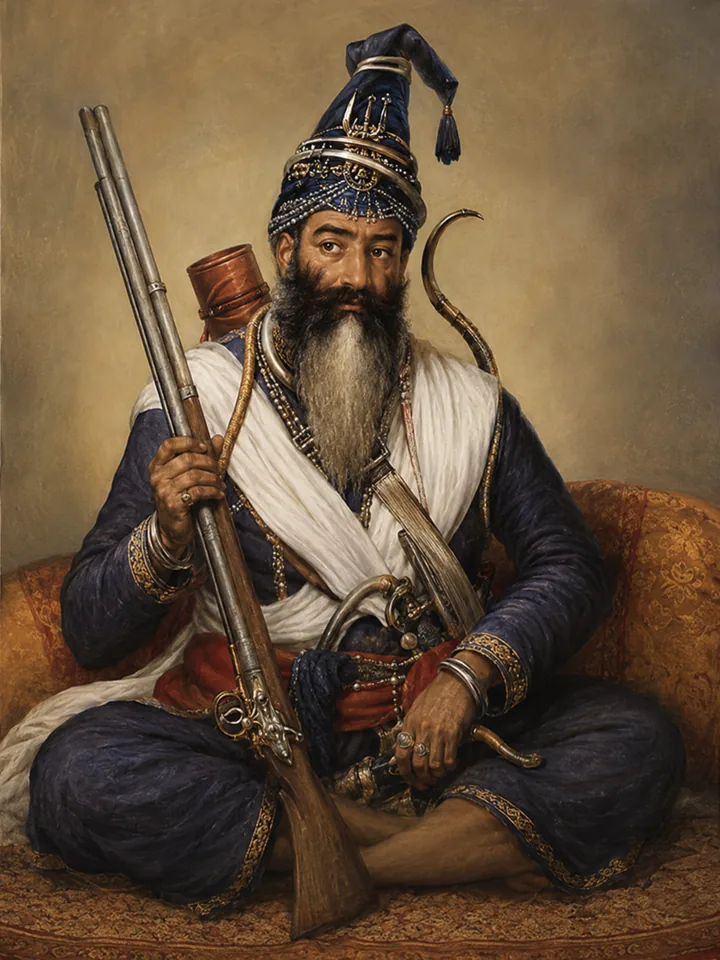
Akali Phula Singh, imagined: a Nihang seated cross-legged in blue bana and tall dumala with chakkars, holding a matchlock, bow and quiver behind him
Digital art created for this site, drawing on contemporary Punjab-school painting and surviving Nihang artefacts. No likeness taken from life survives.
Personalities  ·  The Akal Takht  ·  Buddha Dal

Akali Phula Singh

Jathedar of the Akal Takht for twenty-three years, and the one man in the Lahore Darbar who could summon a sovereign to answer for his conduct — before he led the Nihangs into the guns at Nowshera and did not come back.

Nihang  ·  Jathedar  ·  General of the Buddha Dal

1761 – 14 March 1823

I  ·  Introduction

The Man Who Could Punish the Maharaja

Every other figure on this site who held power in the Sikh Empire held it because Ranjit Singh gave it to him, or because Ranjit Singh had not yet found reason to take it away. Akali Phula Singh is the exception. As Jathedar of the Akal Takht — the seat of temporal authority within the Sikh faith, raised by Guru Hargobind opposite the Harmandir Sahib in 1606 — his standing did not derive from the Lahore Darbar at all. It ran the other way. In 1811 he summoned the Maharaja of the Punjab to Amritsar, held him to account for his conduct with a courtesan named Moran, and sentenced him to a public flogging. Ranjit Singh submitted.

That episode alone would justify a page. But Phula Singh was not primarily a cleric who happened to have influence — he was the general who led the Akali Nihangs, the shock troops of the Sikh army, through three decades of the empire's hardest fighting: the reduction of Multan, the annexation of Kashmir, the repeated campaigns beyond the Indus. He died at their head at Nowshera in March 1823, and Ranjit Singh, by every account, felt the loss as more than a general's.

Nor was the relationship between the two men a settled one. In 1809 his Akalis fought Charles Metcalfe's escort in the streets of Amritsar, and the Maharaja drew from that fight the conclusion that he needed a European-trained army — the very thing Phula Singh spent his life opposing. Five years later the two had broken altogether: the Jathedar withdrew to Anandpur, sheltered a prince the British wanted in custody, took an armed force across the Sutlej into the Company's protectorate, and was outlawed by his own sovereign at British request. The arrest orders were issued and reissued for something like three years. Not one of them was ever carried out.

For a numismatic history, he has a further claim on attention. The Amritsar mint — the source of the Nanakshahi rupee that is this site's central subject — struck its coins in the name of the Akal Takht itself: zarb Sri Amritsar jiyo, julus maimanat bakht Akal Takht, "struck at illustrious Amritsar, under the auspicious reign of the Akal Takht." For the whole of Phula Singh's tenure as Jathedar, that legend named the institution he led. And when the Lahore Darbar tried to put a private indulgence onto that coinage, it was Phula Singh's Akal Takht that stopped it.

II  ·  Origins

A Child of the Wadda Ghallughara

Akali Phula Singh

b. 1761  ·  Sarinh, Malwa tract  ·  d. 1823, Nowshera

Born
14 January 1761, village of Sarinh (Shinh), Bangar tract, present-day Sangrur district
Father
Ishar Singh, mortally wounded at the Wadda Ghallughara, 5–6 February 1762
Raised by
Baba Naina Singh, of the Shaheedan Misl
Jathedar, Akal Takht
1800 – 1823
Jathedar, Buddha Dal
1800 – 1823 (6th)
Died
14 March 1823, Pir Sabaq, near Nowshera

Phula Singh was born in the village variously recorded as Sarinh or Shinh, in the Bangar tract of the Malwa, in what is now Sangrur district — the same countryside, and by most accounts the same general period, that produced the misl confederacies discussed elsewhere on this site. His father, Ishar Singh, is described in most sources as of the Nishanwalia misl, though at least one tradition links him instead to the Shaheedan misl that would raise his son; the sources do not fully agree, and the point is left open here.

What is not in dispute is the manner of Ishar Singh's death. In February 1762, at Kup and Rahira in the Malwa, Ahmad Shah Durrani's forces fell on a column of Sikh non-combatants in what is remembered as the Wadda Ghallughara, the Great Massacre — among the worst single losses the Panth suffered in the eighteenth century. Ishar Singh was mortally wounded there and died shortly after, leaving an infant son not yet a year and a half old.

That child was raised within the Shaheedan Misl, the order founded in the tradition of Baba Deep Singh, by its jathedar Baba Naina Singh. From childhood he was trained in scripture and in arms together, in the manner the Nihang orders held to be inseparable — by the age of ten, tradition holds, he could recite the full round of daily prayer from memory. On Naina Singh's death, Phula Singh succeeded him as leader of the jatha, still a young man, already marked by a discipline that impressed those who dealt with him for the rest of his life.

III  ·  Jathedar of the Akal Takht

Amritsar, 1800

In 1800 Phula Singh brought his jatha to Amritsar and took up residence at the Akal Takht itself. What he found troubled him: the management of the shrines had, in the disorder of the late misl period, fallen into practices he judged corrupt or irreligious, and he set about correcting them with the same directness he brought to everything else. Within the year he was recognised as Jathedar of the Akal Takht — succeeding Jassa Singh Ahluwalia in that office — and, in parallel, as the sixth Jathedar of the Buddha Dal, the senior wing of the old Dal Khalsa. He would hold both positions for twenty-three years, until his death.

The timing placed him directly across the path of Ranjit Singh's own rise. In January 1802 the young chief of the Sukerchakia misl moved to bring Amritsar itself under his authority, displacing the Bhangi sardars who held it. Phula Singh, whose jatha now garrisoned the city's holiest site, mediated the transfer rather than resisting it outright — a choice that cost the Akal Takht none of its independence and gained the new Maharaja a working relationship with the one authority in the Punjab he could not simply overpower.

Ranjit Singh rewarded the accommodation in the customary way, with land and standing: a barracks was granted to Phula Singh's Nihangs at Amritsar, which grew into the Akalian di Chhauni, the Akali Cantonment, and remained the institutional home of the order for the rest of the century. But the relationship between the two men was never simply that of sovereign and subordinate, and nothing makes that clearer than what happened in 1811.

He summoned the powerful Maharaja to the Akal Takht to answer for an affair with a Muslim dancing girl — and later, when Ranjit Singh presented a canopy to the shrine after having first used it himself, punished him again.

IV  ·  The Foreigners at the Gate

Amritsar, February 1809

In the winter of 1808–09 Charles Metcalfe, then twenty-three and the East India Company's envoy to Lahore, was in the Punjab to negotiate what became the Treaty of Amritsar. He travelled with an escort of Bengal infantry, a large part of it Shia Muslim. In late February the escort fell to observing Muharram — the processions, the chanting, the rhythmic matam of mourning — and did so in the streets of Amritsar. The date, most accounts agree, was 25 February 1809. It coincided with Hola Mohalla, and the Akalis were at prayer.

What happened next is disputed in its particulars and undisputed in its outcome. The procession came near the precincts of the Darbar Sahib; the Akalis objected and told them to take it elsewhere; the argument became a scuffle and the scuffle became a fight, and the fight ran through the streets with something near fifty casualties on both sides. The detail worth holding onto comes from the British side of the ledger: in his despatch of 7 March, Metcalfe himself allowed that the first shot had probably been fired by one of his own escort. It is not a small concession from a man whose party had just been mauled, and it is the reason this page does not describe the episode as a simple ambush.

Ranjit Singh was in the city for the festival. He came out personally, and it took him some time to stop the fighting; afterwards he went to Metcalfe and apologised. And then he drew a conclusion from it that would shape the rest of his reign.

What impressed the Maharaja was not the Akalis. It was the sepoys — who, under fire in a strange city and heavily outnumbered, re-formed and stopped shooting the moment they were ordered to.

Nearly every account of the incident credits it with hardening Ranjit Singh's resolve to rebuild the Khalsa army on European lines — the decision that would, in time, bring Allard and Ventura to Lahore and produce the regular Fauj-i-Ain. The irony is exact and worth stating plainly. Akali Phula Singh spent his life objecting to the Europeanisation of the Sikh army; his own men's attack on a European envoy's escort is among the proximate causes of it. This site's page on the foreign officers is, in a real sense, a consequence of this page.

The Metcalfe affair was not an isolated collision. In the same year Lieutenant F. S. White of the Company's service was moving through the country with some eighty troopers, surveying the cis-Sutlej tracts on the authority of the Phulkian chiefs, when he was challenged at Pattoki by Phula Singh's jatha. By the account preserved in the Encyclopaedia of Sikhism, White owed his life to the timely intervention of the chief of Nabha. Half a century later Lepel Griffin, compiling the British records of the Punjab states, would still identify Phula Singh in a footnote by these two acts together — the man who attacked Metcalfe's party, and the officer on survey duty.

The line the treaty drew

The Treaty of Amritsar was signed on 25 April 1809, two months after the fighting in the streets, and it fixed the Sutlej as the limit of Ranjit Singh's expansion. That line is not merely political. It is the reason the Cis-Sutlej states south of the river developed a coinage on a separate trajectory from the Lahore mints to the north — a division this site treats as two distinct corpora rather than one. The Cis-Sutlej States →

Ranjit Singh's response to a subordinate who had just embarrassed him in front of the British was not to punish him. It was to hire him. Phula Singh was confirmed in command of the Akali troops in the Maharaja's service, and his contingent acquired a name in the Lahore establishment: the Changari, the Sparks. It was the arrangement of a ruler who had understood that this was a man he could employ but not command — and, five years later, it would fail.

V  ·  The Moran Affair

A Sentence That Reached the Mint

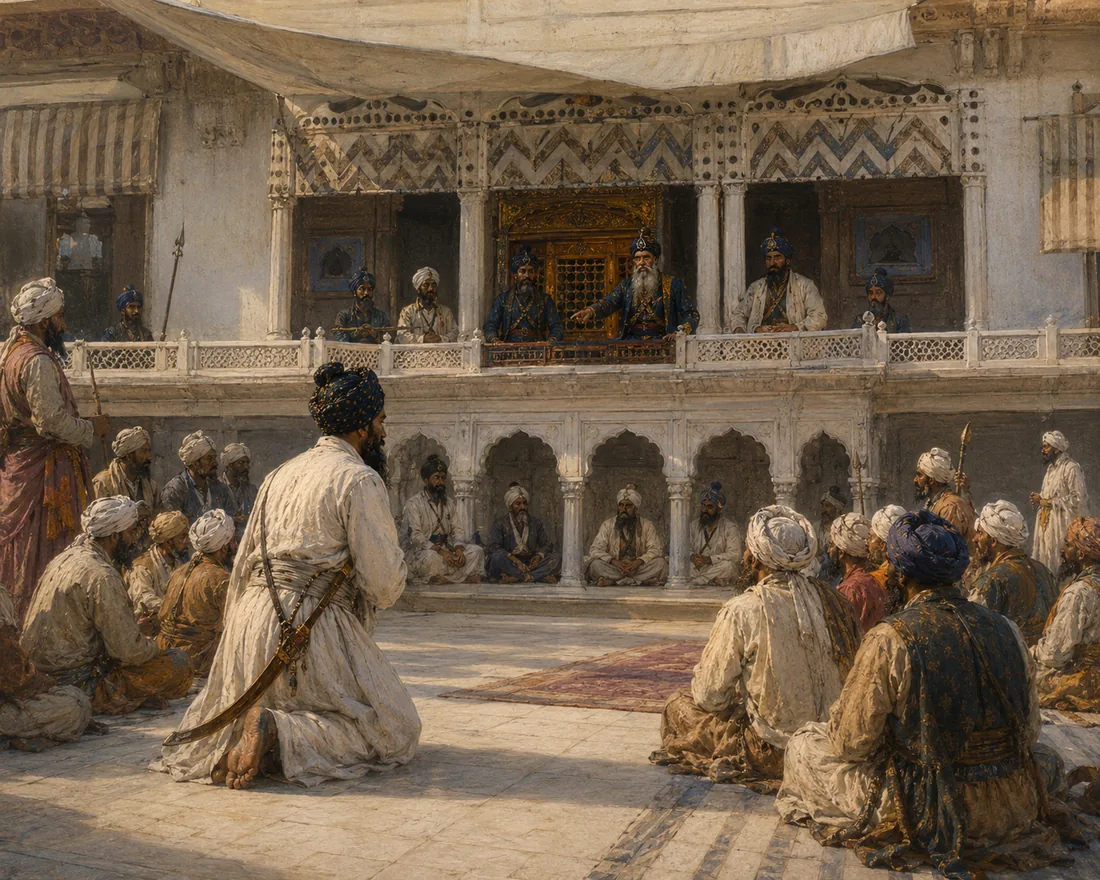
In 1802 Ranjit Singh took as a consort Moran, a Muslim courtesan of Amritsar, and the relationship was resented across the Sikh clergy as a breach of the conduct expected of the Panth's temporal head. The Akal Takht did not let the matter rest as gossip. In 1811, on the authority of the Khalsa Panth, Phula Singh summoned Ranjit Singh to appear before him at Amritsar and answer for his conduct. The Maharaja came, was formally admonished, and was sentenced to a public flogging. By every account he submitted to the punishment without resistance — a demonstration, made in front of the whole Darbar, that even absolute political power in the Punjab answered to a religious authority it did not control. He was ultimately spared the lash itself on payment of a heavy fine, reported at Rs 1,25,000, and Moran was sent from court to Pathankot. On a separate occasion Phula Singh punished Ranjit Singh again, for presenting a canopy to the Akal Takht that he had first used for his own purposes — a lesser echo of the same principle.

The episode is not merely a colourful anecdote. It reached the coinage itself, and that is what places it on this site rather than only in a general history.

Painting of a sovereign kneeling bareheaded on the marble parikrama before the Akal Takht at Amritsar, sword slung at his side, while the Jathedar addresses him from the balcony above and the assembled sangat looks on

Plate  ·  The summons to the Akal TakhtThe Maharaja of the Punjab kneels on the marble before the Takht to answer for his conduct, while the Jathedar speaks from the balcony above and the sangat sits in judgement around him. Digital art created for this site, drawing on contemporary Punjab-school and Company-school painting for the dress, the architecture and the arrangement of a darbar. No contemporary depiction of this scene is known; the setting and gestures are reconstruction rather than record.

The Morashahi Rupee — and its withdrawal

Sometime around 1805, a series of Amritsar rupees appeared carrying a small ornamental device read by tradition as a peacock feather — mor in Punjabi — taken to allude to Moran. The Nanakshahi rupee's legend was not decorative in the ordinary sense: every coin struck at Amritsar named the Akal Takht as the authority under whose reign it was issued — julus maimanat bakht Akal Takht, "under the auspicious reign of the Akal Takht." A symbol read as commemorating the Maharaja's Muslim consort, appearing within that legend, was not received as a private matter. The clergy objected, the type was withdrawn, and the standard ber-leaf symbol was restored to the Amritsar coinage.

This site's dedicated study of the type sets out the numismatic evidence in full, including a later coin of VS 1868 whose symbolism may mark Moran's final departure from court. Read the Morashahi Rupee →

Whether the 1811 summons and the coinage episode were the same event or two related ones is not fully settled between the sources consulted for this page — some accounts place the flogging and the withdrawal of the coin type in close sequence, others treat them as separate expressions of the same underlying objection, separated by several years. What is not in doubt is the mechanism: a coin type existed, the Akal Takht under Phula Singh's jathedarship judged it incompatible with what the coinage was supposed to declare, and it stopped being struck. A named individual, holding a specific office, is the direct cause of a documented change in the output of the Amritsar mint. That is a rare thing to be able to say with this degree of precision about any figure in this period.

VI  ·  The Breach

Anandpur, and the Arrest That Never Happened

The accommodation between the Jathedar and the Maharaja held for about five years, and then it broke. The Sikh traditional accounts are consistent about the cause and should be read with the caution due to sources written by admirers: Phula Singh objected to the rise of the Dogra brothers and the Brahmin officials around the throne, to the appointment of men outside the Panth to positions of trust in what he regarded as a Khalsa raj, and to the European reorganisation of the army. In those accounts the courtiers made it difficult for him to reach the Maharaja at all; he forced his way into the presence, was received with honour, refused the refreshment offered him, said what he had come to say, and left. What is not in dispute is where he went next.

In 1814 he abandoned the Akalian di Chhauni at Amritsar and established himself at Anandpur Makhowal — Anandpur Sahib, the town of Guru Gobind Singh's Khalsa, and, not incidentally, close to the Sutlej frontier the treaty of 1809 had drawn. Here the record improves sharply, because the British began writing about him. Sir David Ochterlony, reporting to the Resident at Delhi on 30 September 1814, put his strength at roughly seven hundred horse and two guns.

The crisis came through the succession at Jind. Prince Partab Singh, whose claim the British would not recognise, was besieged by Patiala troops at Balawali; he abandoned the fort, carried off fifteen or twenty thousand rupees and other valuables, made a long circuitous march and crossed the Sutlej at Makhowal with forty followers to join Phula Singh. He stayed two months, and then persuaded the Jathedar to recross the river and support the rebellion in the Cis-Sutlej — that is, to take an armed force into territory the Company had made its protectorate five years earlier.

The response was immediate and, in the event, entirely ineffective. The Agent at Ludhiana wrote at once to Raja Jaswant Singh of Nabha and to the Khans of Maler Kotla, directing them to combine their forces and attack. Griffin's record of the episode preserves the Agent's own doubts alongside his orders: that the Nabha troops were unlikely to act against Phula Singh with any conviction, given the veneration in which the Sikhs held him, and that Maler Kotla was not strong enough to act alone. Seven hundred Patiala troops moved to intercept him. He could not relieve Balawali, and fell back toward the Sutlej into a village held by two sardars, Dip Singh and Bir Singh, who turned the pursuing troops away with the reproach that they were offering violence to a poor faqir who was also their Guru.

Meanwhile the Maharaja, under British pressure, had formally outlawed him and ordered the Phillaur garrison to drive him out of Sikh territory. The garrison marched. Phula Singh sent to ask the soldiers whether they intended to kill their Guru. They would not touch him — and for some two months the force simply moved where he moved, in Griffin's dry summary "more like a guard of honor than anything else."

Griffin, writing from the Company's files and with no reason to flatter, calls him a robber and an outlaw in the same breath as a splendid soldier and a brave and enthusiastic man. That double verdict is the most useful single sentence written about him in English, and it is a corrective to both the hagiography and the dismissal. The narrative in this section follows Griffin because he is drawing on despatches written at the time; the account of the quarrel at court that preceded it rests on Sikh tradition and is presented here as such.

Hold the arithmetic of those years in view. Between roughly 1814 and 1817 the most powerful ruler in the Punjab and the paramount power in India both wanted Akali Phula Singh arrested. Between them they could call on the Lahore army, the Phillaur garrison, the forces of Patiala, Nabha, Kaithal and Maler Kotla, and the authority of the Political Agent at Ludhiana. He had seven hundred horse and two guns. Nothing happened, because at every point where the order had to become an act, it had to pass through a Sikh soldier — and no Sikh soldier would raise a hand against the Jathedar of the Akal Takht.

That is the same authority described in the Moran episode, seen from the other side. At Amritsar in 1811 it compelled a Maharaja to kneel; in the Malwa three years later it made him unable to carry out his own arrest warrant. Coercion having failed, Ranjit Singh fell back on persuasion: by the traditional accounts he sent Baba Sahib Singh Bedi, a descendant of Guru Nanak and a figure Phula Singh could not refuse, to bring him back to Amritsar, where a public reception was arranged and the breach was closed. Within a year the Jathedar and his Nihangs were at the walls of Multan, and the outlaw of the Ochterlony despatches had become the shock troops of the empire.

VII  ·  The General of the Nihangs

Multan, Peshawar, Kashmir

Phula Singh's authority was never confined to the shrine at Amritsar. From the earliest years of his jathedarship he commanded the Akali Nihangs as a fighting formation within the Sarkar Khalsa's wider army — irregular in organisation, ferocious in the field, and, in the judgement of more than one contemporary observer, only loosely subject to anyone's authority but his own.

Kasur, February 1807. His first major action in the Maharaja's service, and the pattern for all of them. Qutb-ud-Din Khan, the Pathan governor, shut himself in a strong fort and the siege ran on for about a month of bombardment and skirmishing. It ended when Phula Singh's Nihangs went in at a breach in the wall and carried it. Qutb-ud-Din was taken and treated leniently, given a small jagir at Mamdot; Phula Singh's men were given regular barracks at Amritsar, the grant that grew into the Akalian di Chhauni. The same siege was the first independent command of a young officer named Hari Singh Nalwa, with whom the Jathedar would fight for the rest of his life.

Multan, 1816 and 1818. Multan cost the Lahore Darbar seven attempts across a decade. In the sixth, in 1816, Phula Singh led a storming party of Akalis against the walls and did not take them. He was there again for the last one, the eighty-two-day siege of 1818 that ended Saddozai rule in the city, and it was his Akalis who went into the final assault. The action is remembered for the readiness of his men to make themselves, in succession, into a platform to raise a gun against the breach — a detail that belongs to tradition rather than to any despatch, but which is entirely consistent with everything else recorded about how they fought.

The Indus and Peshawar, 1818. Later the same year the Maharaja moved west, bridging the Attock with pontoons. A small party sent forward to assess the ground was attacked, and Phula Singh and Nalwa were sent against the tribal force. By the account preserved in the Sikh sources — and this is a traditional account, not a document — Phula Singh met the volleys with a deliberate withdrawal, drew the defenders out of their cover in pursuit, then turned and enveloped them in the open. The commander opposing him asked for terms. Peshawar was occupied that November, the first Sikh occupation of the city.

Kashmir, 1819. The Akalis were with the expedition that went into the valley the following summer and broke Jabbar Khan Barakzai's army at Shopian on 3 July 1819. Srinagar was entered twelve days later and, unusually for the period, not plundered. With Kashmir came the Srinagar mint, and with Multan the year before came another; between 1818 and 1819 the campaigns Phula Singh fought in added two working mints to the Sikh monetary system — which is the least sentimental way to state what those two summers were worth to the Lahore treasury.

By the early 1820s, then, the Akali contingent had been present at the taking of Kasur, Multan, Peshawar and Kashmir: four of the empire's defining conquests, and in three of them the Nihangs went in first. The reputation for taking the hardest ground before anyone else was not a devotional invention. It was an operational fact the Darbar relied on.

By the early 1820s, as the wider Khalsa army was reorganised on French lines under Jean-François Allard and Jean-Baptiste Ventura, Phula Singh's Nihangs were issued new arms and drilled in something of the new manner, though the irregular character of the formation, and the personal loyalty it held to its own jathedar rather than to the Lahore command structure, was never entirely absorbed into the Fauj-i-Ain discussed on this site's page on the foreign officers. It is worth setting the two next to each other: the same Maharaja who paid Napoleonic veterans to build him a regular European army also depended, at the point of maximum danger, on an irregular religious order he could not fully command and did not always control.

1807

Action at Kasur against the Pathan governor Qutb-ud-Din Khan; the Amritsar barracks granted in reward.

1809

The collision with Metcalfe's escort at Amritsar and the challenge to Lieutenant White's survey party. Confirmed in command of the Akali troops in the Maharaja's service.

1814–c.1817

The breach with the Darbar. Anandpur Makhowal, the sheltering of Prince Partab Singh of Jind, outlawry, and the arrest orders no Sikh soldier would execute.

1816

The sixth Lahore assault on Multan; Phula Singh leads a storming party of Akalis against the walls. The fortress holds.

1818

Multan falls after an eighty-two-day siege, the Akalis in the final assault. The Indus is bridged at Attock; the action against the tribal force before Peshawar; the city occupied in November.

1819

Kashmir. Jabbar Khan's army broken at Shopian on 3 July; Srinagar entered on the 15th and left unplundered. A second mint enters the Sikh system in two years.

1823, March

The Peshawar frontier again in arms under Azim Khan Barakzai; the Sarkar Khalsa marches, Phula Singh among its senior commanders.
VIII  ·  Death

Nowshera, 14 March 1823

In 1823 Azim Khan Barakzai, the Durrani governor of Peshawar and half-brother of the future Amir Dost Muhammad Khan, withheld the tribute the Sarkar Khalsa had levied on the frontier since 1818, and raised a large coalition of Yusufzai, Afridi and Khattak tribal levies against the approaching Sikh column. What followed at Nowshera, on the Kabul River, was among the hardest-fought actions of Ranjit Singh's reign — modern estimates put the Sikh force, regular and irregular together, at somewhere near 23,000 against an Afghan and tribal levy twice that size or more.

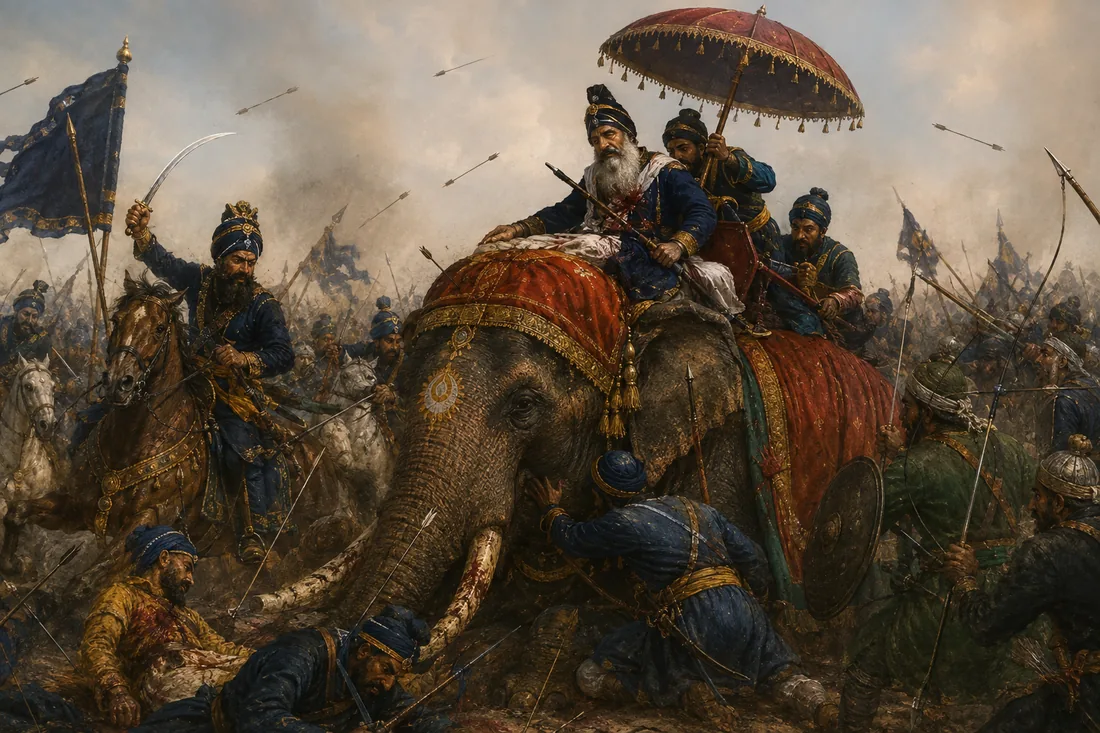
Phula Singh's Nihangs took the leading role, as they generally did. Accounts agree that his horse was shot from under him in the fighting and that he continued the action mounted on an elephant, pressing the charge into the Afghan line at close quarters. It was there, according to the tradition recorded across most surviving narratives, that he was hit by musket fire and mortally wounded, dying in the howdah while the action was still in progress. He was sixty-two.

Painting of the Battle of Nowshera: a wounded Nihang commander in blue upright on a caparisoned elephant amid arrows and spears, a canopy held over him, cavalry and infantry of the Khalsa closing around the fallen

Plate  ·  Nowshera, 14 March 1823The last action: the Jathedar upright on the elephant after his horse was killed under him, in the moments the accounts place immediately before his death. Digital art created for this site, drawing on contemporary battle painting and on surviving arms, standards and horse furniture of the period. The horse, the elephant and the mortal wound are common to the written narratives; the canopy, the faces and the ground are reconstruction.

The battle itself was won. Azim Khan's coalition broke and the Sikh army occupied the field, opening the way to the eventual annexation of Peshawar. But the victory is remembered, in nearly every account that survives it, alongside the cost of it. Ranjit Singh is said to have come to where Phula Singh's body lay and to have covered it himself before the army withdrew — a detail that varies in its particulars between sources and should be read as testimony to what his death meant at Lahore rather than as an established fact in every particular. He was cremated near the field, and a samadhi was raised at Pir Sabaq, a few kilometres from Nowshera, where it still stands. He was succeeded as Jathedar of both the Akal Takht and the Buddha Dal by Baba Hanuman Singh.

A note on the sources: the death of a commander in a fast-moving nineteenth-century cavalry action, recorded first in oral tradition and only later set down, is rarely recoverable in exact sequence. The horse-shot-under-him, elephant, and mortal-wounding-in-the-howdah sequence is consistent across the sources consulted for this page, which gives it reasonable confidence; the finer details of his final moments and of Ranjit Singh's presence at the body vary between accounts and are treated here as tradition rather than settled fact.

IX  ·  The Succession

Baba Hanuman Singh, and the End of the Buddha Dal

What happened to the office after Nowshera is usually left off the end of Phula Singh's life, and it should not be, because the ending is the point. He was succeeded as Jathedar of the Akal Takht and of the Buddha Dal by Baba Hanuman Singh, born in November 1755 at Naurang Singh Wala in the Zira tract of Ferozepur, and already sixty-eight years old when he took the office in 1823. He held it for twenty-three years, exactly as long as his predecessor.

He inherited it at the top of the empire's arc and gave it up at the bottom. In the years he was Jathedar, Ranjit Singh died, three of his successors were killed, the Dogra ministry rose and fell, and the Khalsa army marched to the Sutlej and was broken. By the beginning of 1846, after Sabraon, what remained of the Buddha Dal was a body of armed Nihangs in a country that had just lost its sovereignty — and to the new paramount power they were not a religious order but an irregular force still in the field.

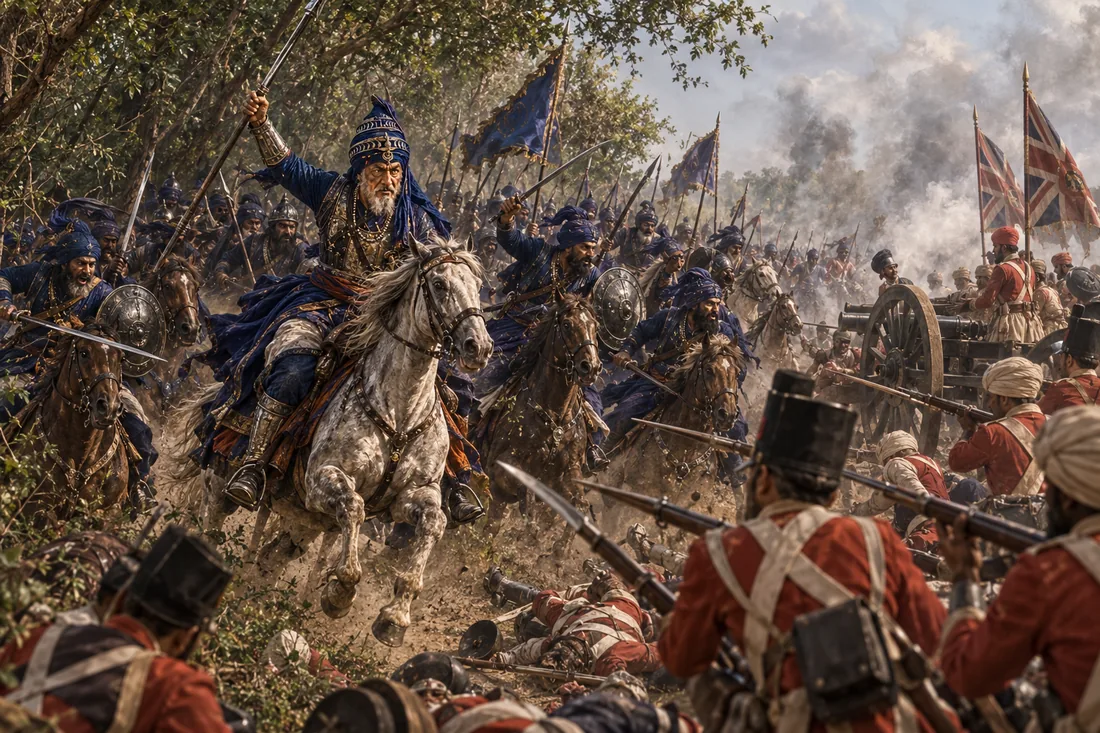
The survivors crossed south of the Sutlej looking for shelter among the Cis-Sutlej states, which had been British protectorates since the treaty of 1809 that Phula Singh's own Akalis had done so much to precipitate. The account preserved in the Nihang tradition, set down in In the Master's Presence, has Hanuman Singh receiving an invitation from the young ruler of Patiala. What met the Nihangs when they arrived was artillery. The Dal was shelled, a large number were killed outright, and the remainder — some five hundred, with Hanuman Singh among them — withdrew into the surrounding country and kept fighting with swords, bows, axes and matchlocks against British-supported guns. Hanuman Singh was badly wounded and died at Sohana, near present-day Mohali, in January 1846, aged ninety. A gurdwara, Singh Shaheedan, stands on the site.

Painting of the last stand at Sohana: an aged Nihang Jathedar in blue, spear raised, leading a cavalry charge out of scrub woodland into the flank of a gun position defended by red-coated Company infantry

Plate  ·  Sohana, January 1846Baba Hanuman Singh at ninety, leading the Buddha Dal’s cavalry into the guns. Digital art created for this site, drawing on contemporary battle painting and on surviving Nihang arms, standards and horse furniture. What the sources attest is the artillery, the Nihangs fighting on with swords, bows, axes and matchlocks, the Jathedar’s age and his mortal wounding. The composition — the charge itself, the ground, the Company regulars placed in the front line — is reconstruction.

The Patiala episode needs a caution. The surviving accounts name two different rulers — Karam Singh, who died in 1845, and his successor Narinder Singh, who issued the invitation according to the Kashi House text — and they cannot both have ordered the guns. The chronology favours Narinder Singh, but the discrepancy is unresolved in the sources consulted here and is flagged rather than smoothed over. What is not in dispute is the outcome: an eighty-year-old order was fired on by a Sikh state acting within a British alliance, and its ninety-year-old Jathedar died of it.

Hanuman Singh was succeeded by Baba Prahlad Singh, and under him the Buddha Dal did not so much continue as disperse. The Nihangs were subject to standing orders to be shot on sight; Prahlad Singh took what was left toward Hazur Sahib at Nanded, and the remainder scattered into the forests of the Punjab and Rajputana. The Akalian di Chhauni at Amritsar, granted to Phula Singh by Ranjit Singh in 1807 for storming the wall at Kasur, ceased to be the headquarters of an armed order and became a memory of one.

Set the two deaths beside each other, twenty-three years apart. In 1823 the Jathedar of the Akal Takht died at the head of the Sikh empire's assault, and the Maharaja is said to have covered his body himself. In 1846 his successor in the same office died under the guns of a Sikh state that had chosen the winning side, and there was no one left to do the covering. Between those two events lies the entire distance the Punjab travelled in a single generation.

X  ·  What He Left

An Institution, Not an Empire

Akali Phula Singh built no dynasty and struck no coin in his own name — the office he held did not permit either. What he left was an institution: a jathedarship at the Akal Takht that had, under him, demonstrated it could hold a Maharaja to account, and a body of Nihang soldiery whose readiness to take the worst ground first became, and largely remains, part of how the order defines itself. The jathedarship survives to the present day. The Buddha Dal as an armed formation did not survive 1846, and the distinction between those two outcomes is worth keeping in view.

For the purposes of this site, his significance sits at an intersection few other figures occupy so exactly: he is the one man whose personal authority is directly legible in the Amritsar mint's own output, in a documented episode with a coin type at one end of it and a Maharaja's public submission at the other. Where most of the personalities gathered on this site are connected to the coinage through the offices they held or the events they lived through, Phula Singh is connected through an act of censorship he personally enforced.

This life is the first in the site's Personalities of the Sikh Empire series — biographies admitted only where the coinage carries the mark of the person.

Sources

Sources and Further Reading

  1. Fakir Syed Waheeduddin. The Real Ranjit Singh. Lahore, 1965. The primary account, drawn from Fakir family papers, of the Moran episode and the Akal Takht's response.
  2. Sohan Lal Suri. Umdat-ut-Tawarikh, Daftar III. The Lahore Darbar's own chronicle of the reign, including the Nowshera campaign; discussed on this site's Umdat-ut-Tawarikh page.
  3. Nidar Singh Nihang and Parmjit Singh. In the Master's Presence: The Sikhs of Hazoor Sahib. Kashi House, London, 2008. The Nihang tradition's own account of the Buddha Dal after Sabraon, and of Baba Hanuman Singh's death at Sohana.
  4. Lepel H. Griffin. The Rajas of the Punjab. Lahore, 1870. Compiled from Company records; the source for the Anandpur years, the Partab Singh episode and the failed arrest orders, drawing on Sir David Ochterlony's despatch to the Resident at Delhi of 30 September 1814.
  5. Harbans Singh (ed.). The Encyclopaedia of Sikhism. Punjabi University, Patiala. The standard reference entry, and the source used here for the challenge to Lieutenant F. S. White's survey party.
  6. Charles T. Metcalfe, despatch No. 72 of 7 March 1809, reporting the Amritsar fighting to his superiors — including his concession on who probably fired first.
  7. Hari Ram Gupta. History of the Sikhs, vol. IV — The Sikh Commonwealth. The standard narrative treatment of the Akali Nihangs' role in the Multan, Kashmir and Peshawar campaigns.
  8. H. S. Dilgeer. Akal Takht: A Historical Account. On the institutional history of the jathedarship and its relationship to the Lahore Darbar's temporal authority.
  9. This site, The Morashahi Rupee, for the numismatic evidence of the coin type discussed above.