Political Economy · Numismatic Research
Coin, Commerce & Control
Monetary Weight Standards, Trade Route Accommodation, and the Sikh Empire on the Silk Road
AD 1799 – 1849 · VS 1856 – 1906 · Amritsar · Peshawar · Kashmir · Hoshiarpur
The Sikh Empire’s Silk Road Corridor · Monetary Zones & Trade Routes
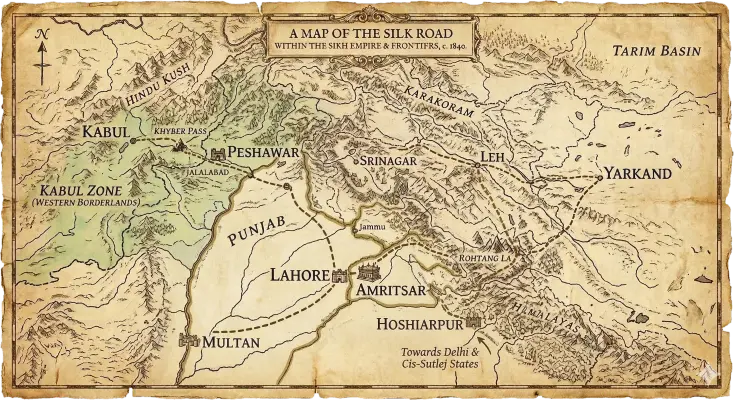
The empire’s two monetary zones — the Amritsar 11g standard covering the Punjab interior, and the Kabul/Afghan 8.33g standard covering the Khyber corridor (green) — were not a failure of uniformity but the two halves of a directional exchange mechanism through which the Silk Road trade entered and exited the Punjab economy.
The Argument
Reading the Weight of a Coin
The coinage of the Sikh Empire has long been treated primarily as a problem of iconography and legend — the anonymous religious couplets, the elaborate mintmark systems of Amritsar, the theological statement of a sovereignty exercised in the Guru’s name rather than the Maharaja’s. Less attention has been paid to what the coins weigh.
The weight differentials preserved across the empire’s mint network constitute a systematic and recoverable record of the commercial geography of the late Silk Road corridor. The two principal standards — Amritsar at 11.0–11.35 grams and Peshawar at 8.33–8.49 grams — functioned as the incoming and outgoing halves of a single directional currency exchange mechanism. Merchants arriving from Central Asian routes converted their Afghan-standard coin into Amritsar-weight rupees for use in the Punjab’s internal economy; merchants departing through the Khyber converted their Punjab holdings back into the lighter Peshawar standard for use in the bazaars beyond the frontier. The Sikh Empire did not merely tolerate two weight standards — it depended on both.
There is a story, preserved in Bhagat Singh’s account of the reign of Ranjit Singh, in which the Maharaja’s minister Raja Dhian Singh remonstrated with his master for dressing as a humble servant. Ranjit Singh’s reply cut to the heart of Sikh political theology: he asked in whose name the coins were struck. When Dhian Singh answered that they bore the name of Guru Nanak, the Maharaja explained that the true ruler was he in whose name the coins were issued — and that he himself was merely the Guru’s servant.
The VS1894 Peshawar weight triad — three simultaneous standards of 8.4g, 7.1g, and 11.11g struck at the same mint in the same year — is the most dramatic single document in this monetary history: commercial convention, centralising state policy, and private extraction all visible in metal. The triad is a direct product of Avitabile's governorship of Peshawar, and its political context is examined on the Foreign Officers page. The VS1889 Kashmir issue under Kunwar Sher Singh, at precisely the Peshawar/Afghan trade weight, reflects a governor’s deliberate monetary alignment with the western trade corridor in the years before the Sikh army annexed Peshawar itself.
The Inheritance
Mughal, Durrani & the Weight Landscape of Northwest India
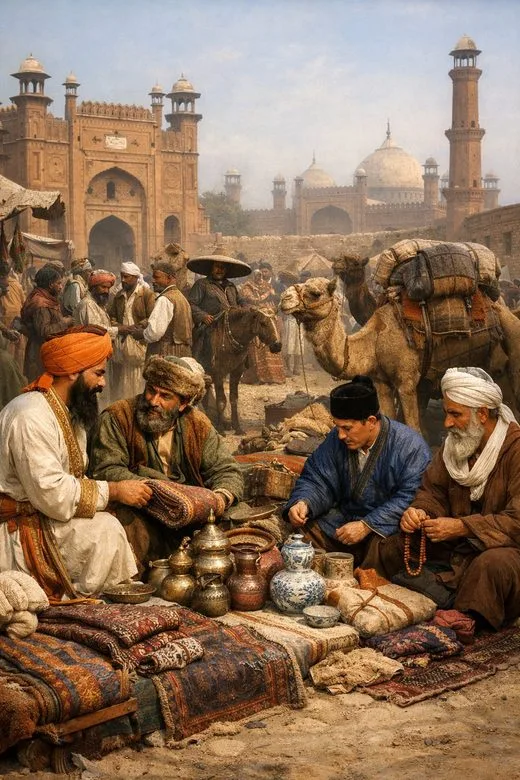
The Lahore entrepôt — Sikh, Afghan and Central Asian merchants converge on the Punjab’s greatest market. Camels arrive laden with carpets, ceramics and raw silk from the northwest; cotton goods, indigo and metalwork depart in return.
Reconstruction — Badshahi Mosque, Lahore, c.1820s
When Ranjit Singh rode into Lahore in July 1799, he inherited not a blank monetary landscape but one shaped by a century and a half of Mughal administration followed by several decades of Durrani disruption. The decision to continue established weight standards at the principal mints was not merely conservative: it was the only economically rational option for a state whose revenue depended substantially on the flow of goods through its territory.
The Mughal silver rupee had been struck on the tola standard at approximately 11.66 grams. The Sikh Nanakshahi rupee of Amritsar settled into a range of 11.0–11.35 grams. The money-changers of the Punjab classified Amritsar rupees into three commercial grades that operated independently of, and sometimes in tension with, official mint policy:
| Grade | Period (VS) | Date (AD) | Commercial Status |
|---|---|---|---|
| Purana — Old | VS 1841–1869 | AD 1784–1812 | Discounted for age and circulation wear |
| Chalan — Current | VS 1870–1879 | AD 1813–1822 | Standard commercial grade — accepted at par |
| Chitta — White/New | VS 1880–1905 | AD 1823–1848 | Premium grade — high silver content, freshly struck |
The Durrani rupee was a different coin serving a different commercial geography. The Afghan monetary system operated at approximately 8.33–8.49 grams — the weight at which the bazaars of Kabul conducted accounts and at which caravans toward Bukhara and Yarkand settled transactions. A Peshawari merchant presenting a heavier Mughal-standard rupee in Kabul would face the saraf’s batta — a discount of roughly 24–25 percent that made such a coin commercially useless for westward trade.
The Derajat and Mankera mints, and Dera Ismail Khan, are an important corrective to any simple two-zone model. Their silver rupees struck on or close to the Amritsar standard — Derajat issues running at 10.37–10.76 grams, Mankera and Dera broadly within the Amritsar range — confirm that even at the furthest reaches of the Indus valley and the Gomal Pass corridor, the Sikh state maintained the Punjab weight standard for its principal silver coinage. The commercial axis of these mints ran east toward the Punjab rather than west toward Kandahar. Mankera, controlling the Gomal Pass route at the edge of the Sind-Sagar Doab, appears regularly in Punjab hoards alongside Amritsar and Lahore issues, confirming this eastern orientation.
What Derajat and Dera did possess, however, was a complex system of local copper coinage inherited from the pre-Sikh frontier economy and continued under Sikh paramountcy: the Billishahi and related types, coins bearing the Fath Gobind legend, and Gurmukhi-script issues that reflect the cultural and administrative palimpsest of a frontier zone where Sikh sovereignty was layered over deeply rooted local monetary traditions. These copper denominations served the retail economy of the Indus valley towns in a way the silver rupee did not — they are the monetary fingerprint of local commerce, as distinct from the trans-regional silver trade the standard rupee served.
The Central Standard
Amritsar & the Architecture of the Nanakshahi
The Amritsar mint played a dual role: simultaneously the empire’s principal commercial mint and the religious institution through which coins were consecrated to Khalsa sovereignty. The custom that coins struck at a new mint on its first day were sent to Amritsar as an offering at the Akal Takht was not merely ceremonial — it established the Amritsar standard as the theological and commercial benchmark from which all other mints were understood to deviate.
The Nanakshahi rupee maintained 11.0–11.35 grams from VS1856 through the final issues before annexation in VS1906 — a consistency that survived the turbulence of four successive maharajas after Ranjit Singh’s death in 1839. The mint outlasted the Maharajas. It endured because the Punjab’s commercial classes needed it to endure.
The Weight Sequence
Peshawar & the Afghan Trade Standard
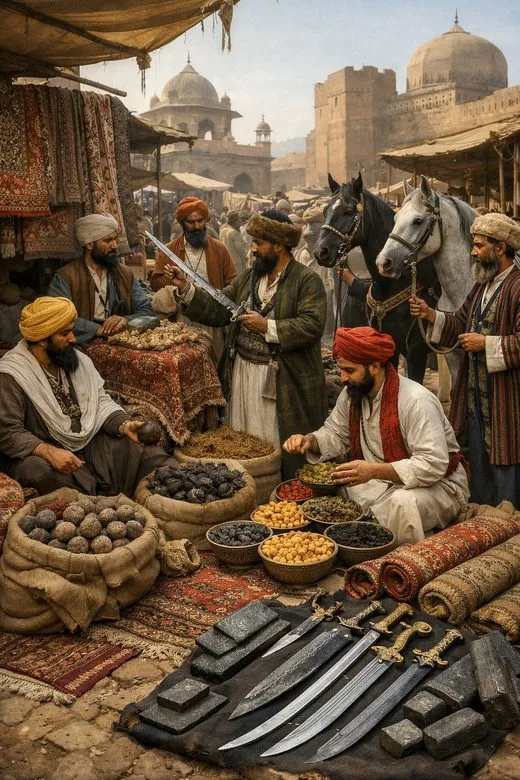
The Peshawar bazaar — horses from Central Asia, dried fruit from Kandahar, carpets and weapons trading alongside cotton goods and indigo from the Punjab. A coin at 8.33g moved through this market without discount; one at 11g did not.
Reconstruction — Peshawar, c.1830s
Peshawar in the early nineteenth century was as much a Central Asian city as an Indian one — the winter capital of the Durrani Empire and the primary entrepôt through which the produce of the Indian subcontinent was exchanged for the horses, dried fruit, raw silk, carpets, and pashmina of Afghanistan and Central Asia. The traveller Charles Masson, passing through in the late 1820s, described its commercial quarter as a place where the goods of half a dozen nations were available within a short walk. The weight sequence of the Peshawar series spans two distinct periods of striking, and the documents now available allow the distinction to be made:
VS 1891 — Year of Conquest
9.34
grams · Transitional Issue
Struck in the year of conquest itself. Heavier than the Afghan trade standard but lighter than Amritsar — a mint finding its footing in the year of first Sikh authority. Neither the imperial standard nor the settled commercial weight.
VS 1892–1893 — Settled Standard
8.34–8.49
grams · Afghan Commercial Range
The commercial logic of the frontier asserting itself after the transitional year. The weight at which Kabul bazaar merchants accepted the coin at par — at which caravans through the Khyber carried it without discount.
VS 1894 — Three Standards on a Single Date · Two Eras of Striking
The VS 1894 date spans two distinct periods of striking separated by a decade, with the mint dormant between them. The 8.4g coins are the original Hari Singh Nalwa-era issues of AD 1834–37, calibrated to the Afghan trade standard. The mint then ceased operation. The 11.11g coins are almost certainly recoinage-era restrikes produced when the Peshawar mint was reopened under British direction for the interregnum recoinage campaign (AD 1847–49) — struck on the old VS 1894 die, at the same Amritsar standard weight as the Nimak rupees, for the same administrative purpose. Dr L. White King (1905 Sale) placed both VS 1893 and VS 1894 Peshawar rupees explicitly in “Régence après la mort de Runjit Singh” — the post-December 1846 Regency period.
Directional Exchange
Peshawar as the Empire’s Currency Exchange Node
The weight differential between Amritsar and Peshawar was not a passive geographic fact — it was the mechanical basis for an active, directional monetary system. The two standards constituted the two halves of a currency exchange mechanism through which the Silk Road trade entered and exited the Sikh Empire’s monetary zone.
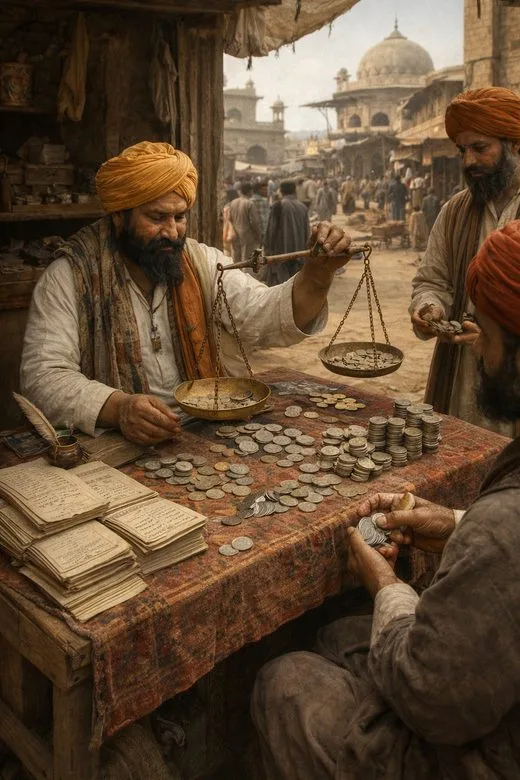
A sarraf at the Peshawar exchange — balance scales, stacked rupees sorted by standard, and Persian ledger books. The Gor Khatri community of money-changers made the 24–25% weight differential a commercial institution rather than an inconvenience.
Reconstruction — Peshawar bazaar, c.1830s
A merchant or caravan arriving from Kabul carried Afghan-standard coin. On entering Sikh territory, this silver needed conversion into Amritsar-weight rupees acceptable in the Punjab’s internal markets — presenting Afghan-standard coin in a Lahore bazaar would face the saraf’s batta discount of roughly 24–25 percent. Equally, a merchant departing through the Khyber with Punjab holdings needed to convert back into the 8.33–8.49g standard before crossing the frontier.
The VS 1894 11.11g coins at Peshawar were not produced within this exchange system as a centralising act — they are almost certainly recoinage-era restrikes produced when the Peshawar mint was reopened under British direction in 1847–49, struck on the old VS 1894 die at the Amritsar standard weight. The same administrative operation produced the Nimak rupees at Pind Dadan Khan: both at 11.1g, both bearing the Nanakshahi obverse couplet, both directed at replacing the frontier commercial silver with a standard aligned to the Company’s rupee. What the VS 1891–1893 weight sequence shows is that the Afghan commercial standard was never seriously challenged during the empire’s active life. It was challenged only during the interregnum — and by the administration that was about to end the empire.
The Punjab Terminus
Hoshiarpur & the Kullu-Rohtang Route to Yarkand
Any account of the Sikh Empire’s engagement with the overland Silk Road must reckon with the routes connecting the Punjab plains to the trans-Himalayan trade. There were two principal arteries. The first ran via the Kashmir valley and over the Zoji La to Leh, then northward across the Karakoram to Yarkand. The second — harder, higher, and in some respects more remarkable — began at Hoshiarpur.
The Hoshiarpur-Yarkand route ran north through Mandi into the Kullu Valley, over the Rohtang La into Lahaul, then across the Bara Lacha La and onward to Leh before pushing over the Karakoram passes toward Yarkand. The journey involved crossing the Dhauladhar Range, the Great Himalaya, the Karakorams, and the Kun Lun mountains — more than ten high passes in total, some among the highest trade crossings anywhere in the world.
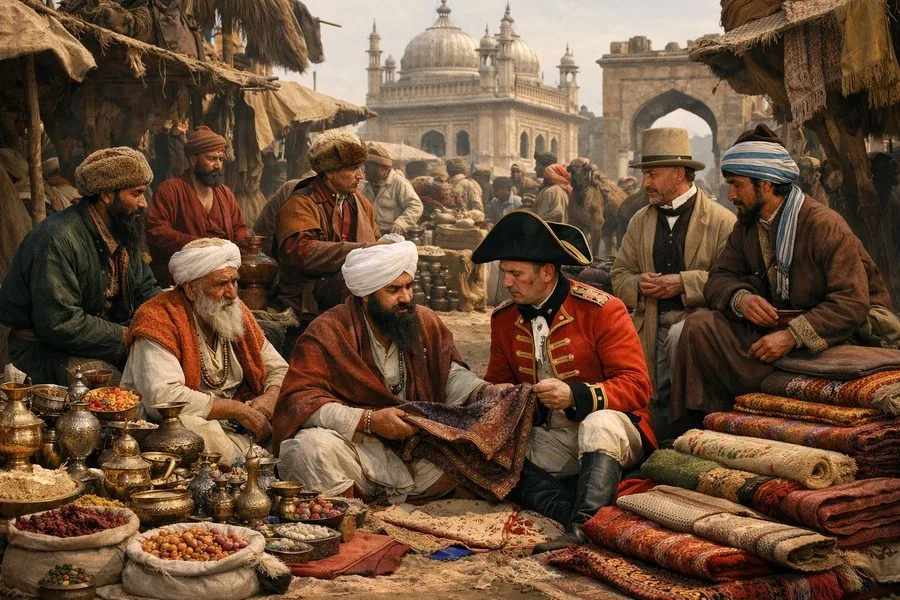
Reconstruction — Punjab foothills market, c.1840s
Primary Source · Commercial Correspondence · Yarkand to Hoshiarpur · October 1890
A letter survives in the philatelic record — written in Persian, English, and Dogri in Takri script — addressed to one Lala Mela Das of Hoshiarpur and sent from Yarkand in October 1890. It arrived at Hoshiarpur fifty-five days later, crossing the Karakoram pass at 18,000 feet, entering the Joint British–Jammu and Kashmir postal system at Leh on 12 November, and arriving at Hoshiarpur on 29 November — fifty-five days in transit, at a cost of one anna. The sender, Janab Samad Joo Sufi, was a Kashmiri trader based in Yarkand; the recipient almost certainly a Hoshiarpuri Khatri merchant with commercial interests extending to the Tarim Basin. Written forty years after the Sikh Empire’s annexation, this letter documents commerce on routes that the Sikh imperial mint system had been calibrated to serve.
The merchants who animated this route had a collective identity recognised in the historical record. During the route’s high period of activity — roughly 1880 to 1950 — all trading activity in Kargil was controlled by Punjabis and the Hoshiarpuri Lalas: predominantly Hindu Khatri merchants whose roots in the trans-Himalayan and Central Asian trade stretch back centuries. The most tangible surviving monument is the Aziz Bhat Sarai at Kargil, built in 1920 in partnership between Munshi Aziz Bhat and a Punjabi Sikh merchant, Sardar Kanth Singh. Their initial capital of 6,000 silver coins returned an annual profit of 9,000 rupees within a single trading year.
Imports — Central Asia to Punjab
- Charas (raw cannabis) from Yarkand
- Rugs and carpets from Central Asia
- Borax and mineral salts
- Raw silk and pashmina wool
- Horses and ponies — military procurement
- Dried fruits from Afghanistan
Exports — Punjab to Central Asia
- Cotton piece-goods and indigo
- Metalwork and iron implements
- Manufactured silk and tea
- Sugar and refined foodstuffs
- Finished Kashmir shawls
- Spices and medicinal goods
Hoshiarpur lay east of the Sutlej, in cis-Sutlej territory under British protection after 1809 — outside the Sikh Empire’s direct monetary jurisdiction. The Kullu-Rohtang route was actively encouraged by the British partly because it allowed merchants to bypass the heavy transit duties imposed on the Srinagar-Zoji La route. Hoshiarpur functioned as a monetary frontier as well as a commercial one — the point at which the Sikh weight-standard system gave way to British monetary rationalisation.
Deliberate Alignment
Kashmir & the VS1889 Issue under Kunwar Sher Singh
Kashmir illustrates a more nuanced dimension of frontier monetary policy than simple gubernatorial fraud. The weight data now available allows a distinction to be drawn between deliberate monetary alignment with the western trade standard and private extraction — and the VS1889 Kashmir issue under Kunwar Sher Singh falls most plausibly into the former category.
| Governor | Period (VS) | Weight | Classification |
|---|---|---|---|
| Diwan Moti Ram / Diwan Chuni Lal | VS 1881–1883 | 11.07g | Amritsar Standard |
| Kunwar Sher Singh | VS 1888–1891 (VS1889 issue) | 8.38–8.40g | Afghan Trade Weight — Deliberate Alignment |
| Mihan Singh Kumedan | VS 1892–1898 | 11.00g | Standard Restored |
| Bhima Singh | Later issues | 10.95–10.98g | Within Amritsar Range |
The VS1889 Kashmir rupees at 8.38–8.40 grams are not merely light: they are precisely on the Peshawar/Afghan commercial standard. The coincidence of weight with the Peshawar series — which settles into 8.34–8.49 grams in VS1892–1893 — is too exact to be accidental.
The identity of the governor provides the interpretive key. Kunwar Sher Singh, son of Maharaja Ranjit Singh, governed Kashmir from VS1888 to VS1891. His Kashmir governorship ended in VS1891 (AD 1834) — the very year the Sikh army, under Hari Singh Nalwa and Prince Nau Nihal Singh, annexed Peshawar, the city whose commercial weight standard his Kashmir coins had been replicating for the previous two years. Sher Singh, who had himself campaigned on the Peshawar frontier under Nalwa, was minting to the standard of precisely the trade corridor the empire was then absorbing. It strains credulity to believe this alignment was coincidental.
The two motives — aligning the coin with western trade conventions, and extracting seigniorage through the weight differential — are not mutually exclusive. A governor who struck at 8.38 grams when the Amritsar standard required 11 grams extracted approximately 24 percent of face value as seigniorage, while simultaneously producing a coin better suited to the western trade circuits through which the province’s most valuable commodities moved.
The contrast with VS1894 Peshawar is instructive. At Peshawar, three simultaneous standards reveal a mint under contested policy. At Kashmir in VS1889 under Kunwar Sher Singh, there is no such contest: a single weight, precisely the Afghan commercial standard, struck throughout the issue. The VS1889 Kashmir rupee is a more coherent monetary policy statement than anything in the VS1894 Peshawar sequence.
Baron Karl von Hügel, visiting Kashmir around 1835–36 in the immediate aftermath of Kunwar Sher Singh’s governorship, observed monetary irregularities now placeable in precise context. The Hari Singhee rupee — the below-standard coin associated with Hari Singh Nalwa’s earlier governorship, still current in Kashmir as late as 1890 — circulated at approximately ten mashas, itself in the 8–9 gram range. The valley had an established tradition of below-standard rupees with recognised commercial identities; the VS1889 issue fits within this tradition while its specific weight at the Afghan standard gives it a more precise commercial logic.
Hoard Distribution
What the Hoards Confirm
Weight analysis and the literary record converge on the directional model, but the most direct evidence comes from hoard distribution — the actual findspot patterns of coins deposited together in antiquity, which preserve the boundaries of the monetary circuits within which specific coin types circulated and were trusted as savings.
No hoard studied to date in which Sikh coins constitute the majority contains Peshawar rupees as a regular component. The mints that appear together in Punjab hoards — Amritsar, Lahore, Multan, Nimak, Mankera — are precisely those that struck on the Amritsar weight standard or close to it. Mankera and Dera Ismail Khan coins circulate within this Punjab zone, their silver rupees compatible with the standard; it is Peshawar that stands apart. Peshawar rupees, when they appear in the subcontinent’s hoard record at all, turn up in association with coins of the Afghan and Iranian monetary zones: Durrani rupees, Kabuli issues, Persian currency.
The weight series makes this segregation explicable with precision. The VS1891 Peshawar rupee at 9.34 grams — heavier than the Afghan trade standard but lighter than Amritsar — would have attracted discounting in both directions, which may explain why transitional-year coins are so rarely encountered in hoards of any type. The VS1892–1893 pieces settled into the Afghan commercial zone and circulated northwestward; the 7.1g VS1894 pieces would have been discounted everywhere and hoarded nowhere — consistent with their rarity in the numismatic record.
Kashmir coins are not habitually found with Amritsar or other Sikh Punjab mint coins — a segregation explained by the distinct commercial circuit they served: the north-south trans-Himalayan axis running toward Leh and Yarkand rather than east toward the Punjab plains. The VS1889 Kunwar Sher Singh issues at the Afghan commercial weight would have had an even stronger tendency to flow westward, reinforcing the Kashmir hoard segregation from the Punjab series.
The mixed hoards of the Punjab interior also document a striking phenomenon: the presence of shroff marks on machine-struck EIC coins. The entire logic of EIC machine production was to defeat the shroff’s batta system. Yet the Punjab hoards show that even these coins, when they entered the zone where the Sikh commercial system was dominant, were subjected to the same hand-testing regime as the hand-struck rupees they circulated alongside. The shroffs of the Punjab did not modify their practice simply because the coin in their hand had been struck by steam rather than hammer.
Synthesis
The Monetary Map of the Silk Road Corridor
The weight data assembled here produces a map — not of the Sikh Empire’s territorial extent but of the commercial geography of the Silk Road corridor as it expressed itself in metal. At its eastern anchor, Amritsar maintained the incoming currency of the trade. Moving northwest, the standard fell to Peshawar’s 8.33–8.49 grams — settling after the transitional VS1891 year into the established Afghan commercial range. Moving north, Kashmir’s rupees present the most complex picture: standard-weight issues under most governors serving the valley’s shawl trade accounts with Lahore, punctuated by the deliberate Afghan-weight issues of Kunwar Sher Singh in VS1889, aligned with the western trade corridor.
The VS 1894 Peshawar weight data — 8.4 grams, 7.1 grams, and 11.11 grams against a single date — is the most revelatory document in Sikh frontier monetary history, but its meaning has shifted with the evidence. The 8.4g coins are the original Hari Singh Nalwa-era issues of AD 1834–37, calibrated to the Afghan commercial standard. The 11.11g coins are almost certainly recoinage-era restrikes produced at the Peshawar mint when it was reopened under British direction after December 1846, struck on the old VS 1894 die at the same Amritsar-standard weight as the Nimak rupees. Dr L. White King placed VS 1893 and VS 1894 Peshawar rupees explicitly in the post-Bhairowal Regency period; the Lawrence diary of 10 December 1847 confirms the Peshawar mint was already recoin ing before that date. What this means is that the empire’s commercial weight standard — 8.34–8.49 grams — was never overridden from within. It was overridden only by the administration that dissolved the empire.
The failure of complete monetary standardisation across the empire is not evidence of state weakness. It is evidence of commercial intelligence accumulated over generations of Khatri merchant practice — the knowledge, embedded in the monetary system, that disrupting established weight conventions would impose transaction costs on the trade that the empire depended upon.
A Note on Sources · The Khalsa Darbar Records at Patiala
The Khalsa Darbar Records at Patiala — approximately 100,000 files covering Sikh state administration from 1811 to 1849 — remain largely unstudied by historians. The cataloguing undertaken by SitaRam Kohli in 1915–1919 identified them; very little systematic research has followed. Until that archival work is done, the coins themselves are the primary evidence. The 1,320+ documented pieces in the SikhCoins.in database, the catalogue entries in Herrli and in Sidhu/Spink, and the weight data preserved in auction records constitute a body of material evidence whose evidential value for economic and monetary history has barely begun to be exploited.
The Eastern Terminus
The Cis-Sutlej States & the Silk Road Corridor
The four Phulkian states — Patiala, Nabha, Jind, and Kaithal — were not frontiersmen of the Silk Road in the way that Peshawar or Kashmir were. They were its eastern terminus: the zone through which goods arriving from Central Asia via Lahore and Amritsar dispersed into the broader subcontinental economy and continued toward Delhi, the Gangetic plains, and the maritime ports. Their significance for the monetary argument of this page lies in three distinct areas.
| State | Mint Name | Coinage Type | Weight Standard | Hoard Context |
|---|---|---|---|---|
| Patiala | Sahrind | Rajashahi (Durrani couplet) Later: Gobindshahi nazaranas |
~11g — Amritsar zone | Found with Amritsar, Lahore & EIC issues in Punjab hoards |
| Nabha | Sarkar Nabha Lal | Durrani type; Gobindshahi from VS 1893 | ~11g — Amritsar zone | Circulated interchangeably with Punjab-standard silver |
| Jind | Sirhind | Rajashahi (Jindia rupees) — Durrani type only | 12 annas — discounted | Discounted by sarrafs; 1¼ mashas, valued below par |
| Kaithal | Sahrind type | Rajashahi modelled on Patiala | ~11g — Amritsar zone | Annexed by British 1843 — before Sikh Empire fell |
The Grand Trunk Road axis. The Cis-Sutlej states straddled the Grand Trunk Road — the main artery along which goods arriving from Peshawar via Lahore and Amritsar continued toward Delhi and the subcontinental interior. Sirhind, the mint name shared by Patiala and Jind, had been one of the great commercial nodes of the Mughal Empire: a crossroads of the routes connecting Central Asia, Persia, and northern India. The Phulkian states chose to name their mints after this regional trade centre rather than their political capitals — a signal that their monetary identity was articulated through commercial geography as much as political sovereignty.
The monetary boundary of 1809. The Treaty of Amritsar placed these states under British protection, drawing the Sutlej as the boundary between Ranjit Singh’s sphere and the British. For the monetary corridor, this was the moment the Silk Road’s Punjab terminus acquired a formal political edge. East of the Sutlej, the EIC rupee gradually displaced all other standards; west of it, the Sikh multi-standard system continued. The Cis-Sutlej states, straddling this boundary, operated in both monetary worlds simultaneously. This is confirmed by their hoards: Phulkian Rajashahi rupees appear in Punjab assemblages alongside Amritsar Nanakshahis and EIC machine-struck coin, all bearing shroff marks, all passing through the same saraf hands.
The Jind weight anomaly. Of the four states, Jind is the most numismatically telling. Its Jindia rupees were valued at only 12 annas — significantly below the 16-anna parity of the Patiala Rajashahi — a discount attributed by Major-General Taylor to irregular minting and the absence of private bullion tendering. This is a cis-Sutlej parallel to the Peshawar phenomenon: a coin whose below-standard weight placed it at a commercial discount within the prevailing monetary zone. Where Peshawar’s lighter weight served the outgoing western trade, Jind’s lighter weight served only to discount the coin within the Punjab circuit. The contrast illuminates the difference between deliberate commercial calibration to a neighbouring trade standard and simple minting irregularity.
The Durrani legend and its commercial logic. The Phulkian states struck their principal coinage in the name of Ahmad Shah Durrani — the same Afghan king whose authority the Sikh Empire had displaced — for over a century. This was not apostasy but commercial pragmatism: the minting right derived from the Durrani grant, and the Durrani inscription was the legal basis of the coin’s commercial authority south of the Sutlej. The Rajashahi rupees thus carried the Durrani couplet on one face and a Sikh state’s marks on the other — a monetary palimpsest of the political transitions of the northwest, legible to every saraf who handled them.
Nabha’s transition to the Gobindshahi couplet from VS1893 (AD1836) — earlier and more complete than Patiala’s — coincides precisely with the consolidation of Sikh imperial power and the final conquest of Peshawar. It is the numismatic moment when the Cis-Sutlej states began, at least in legend, to align themselves with the monetary theology of the empire to their north. That Patiala reserved its Gobindshahi issues as court nazaranas rather than full circulation coin tells its own story: commercial continuity required the Durrani legend, whatever the religious politics of the moment demanded.
Dissolution
The Undoing of the Monetary Map, 1847–1849
The commercial architecture described in this page — the Peshawar weight-differential, the Amritsar–Afghan exchange mechanism at Gor Khatri, the Kashmir standard calibrated to the north-south Yarkand axis — was not dismantled by the Second Sikh War. It was dismantled, instrument by instrument, during the twenty-seven months of the Bhairowal interregnum.
The Treaty of Bhairowal (December 1846) installed a British Resident at Lahore with, in the words of the Governor-General’s Secretariat, “full authority to direct and control all matters, in every department of the State.” Two of the first acts of that authority struck directly at the monetary and commercial system described in this page.
The Customs Reform & the Afghan Trade Corridor
The Sikh customs system was replaced under the Resident’s direction with a frontier duty line: three new collection boundaries along the Beas-Sutlej, the Indus, and the north-east frontier. The reform abolished internal transit duties. But its structural effect on the Afghan corridor trade was acknowledged by the British themselves. In instructions to the new Nazim of Mooltan in early 1848, the Resident noted that the new frontier import duty “will, it is to be feared, act as a total prohibition to the trade, or turn its course to Shikarpur and Kelat.”
The Afghan transit merchant whose silver the Peshawar exchange mechanism existed to receive now faced a prohibitive frontier impost. The Gor Khatri exchange node was commercially viable only while goods and silver moved freely through the Khyber; the frontier duty line severed that flow.
The Recoinage Campaign & the Nimak Mint
In January 1847 the Court of Directors of the East India Company issued a circular asking about the “possibility of reducing” Punjab currency standards to uniformity with the Company’s rupee. The Resident, Henry Lawrence, arranged for the Finance Minister Dewan Dina Nath to propose currency uniformity at Lahore Durbar on 20 June 1847, then recorded: “I purposed making the proposition myself, but am glad that the Dewan has broached it.”
Three frontier recoinage mints were activated: at Pind Dadan Khan (the Nimak mint), Peshawar, and Dera Ismail Khan. Their feedstock was precisely the coinage that made the Peshawar exchange mechanism work: Mahmoud Shah (Durrani) rupees at 8.5 grams, arriving through the Khyber and circulating at their established 12-anna commercial discount. Dr Andrew Fleming, visiting Pind Dadan Khan in March 1848, recorded the conversion in his diary:
Primary Source · Dr Andrew Fleming, Diary · Pind Dadan Khan, 22 March 1848
“Visited the mint here, which is under the superintendence of [Misr Rulia Ram]. Silver is collected in all directions in the shape of old rupees, bangles and silver ornaments, which after being refined are converted into the new Lahore Rupee. At present the silver from which rupees are being manufactured, are Mahmoud Shah Rupees from the Hazara and countries to the North, and of the value of about 12 annas… From 1000 Mahmoud Shah rupees, 750 new Lahore rupees are manufactured.”
The ratio of 750:1000 is the monetary logic of the page’s Peshawar sections expressed in reverse. The Mahmoud Shah rupee circulated at 12 annas precisely because its silver content was c. 73% of the Nanakshahi’s. The recoinage confirmed that discount as a one-time extraction: the Peshawar exchange discount, which sarrafs had commercialised for decades, was now administered as a state operation.
The Nimak rupees (Herrli 03.01.04 and 03.02.04, VS 1904–1905, 11.1g) are the physical residue. They are at full Amritsar Nanakshahi weight — not the frontier commercial weight — and bear Nanakshahi couplet V, the couplet of the Amritsar series, not the Gobindshahi couplet of the frontier mints at Peshawar and Derajat. This choice of couplet is deliberate: these coins are constituted as Amritsar coins, members of the standard against which the Company’s rupee was aligned, not as continuations of the frontier monetary tradition.
Mahmoud Shah Rupee — Feedstock
8.5
grams · Afghan frontier standard
The coin the Silk Road corridor had run on for generations. Circulating at 12 annas to the Nanakshahi — the exact differential that made Gor Khatri a viable exchange node.
Nimak Rupee — Output · VS 1904–1905
11.1
grams · Amritsar Nanakshahi standard
750 produced per 1,000 submitted. Nanakshahi couplet V. Pegged to the Company’s rupee. The frontier commercial weight absorbed into the imperial-then-colonial standard.
The Recoinage Network · October 1847 – June 1849
VS 1904–1905 • 11.1g
10.4–11.0g
VS 1904–1906 • 10.7–10.9g
established
All directed by Lawrence, administered through Misr Rulia Ram. The Derajat series runs to VS 1906 — the last Sikh coins struck anywhere, their final date confirmed by Longworth Dames who recorded his VS 1906 specimen was struck “when the Khalsa army was making its last struggle against the British Government.”
Fifty Lakhs Down the Indus
The interregnum recoinage moved Afghan silver up the Indus valley to the recoinage nodes, converting it to Nanakshahis. After annexation the flow reversed. The Board of Administration’s General Report (1852–53) records: “large bullion remittances of the old coin, aggregating about fifty lacs, were transmitted to Calcutta, and also down the Indus, to be returned from the Bombay Mint with the British stamp.” The Nanakshahi rupee would be “numbered with the things of the past” within two or three years.
The page you are reading has argued that the Sikh mint system was calibrated to the Silk Road’s commercial rhythms rather than simply imposed by state fiat. The recoinage campaign of 1847–49 is the obverse of that argument: a system calibrated over generations to serve the commercial logic of the Khyber corridor was dismantled not by war but by administrative instruments, applied during the nominal period of Sikh sovereignty, because it was incompatible with the Company’s rupee standard the Resident had been directed to impose.
For the complete account: The Bhairowal Interregnum — Seven Instruments of Dissolution · The Nimak Mint — Pind Dadan Khan, 1847–49
Scholarship
References & Bibliography
Primary Sources
- The Coins of the Sikhs. Second revised and augmented edition. Munshiram Manoharlal Publishers, New Delhi, 2004.
- Coins of the Sikh Empire, Punjab and the Cis-Sutlej States. Spink Books, London, 2022.
- Papers Related to the Punjab 1847–1849. Presented to Parliament, May 1849. Harrison and Son, London. The primary correspondence of the Bhairowal interregnum, including the customs reform instructions and currency peg directive.
- ‘Diary of a Trip to Pind Dadan Khan and the Salt Range.’ Royal Asiatic Society of Bengal, Vol. XVIII, Part II, 1849, pp. 667–68. First-hand account of the Nimak mint at Pind Dadan Khan in operation, March 1848.
- General Report on the Administration of the Punjab. Calcutta, 1852–53. Para. 108: the fifty-lakh bullion remittance down the Indus to the Bombay Mint.
- ‘Unidentified Sikh mints — proof of the existence of the mint at Nimak.’ ONS Newsletter No. 143, Winter 1995, pp. 13–15.
- ‘Rediscovering Sikh Mints — Peshawar, Dera, Rawalpindi.’ ONS Newsletter No. 146, Autumn 1995, pp. 10–12. Documents the Peshawar recoinage (1847–49) and the Derajat series running to VS 1906.
- ‘Coins of the Durranis and Barakzais.’ Numismatic Chronicle, 1888, p. 330. Records the Derajat VS 1906 rupee — the latest dated coin of any Sikh mint.
- Sikh Empire Coinage Database. www.sikhcoins.in.
- Kaschmir und das Reich der Siek. Stuttgart, 1840–1848. Notes on the coinage of Kashmir reproduced in Herrli, Appendix 1.
- Punjab State Archives, Patiala. Catalogued by SitaRam Kohli, Lahore, 1919 and 1927.
- Umdat-ut-Tawarikh. Persian-language chronicle of the Sikh court. Lahore, c.1840s.
- Narrative of Various Journeys in Balochistan, Afghanistan and the Punjab. Richard Bentley, London, 1842.
Secondary Sources
- Maharaja Ranjit Singh and His Times. 1990.
- The Sikhs of the Punjab. The New Cambridge History of India, II.3. Cambridge University Press, 1990.
- History of the Sikhs, Vol. V: The Sikh Lion of Lahore — Maharaja Ranjit Singh, 1799–1839. Munshiram Manoharlal, New Delhi, 1991.
- Catalogue of Khalsa Darbar Records, Vol. I. Government of the Punjab, Lahore, 1919.
- India and the Silk Roads: The History of a Trading World. Hurst, London, 2021.
- Caravans: Punjabi Khatri Merchants on the Silk Road. Penguin Books India, 2015.
- ‘Trade Relations between Central Asia and Kashmir Himalayas during the Dogra Period (1846–1947)’. Cahiers d’Asie centrale, 1/2, 1996, pp. 113–124.
- Report on the Coinage of the Phulkian States (Patiala, Jind, Nabha). Reproduced in Herrli, Appendix 3, 2004.
- ‘The Cis-Sutlej States — Phulkian Coinage & History’. sikhcoins.in/cis-sutlej.php.