Phulkian Sovereignty
The Cis-Sutlej States
Patiala, Nabha, Jind & Kaithal — The Phulkian Coinage
VS 1820 – 2005 · AD 1763 – 1948
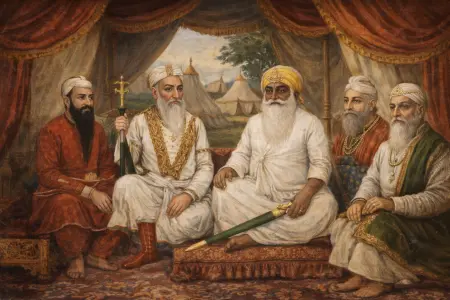
Artists impression of the chiefs of the Cis-Sutlej — Chaudhary Phul & his descendants Ala Singh(Patiala), Gajpat Singh(Jind) & Hamir Singh(Nabha) and Bhai Lal Singh(Kaithal)
Common Ancestry
Phul & the Cis-Sutlej Sikhs
The Phulkian states traced their descent from Phul, a Sidhu Brar Jat of village Maharaj who died in 1652. The Sidhu clan was the most powerful Jat tribe south of the Sutlej — the great river that divided the Sikh world. To the north of it lay Majha, the heartland of the Dal Khalsa's militant confederacies; to its south, the Malwa region, where the Phulkian chiefs built their kingdoms in the shadow of Delhi, Sarhind, and — most critically — the armies of Ahmad Shah Durrani.
The Cis-Sutlej region lay between the Jamuna in the east and the Sutlej in the west. For administrative purposes it had been divided between the provinces of Delhi, Lahore and Multan. Its two main divisions of Sarhind and Hisar fell under Delhi. The Phulkian states were thus oriented as much toward the Mughal capital as toward Amritsar, and this geography shaped every political choice their rulers made.
From Phul descended six main lines. Patiala was founded by his grandson Ala Singh from the branch of Rama. Nabha descended from the senior line through Gurditta. Jind descended through Sukhchain Singh, Phul's grandson. Kaithal was not a Phulkian dynasty at all — its ruling Bhais descended from Bhai Ram Dayal, a Sandhu Jat saint closely allied by marriage to the Phulkian family but of independent lineage. Further Phulkian branches governed Faridkot, Bhadaur, Badrukhan, Dayalpur and many smaller principalities.
The relationship of these states to the Dal Khalsa was a source of persistent tension. Historian Hari Ram Gupta summarised the contradiction bluntly: the Phulkian chiefs kept religion and politics apart. They took pahul and wore the Khalsa bana; they built gurudwaras and made gifts to Harmandir Sahib. Yet they paid tribute to Ahmad Shah Durrani, submitted to Mughal governors, and — uniquely among Sikh rulers — minted their principal coinage in the name of the Afghan king rather than the Gurus. Only late in their history, after the British closed the Sikh empire's mints, did the Phulkian courts begin striking Gobindshahi rupees of their own.
The Four States
Founders & Sovereigns
Each of the four principal Cis-Sutlej states had a distinct founding moment, political temperament, and numismatic character. All four became British protectorates under the Treaty of Amritsar in 1809 — but their internal histories diverged sharply. Three persisted into the twentieth century; one was extinguished by British annexation in 1843, six years before the Sikh Empire itself fell.
| State | Founder | Founded | Minting Right | Coinage Type | Fate |
|---|---|---|---|---|---|
| Patiala | Ala Singh (d. 1765) | c. 1714 / capital 1753 | AH 1178 / AD 1765 — Ala Singh (earliest known coin); confirmed to Amar Singh on the Sutlej c. 1767 | Rajashahi (Durrani) rupees + Gobindshahi nazaranas | Merged into PEPSU 1948 |
| Nabha | Hamir Singh (d. 1783) | 1755 AD | pre-1783 — Hamir Singh (crude undated); regular dated series from VS 1820 (Jaswant Singh) | Durrani (from c. 1755); full switch to Gobindshahi from VS 1893 | Merged into PEPSU 1948 |
| Jind | Sukhchain Singh (d. 1758) | Early 18th century | 1772 AD — Gajpat Singh, firman of Emperor Shah Alam II | Rajashahi (Jindia) rupees — only Durrani type known | Merged into PEPSU 1948 |
| Kaithal | Bhai Desu Singh (son of Gurbakhsh Singh; Bhai lineage) | 1767 AD — seized from Afghan chiefs | c. late 18th century | Rajashahi rupees modelled on Patiala type | Annexed by British, April 1843 |
State by State
Histories of the Phulkian Courts
Patiala
Ala Singh (1691–1765), grandson of Phul and third son of Rama, founded the Patiala state from a holding of twenty-two villages in the Bhatinda district. Beginning at Rampura Phul and expanding steadily eastward, he established a fort at what would become Patiala in 1753, shifting his capital there in 1764 — the same year the Dal Khalsa destroyed the Mughal fort of Sarhind just thirty kilometres away and allowed Ala Singh to absorb the ruins of that once-feared city.
Ala Singh navigated his position with remarkable dexterity. He took pahul from Nawab Kapur Singh of the Dal Khalsa and a second initiation from Dip Singh Shahid, yet simultaneously maintained tribute relationships with successive Mughal governors and the Durrani court. Ahmad Shah Durrani, recognising a useful counter to the Majha Sikhs, confirmed Ala Singh in ownership of Sarhind in 1762 and granted him the title Raja-i-Rajagan Bahadur — and with it, the right to mint in the name of the Durrani king.
His successor Amar Singh (1765–1781) formally received the minting right around 1767 when he met Ahmad Shah on the Sutlej. The Patiala coins — called Rajashahi rupees — bore the full Ahmad Shah Durrani couplet on the obverse and the mint name Sahrind on the reverse. Though the mint was physically at Patiala, it invariably styled itself Sahrind (the Patiala spelling) — a name which historically described not just the town but the entire swathe of territory from Patiala to Ambala. The spelling varied by state: Patiala used Sahrind, Jind used Sirhind — a subtle but consistent difference that helps attribute otherwise similar coins. Sahib Singh (1781–1813) kept this tradition, though his reign was dominated by domestic conflict with his powerful Rani, whose attacks on Nabha and Jind in 1805 ultimately drew Ranjit Singh across the Sutlej and precipitated the British protectorate of 1809.
Under Karam Singh (1813–1845) and Narendra Singh (1845–1862) Patiala supported the British in both the Sikh Wars and the Mutiny of 1857, receiving additional territories in recognition. The Gobindshahi nazarana series in fact begins during Karam Singh's own reign — a VS 1893/1898 Gobindshahi nazarana rupee bearing Narendra Singh's khanda symbol was struck from a worn die during Karam Singh's time, placing the first Patiala Gobindshahi coin before the fall of the Sikh Empire in 1849. Under Narendra Singh the series was formalised — struck not for circulation but in small numbers before Dusserah for religious gifts, puja and presentation. The state mint closed its regular operations in 1892–93 but Gobindshahi nazaranas continued to be produced for the ruling house under Bhupindra Singh and Yadavindra Singh until the merger of Patiala into PEPSU in 1948.
Nabha
Hamir Singh founded the town of Nabha in 1755, establishing from it a compact state in the heart of the Malwa. Nabha descended from the senior line of Phul's descendants, making its rulers technically the eldest of the Phulkian chiefs — a claim that the more powerful Patiala consistently ignored and that produced generations of bitter inter-state rivalry. Crude undated rupees attributable to Hamir Singh are known, though a regular dated series commences only under Jaswant Singh (1783–1840) from approximately VS 1820.
Nabha's earliest coins were direct copies of the Patiala Durrani type, differing only in the mint name — Sarkar Nabha Lal — and the state and ruler's personal marks on the reverse. From VS 1893 (1836) the Gobindshahi couplet replaced the Durrani inscription on the obverse, making Nabha's transition to Sikh legendary coinage earlier and more complete than Patiala's — and unlike Patiala, these were full circulation issues, not court nazaranas.
The state suffered its most serious political blow when Devindar Singh sided with the trans-Sutlej Sikhs in the First Sikh War. He was removed and nearly a quarter of Nabha's territories confiscated. His son Bharpur Singh recovered by supporting the British during the Mutiny. Hira Singh (1871–1911) was elevated to the title Maharaja by the British in 1911. By the 1930s the Nabha mint was running on Rs 570 per year in administrative expenditure, producing rupees almost entirely for annual Gurudwara offerings — a poignant survival of sovereign coinage reduced to pure religious function.
Jind
The Jind branch of the Phulkian family descended through Sukhchain Singh, who divided his territory among his sons, keeping Jind for himself. The state lay closest to Delhi of all the Phulkian domains — a mere 128 kilometres — and this proximity kept it firmly in the gravitational field of Mughal and later British authority. Sukhchain's son Gajpat Singh (1738–1789) transformed Jind from a landlord's estate into a recognised principality. Present at the Dal Khalsa's conquest of Sarhind in January 1764, he seized a large tract including Karnal, Panipat, Kharkhaudah and Kasuhan.
Having accumulated three years of unpaid revenues to the Mughal court by 1767, Gajpat Singh was summoned to Delhi. The Mughal court forced his conversion to Islam and imprisoned him for three years. He secured release in 1771 by paying three lakhs of rupees and leaving his son Mehar Singh as hostage. In exchange he obtained the title of Raja, confirmed ownership of his territories, and — crucially — a formal imperial firman dated 25 Shawal 1185 AH (31 January 1772 AD) granting him the right to coin. Jassa Singh Ahluwalia publicly re-administered pahul to him as a mark of Khalsa forgiveness and solidarity. His coins, the Jindia rupees, exactly copied the Patiala Rajashahi type. They were 1¼ mashas in weight and valued at only 12 annas — significantly below the 16-anna Patiala rupee — a discount Taylor attributed to irregular minting and the absence of private bullion tendering. An extraordinary dynastic connection runs through this state: Gajpat Singh's daughter Raj Kaur — known to history as Mai Malwain Sahiba — married Mahan Singh of the Sukerchakia Misl; their son was Maharaja Ranjit Singh, future sovereign of the Sikh Empire. Jind was thus the maternal birthplace of the Empire.
No Gobindshahi rupees of Jind are documented. Jind's coinage remained the Durrani-type Rajashahi rupee throughout — a reflection of the state's persistent orientation toward Mughal and British authority. An unusual production detail: Patiala shared its own dies with Jind, and Raghbir Singh (1864–1887) never commissioned new dies of his own, having his initials re re-engraved on worn Bhag Singh dies. Ranbir Singh struck a coronation rupee (VS 1940), a 50th-anniversary nazarana rupee (VS 1993) and a nazarana mohur — the only identifiably celebratory Jind numismatic issues.
Kaithal
Bhai Gurbakhsh Singh — the clan founder, from whom the Kaithal ruling house derived — was a close associate of Ala Singh of Patiala, and the two families fought together and divided spoils as equals. His son Bhai Desu Singh — descended from Bhai Bhagtu ji, a devoted Sikh of Guru Amar Das — seized the principality of Kaithal in 1767 from its Afghan chiefs. The two families considered themselves equals. Desu Singh fell out with Raja Amar Singh of Patiala in 1778, sought the patronage of the Delhi Wazir, and was forced to pay four lakhs in back revenue and fines, leaving his son Lal Singh as hostage. Lal Singh was tortured. Embittered, he became a rebel against his own father; upon Desu Singh's death in 1781 he escaped confinement, killed his elder brother Khushal Singh (whose name was afterwards expunged from records and replaced with Behal Singh) and seized the family estates. Kaithal became under Lal Singh the second most powerful Cis-Sutlej state after Patiala at the time of the British advance in 1809.
Kaithal's end came with dramatic suddenness. Udai Singh died on 15 March 1843 without a male heir. The British, then applying their doctrine of lapse aggressively to the princely states, refused to allow the Rani to administer the state and sent a force to annex it. The Rani — in one of the more extraordinary episodes of pre-annexation Sikh history — mounted an armed resistance. Her troops routed the first British column, driving it back to Kamal. A stronger combined force, including Patiala cavalry, eventually took the town. The Rani escaped into the night with her treasure in carts, eluding British pursuit. Kaithal was formally annexed and Henry Lawrence was appointed its first British administrator. Kaithal was the only major Cis-Sutlej state to be absorbed by the British before the annexation of the Punjab itself in 1849.
Chronology
A Timeline of the Cis-Sutlej
AD 1652
Death of Phul, Common Ancestor
Phul, a Sidhu Brar Jat of village Maharaj, dies. His descendants will divide into the ruling houses of Patiala, Nabha, Jind, Faridkot and dozens of smaller principalities across the Malwa and Cis-Sutlej region.
AD 1714 – 1753
Ala Singh Builds Patiala
Beginning from twenty-two villages, Ala Singh expands steadily, defeats a coalition of Muslim chiefs at Thikriwala with Nawab Kapur Singh's help, and founds the town of Patiala in 1753 at a site of mango groves called Patti Sodhian.
FoundationJanuary 1764
Fall of Sarhind — The Phulkians Gain
The Dal Khalsa defeats and kills Zain Khan, the Afghan governor of Sarhind. Ala Singh of Patiala, Gajpat Singh of Jind and Harnir Singh of Nabha all seize territory in the aftermath. Ala Singh acquires Sarhind itself and shifts his capital to Patiala, 30 km away.
Territorial Expansionc. AD 1767
Minting Right Granted to Patiala
Amar Singh of Patiala meets Ahmad Shah Durrani on the Sutlej and is confirmed in ownership of Sarhind. He receives the right to mint coins using the Durrani couplet and the mint name Sahrind — inaugurating the Rajashahi rupee that will be struck continuously for over 125 years.
Numismatic Event31 January 1772 AD
Imperial Firman for Jind
Emperor Shah Alam II issues a firman dated 25 Shawal 1185 AH granting Gajpat Singh of Jind the title of Raja and the right to issue coinage. Jassa Singh Ahluwalia publicly re-administers pahul to him. The Jindia rupees, identical in type to Patiala, begin to circulate.
Numismatic Event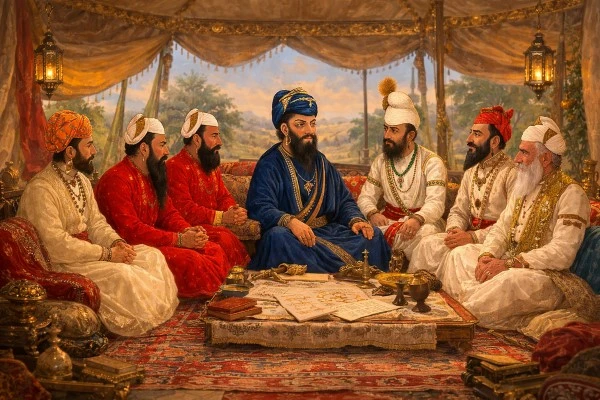
Maharaja Ranjit Singh with his contemporary chiefs — Raja Jaswant Singh of Nabha, Bhai Lal Singh of Kaithal, Raja Bhag Singh of Jind, Maharaja Ranjit Singh, Raja Fateh Singh Ahluwalia, Raja Sahib Singh of Patiala and Bhai Jodh Singh of Kalsia
AD 1806 – 1809
Ranjit Singh Crosses the Sutlej
The Rani of Patiala attacks Nabha and Jind; both states appeal to Ranjit Singh. He crosses the Sutlej in 1806 and again in 1807, establishing a Sikh imperial presence south of the river. The British react decisively: by the Treaty of Amritsar (1809) all four Cis-Sutlej states become British protectorates.
Loss of Sovereigntyc. VS 1892 / AD 1835
Nabha Adopts the Gobindshahi Couplet
The Lahore Museum's earliest known Nabha Gobindshahi rupee — dated VS 1892 — signals the replacement of the Durrani inscription with the Sikh couplet at Nabha. After VS 1893 all Nabha rupees bear the Gobindshahi obverse. Nabha's transition is earlier and more complete than Patiala's.
Numismatic Event10 April 1843
Annexation of Kaithal
Following the death of Udai Singh without a male heir, British forces march on Kaithal. The Rani's troops rout the first column. A reinforced force takes the town. The Rani escapes with her treasury. Kaithal is annexed to British territory — the first Cis-Sutlej state absorbed, six years before the fall of the Sikh Empire.
Annexationc. AD 1849 – 1854
Patiala Begins Striking Gobindshahi Rupees
After the British close the Sikh Empire's mints at Lahore and Amritsar, the supply of Gobindshahi rupees for religious use dries up. Patiala begins striking a parallel Gobindshahi series — not for commerce but for puja, temple offerings and nazaranas. Only a few hundred are struck annually before Dusserah.
Numismatic EventAD 1892 – 1893
Patiala State Mint Closes Regular Operations
The Patiala mint ceases general coinage. Rajashahi rupees are still struck occasionally by sharafs under contract. The Gobindshahi nazarana series continues for the ruling house and Gurudwara offerings through Bhupindra Singh and Yadavindra Singh's reigns.
End of Regular Coinage20 August 1948
Merger into PEPSU
Patiala, Nabha, Jind and five other princely states merge into the Patiala and East Punjab States Union (PEPSU). The last Gobindshahi nazaranas of Nabha — bearing the frozen accession year of Partap Singh — are among the final coins of any Sikh state ever struck. PEPSU itself merges into the Punjab State in November 1956.
End of the StatesThe Coinage
Rajashahi & Gobindshahi — Two Legends, One Mint
The Cis-Sutlej coinage is unlike that of any other Sikh state. Where the Dal Khalsa mints and the Sikh Empire struck exclusively in the name of the Gurus, the Phulkian courts maintained for over a century a coinage in the name of Ahmad Shah Durrani — the same Afghan king who had slaughtered thousands of Sikhs at the Vadda Ghallughara of 1762. This was not apostasy but realpolitik: the minting right itself derived from the Durrani grant, and the inscription was the legal and commercial basis of the coin's authority south of the Sutlej.
The Rajashahi rupees — so called from Raja Shahi, the royal coinage — carried Ahmad Shah's Persian couplet on the obverse and the Sahrind mint attribution on the reverse, along with state marks and personal marks distinguishing each ruler's reign. The Sad mark (the Arabic letter “sad” signifying authenticity) appears on the reverses of all Phulkian coins and was long misread as a numeral 4 by early numismatists. Each state and each ruler added their own countermarks, creating a layered authentication system that Herrli describes as not yet fully studied.
Only after 1849 — when the Lahore and Amritsar mints closed and the supply of Nanakshahi and Gobindshahi rupees for Sikh religious use dried up — did the Patiala court begin striking Gobindshahi nazaranas in parallel. These were never commercial currency: they were struck in small numbers before Dusserah for distribution at temple offerings, marriages and as royal gifts. Many were melted after use; the survivors are today among the rarest of all Sikh rupees. The Nabha Gobindshahi series is older and more varied, with documented coins from VS 1892 through the final Nabha reign.
The Two Couplets of the Cis-Sutlej
The Rajashahi Couplet — Ahmad Shah Durrani (Patiala, Nabha, Jind, Kaithal)
The command came from the Powerful One, who has none like Him, to Ahmad the Emperor — to strike coins on silver and gold from the height of the Fishes to the Moon.
Reverse: Manus Maimanat Julus Sanah [year] Zarb Sahrind · In the auspicious reign, year [date], struck at Sahrind
The Gobindshahi Couplet Ie — Patiala & Nabha Nazaranas
The cauldron (munificence), the sword (strength), victory and infinite help — obtained through the spiritual succession from Guru Nanak by Guru Gobind Singh.
Reverse: Manus Maimanat Julus Sanah [year] Zarb Sahrind · The reverse unchanged from the Rajashahi type — only the obverse legend shifts
Note: Herrli classifies this as Couplet Ie — the same as the standard Gobindshahi couplet but with DEG spelt in a distinctive variant form found only at Patiala and Nabha. The words also appear without the connecting o (and) between each term.
Nabha Mint Attribution
The Government of Beautiful [or Crimson] Nabha — the unique mint epithet of Nabha, replacing Sahrind on both Durrani and Gobindshahi types. Three variants are documented: Sarkar Nabha Lal, Nabha Kamal (beautiful), and simply Nabha on some earlier Durrani-type coins.
Patiala
Zarb Sahrind · AH 1178 / VS 1822 onwards · Rajashahi + Gobindshahi Nazaranas
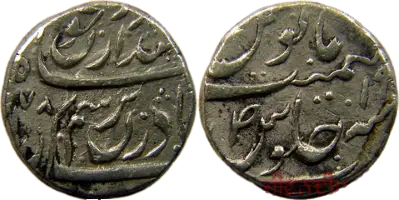
Obverse — Rajashahi Type
Hukm shud az Qadir-i-bechun ba Ahmad Badshah Sikka zan bar sim-o-zar az ouj-i-mahi ta ba MahReverse
Zarb Sahrind Struck at Sahrind [i.e. at Patiala, in the name of the Sarhind territory]Personal ruler marks on reverse: Ala Singh — no mark; Amar Singh — 3 dots between u and s of Julus; Sahib Singh — 6-dot flower + sprig (sword symbol also known); Karam Singh — cross symbol; Narendra Singh — khanda; Mohinder Singh — halberd blade; Rajinder Singh — katar (dagger); Bhupinder Singh — spearhead; Yadavindra Singh — bayonet rifle. The Gobindshahi Nazarana series (obverse: Gobindshahi couplet, reverse: unchanged Durrani type): Karam Singh (VS 1893, 1898), Narendra Singh (VS 1898–1909), Mohinder Singh (undated), Rajinder Singh (VS 1943, 1950), Bhupinder Singh (VS 1958), Yadavindra Singh (VS 1994). Full denomination range issued by the state: ¼ rupee, ½ rupee, 1 rupee, nazarana rupee; ⅙, ⅓, ⅔, 1 mohur.
Browse Cis-Sutlej Collection →Nabha
Zarb Sarkar Nabha Lal / Nabha Kamal / Baldah Nabha · c. 1755–1948 · Durrani then Gobindshahi from VS 1893
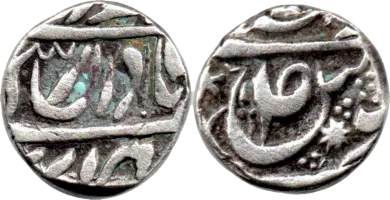
Obverse — Gobindshahi Type (from VS 1893 onwards)
Deg o Tegh o Fateh o Nusrat be-dirang Yaft az Nanak Guru Gobind SinghReverse
Zarb Sarkar Nabha Lal Struck by the Government of Beautiful NabhaThe state mark is a star between the u and s of Julus — two varieties of star shape are documented. The earliest crude rupees are attributed to Hamir Singh (founder, pre-1783); dated coins begin with Jaswant Singh from approximately VS 1820. Nabha rupees weighed 10 mashas 4¼ rutis of pure silver and were valued at 15 annas — one anna below the Patiala rupee, a difference carefully noted by Taylor. Mohurs: 9¾ mashas of pure gold (9.89 g). The transition from Durrani to Gobindshahi legend occurs at VS 1893 (1836) during Jaswant Singh's final years; a single VS 1907 coin (Bharpur Singh) anomalously reverts to Durrani. Three mint name forms documented: Sarkar Nabha Lal, Nabha Kamal, and (VS 1912–1913 nazaranas only) the unexplained Baldah Nabha. Unlike at Patiala, the Nabha Gobindshahi was a regular circulation coinage. Documented coin types by ruler — Hamir Singh: rupee; Jaswant Singh: rupee, nazarana rupee, mohur; Devinder Singh: ½ rupee, rupee, nazarana rupee; Bharpur Singh: ¼ rupee, rupee, mohur; Bhagwan Singh: rupee, nazarana rupee; Hira Singh: rupee, nazarana rupee, mohur; Ripudaman Singh and Partap Singh: no coins known.
Browse Cis-Sutlej Collection →Jind
Zarb Sirhind — Jindia Rupees · From AD 1772 · Rajashahi type
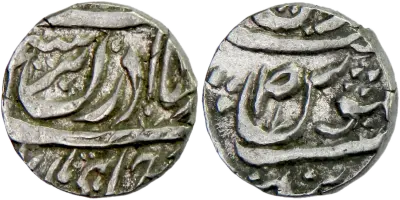
Obverse — Rajashahi Type
Hukm shud az Qadir-i-bechun ba Ahmad Badshah Sikka zan bar sim-o-zar az ouj-i-mahi ta ba MahReverse
Zarb Sirhind Struck at SirhindThe Jindia rupee was valued at about 12 annas. Mint name: Sirhind (distinct from Patiala's Sahrind). Jind had no fixed state symbol; each ruler used a personal mark. Gajpat Singh (1764–1789): sprig within s of Julus; rupee and mohur. Bhag Singh (1789–1819): sword then re-engraved kalgi on worn Patiala dies; rupee. Fateh Singh (1819–1822): 4-pointed flower; rupee. Sangat Singh (1822–1834): 4 dots; rupee and mohur. Sarup Singh (1837–1864): rosette of 6 dots; rupee, nazarana coronation rupee (VS 1893). Raghbir Singh (1864–1887): re-engraved initials re on Bhag Singh's worn dies; rupee. Maharaja Ranbir Singh (1887–1948): annulet within s of Julus; rupee (VS 1940, coronation), nazarana rupee (VS 1993, 50th anniversary of reign), nazarana mohur (VS 1993). Patiala dies were shared with Jind — a documented production detail unique in this series.
Browse Cis-Sutlej Collection →Kaithal
Bhai State Coinage · Late 18th century to 1843 · Rajashahi type
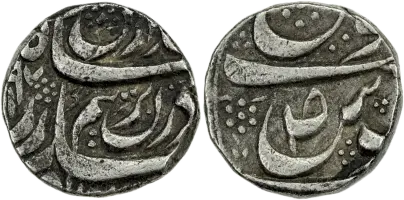
Obverse — Rajashahi Type
Hukm shud az Qadir-i-bechun ba Ahmad Badshah Sikka zan bar sim-o-zar az ouj-i-mahi ta ba MahReverse
Zarb Sahrind Struck at SahrindKaithal's coinage is distinguished by a 6-dotted rosette within the nun of Bechun on the obverse — the key mark identifying it against the otherwise near-identical Patiala type. Later coins (from AH 1197 onwards) add four dots to the right of the sin of Julus on the reverse, against Patiala's three. The Bhai ruling house descended from Bhai Bhagtu ji, a devoted Sikh of Guru Amar Das — not from Phul — giving Kaithal a distinct religious identity; its chiefs styled themselves Bhai rather than Raja. Documented rulers: Bhai Desu Singh (1767–81), Bhai Khushal/Behal Singh (1781–83), Bhai Lal Singh (1783–1819), Bhai Partap Singh (1819–24), Bhai Uday Singh (1824–43). Mohurs are also known (Bhai Lal Singh, AH 1220). Coinage ended with British annexation in 1843.
Browse Cis-Sutlej Collection →Historical Context
Not a Misl — A Kingdom in Miniature
The Phulkian states were frequently listed among the twelve Sikh misls in early histories. Herrli, Gupta and other modern scholars are agreed that this classification is incorrect. The differences were not superficial. The misls distributed booty equally among followers and operated as collective confederacies; the Phulkian chiefs appropriated territory entirely to themselves and rewarded followers with jagirs and cash payments, on the Mughal model. The misls attended Gurmattas at Amritsar and Anandpur; no Phulkian ruler attended a Gurmatta in the eighteenth century. The misls refused to serve Muslim masters — Lahna Singh Bhangi flatly declined Ahmad Shah Durrani's offer of the Punjab governorship; Baghel Singh Karorasinghia thrice turned down Emperor Shah Alam's offer of the Upper Ganga Doab. The Phulkian chiefs served and submitted.
Yet the Phulkian states were not simply collaborators. Their founders took pahul from the greatest Sikh leaders of their age — Ala Singh from Kapur Singh and Dip Singh Shahid, Gajpat Singh re-initiated by Jassa Singh Ahluwalia. They built gurudwaras, endowed shrines, and maintained the outward forms of Khalsa identity. Their position was one that the geography of the Cis-Sutlej imposed on them: they lay on the direct road between Delhi and Lahore, without the great river barrier that sheltered the Majha Sikhs, and they survived by mastering the art of calculated ambiguity.
The numismatic legacy of this ambiguity is unique. Only on the Phulkian coins can one find the same reverse — Sarhind, the city of Sikh martyrs, the city where Guru Gobind Singh's younger sons were bricked alive — bearing first the legend of the Afghan king and, in the same state mint a generation later, the couplet of the Sikh Gurus. No other coins in the entire corpus of Sikh numismatics carry this tension in so compact a form.
Primary Source
Major-General Taylor's Report, 1869
The most detailed contemporary account of the Phulkian mints comes from a report commissioned in 1869 by the Foreign Secretary to the Government of India and compiled by Major-General R.G. Taylor, C.B., C.S.I., Agent to the Lieutenant-Governor of the Cis-Sutlej States. The report, published by Sir Lepel Griffin as a footnote in The Rajahs of the Punjab, covers the mints of Patiala, Jhind (Jind) and Nabha.
Taylor confirmed that the Patiala rupee — the Rajashahi — weighed 11¼ mashas of pure silver, five ratis less than the British Government rupee in weight but equivalent in pure silver content, and consequently passing at 16 annas in local markets. The mint could strike 2,000 coins per day if required. He noted the inscription had never been altered — only the personal marks changed with each reign. He also recorded the full staff composition of the Sarhind Mint: a Superintendent; a Mohurria (responsible for affixing the seal); Testers; a Weigher (Wasankash); Blacksmiths; Coiners; Refiners of Silver and Gold; and Engravers — a structure closely paralleling the Mughal imperial mint organisation from which the Phulkian minting tradition directly descended.
For Jind, Taylor found that bullion had never been brought by private individuals for coining and that the coin — valued at about 12 annas — circulated only within state boundaries. The Jind rupee was called the Jhindia. For Nabha, he recorded the Gobindshahi couplet in full, noting that the rupee was equivalent to 15 annas and that gold mohurs were occasionally struck. His translations — "food, sword, and victory were promptly obtained from Nanak by Guru Govind Singh" — capture something of the practical, merchant-class view through which officials of the colonial government perceived Sikh religious coinage.
Taylor's report is a rare administrative snapshot of three living Phulkian mints taken just two decades after the fall of the Sikh Empire, when the political meaning of their coinage was still contested and the transition from commercial to purely ritual currency was well underway.
Beyond the Four States
The Wider Cis-Sutlej Numismatic World
The four principal Phulkian states were not the only minting entities in the Cis-Sutlej region. A richer ecosystem of smaller states, Mughal-successor polities and allied dynasties produced coinage that shares the visual grammar of the Rajashahi rupee but carries its own distinct marks.
Malerkotla, ruled by the Muslim Nawabs of the Sherwani family, was granted minting authority by Ahmad Shah Abdali in 1761 (Nawab Bhikhan Khan, titled Rustam-i-Hind) — but no coins of Bhikhan Khan are known. The earliest documented Maler Kotla rupees are those of Umar Khan (AH 1180–1195). The coins use the Durrani couplet but are distinguished by a large flower stem on the left of the obverse — a consistent Maler Kotla identifier across twenty-two Nawabs and nearly two centuries of coinage. Of all those Nawabs, only one was permitted to place his own name on the reverse: Nawab Ahmad Ali Khan (1908–1947), whose 1908 accession coins replace the Durrani legend with Ba-hukm Wale-i-Maler Kotla bar Sem — struck in silver and gold to commemorate his installation. Every previous ruler, including those who ruled under British protection after 1809, continued to issue coins in the name of Ahmad Shah Durrani. Full denominations issued by the state: ¼, ½, 1 rupee; ¼, ½ mohur; also copper paisa.
Bhadaur was the original seat of the Phulkian dynasty — the first joint capital, founded by Rama, the second son of Phul, from whom both the Patiala and Malod branches descended. While Ala Singh moved out to found Patiala, his elder brother Dunna held Bhadaur and the hereditary title of Chaudhri. Disputes among the Phulkian chiefs were arbitrated at Bhadaur, whose seniority within the dynasty was acknowledged even by Patiala. After Chuhr Singh's murder in 1793 the state passed to Bir Singh (1793–1813) and then came under British protection. In 2014 a previously unknown Cis-Sutlej rupee was identified — struck in the Durrani type, with a floral bud-and-flower state symbol, attributed to Bhadaur (Bir Singh, c. 1805–15) — making it a significant recent addition to the corpus of Phulkian numismatics.
Kapurthala, ruled by Ahluwalia sardars, had an unusually close personal relationship with Maharaja Ranjit Singh. In 1802, Fateh Singh Ahluwalia and the Maharaja exchanged turbans — the traditional mark of perpetual friendship and brotherhood among Sikh chiefs — and Fateh Singh subsequently participated in a series of Ranjit Singh’s campaigns: Kasur, Bahawalpur, the Malwa, Kangra, Multan, Kashmir and Mankera. In 1824 the relationship fractured when Ranjit Singh ordered the demolition of a fort Fateh Singh had begun constructing at Isru; Fateh Singh crossed to the British side for three years before the two reconciled around 1828 and exchanged turbans a second time. In VS 1862 (1805 AD) Ranjit Singh personally allowed Fateh Singh to strike a commemorative rupee — the only coin of the Ahluwalia Misl to bear the name of the Misl itself. The obverse carries the Gobindshahi couplet in Persian; the reverse in Gurmukhi reads Akal Sahai with the VS date, a lion, and in Persian Sarkar Ahluwalia. The Ahluwalia Misl is the only Misl to have issued a coin naming the Misl rather than using a city mint attribution.
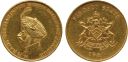
Buria/Jagadhri struck coins at the Jagadhri Mint (and the Najibabad Mint) under the Bhangi Misl chief Rai Singh (late 18th century) and his widow Rani Sukhan (c. 1806–08) — in the name of Shah Alam II rather than Ahmad Shah Durrani — in denominations of ¼, ½ and 1 rupee. Rai Singh rebuilt Jagadhri in 1783 and made the small State of Garhwal a Sikh tributary; the British Museum lists certain rupees of the Jagadhri Mint as coins of "Rani Sukhan." Kalsia, a Karorasinghia Misl state centred in the Ambala area (Chachrauli capital), issued copper falus/dams at the Chachrauli Mint under Jodh Singh in the name of Shah Alam II — denominations of ¼, ½, 1 and 2 paisa, in the Mughal style similar to Saharanpur coins. It is among the very few Sikh Misls to have issued copper coinage. Faridkot — ruled by the Brar Jats, a branch of the Phulkian family — issued no regular circulation coinage. In 1941 however, Maharaja Sir Harinder Singh Brar issued a complete series of presentation pieces on the occasion of the Viceregal visit to the state: ½ rupee, 1 rupee, 5 rupee (silver), ⅓ mohur, ⅔ mohur (gold) — all featuring his portrait on the obverse and the State coat of arms on the reverse. These are the only genuine Faridkot numismatic issues and were not intended for circulation.
A note on a widely discussed forgery: in the late 1990s a group of gold mohurs dated 1932 appeared in trade, bearing an incomplete version of the Faridkot State coat of arms on the reverse and a portrait of the Maharaja modelled on the 1941 dies. The discrepancies — an incomplete coat of arms, a 1941-style portrait on a coin claiming a 1932 date — were noted at the time and the pieces are generally regarded as fabrications with no genuine numismatic standing. Given their relative attractiveness, they continue to appear at auction from time to time. Collectors are best advised to avoid them.
The diversity of this coinage reflects the fragmented political reality of the Malwa during the late eighteenth and early nineteenth centuries: dozens of semi-independent chiefs, some allied to the Mughals, some to the Marathas, some to the Durranis, and eventually all drawn under the British umbrella of 1809 — each leaving their own small mark, literally, on the silver rupees that circulated among their subjects.
Attribution Reference
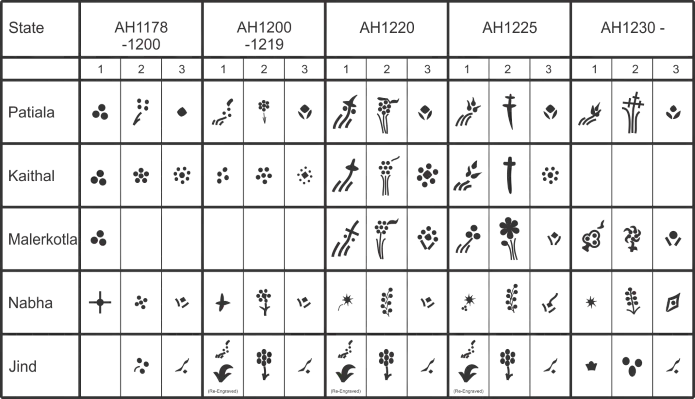
State Symbols & Mint Marks by Period
The Rajashahi rupees of the Cis-Sutlej states share the same couplet, the same mint name (Sahrind or Sirhind), and the same general design — making state attribution entirely dependent on identifying the small symbols placed at specific positions on the die. The table below, compiled from the author’s study of the series, records the state symbols and ruler marks for Patiala, Kaithal, Malerkotla, Nabha and Jind across five date periods from AH 1178 to AH 1230+. Column 1 = obverse mark; column 2 = central obverse symbol; column 3 = reverse mark.

Sources
References
- The Coins of the Sikhs. 2nd ed. Printed for the Author, 2004. — Chapters 14 (Patiala) and 15 (Nabha); Appendix 3 (Taylor's Report); pp. 216–228.
- History of the Sikhs, Vol. IV: The Sikh Commonwealth or Rise and Fall of Sikh Misls. Munshiram Manoharlal, 1989. — Chapter 9: The Phulkian States, pp. 143–204.
- Report on the Coinage of the Phulkian States, 1869. Published in Griffin, Lepel. The Rajahs of the Punjab. Lahore, 1870.
- The Rajahs of the Punjab. Lahore: Punjab Government Press, 1870. — Political and biographical accounts of the Phulkian chiefs.
- Patiala State Mint and Nazrana Coins. Patiala, 1990.
- Patiala State Coinage. Punjab University, 1990.
- Nabha State Coinage. Punjab University, April 1990.
- "The Coinage of the Native States of the Punjab." Indian Antiquary, Bombay, Vol. XVIII, 1889.
- Khalsa Darbar Records, Vol. I. Punjab Government Record Office, Lahore, 1919.
- Coins of the Sikh Empire, Punjab and the Cis-Sutlej States; Sikh Religious Tokens. Spink & Son, London, 2022. — Chapter Five: The Coins of the Cis-Sutlej States. Primary reference for full die varieties, weights, and ruler attribution across all nine states.
- "Coins of the Cis-Sutlej States." Presentation, NDMC Exhibition, Delhi. sikhcoins.in, 2022.
- "Cis-Sutlej Punjab States — A New Discovery [Bhadaur]."Numismatic Society of India, Shimla. sikhcoins.in, 2023.
- "A Heavy Sikh Rupee of Patiala." Oriental Numismatic Society Journal. sikhcoins.in.
- "Coinage of Kaithal State." Awadh Coin Society. sikhcoins.in.
Cis-Sutlej State Coinage
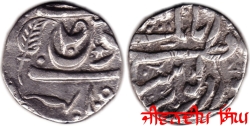
Select specimens from the SikhCoins.in collection. Click any image or title to browse the full album.


| Specimen | Mint | Date | |
|---|---|---|---|
|
Nabha, 03, Bharpur Singh, VS1913, Rupee | ||

|
Nabha, 01, Jaswant Singh, VS1897, Rupee | ||

|
Nabha, 05, Hira Singh, VS1928, Rupee | ||

|
Nabha, 04, Bhagwan Singh, VS1920, Rupee |
| Specimen | Mint | Date | |
|---|---|---|---|

|
Jind, 05, Raja Sarup Singh, VS1893, Nazarana Rupee | ||

|
Jind, 04, Raja Sangat Singh, Rupee | ||

|
Jind, 02, Raja Bhag Singh, Rupee, Re-engraved Kalgi symbol | ||

|
Jind, 01, Raja Gajpat Singh, Rupee |
| Specimen | Mint | Date | |
|---|---|---|---|

|
Kaithal, Bhai Lal Singh, Rupee, AH1198 | ||

|
Kaithal, Bhai Udai Singh, Rupee | ||

|
Kaithal, Bhai Lal Singh, Rupee, AH1215 | ||

|
Kaithal, Bhai Lal Singh, Rupee |


| Specimen | Mint | Date | |
|---|---|---|---|
|
Faridkot, Medallic 1/3 Mohur | ||

|
Faridkot, Medallic 2/3 Mohur, AD1941 | ||

|
Faridkot, Medallic Rupee, AD1941 | ||

|
Faridkot, Medallic 5 Rupees, AD1941 |
| Specimen | Mint | Date | |
|---|---|---|---|

|
Buriya, INO Shah Alam II, AH1213/RY40 | ||

|
Buriya, INO Shah Alam II, AH1211/RY29 | ||

|
Buriya, INO Shah Alam II, AH1211/RY38 | ||

|
Buriya, INO Shah Alam II, AH1212/RY29 |