Foreign Officers
at the Lahore Court
The European commanders who transformed the Khalsa army — soldiers of Napoleon who found new service beneath the banners of Maharaja Ranjit Singh, and the others who served, observed, and recorded the most remarkable court in Asia.
Allard · Ventura · Avitabile · Court · Van Cortlandt · GardnerI · Introduction
A Deliberate Policy of Military Modernisation
When Maharaja Ranjit Singh consolidated his authority over the Punjab in the first decade of the nineteenth century, he inherited a formidable but fundamentally medieval fighting force: the horse-mounted Sikh misldars, whose guerrilla mobility had broken Mughal authority and checked Afghan invasion, but whose loose confederate structure could not be made to hold a line against disciplined European-trained infantry. Ranjit Singh understood this with the clarity of a sovereign who had watched the English East India Company absorb Bengal, the Deccan, and Mysore within living memory.
His response was systematic and shrewd. He would hire the Europeans — but not the British. The deliberateness of this exclusion was political: British officers meant British intelligence, British loyalties, and, eventually, British pretexts. Instead, Ranjit Singh recruited from the pool of officers cast adrift by Napoleon's defeats: Frenchmen, Italians, and others who had nothing left to fight for in Europe and everything to gain in the Punjab. They brought with them the tactical inheritance of the Grande Armée — linear infantry drill, field artillery handling, engineering and logistics — and deployed it in service of a sovereign who paid well and trusted them precisely because they owed nothing to his enemies.
The result was the Fauj-i-Ain, the Regular Army, which by the 1830s had grown to some 29,000 trained infantry and 192 guns. Alongside it, the Fauj-i-Khas, the Special Force, represented the élite. When the Khalsa finally met the British in the First Anglo-Sikh War of 1845–46, it did so on near-equal terms — and the battles of Ferozeshah and Aliwal came close enough to disaster that several British officers later admitted the outcome was not inevitable. The foreign officers had done their work well.
Six men stand at the centre of this transformation. Five were soldiers of Napoleon who crossed the Hindu Kush and found a new empire to serve. The sixth was a Scotsman of uncertain origins who became, in dress and manner, more Punjabi than the Punjabis. Their careers, portraits, and — in one remarkable case — their coin collections are the subject of this page.
II · Jean-François Allard
Commander of the Fauj-i-Khas
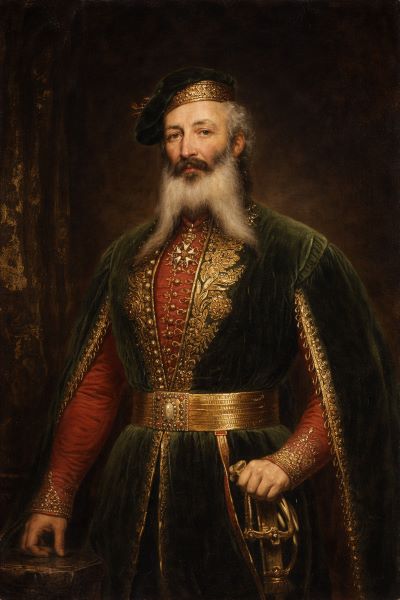
After August Theodor Schoefft, c. 1838–39.
Jean-François Allard
1785 – 1839 · French · Saint-Tropez
- Origin
- Saint-Tropez, Var, France
- Prior service
- Napoleon's cavalry; 7th Hussars; Waterloo campaign
- Arrived Lahore
- 1822
- Commands
- Fauj-i-Khas (élite combined force); later broader field commands
- Left Lahore
- leave in France 1834–37; d. on duty 1839
- Died
- Peshawar, 23 January 1839
Jean-François Allard was among the first of the Napoleonic officers to reach the Punjab, arriving at Lahore in 1822 alongside Jean-Baptiste Ventura after a journey through Persia that had tested both men's endurance and resolve. Ranjit Singh received him at court and commissioned him almost immediately.
Allard's primary command was the Fauj-i-Khas, the Special Force, which he organised along the lines of a Napoleonic combined-arms brigade: cavalry, infantry, and artillery trained to operate together. He imposed drill, uniform, and above all discipline — the defining quality that distinguished the new Khalsa regulars from the misls. Ranjit Singh gave him land, titles, and a Punjabi wife, Bannou Pan Dei, with whom he had several children.
He took leave in France from 1834, building a palace for his wife at his native Saint-Tropez, and returned to the Punjab in early 1837. He died on duty at Peshawar in January 1839, the same year as his sovereign, before the empire whose army he had shaped began to fracture.
III · Jean-Baptiste Ventura
The Infantry Commander
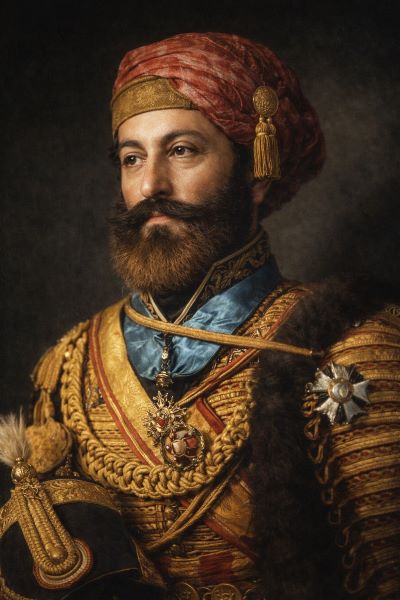
After August Theodor Schoefft, c. 1838–39.
Jean-Baptiste Ventura
1792 – 1858 · Italian-born · Modena
- Origin
- Modena, then under French imperial administration
- Prior service
- Napoleon's Italian campaigns; French imperial army
- Arrived Lahore
- 1822 (with Allard)
- Commands
- Fauj-i-Ain infantry regiments; later Governor of Lahore
- Notable act
- Commissioned the Alfred de Dreux portrait of Ranjit Singh for Louis-Philippe, 1838
- Coin collection
- Seals and coins acquired by the Royal Asiatic Society; excavations at Manikyala stupas
- Died
- Paris, 1858
Ventura arrived at Lahore as Allard's companion in arms, and where Allard took the cavalry and the Fauj-i-Khas, Ventura took the infantry. His task — the creation of disciplined, drilled foot regiments from what had been an army of horsemen — was in many respects the harder assignment. Sikh military culture prized mounted warfare and personal martial honour; submission to the rhythms of infantry drill was culturally alien. Ventura imposed it nonetheless, building the Fauj-i-Ain battalions that would form the backbone of the Khalsa army for the next twenty years.
In 1838, he commissioned the French painter Alfred de Dreux to produce a formal portrait of the Maharaja, subsequently presented to King Louis-Philippe of France. The painting entered the collections of the French royal house and remains one of the few portraits of Ranjit Singh made in the European academic tradition during his own lifetime.
Like Court, Ventura developed a serious interest in the antiquities of the territories his command covered. He excavated the Manikyala stupas in the Potohar plateau, recovering significant relic deposits now split between the British Museum and the Cabinet des Médailles in Paris. His collection of coins and seals was subsequently acquired by the Royal Asiatic Society, where it was catalogued by H.H. Wilson and published in Ariana Antiqua (1841) — one of the foundational texts of Indo-Greek numismatics. A further collection of 145 coins with strong stylistic affinities to Sikh-period frontier material was purchased by the British Museum from a Colonel Lafont in February 1845, and researchers have noted that this was almost certainly one of the two officers named Lafont in Ranjit Singh's service, making it likely that the French officers' coin collecting extended even beyond the individuals most prominently documented.
— W.G. Osborne, The Court and Camp of Runjeet Sing, 1840
IV · Paolo Avitabile
Governor of Peshawar
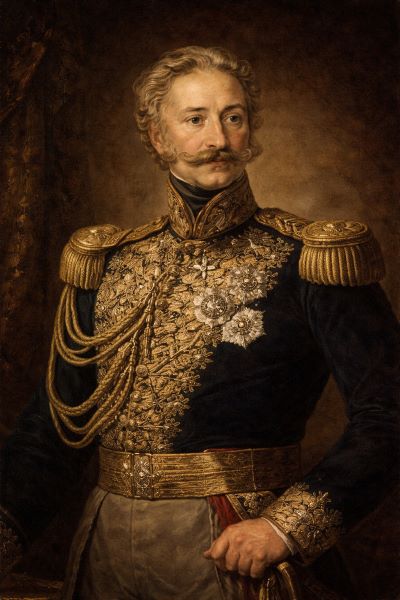
Portrait, c. 1840s.
Paolo Avitabile
1791 – 1850 · Italian · Agerola, Kingdom of Naples
- Origin
- Agerola, Kingdom of Naples
- Prior service
- Neapolitan army; service in Persia
- Arrived Lahore
- c. 1827
- Commands
- Artillery and infantry; Governor of Wazirabad; Governor of Peshawar 1838–1843
- Left Punjab
- 1843
- Died
- Agerola, 1850
Paolo Avitabile was the most feared of the foreign officers at the Lahore Darbar, and the most extensively documented by British observers who encountered him at Peshawar. A Neapolitan who had served in the army of Murat before seeking employment first in Persia and then at Lahore, he arrived with a harder edge than the Napoleonic Frenchmen: less polished, more ruthless, and possessed of a talent for frontier administration through calculated exemplary violence that made him both effective and notorious.
Ranjit Singh appointed him Governor of Peshawar in 1838 — the most dangerous post in the empire, the city that sat at the throat of the Khyber. Avitabile held it through a regime of public executions that kept the frontier population in terrified submission. The British political officer Henry Rawlinson, passing through Peshawar in the early 1840s, left detailed accounts noting their practical effectiveness even while recording their severity.
Avitabile left the Punjab in 1843 and returned to Italy a wealthy man. He died at Agerola in 1850.
Numismatic Evidence — The Peshawar Mint under Avitabile
Avitabile's governorship produced the most significant numismatic episode directly traceable to a foreign officer's administration. In VS1894 (c. 1837–38 CE), three weight standards appear simultaneously at the Peshawar mint: an Afghan-compatible standard of approximately 8.4g aligned with local circulation needs; a debased standard of approximately 7.1g; and a heavier centralising standard of approximately 11.11g consistent with the Amritsar mint weight.
The coexistence of these three standards within a single mint and narrow date range reflects Avitabile's attempt to impose Lahore-standard coinage on a frontier economy deeply accustomed to Afghan rupee weights. The effort was only partially successful: lighter standards continued to circulate in the Peshawar bazaar, while the heavier Amritsar-weight coins tended to be remitted eastward to Lahore. The episode is documented in full on the Trade & Commerce page, where the weight triad and its implications for Silk Road exchange are examined alongside hoard distribution evidence.
V · Claude Auguste Court
Artillery Commander & Numismatist
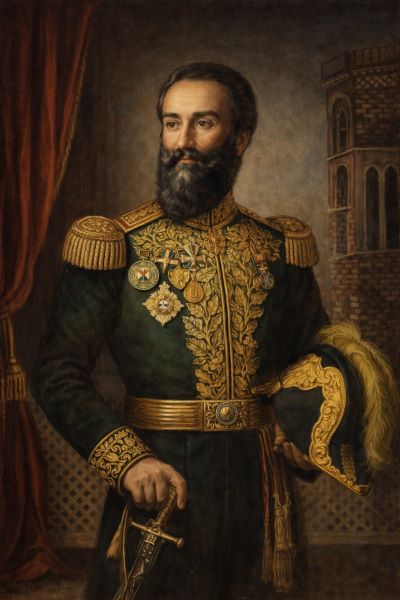
Portrait, c. 1840s–50s.
Claude Auguste Court
1793 – 1880 · French · Paris
- Prior service
- French imperial artillery
- Arrived Lahore
- c. 1827
- Commands
- Artillery arm of the Khalsa regular forces
- Collecting began
- January 1826, Laghman valley; systematic research from 1829
- Collection size
- 791 coins (full catalogue); 627 rubbings survive in the British Museum albums
- Published
- Revue Numismatique, 1839; Mémoires, Paris 1856–57
- Left Punjab
- 1849, after annexation
- Died
- Paris, January 1880
Of all the European officers at the Lahore Darbar, Claude Auguste Court is the one whose significance extends most naturally into the scholarly world of numismatics. He was the first European to develop a systematic scholarly interest in the coinage of South Asia — a distinction confirmed by the report on his collection made by Adrien de Longpérier for the Bibliothèque Nationale, and by Court's own account in his Mémoires.
Court first began picking up coins in January 1826, during operations in the Laghman valley in Afghanistan, where he acquired Persian, Parthian, Bactrian, and Indo-Scythian pieces alongside caliphate coins. By his own account his research began in earnest in 1829, and the scale of what followed was extraordinary: excavating at the Manikyala stupas in the Potohar plateau alongside Ventura, he recovered so many bronze coins of the Scythian kings that, after selecting the best specimens, he had the remainder melted down to cast a cannon. He further excavated at Banamari near Peshawar, where he recovered the spectacular bronze mask of Shiva now in the Musée Guimet, Paris. He also employed agents to prospect sites throughout the frontier region, and the French officers — Ventura and Court in particular — were noted by the traveller Charles Masson as having effectively cleared Peshawar's dealers of copper coins, paying four to two per rupee.
The full de Longpérier catalogue, compiled after 1854, lists 791 coins in Court's collection: 141 Roman coins from Syria; 3 Alexander the Great; 118 Graeco-Bactrian and Indo-Greek; 88 uncertain Bactrian; 55 Saka; 9 Indo-Parthian; 95 Kushan; 76 Parthian and Sasanian; 82 ancient Indian; and 123 Muslim coins including Mughal and Samanid pieces. His largest individual holdings were of Menander (41 coins) and Azes (58 coins). By 1839, the collection was substantial enough that he published a description of part of it in the Revue Numismatique — the first academic publication of Indo-Greek coinage in a European scholarly venue. In 1869, approaching his final years, Court even approached the Court of the Tsar through the Russian Consulate in France to arrange a sale; the covering letter and a copy of the de Longpérier report survive today in the archives of the Hermitage Museum. The sale did not proceed.
Court was the longest-serving of the principal foreign officers, remaining in the Punjab until the annexation of 1849. His Mémoires, published in Paris in 1856–57, discuss his coin collection alongside his military observations and remain essential reading for any student of the Sikh Empire. He died in Paris in January 1880; his will of 14 May 1879 had instructed his heirs not to break the collection up, urging them to find a sovereign or wealthy collector to acquire it entire. Instead it vanished.
The Vanishing Collection — and Its Rediscovery
After Court's death in January 1880, his collection — catalogued by de Longpérier at 791 coins, part of it already published — vanished from the record entirely. No auction, no institutional acquisition, no dealer catalogue from the 1880s or after accounts for it, despite its documented importance. The only known survivor in public holdings for over a century was a single copper coin of Archebius acquired by the Bibliothèque Nationale from the coin dealer Feuardent in 1892.
The rediscovery came in March 1994, when Douglas Saville of the London auction house Spink and Son noticed three small albums at a provincial book sale in England. The albums were entitled La collection numismatique du Général Court and contained 627 coin rubbings of mostly high quality — sufficient to identify not only specific coin types but monograms and die details. Saville recognised their importance and offered them to the British Museum Department of Coins and Medals, which acquired them.
Work on the albums by Elizabeth Errington and Joe Cribb of the British Museum established the Cunningham connection with precision: of 422 rubbings studied in the preliminary report, 233 coins were identified in the British Museum's Alexander Cunningham collection, donated to the Museum after Cunningham's death in 1894. Court's final instructions — that the collection should not be broken up — were at least partly fulfilled: more than half of it was acquired by one of the foremost numismatists of the nineteenth century. A further five Graeco-Bactrian and Indo-Greek coins were traced to the Cabinet des Médailles in Paris, acquired via the same Feuardent dealership in 1892, suggesting Cunningham may also have used Feuardent as his acquisition channel for this portion.
The albums are written entirely in French, as expected — except for two annotations in English identifying a silver coin of Soter Megas and one of Azes as false. This detail, pointing to the originals having been physically examined alongside the rubbings by an English speaker, is among the evidence linking the albums directly to Cunningham. The three Kushan gold fakes in the collection — derived from drawings published by Prinsep in 1835 — also connect the albums to the broader numismatic circle of mid-nineteenth-century British India in which Cunningham moved. The precise chain of custody between Court's Parisian heirs and Cunningham's possession remains unresolved; 184 coins remain untraced and 205 rubbings (predominantly Sasanian, Hindu Shahi, and Muslim series) had not yet been fully studied at the time of the 1995 preliminary report.
The Collection — A Chronology
January 1826
Court begins acquiring coins during operations in the Laghman valley, Afghanistan — Persian, Parthian, Bactrian, and Indo-Scythian pieces, alongside caliphate coins. The earliest documented European numismatic collecting from the region.
1829
Systematic research begins in earnest. Court excavates the Manikyala stupas in the Potohar plateau, recovering Scythian bronze coins in such numbers that he melts the surplus to cast a cannon. He also excavates at Banamari near Peshawar.
1839
Part of the collection described in the Revue Numismatique by Adrien de Longpérier — the first academic publication of Sikh and Indo-Greek coinage in a European scholarly venue.
1849
Court departs the Punjab following the British annexation, returning to France with his collection intact. Full de Longpérier catalogue eventually lists 791 coins.
1856 – 57
Mémoires sur la guerre et le gouvernement dans l'Inde published in Paris. Court discusses his coin collection throughout.
1869
Court approaches the Court of the Tsar through the Russian Consulate in France to arrange a sale. The covering letter and a copy of the de Longpérier report survive today in the archives of the Hermitage Museum. The sale does not proceed.
14 May 1879
Court's will instructs his heirs not to break up the collection, urging them to find a sovereign or wealthy collector to acquire it entire.
January 1880
Court dies in Paris. The collection passes to his heirs and disappears from the scholarly record entirely.
1880s – 1894
Alexander Cunningham — first Director-General of the Archaeological Survey of India — acquires the bulk of Court's coins. Of 422 rubbings later studied, 233 coins are identified in the Cunningham collection at the British Museum (donated after his death in 1894). Five further coins traced to the Cabinet des Médailles, Paris, via the dealer Feuardent (1892).
March 1994
Douglas Saville of Spink and Son notices three albums — La collection numismatique du Général Court — at a provincial book sale in England. The albums contain 627 coin rubbings. Offered to and purchased by the British Museum Department of Coins and Medals. The documentary record of the collection is reassembled after over a century of obscurity.
VI · Henry Charles Van Cortlandt
Between Two Worlds
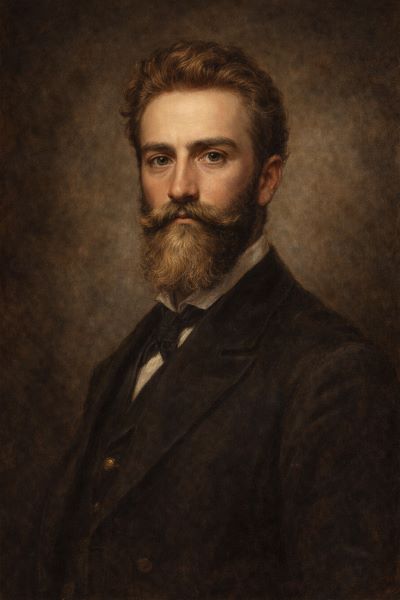
Portrait, later period.
Henry Charles Van Cortlandt
1815 – 1888 · Anglo-Indian · Born in India
- Origin
- Born in India; Anglo-Indian; Dutch-descended paternal line
- Entered Sikh service
- c. 1838
- Commands
- Infantry and irregular forces; western Punjab and frontier
- Post-annexation
- Continued service under the British in the Punjab
- Died
- 1888
Henry Charles Van Cortlandt occupies an anomalous position among the foreign officers of the Lahore Darbar. He was not European in the sense that Allard, Ventura, Avitabile, and Court were European — he was born in India, was Anglo-Indian by parentage, and carried a Dutch-American family name that had reached the subcontinent through generations of East India Company service. His world was the Indo-British frontier, not the salons of post-Napoleonic Europe.
He entered Sikh service around 1838, in the last years of Ranjit Singh's reign, commanding infantry and irregular forces in the western Punjab and along the frontier territories. His career at Lahore was shorter than those of the first-generation Napoleonic officers, shaped by the political complexities of the late empire — the regencies, the intrigues of the Dogra ministers, and the accelerating shadow of British expansion.
Uniquely among the six principal officers, Van Cortlandt did not leave after the annexation of 1849. He transitioned seamlessly into British service under the administration of John and Henry Lawrence. His career spans two sovereignties and illustrates a pattern common among the frontier military class: loyalty that was professional and territorial rather than political, attached to the Punjab itself rather than to either of the powers that contended for it.
VII · Alexander Gardner
The Tartan Soldier of Lahore
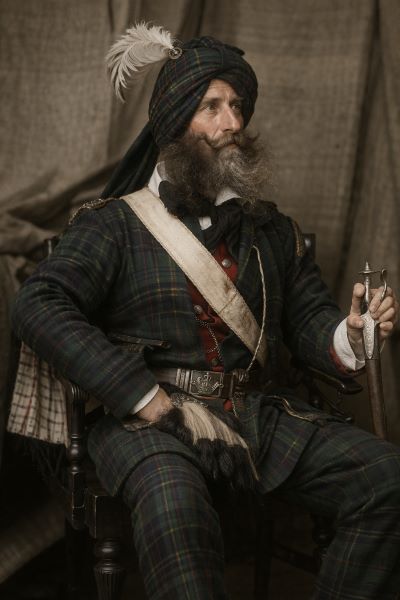
Photograph, c. 1860s.
Alexander Haughton Campbell Gardner
c. 1785 – 1877 · Scottish-American · Origins disputed
- Origin
- Claimed Scottish-American; exact origins disputed and embellished
- Arrived Lahore
- c. 1832
- Commands
- Artillery; bodyguard units; later service under Gulab Singh of Jammu
- Known for
- Invariable tartan dress; decades of Central Asian wandering before Lahore
- Post-annexation
- Continued in Jammu & Kashmir service under Dogra rule
- Died
- Jammu, 1877
Alexander Gardner is the most improbable figure associated with the Lahore Darbar, and his portrait — invariably in head-to-toe tartan, with a turban wrapped in the same plaid — is the most visually striking image to emerge from the court of Ranjit Singh outside the formal Schoefft series. He claimed Scottish and American ancestry, a childhood in Wisconsin, and decades of wandering across Central Asia, Persia, Afghanistan, and the Hindu Kush before arriving in the Punjab in the early 1830s. How much of this is literally true, how much embroidered, and how much wholesale fabrication is a question that has occupied historians ever since his Memoirs were published in 1898, more than two decades after his death.
What is beyond dispute is that Gardner served at Lahore, commanded artillery and bodyguard units, survived the violent succession politics of the post-Ranjit Singh regencies — a period during which several foreign officers and many more Sikh nobles were killed — and continued in service under Gulab Singh in the princely state of Jammu and Kashmir after 1849. He died at Jammu in 1877 at an age he himself claimed exceeded ninety.
— Contemporary account, c. 1860s
The tartan was not affectation. Gardner wore it consistently throughout his Lahore service and continued to do so in old age, by which time the photographs of him — seated, turbaned, holding a curved tulwar, the plaid covering him from crown to boot — had made him an icon of a world that no longer existed.
VIII · Others at the Court
Others in the Maharaja's Service
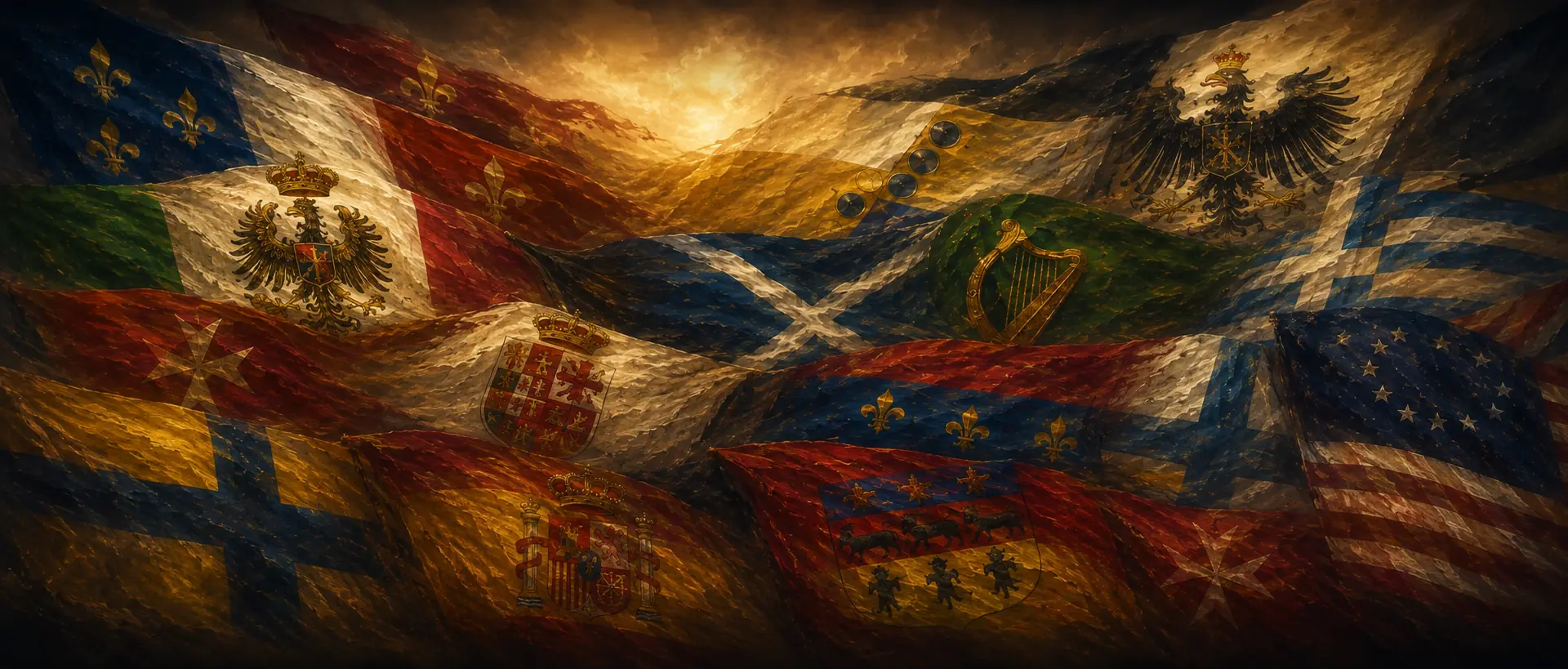
The six officers above stand at the centre of the story, but they were far from alone. Ranjit Singh's service drew Europeans and Americans of every description — physicians and naturalists who left invaluable records, and soldiers of fortune who held lesser commands or briefer careers. A dozen nations are represented in the roster above, from the Bourbon fleur-de-lis to the arms of Naples and the stars of the American republic: the Maharaja recruited where the Company had no claim. Each added a thread to what was, in its day, among the most cosmopolitan courts in the world.
The Physician & the Naturalist
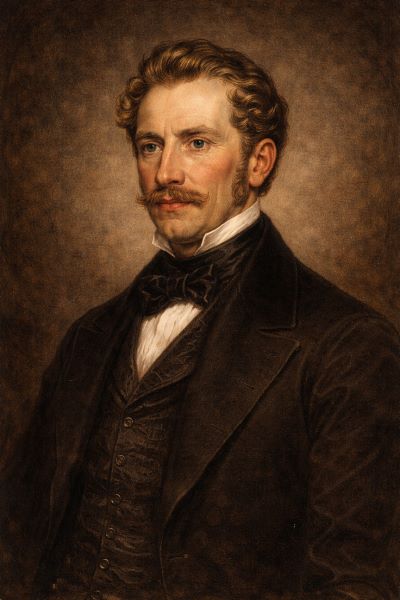
Johann Martin Honigberger
1795 – 1869 · Physician · Brașov, Transylvania
A physician, botanist, and polymath who served as court physician to Ranjit Singh and his successors. His Thirty-Five Years in the East (1852) covers medicine, natural history, and political observation with equal fluency. He was among the earliest Europeans to document Ayurvedic and Unani medical practice with genuine scholarly rigour, and his long service at the Lahore Darbar gave him access to court life unavailable to military officers. He returned to Europe after the annexation and died in his native Kronstadt (Brașov) in 1869.
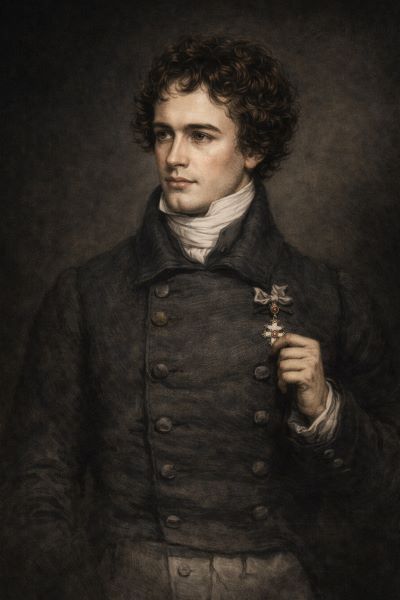
Victor Jacquemont
1801 – 1832 · Naturalist · Paris
A French naturalist employed by the Muséum national d'Histoire naturelle who visited Lahore in 1831 on a scientific expedition through the Punjab, Kashmir, and the Himalaya. His Voyage dans l'Inde (1841, posthumous) and his letters home contain some of the most vivid and unsentimental observations of Ranjit Singh in European sources — the Maharaja's manner, his court in full vigour, his extraordinary memory for faces. Jacquemont died of fever at Bombay in 1832, aged thirty-one. His letters remain essential primary reading.
Other Soldiers of Fortune
Beyond the celebrated commanders, the Khalsa's officer corps drew in a scattering of others — some who held lesser commands, some whose careers were cut short, and some who left their chief mark on the page rather than the battlefield. Several served the empire to its very end.
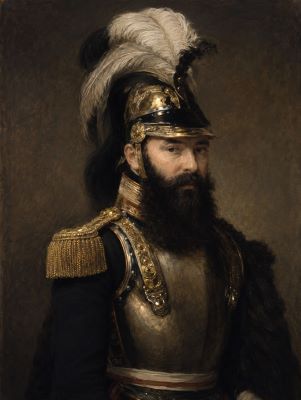
François Henri Mouton
b. 17 August 1804 · French · Cavalry officer
A French cavalry officer — a volunteer at eighteen, later captain of Spahis — who came out with Ventura in 1838 and rose to high command in the Khalsa. With the engineer Hurbon he threw the pontoon bridge that carried the Sikh army across the Sutlej at Sobraon in 1846, and he fought through the Anglo-Sikh Wars — one of the Firangi officers who served the Lahore Darbar into its final years. He later set down his recollections of the Sikh army, a useful first-hand source on its French-trained units.
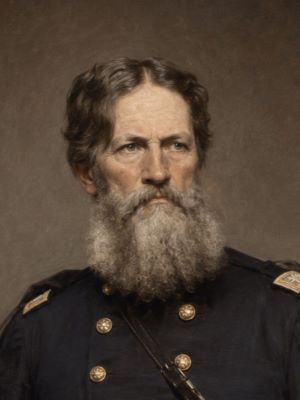
Josiah Harlan
1799 – 1871 · American · Governor & adventurer
The only American among the Firangis — an adventurer and physician from Pennsylvania who entered Ranjit Singh's service on an oath sworn "in the name of Christ." He governed Nurpur and later Gujrat, and was granted the title of Raja. Restless and ambitious, he afterwards crossed into Afghanistan and styled himself "Prince of Ghor"; Kipling's The Man Who Would Be King is often thought to draw partly on his career.
Henry Steinbach
Prussian · Officer & author · no known portrait
A Prussian officer in the Khalsa army whose book The Punjaub (1845) remains one of the most valuable European eyewitness accounts of Ranjit Singh's military machine — its organisation, its drill, and its artillery — and is among the sources drawn on elsewhere on this site.
Domingo Hurbon
Spanish · Engineer · no known portrait
The Spanish engineer-officer known in the records as the "Signor Colonel," and the only European officer who served with the Sikh army against the British. He was first into the assaults during Sher Singh’s siege of Lahore, and Gardner credits him with planning the earthworks at Sobraon — though Cunningham, an engineer himself, thought them unscientific. With Mouton he built the pontoon bridge at Sobraon, and he was among the very last Europeans still in arms for the empire when it fell. His skill lay in the technical branches — bridging, fortification, and the handling of the guns.
Colonel Foulkes
British · hired 1835 · no known portrait
A rare Briton in Sikh service — Ranjit Singh generally refused to employ British subjects, wary of the Company at his border — taken on in 1835 during a brief warming of relations. He held a junior command and was killed in the factional violence that convulsed the Darbar after the Maharaja's death.
The Rest of the Roster
Gardner’s appendix numbers nineteen Europeans in the Maharaja’s service and names ten more in a closing paragraph — twenty-nine in all. Most left no portrait, no memoir and no monument, and survive only in Pearse’s terse paragraphs and in the Darbar’s pay rolls. They are set down here because a roster of six flatters the record.
Colonel M. W. Ford
British · d. 1843, Peshawar · no known portrait
Matthew William Ford came to Lahore with thirty-four years of British service behind him — ensign of the 8th West India Regiment in 1803, captain by 1812, paymaster of the 16th from 1823 — and entered the Khalsa late in 1837. The Khalsa Durbar Acquittance Rolls record his pay at 800 rupees a month. His regiment lined the streets of Lahore at Ranjit Singh’s funeral. In the mutiny of 1843 his own men stripped him of everything down to the ring on his finger, and he died at Peshawar.
Captain Argoud
French · drill-instructor · no known portrait
Reputedly the finest drill-instructor in the army, and quarrelsome enough to be forced out of it by Sikhs and Europeans alike. Pearse prints his own letter to Wade from Kabul, 12 August 1839: penniless at Calcutta, turned away at Kandahar because treaty barred Shah Shuja from employing foreigners, and rescued by Burnes, who he wrote had treated him more like a father than a stranger.
Colonel Canora
Origin unrecorded · d. 1848, Hazara · no known portrait
Gardner could not say where he came from, but was certain how he ended. At the outbreak of Chattar Singh’s rebellion in Hazara in 1848 he refused to give up his guns and was killed defending them. An inscription was raised where he fell and a small pension settled on his family — a rare instance of the Darbar honouring a foreigner’s death in its service.
Colonel Jacob Thomas
Anglo-Irish · commander of a najib regiment · no known portrait
Son of George Thomas, the Irish sailor who made himself a raja at Hansi — a second generation of the same adventuring trade. He commanded a najib regiment without distinction; Barr called him “a dull and heavy man,” and on 14 April 1839 his regiment mutinied and inverted his chair as a mark of contempt.
Leslie, alias Rattray
British · later Fida Muhammad Khan · no known portrait
Burnes found him in September 1837 holding Fort Ali Masjid in the Khyber, styling himself lieutenant-colonel, living in a cave, and levying blackmail on passing kafilas by cutting off Jamrud’s water and restoring it on payment. He converted and took the name Fida Muhammad Khan, to Dost Muhammad’s open contempt. He wrote an autobiography for Burnes which Pearse could not trace.
Captain Auguste de la Font
French · Ventura’s aide-de-camp · no known portrait
Aide-de-camp to Ventura. When Ventura was blocked from the Kabul command, de la Font served instead as staff officer to Wade at the taking of Ali Masjid in 1839 — the operation whose aftermath produced Kunwar Nau Nihal Singh’s congratulatory letter to Wade, recorded in the Ludhiana Agency papers.
Captain M’Pherson
British · d. 1 July 1848, Sadusam · no known portrait
Left the Khalsa to command a Bahawalpur regiment and was killed at its head at Sadusam on 1 July 1848 during Edwardes’s Multan campaign — one of those who ended by fighting on the other side of the wars that destroyed the empire he had helped build.
Campbell and Garron
British · named by Masson · no known portrait
Both known chiefly through Masson. Campbell was probably the officer who raised Shah Shuja’s Hindustani regiment and was deserted at Kandahar; wounded and succoured by Dost Muhammad, he entered Afghan service, and his daughter was said to be living at Kabul still. Garron may be the Carron who worked as a British secret agent.
And the remainder, in a single paragraph. Alvarine, Hommus and Amise all died at Lahore. Hest, a Greek, was murdered in the streets. De la Roche was killed by a fall from his horse. Dubuignon was plucked out of the Begum Sumroo’s service by Ventura, who married him to his own sister-in-law. And John Holmes, of mixed parentage, served with Edwardes and Van Cortlandt in the 1848 advance on Multan, was murdered by his own men, and left a compensation claim listing among his dependants two mothers.
What the whole roster shows. Two things emerge once the full list is set down rather than the celebrated six. The Acquittance Rolls put figures on it — Ford at 800 rupees a month, Foulkes at 500 — so the cost of the Darbar’s European establishment is recoverable from the state’s own accounts. And then there is how they ended: stripped by his own men at Peshawar, killed defending his guns in Hazara, cut down at Sadusam, murdered in a Lahore street, murdered by his own soldiers before Multan. The romance of the Napoleonic adventurer sits awkwardly against that record.
IX · The Fauj-i-Ain
The Military Revolution: What Changed
The transformation that Allard, Ventura, Court, and Avitabile wrought on the Khalsa army between 1822 and 1839 was not simply a matter of replacing turbans with shakos and tulwars with muskets. It was a comprehensive restructuring of military organisation from the tactical level upward — a change in how soldiers thought about war as much as how they fought it.
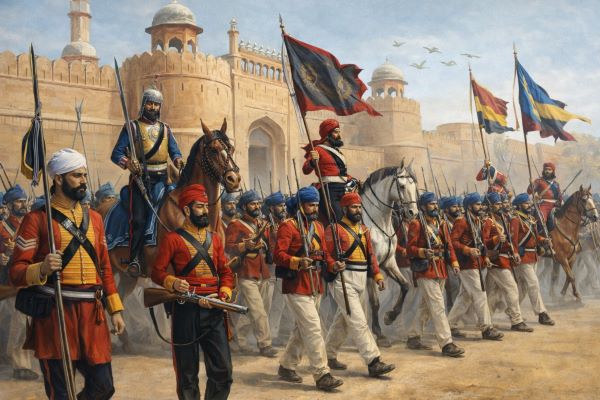
The Fauj-i-Ain outside the Gobindgarh Fort, Amritsar. The mixed composition of the Khalsa regular army is visible: European-drilled infantry in red coats carrying muskets stand alongside traditionally dressed cavalry and commanders in Lahori court dress. The Gobindgarh Fort served as the principal treasury and arsenal of the Sikh Empire.
Infantry Drill
Ventura's battalions were trained in the Napoleonic linear system: musket volley fire by rank, bayonet charge on command, and the discipline to hold formation under artillery fire. Converting individually brave fighters into a coherent fighting machine was the single greatest tactical innovation.
Field Artillery
Court transformed the Khalsa from a force that transported cannon as prestige objects into one that deployed them tactically. By the 1840s, the Sikh artillery was considered by British officers to be technically superior to their own in gun quality and crew training.
Cavalry Reform
Allard reorganised the cavalry from misldari warbands into formed regiments with standardised equipment, drill, and command structures, retaining the Sikh cavalry's mobility and aggression within a disciplined framework.
Military Engineering
The foreign officers introduced military engineering as a formal discipline — fortification, siege works, bridging, and logistics. The permanent cantonments they built at Lahore and Amritsar remained in use under the British after 1849.
Uniform & Logistics
Standardised uniform, regular pay through a regimental system, and systematic supply replaced the ad hoc provisioning of the misldari period. A soldier who was paid, clothed, and fed reliably was a soldier who would fight where ordered.
Scale by 1839
At the death of Ranjit Singh, the Khalsa regular forces comprised approximately 29,000 trained infantry, 12,000 cavalry, and 192 guns — a force that outmatched any power between the Indus and the Ganges except the East India Company.
The military machine the foreign officers built could not have functioned without a parallel Hindu administrative apparatus that handled its finances, provisioning and pay. Diwan Ajodhia Prashad — son of Diwan Ganga Ram, himself keeper of the royal seal under Ranjit Singh — served as paymaster of the Fauj-i-Khas, the élite combined force that Allard and Ventura had shaped. His relations with both Ventura and Allard were, by all contemporary accounts, on excellent terms; he was the Hindu official whose administrative competence made the European military system practically operable. Shahamat Ali, an eyewitness, described him as eminently successful across administrative, judicial, military and diplomatic duties. After Ranjit Singh's death he was particularly popular with the Sikh soldiery — the one figure of genuine administrative continuity in an army whose commanders were being assassinated and replaced at speed. The Fauj-i-Khas functioned as a Franco-Punjabi hybrid not only in its drill and command language, but in its accounting: European methods of regimental pay, administered through a Hindu treasury tradition stretching back through Mughal service to Delhi.
Why the Anglo-Sikh Wars were so costly. The First Anglo-Sikh War of 1845–46 produced four major engagements — Mudki, Ferozeshah, Aliwal, and Sobraon — in which British forces suffered casualties disproportionate to their numerical advantage. At Ferozeshah in December 1845, the Sikh artillery, trained by Court's methods, inflicted such losses that General Gough later admitted the battle had come close to defeat. The Governor-General, Sir Henry Hardinge, serving as a volunteer, told his son the army had been saved by the early morning fog.
The reason the Khalsa did not prevail despite this military parity lies outside tactics. By 1845, six years after Ranjit Singh's death, the Lahore Darbar had been consumed by succession struggles, the murders of multiple Maharajas, and the machinations of the Dogra ministers. The army was politically fractured from above at the very moment it was militarily capable of holding its own below. The foreign officers had built a machine that worked; the political architecture that should have directed it had collapsed.
X · References
Sources and Further Reading
- Gardner, Alexander (ed. Major Hugh Pearse). Soldier and Traveller: Memoirs of Alexander Gardner, Colonel of Artillery in the Service of Maharaja Ranjit Singh. Blackwood, Edinburgh & London, 1898. The appendix, “Some Account of Maharaja Ranjit Singh and his White Officers” (pp. 293–354), is the fullest roster of the Europeans in Sikh service and the source for most of the men listed above; Pearse cites the Khalsa Durbar Acquittance Rolls throughout for rates of pay.
- Lafont, Jean-Marie. Maharaja Ranjit Singh: Lord of the Five Rivers. Oxford University Press, 2002. The authoritative scholarly account of the European officers at the Lahore Darbar, drawing on French and Italian archival sources unavailable to earlier historians.
- Lafont, Jean-Marie. La présence française dans le royaume sikh du Penjab, 1822–1849. Paris, 1992. The foundational French-language study of the officers' military, civil, and cultural activities; the primary source for biographical detail on Allard, Ventura, Court, and Avitabile.
- Errington, Elizabeth. «Rediscovering the Coin Collection of General Claude-Auguste Court: A Preliminary Report.» Topoi, vol. 5/2, 1995, pp. 409–424. The scholarly paper documenting the 1994 rediscovery of the Court albums at Spink, the identification of 233 coins in the Cunningham/British Museum collection, and the partial reconstruction of the full 791-coin catalogue.
- Wilson, H.H. Ariana Antiqua. London, 1841. Includes the earliest published catalogue of coins from the French officers' collections, specifically Ventura's Indo-Greek holdings acquired by the Royal Asiatic Society.
- Osborne, W.G. The Court and Camp of Runjeet Sing. London: Henry Colburn, 1840. The most widely read contemporary British account of the Lahore Darbar. Also cited on Gifts & Diplomacy.
- Court, Claude Auguste. Mémoires sur la guerre et le gouvernement dans l'Inde. Paris, 1856–57. 2 vols. Primary source; Court discusses his military commands and his coin collection throughout.
- Court, Claude Auguste. «Rapport sur la collection numismatique du Général Court» (de Longpérier report on Court's collection). Revue Numismatique, 1839, pp. 81–88. The first academic publication of Sikh and Indo-Greek coinage in a European scholarly venue.
- British Museum, Department of Coins and Medals. La collection numismatique du Général Court. Three albums of coin rubbings, 627 entries. Acquired March 1994 via Spink and Son (Douglas Saville). Originally from the Cunningham collection, donated to the Museum 1888–94.
- Gardner, Alexander Haughton Campbell. Memoirs of Alexander Gardner. Edited by Major Hugh Pearse. Edinburgh: Blackwood, 1898. Posthumously published; to be read with caution on biographical claims but invaluable for court atmosphere.
- Honigberger, Johann Martin. Thirty-Five Years in the East. London: H. Baillière, 1852. The court physician's account; covers medicine, natural history, and court observation.
- Jacquemont, Victor. Voyage dans l'Inde. Paris, 1841 (posthumous). His letters contain the most penetrating short portrait of Ranjit Singh in the European record.
- Herrli, Hans. The Coins of the Sikhs. 2nd ed. Münsterberg, 2004. Standard numismatic reference; essential for the mint evidence in the Avitabile and Court sections.
- Sidhu, Saran & Dalwinder Singh. Coins of the Sikh Empire, Punjab and the Cis-Sutlej States: Sikh Religious Tokens. London: Spink, 2022. Most recent major catalogue; incorporates weight data and hoard analysis relevant to the Peshawar mint episodes.