Amritsar Mint · Numismatic Research · Royal Court
The Morashahi Rupee
Moran, Ranjit Singh, and the Peacock Hidden in the Calligraphy
VS 1861–1868 · AD 1804–1811 · Amritsar Mint
The Morashahi Series — VS 1861 Rupee
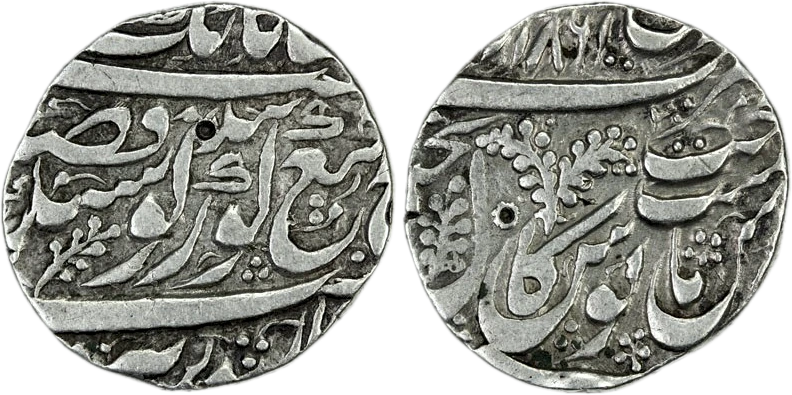
VS 1861 (AD 1804) — Amritsar — the first year of the Morashahi series, with the characteristic sprig on the reverse replacing the standard Amritsar leaf symbol
The Paradox
A Coin That Should Not Exist
The political theology of Sikh coinage rested on a single, non-negotiable principle. Coins struck at Amritsar carried not the name of a ruler but the names of the Gurus — the Nanakshahi couplet invoking Guru Nanak and Guru Gobind Singh. When Maharaja Ranjit Singh was asked in whose name his coins were struck, he answered: in the name of Guru Nanak. That, he said, made the Guru the true sovereign and himself merely a servant.
This is why the coins struck at Amritsar between VS 1861 and VS 1868 are so remarkable. Onto the reverse of the standard Nanakshahi rupee — into the body of the legend that acknowledged the Gurus' sovereignty — the calligraphers of the Amritsar mint introduced a symbol that had nothing to do with theology and everything to do with love: the figure of a peacock, hidden within the letterforms, invisible to the casual eye, placed there in honour of the woman the Maharaja wished to commemorate on his coinage.
Her name was Moran. She was a Muslim courtesan from Batala. And the coins that carry her name — the Morashahi rupees — constitute one of the most discussed, most debated, and for most of their history most misread series in all of Sikh numismatics.
The Woman
Moran of Batala
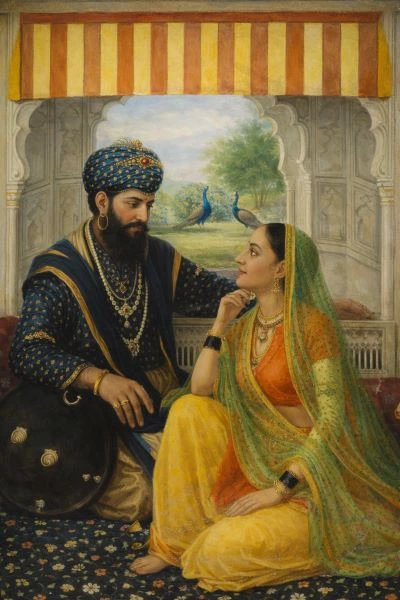
Ranjit Singh and Moran — a modern AI-generated reconstruction based on known portraits of both. The peacocks in the garden are an artistic addition, not historical evidence.
Moran appears in the primary sources as a kanchni — a Muslim dancing girl and singer from Batala — who came to the attention of Ranjit Singh around VS 1858 (AD 1801), in the earliest years of his consolidated rule over Lahore. The historical accounts, written by court chroniclers of varying sympathy, agree on the essentials: that the Maharaja was genuinely captivated, that her influence at court was substantial, and that it provoked serious discomfort among the Sikh clergy.
The Sohan Lal Suri chronicle Umdat-ut-Tawarikh records Moran as a notable presence in the Maharaja's life during the first decade of his reign. Khushwant Singh, in his History of the Sikhs, places particular emphasis on the coins as evidence of the relationship's intensity — noting that to commemorate a personal favourite on the coinage was a gesture that placed private sentiment in open collision with Sikh public theology.
The Akal Takht eventually intervened. The Sikh clergy, the jathedar, issued a summons and Ranjit Singh submitted to a public punishment at the Akal Takht — a remarkable demonstration, for a man of absolute political authority, of the limits that religious accountability placed on even the Maharaja's personal conduct. The coins were eventually discontinued.
Moran did not disappear from the historical record at this point. She remained connected to the Lahore court, and the numismatic evidence — a peacock appearing on a coin of VS 1868, the year associated with her departure to Pathankot under pressure from the clergy and palace factions — suggests the Maharaja found one final way to mark that event in silver.
The Long Confusion
What Everyone Saw, and What Nobody Found
Between VS 1861 and VS 1863, a series of rupees struck at Amritsar carried a distinctive ornamental symbol on the reverse: a branching, upward-curving spray of foliage that replaced the standard leaf symbol characteristic of almost all Amritsar coins after VS 1845. This sprig-like element was noticed from an early period and associated with the name Moran — giving rise to the term Morashahi (Moran's sovereignty) for these issues.
The problem was the symbol itself. A peacock — mor in Punjabi — gives the coins their name and their numismatic category. But the symbol on the reverse was unmistakably a plant, not a bird. Generation after generation of numismatists and historians confronted the same difficulty: why were these plant-symbol coins called peacock coins? Two positions emerged:
The Two Positions in the Historical Debate
The Peacock Tail Reading
The sprig is a stylised peacock tail. The branching structure represents the fanned display feathers of a mor. The name Morashahi is thus literal — the peacock is right there on the coin.
Rejected by most numismatists — the symbol shows no realistic correspondence to peacock plumage
The Maur Reading
The symbol is a maur — the flowering spray of the mango blossom — and the name is a corrupted derivation from this botanical term, not from the peacock at all.
Few takers — the connection to Moran's name is too strong and too consistent in the primary sources
Both positions shared the same foundational error: they assumed that whatever the Morashahi symbol was, it was fully visible to the naked eye. Nobody looked for anything beneath the sprig.
The resolution, when it came, arrived through patient digital enlargement of coin images rather than through any new historical document. The scholar Gurprit Singh, working intensively with coin imagery assembled from multiple collections — including a substantial number provided by Kulwant Singh Bahra and Parminder Singh in the United Kingdom — was examining the sprig symbols of VS 1862 rupees when he found what two centuries of numismatic attention had missed entirely.
At the base of the sprig, merged into the letterforms of the surrounding Arabic calligraphy, was a complete peacock.
The Discovery
The Peacock in the Calligraphy
The peacock on the VS 1862 Morashahi rupee is not prominently displayed. It does not sit in open space where the eye would naturally rest. The calligraphers of the Amritsar mint hid it by exploiting three points of convergence between the bird's form and the surrounding letterforms of the Persian legend.
◆ The VS 1862 Peacock Specimen — SikhCoins.in Collection — The Morashahi Rupee
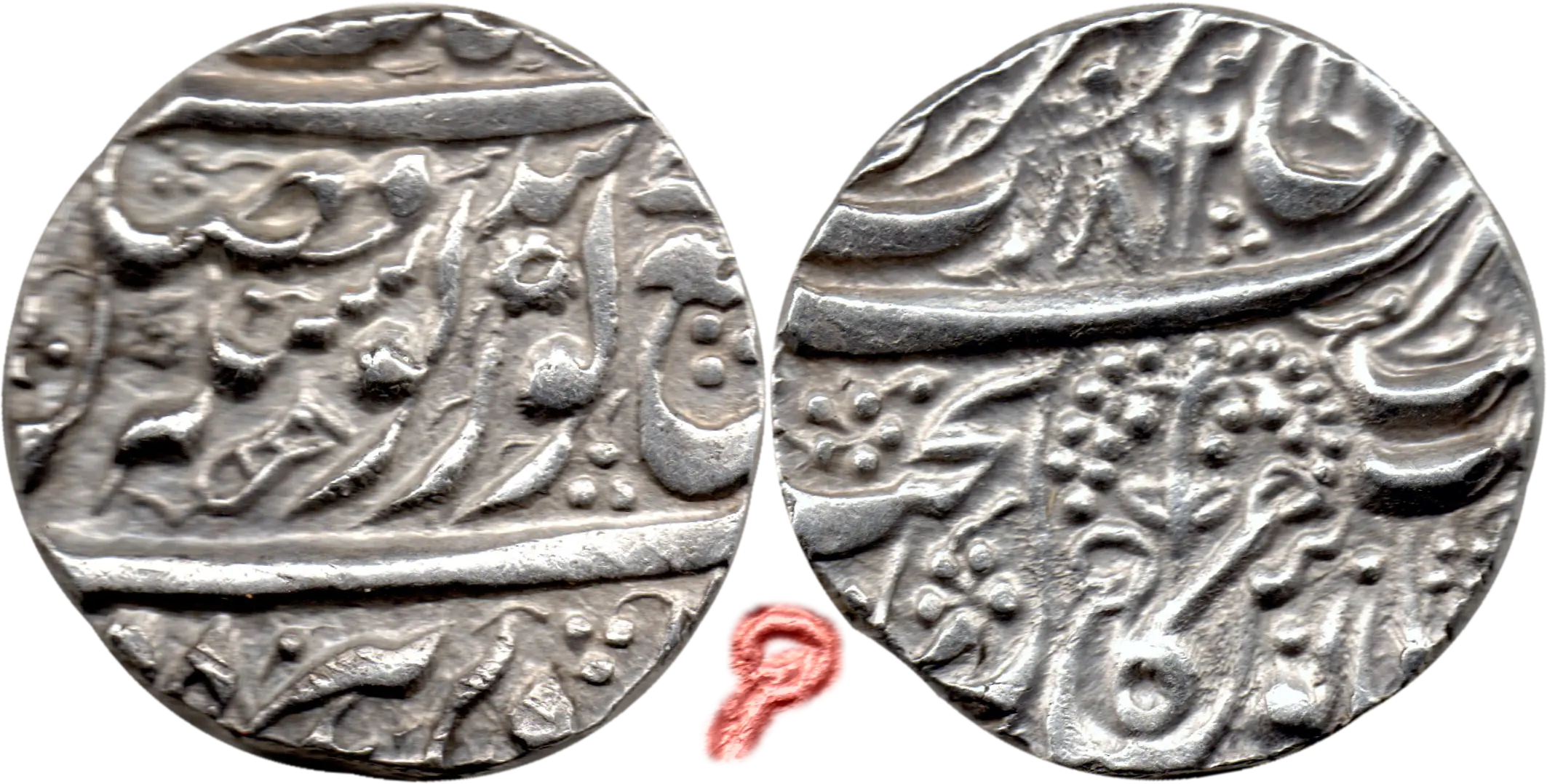
The reverse of this VS 1862 Amritsar rupee carries the characteristic sprig symbol of the Morashahi series. Close examination below the sprig reveals the concealed peacock: its body formed within the ornamental grouping, its tail merging with the seen (س) of Jalus (جلوس) in the Persian legend, and its legs merging with the vertical stroke of Ka (ک) in Akaal (اکال). On the finest specimens, a second peacock has been identified, its own tail formed by the inclined stroke of the same letter — a double concealment that represents one of the most sophisticated examples of calligraphic ingenuity in the entire Sikh coinage series.
◆ Definitive Morashahi specimen · VS 1862 (AD 1805) · Amritsar · Weight: Nanakshahi standardThe mechanism of concealment, as documented by Singh, is precise and deliberate:
The Three Points of Calligraphic Concealment
The Tail
The peacock's tail feathers merge with the seen (س) of the word Jalus (جلوس) in the Persian legend. The curved sweep of the tail becomes indistinguishable from the letter's natural terminal stroke.
The Legs
The peacock's legs merge with the vertical stroke of Ka (ک) in Akaal (اکال). On the Morashahi specimens, the tail of this letter is extended and attached to the sprig above — a distinctive feature absent from normal coins with the same symbol.
The Second Peacock
On the finest specimens, the inclined stroke of the same Ka forms the tail of a second, smaller peacock — facing the opposite direction from the first. To a casual observer, as Singh notes, it is as good as non-existent.
The reason the peacock escaped detection for so long is partly explained by a coincidence of Amritsar mint iconography. Coins of VS 1857 and several subsequent years carry round, face-like ornamental symbols in the same general area of the reverse. The peacock's rounded body was routinely mistaken for one of these ornamental devices — its distinctiveness dismissed as decorative variation rather than intentional figuration.
Once identified, the implication is significant. The sprig symbol on its own was a disguise. The Morashahi coins were not named for their sprig — they were named for the peacock concealed beneath it, which only the mint's calligraphers and those who knew where to look would ever see. The coin commemorated Moran not openly, but clandestinely — hidden within the very legend that acknowledged the Guru's sovereignty.
The Series
Year by Year — VS 1861 to VS 1868
The Morashahi series spans eight Vikrami Samvat years at the Amritsar mint. The sprig symbol appears in the core years VS 1861–1863; the VS 1863 gold mohur confirms the series extended to the highest denomination; and the VS 1868 rupee — here documented for the first time with a clandestine peacock — marks the final known appearance of the symbol, in the year associated with Moran's departure from Lahore to Pathankot.
VS 1861 · AD 1804 · Silver Rupee
The earliest documented year of the Morashahi series. The reverse carries the characteristic sprig symbol in place of the standard Amritsar leaf. This is the year in which the series begins — whether in direct response to Ranjit Singh's relationship with Moran at its most intense, or as part of a gradual mint practice, cannot be confirmed from documentary evidence alone.
Sprig symbol present · Peacock: subject to examination
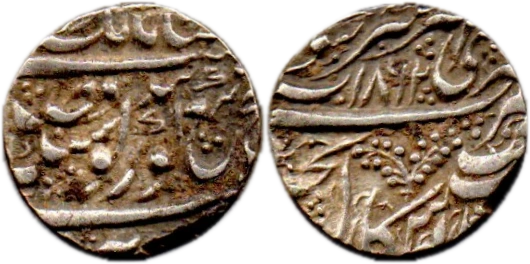
VS 1862 · AD 1805 · Silver Rupee
The central year of the Morashahi series and the principal focus of Singh's research. Specimens from this year have been documented with one and two concealed peacocks at the base of the sprig — but most VS 1862 coins do not carry the peacock figure. The distinction between sprig-only and sprig-with-peacock specimens appears to be a die variant, implying that the peacock was intentionally added to a subset of the VS 1862 production.
✔ Peacock documented on select dies · Die variant
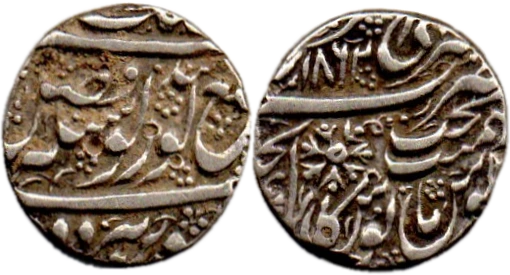
VS 1862 · AD 1805 · Silver Rupee — Arsiwala
This coin belongs to the Arsiwala series — named for the arsi (mirror ring worn on the thumb), whose circular form the reverse device was thought to resemble. The ornament on the reverse is now understood to be the flower of the Ber tree (Ziziphus mauritiana), which carries specific sacred associations: the ancient Ber tree under which Baba Buddha sat while laying the foundation stone of the Harmandir Sahib still stands within the Golden Temple complex, and the tree and its flower are woven into the earliest history of the shrine. Its appearance on Amritsar mint coins of this period connects the coinage directly to the sanctity of the Harmandir Sahib precincts.
Arsiwala · Ber flower device · Harmandir Sahib association
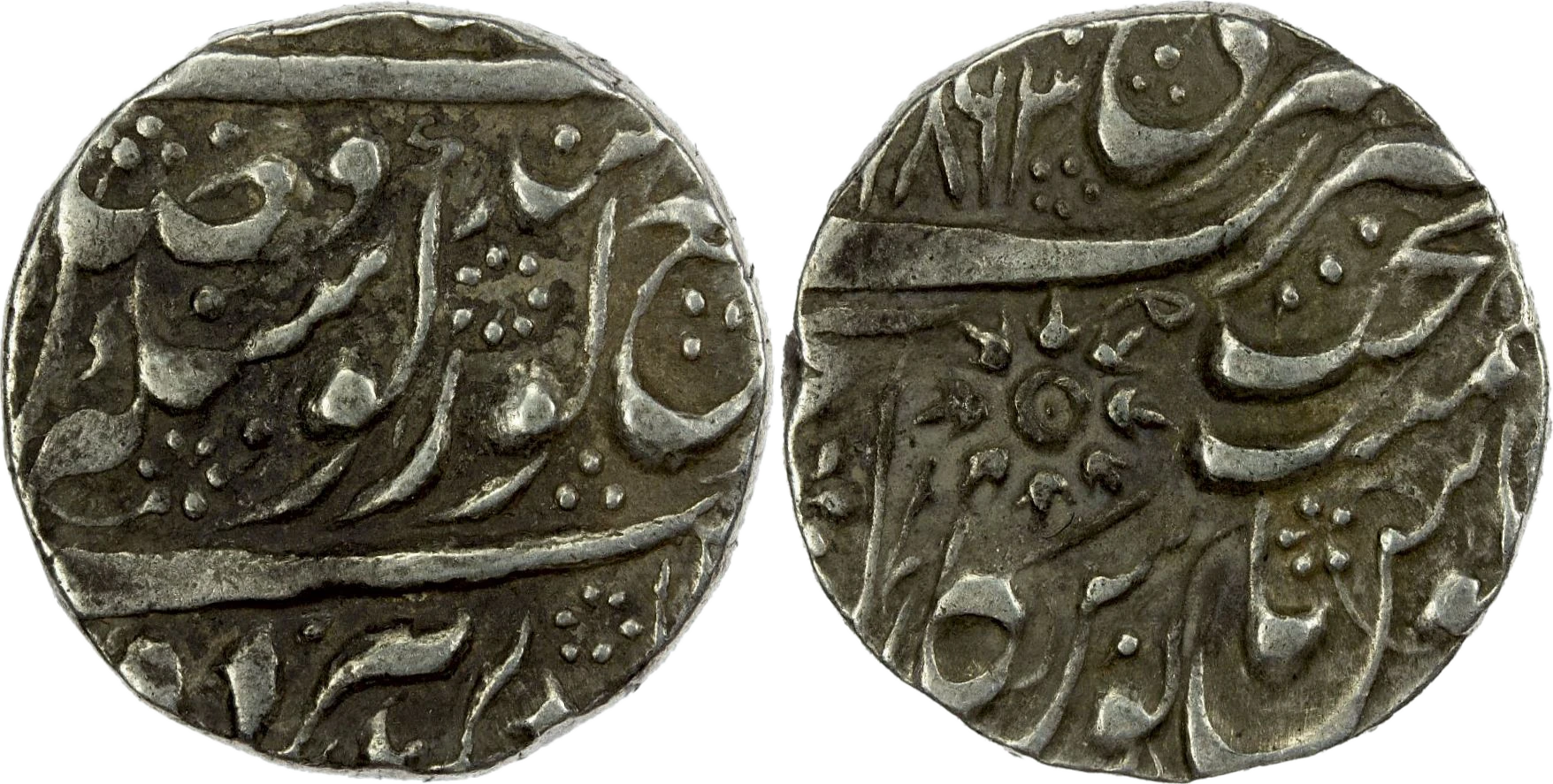
VS 1863 · AD 1806 · Silver Rupee — Arsiwala
A VS 1863 Arsiwala rupee, carrying the Ber flower device prominently on the reverse. The upright, structured form of the flower is clearly differentiated from the free-branching sprig of the Morashahi and Bershahi types. The Arsiwala name derives from the device's resemblance to the arsi mirror ring — but the botanical identification as the Ziziphus mauritiana (Ber) flower connects it to the Harmandir Sahib: the Ber tree at the Golden Temple complex, under which Baba Buddha oversaw the foundation laying, is among the most sacred living monuments of the Sikh faith.
Arsiwala · Ber flower device · VS 1863
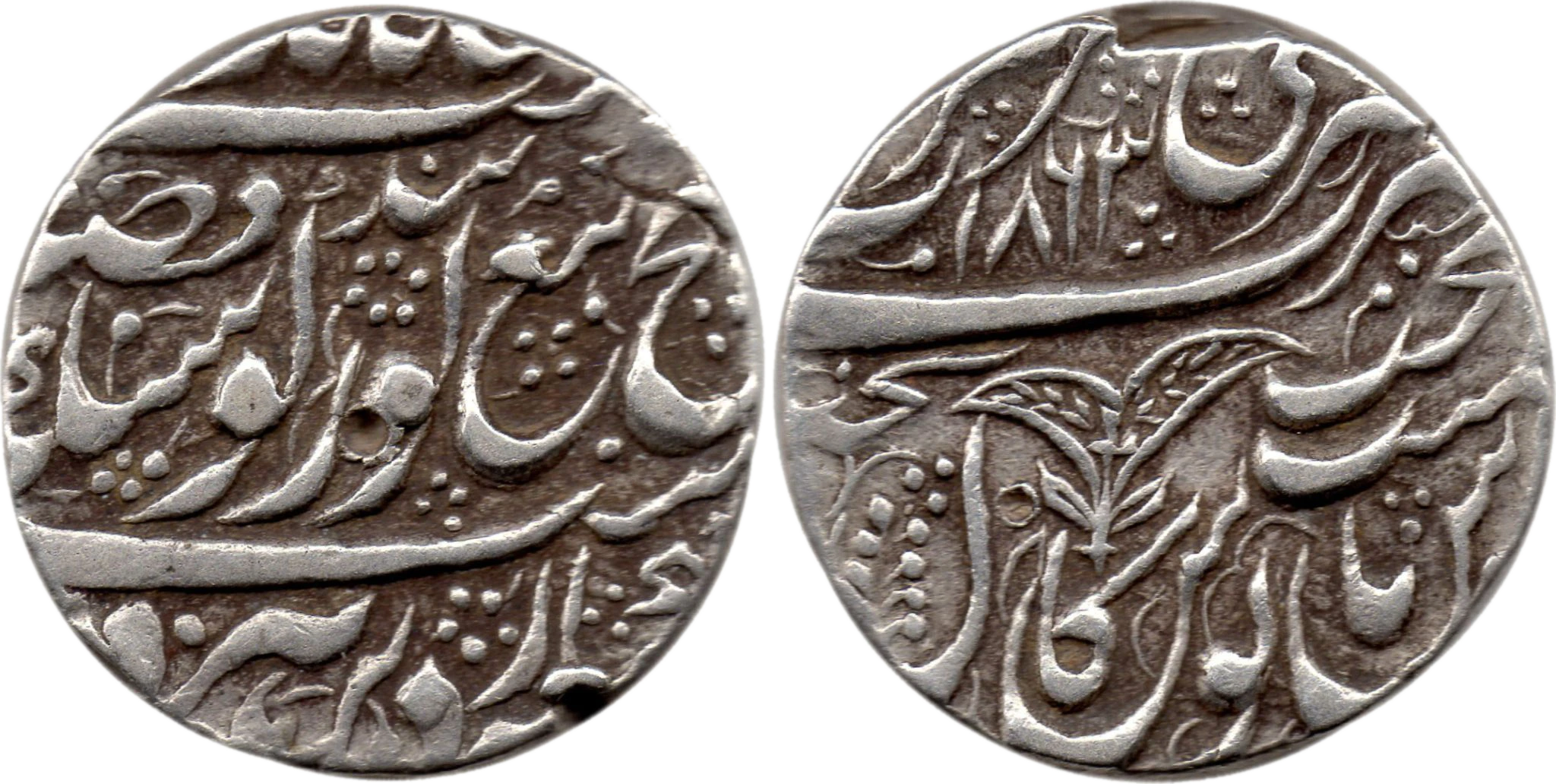
VS 1863 · AD 1806 · Silver Rupee — Double-Leaf Variety
This VS 1863 rupee belongs to the double-leaf variety — a distinct type in which two leaves appear on the reverse in place of the single sprig of the Bershahi, the Ber flower of the Arsiwala, or the concealed peacock of the Morashahi. The two-leaf form is clearly visible on the reverse die and should not be conflated with any of the other named types of this period. It represents a fourth named die variety at the Amritsar mint in VS 1861–1863, and its specific association — if any — with the events of the period remains to be established.
Double-Leaf variety · Two leaves · Distinct from Bershahi & Arsiwala
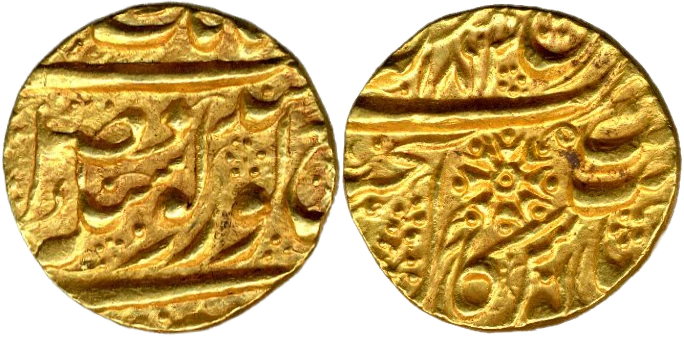
VS 1863 · AD 1806 · Gold Mohur — Arsiwala
The Arsiwala gold mohur of VS 1863 confirms the series extended to the highest denomination in the Amritsar mint's production. The Ber flower device on the reverse — sacred through its association with the Harmandir Sahib — appears here in gold, the prestige metal of the empire. That the Arsiwala symbol was authorised at this denomination reflects deliberate Maharaja-level sanction: this was not an incidental mint variation but a programme that ran from the silver rupee to the gold mohur.
Arsiwala · Gold Mohur · Ber flower at highest denomination
◆ Previously Undocumented — The VS 1868 Rupee
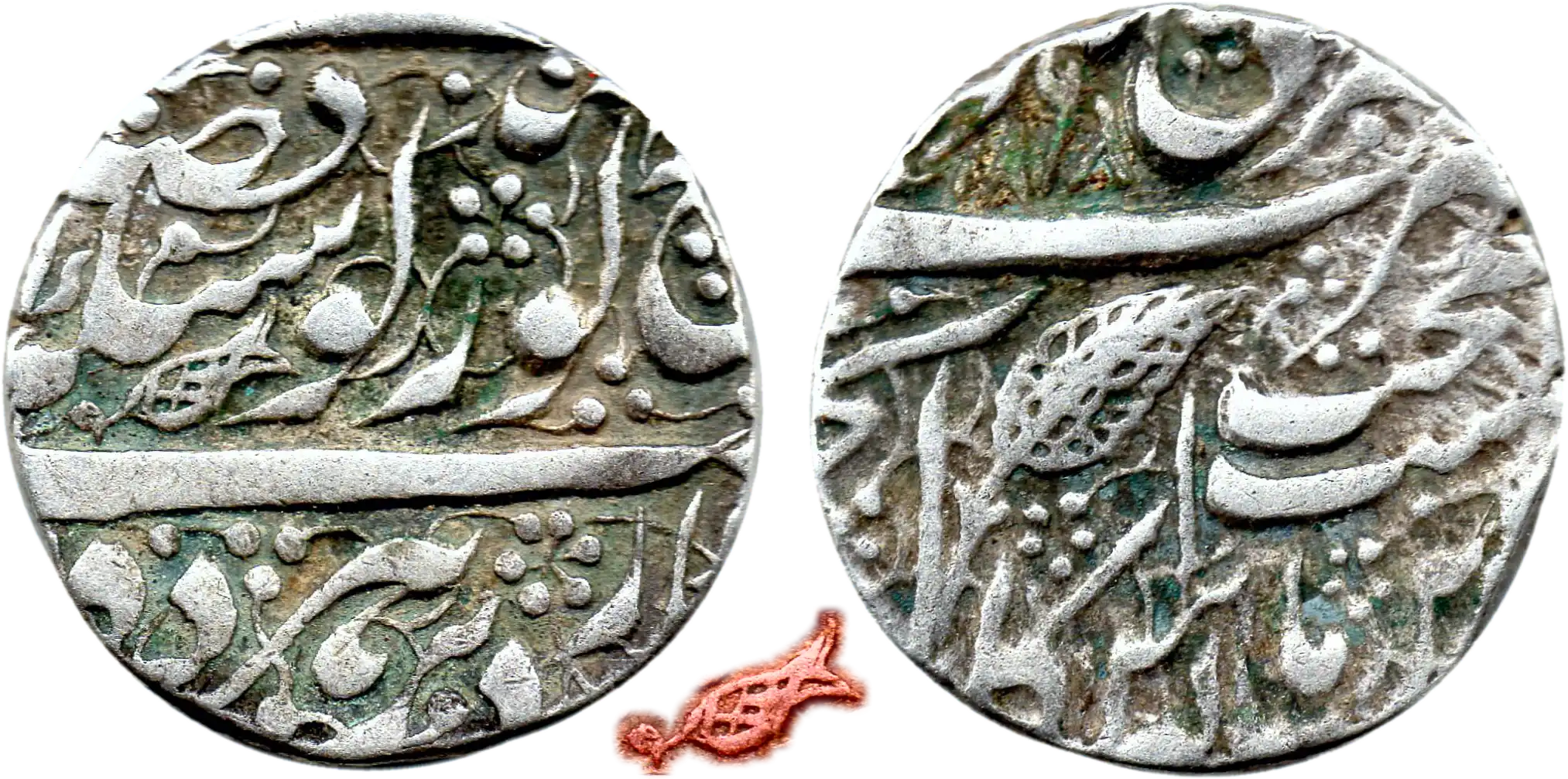
VS 1868 · AD 1811 · Silver Rupee — SikhCoins.in
The obverse of this VS 1868 rupee carries a peacock symbol placed below the words of the Nanakshahi legend — the couplet invoking Guru Gobind Singh's sovereignty. The symbol sits in a field where the mint placed minor symbols, and a fish symbol is recorded at the same position in this year. On this die the fish has been reworked: a neck extends from the hatched body and ends in a clearly formed head and beak, turning it into a peacock. This specimen is not documented in Herrli or Sidhu–Spink and extends the known Morashahi record by five years.
✔ Peacock confirmed · Below Nanakshahi legend · Previously undocumented
The VS 1868 rupee in the SikhCoins.in collection is a document of personal history as much as of monetary policy. The year VS 1868 (AD 1811) corresponds to the period in which Moran, under combined pressure from the Sikh clergy and the competing factions of the Lahore court, left for Pathankot — removed from the Maharaja's immediate presence by the political forces that had never accepted her position at court.
The placement of the peacock on this coin is particularly charged. It appears not in the ornamental zone of the sprig, where the VS 1862 peacocks were hidden, but below the words of Guru Gobind Singh's name on the obverse — the same legend that acknowledged the Guru's sovereignty over all that the mint struck. To place Moran's symbol there, in that specific position, is a statement of a very particular kind.
Whether this reflects Ranjit Singh's personal instruction to the calligraphers, or the autonomous act of craftsmen who had commemorated Moran in silver before and chose to do so once more at the moment of her departure, cannot be confirmed. What the coin documents is that the gesture was made — and that it was made in VS 1868, in the year she left.
This specimen adds a new year and a new placement to the Morashahi record, and extends the series from its previously accepted close of VS 1863 by five years.
The Reckoning
The Akal Takht and the Price of the Coin
The Sikh clergy's objection to the Morashahi coins was not simply one of personal morality — it was constitutional. The Nanakshahi rupee existed precisely because the Gurus' sovereignty was inscribed on every coin. A symbol that commemorated a Muslim courtesan within that sacred space was not a private indulgence: it was a public theological statement, struck in silver at the Amritsar mint, the same mint that sent its first coins of every new series to the Akal Takht as a ceremonial offering.
Ranjit Singh was summoned before the jathedar of the Akal Takht and underwent a public punishment — the specifics of which vary between sources but which all agree was a genuine submission rather than a nominal gesture. The Maharaja who controlled the most powerful military force in the subcontinent stood before the religious institution and accepted its authority.
The coins did not immediately disappear after the Akal Takht proceedings. The VS 1863 gold mohur confirms production continued into that year. The VS 1868 rupee suggests that after five years without the symbol, it returned once more — quietly, clandestinely, in the year that Moran departed. This time there was no recorded controversy. Rather than hiding a bird in the letterforms, the die-cutter took the fish symbol already in use at the mint and reworked it into a peacock — a change that went unrecorded in the numismatic literature until now.
Classification
Four Named Series at the Amritsar Mint
The coins of the Amritsar mint from VS 1861 to VS 1868 have long been grouped loosely under the Morashahi name. Careful examination of the reverse devices reveals four distinct series, each with a different symbol and a different numismatic identity. The Morashahi designation properly belongs only to coins carrying the concealed peacock.
Four Named Series at the Amritsar Mint — VS 1861 to VS 1868
Morashahi
Coins with the sprig symbol and the concealed peacock at its base. Identified by the attached tail of Ka (ک) of Akaal (اکال), joined to the sprig on peacock-bearing dies. One or two peacocks may be present. The true peacock coins — their name is now fully explained by Singh's research.
VS 1862 (primary) · VS 1868 (reworked fish symbol, obverse) · Die variants only
Bershahi
Coins with the single sprig symbol, without the peacock. The Ka of Akaal remains unattached. Previously grouped with the Morashahi coins but carrying no peacock, these form a distinct majority type. Singh proposes Bershahi for this series.
VS 1861, VS 1862 (majority), VS 1863 · Standard single sprig · No peacock
Arsiwala
Coins carrying the Ber flower (Ziziphus mauritiana) device on the reverse. Named Arsiwala for the device's resemblance to the arsi (mirror ring worn on the thumb). The Ber flower carries sacred associations: the ancient Ber tree within the Harmandir Sahib complex — under which Baba Buddha sat while overseeing the Golden Temple's foundation laying — connects this device to the sacred precincts of the Amritsar mint and to the Sikh Gurus themselves. Documented on silver rupee and gold mohur.
VS 1862 · VS 1863 (silver & gold) · Ber flower device
Double-Leaf
Coins carrying two leaves on the reverse in place of the single sprig, Ber flower, or concealed peacock. A distinct die variety, currently documented at VS 1863. Not to be conflated with the Bershahi (single sprig) or the Arsiwala (Ber flower). Its specific association — if any — with the events of the period remains to be established; it may represent a further calligrapher's variant within the same programme of non-standard reverse devices at the Amritsar mint.
VS 1863 · Two leaves · Distinct fourth type
The diagnostic features across all four types: for the Morashahi, examine the Ka (ک) of Akaal (اکال) on the reverse — if its tail is extended and attached to the sprig above, the coin warrants examination for the concealed peacock. For the Bershahi, the Ka is detached and the single sprig stands free. For the Arsiwala, the reverse device is not a sprig at all but the structured, circular Ber blossom — recognisable by its radiating form and sacred botanical associations with the Harmandir Sahib. For the Double-Leaf, two distinct leaf forms appear together on the reverse. The Arsiwala series alone extends from silver rupee to gold mohur.
Chronology
The Morashahi Record — VS 1861 to VS 1868
Sprig VS 1861 · AD 1804
First documented appearance of the sprig symbol at the Amritsar mint. Silver rupee. Whether this year carries a concealed peacock on any known die has not yet been conclusively established — it predates the principal peacock year of VS 1862 and may represent the series at its inauguration, before the peacock device was introduced.
Peacock VS 1862 · AD 1805
The central year of the series and the primary focus of numismatic documentation. Silver rupee. Both the single-peacock and double-peacock die variants have been identified on VS 1862 coins. The majority of VS 1862 sprig coins are the Bershahi type (peacock absent); the Morashahi die variants are the rarer subtype. Ranjit Singh's relationship with Moran is at its most publicly documented intensity in this period — the Akal Takht proceedings most likely follow this year's production.
Arsiwala Double-Leaf Gold VS 1863 · AD 1806
The most typologically diverse year of the series. Three distinct reverse devices are documented at the Amritsar mint in VS 1863: the Arsiwala (Ber flower — silver rupee and gold mohur), the Double-Leaf variety (two leaves in place of the sprig), and the standard Bershahi sprig. The Arsiwala Ber flower carries sacred associations through the ancient Ber tree within the Harmandir Sahib complex, under which Baba Buddha sat during the Golden Temple's foundation laying. That this device appears on the gold mohur — the prestige denomination — reflects Maharaja-level sanction for its use. The Akal Takht proceedings concluding the broader Morashahi programme most likely fall in or shortly after this year.
VS 1864–1867 · AD 1807–1810
The gap years. The Amritsar mint returns to its standard leaf symbol following the Akal Takht proceedings. Moran remains in proximity to the Lahore court but the numismatic commemorations cease. No sprig or peacock coins are known from these four years.
Departure Peacock VS 1868 · AD 1811
The VS 1868 rupee in the SikhCoins.in collection carries a concealed peacock placed below the words of Guru Gobind Singh's name on the obverse. This is the year associated with Moran's departure from Lahore to Pathankot under pressure from the clergy and palace factions. Five years after the series' apparent end, the peacock returns, this time as the mint's fish symbol reworked with a neck and beaked head, in a position of particular theological weight. This specimen is not previously documented in the numismatic literature and extends the known Morashahi record by five years.
Numismatic Significance
What the Morashahi Coins Tell Us
The Morashahi rupees are unlike anything else in the Sikh coinage series. In seven decades of Sikh imperial coinage, spanning more than a dozen mints and hundreds of die varieties, no other coins encode a private name within the public legend. No other coins required their commemorative function to be hidden rather than displayed.
The hiding itself is significant. Ranjit Singh could not place Moran's name openly on the coin — the clergy's objection would have been immediate, the political cost prohibitive, and the theological contradiction impossible to sustain. But the coins could carry a sign that those who knew would recognise and those who did not would pass over unaware. The peacock is a secret address to a specific audience — and the calligrapher's art made it possible.
The double peacock, where it appears, adds another layer. The first peacock is for those who look carefully. The second is for those who look at what the first one changes — who notice that finding one hidden figure means there may be another. It is a puzzle that rewards attention and withholds itself from casual observation, which is precisely what the situation required.
The VS 1868 rupee extends this narrative. Five years after the Akal Takht proceedings, in the year of Moran's departure, the peacock appears once more — this time placed not at the ornamental margin of the calligraphy but directly beneath the words that name Guru Gobind Singh. This is either the boldest or the most sorrowful gesture in the entire series, depending on how one reads it. The numismatic evidence alone cannot settle that question. But it can document that the gesture was made.
Scholarship
Sources and Further Reading
Primary Research
- — “The Enigma Called Moran: Mystery Unveiled,” Journal of the Oriental Numismatic Society, No. 198. The foundational paper establishing the peacock identification within the VS 1862 calligraphy, with detailed photographic analysis of the concealment mechanism and the Bershahi/Morashahi distinction.
- — “Coins of the Sikhs: Mora and Aarsi Myths,” JONS No. 198. The earlier paper arguing against the sprig-as-peacock-tail reading, which set the stage for the peacock discovery by eliminating the wrong answer.
Catalogues
- — The Coins of the Sikhs, 2nd edition, 2004. The modern standard reference for Sikh coinage; the Amritsar mint entries document the sprig series but predate the peacock identification.
- — Coins of the Sikhs (Spink, 2022). The most comprehensive recent catalogue; entries for the Morashahi series should now be read in light of the Bershahi/Morashahi distinction.
- — Sikh Coins: Symbol of Sovereignty. Contains a full chapter on the Morashahi controversy; the analysis is superseded by Singh's peacock identification but remains valuable for the history of the debate.
Historical Sources
- — Umdat-ut-Tawarikh (Chronicle of Ranjit Singh's Reign). The primary court chronicle; contains the primary sources on Moran's presence at the Lahore durbar.
- — History of the Sikhs, Volume II: The Sikh Empire 1839–1964. Princeton University Press, 1966. The standard modern narrative history; the account of Moran and the coins is discussed in the context of Ranjit Singh's personal life and court culture.
SikhCoins.in Collection Notes
- The SikhCoins.in collection holds specimens across all four named series: VS 1861 Bershahi; VS 1862 Morashahi (multiple dies including the definitive peacock specimen); VS 1862 Arsiwala (Ber flower); VS 1863 Arsiwala silver rupee; VS 1863 Arsiwala gold mohur; VS 1863 double-leaf variety; and the VS 1868 rupee with a peacock, reworked from the fish symbol, below the Nanakshahi legend. The VS 1868 specimen is not previously documented in the published numismatic literature and extends the known Morashahi record by five Vikrami Samvat years.