AD 1799 – 1849 · VS 1856 – 1906
The Sikh Empire
Sarkar-i-Khalsaji — The Lion of Lahore & the Coins of the Punjab
Maharaja Ranjit Singh · Five Maharajas · Fourteen Mints
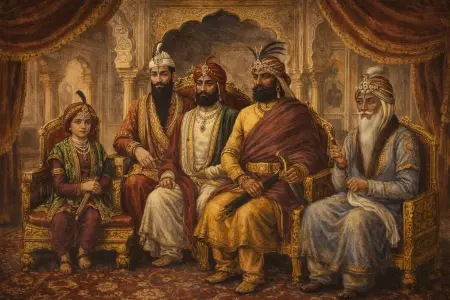
The Five Maharajas of the Sikh Empire — Ranjit Singh, Kharak Singh, Nau Nihal Singh, Sher Singh & Duleep Singh
Foundation
The Sarkar Khalsa
The year 1799 marked a turning point in the history of the Sikhs. On 7 July of that year, Ranjit Singh — barely nineteen years old and Sardar of the Sukerchakia misl since 1792 — rode into Lahore and ejected the three fractious Bhangi chiefs, Chet Singh, Sahib Singh and Mohar Singh, who had long shared its misrule. He had obtained the grant of the city from Shah Zaman, the Durrani ruler of Afghanistan, and now made it his capital and the seat of an emerging Sikh polity.
On 12 April 1801 — the first day of Baisakhi — Ranjit Singh was proclaimed Maharaja of the Punjab, by Sahib Singh Bedi, a direct descendant of Guru Nanak, placing the tilak on his forehead. His government was known as the Sarkar Khalsa and his court as the Durbar Khalsa. He never sat upon a throne; his ordinary chair was his throne and his turban his crown. His coins, like those of the Dal Khalsa before him, bore no royal name or portrait — only the religious couplets that invoked the sovereignty of Guru Nanak and Guru Gobind Singh.
When his minister Raja Dhian Singh once remonstrated with him for dressing as a humble servant, Ranjit Singh replied with the question: "In whose name are the coins struck?" Dhian Singh named Guru Nanak, and the Maharaja explained that he in whose name the coins were issued was the true ruler — and he himself merely the Guru's servant. This story, recorded by Bhagat Singh, goes to the heart of the political theology of the Sikh state: the Maharaja ruled as viceregent of the Khalsa, not as sovereign in his own right.
The Sarkar Khalsa was a multi-religious polity in which Muslims, Hindus and Sikhs served at every level. Ranjit Singh's most able diplomat was the Muslim Fakir Azizuddin; his chief administrator for much of the empire's western province was the Hindu Diwan Sawan Mal of Multan. His army — the Fauj-i-Khas — was trained by officers of the former Napoleonic armies: Generals Allard, Ventura, Court and Avitabile. It fought under regimental colours combining the Tricolore with the likeness of Guru Gobind Singh, and received all its commands in French.
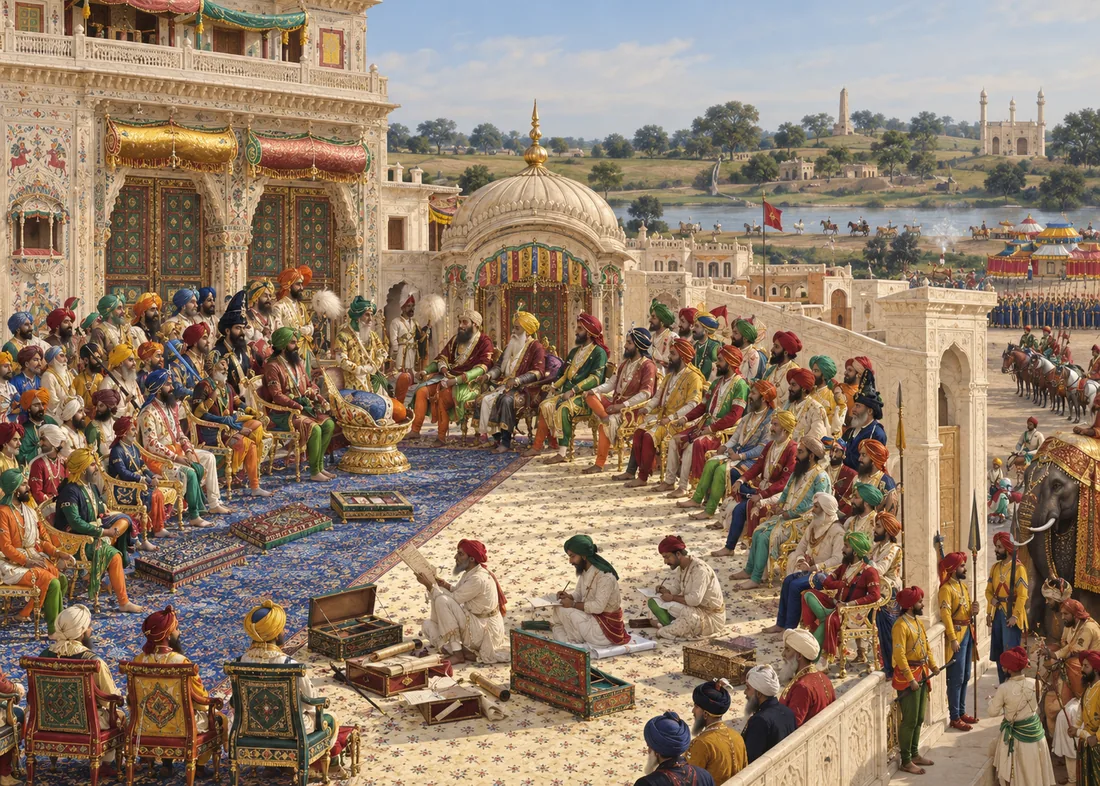
The Civil Administration
The Darbar-i-Mulla — Central Secretariat
The administrative coherence of the Sikh Empire rested on a system of record offices — Daftars — that Ranjit Singh allowed the Brahmin and Khatri communities virtually to monopolise. Their generations of experience in the Mughal and Kabul governments made them, as the thesis of Rajinder Kaur (Punjabi University, 2011) demonstrates, the only pool of trained administrative talent available to him at speed. The resulting Central Secretariat, known as the Darbar-i-Mulla, was built incrementally from 1803 onward by four principal officers whose careers interlocked across forty years.
Diwan Bhawani Das, arriving from Kabul service in 1808, found no regular treasury and no departmental accounts in Lahore. He organised both within a decade. He established twelve Daftars covering every category of state income and expenditure, appointed finance minister in 1811, with a total state income at the time of approximately thirty lakh rupees. When he died in 1834 the secretariat he had created was the most sophisticated administrative machine between Delhi and Kabul. Diwan Ganga Ram, invited by Bhawani Das in 1813 and placed in charge of military accounts, also became keeper of the royal seal — the critical office through which every pay order passed. He simplified the record-keeping system and organised the Abkari (excise) system covering opium, bhang and spirits. On Ganga Ram's death in 1826, both offices passed to Diwan Dina Nath, who had arrived in 1815 at Ganga Ram's own recommendation. On Bhawani Das's death in 1834, Dina Nath assumed the Finance Ministry too, becoming by the final years of the reign the single most indispensable man in Lahore — so deeply embedded in the machinery of state that the early British administrators after 1849 kept him on as the only man who understood the accounts.
The pay order process illustrates how tightly the system was integrated. Every order from the Maharaja — given verbally in Punjabi — was transcribed into Persian by a Munshi, then sealed twice: once with the Akal Sahai Ranjit Singh seal in Gurmukhi and once with Mulahiza Shud in Persian. The sealed document then passed in sequence through the Sarishta-i-Hazur, the Daftar-i-Devi Das, the Daftar-i-Bhawani Das, the General Secretariat, and finally the Naqal Daftar (copying office). Not a single pie could be disbursed from the state treasury without completing this chain. The Toshakhana — the royal treasury — held three keys simultaneously: one with Misr Beli Ram, the Chief Toshakhania; one with Fakir Nur-ud-Din, incharge of the fort; and one with Sardar Hukam Singh, Thanedar of Lahore. All three keys were required to open it.
The Five Maharajas
Maharajas of the Punjab
From the proclamation of Ranjit Singh in 1801 to the annexation of the Punjab by the British in 1849, five maharajas sat on the Lahore masnad. Only the first of them — the Lion of Lahore — ruled with undisputed authority. The four who followed him were swept away by the palace intrigues and army insubordination that the Lion had kept in check through the force of his personality.
| Maharaja | Reign | VS | Note |
|---|---|---|---|
| Ranjit Singh (Lion of Lahore) | 1 Baisakhi 1801 – 27 June 1839 | VS 1858 – 1896 | Founder; united the Punjab from the Sutlej to Peshawar. Died of stroke after long illness. |
| Kharak Singh | 27 June 1839 – 5 Nov 1840 | VS 1896 – 1897 | Eldest son of Ranjit Singh; dominated by his own son Nau Nihal Singh and minister Dhian Singh. Died under disputed circumstances. |
| Nau Nihal Singh | 5 Nov 1840 | VS 1897 | Killed on the day of his father's cremation when an archway collapsed — possibly arranged by Dhian Singh's faction. Never formally reigned. |
| Sher Singh | 18 Jan 1841 – 15 Sept 1843 | VS 1898 – 1900 | Son of Ranjit Singh; shot by Ajit Singh Sandhanwalia at the Shah Bilawal baradari; the wazir Dhian Singh was killed in the fort the same day. |
| Duleep Singh | 18 Sept 1843 – 29 March 1849 | VS 1900 – 1906 | Born 6 September 1838; proclaimed Maharaja at the age of five. Ruled through regents — Hira Singh, Jawahar Singh, Lal Singh. Deposed at annexation and exiled to England. |
Imperial Expansion
The Making of an Empire
Ranjit Singh's great ambition was to weld the whole of the Punjab into a united Sikh empire. The perpetual conquest of new territories quickly also became an economic and political necessity — like many a conqueror, he found early on that expanding the frontier was the easiest way to replenish an empty treasury and to keep a large and expensive army gainfully employed. His domains grew in a series of carefully calculated campaigns over four decades.
In 1805 he took Amritsar from the Bhangi misl and with it acquired the most sacred city of the Sikhs and its prosperous commercial traffic. In 1818 he stormed the citadel of Multan after six previous attempts, killing its Afghan defender Muzaffar Khan; the city gave him command of the great caravan routes to Sindh and central Asia. Kashmir fell in 1819 to a combined force under Misr Diwan Chand and Raja Gulab Singh of Jammu — the valley's famous shawl trade brought enormous revenue to Lahore. The Derajat was absorbed between 1819 and 1821, giving control of the Indus crossings and the southern approaches from Afghanistan.
The question of supremacy over north-west India was resolved by the Treaty of Amritsar, 25 April 1809, which drew the Sutlej as the western boundary of British influence and the eastern boundary of Ranjit Singh's sphere. He signed as a realist — fully aware of British military superiority — and thereafter maintained a scrupulous observance of the treaty for thirty years. His final major conquest was Peshawar, taken definitively on 6 May 1834 by an army nominally commanded by the young Prince Nau Nihal Singh but in reality by the formidable Sardar Hari Singh Nalwa, who became its first governor and held the North-West Frontier against repeated Afghan incursions until his death at Jamrud in April 1837.
VS 1856 · AD 1799
Ranjit Singh Takes Lahore
7 July: The young Sukerchakia Sardar rides into the Mughal capital of the Punjab. The Bhangis flee. The city becomes the political capital of the nascent Sikh state — and its mint, striking coins since the Dal Khalsa's conquest in 1765, passes into his hands.
FoundationVS 1858 · AD 1801
Proclaimed Maharaja of the Punjab
12 April (Baisakhi): Sahib Singh Bedi places the tilak on Ranjit Singh's forehead at Lahore. He is proclaimed Maharaja of the Punjab. His government takes the name Sarkar Khalsa; his court becomes the Durbar Khalsa. No crown is placed on his head; he never sits upon a throne.
ProclamationVS 1866 · AD 1809
Treaty of Amritsar with the British
25 April: Ranjit Singh meets Charles Metcalfe at Amritsar and signs the treaty that fixes the Sutlej as his eastern boundary of influence. He yields the Cis-Sutlej Sikh chiefs — including the Phulkian states of Patiala, Nabha and Jind — to British protection. In return, the British leave him a free hand north and west of the river.
TreatyVS 1862 · AD 1805
Amritsar Taken from the Bhangis
Ranjit Singh takes Amritsar from Mai Sukhan of the Bhangi misl, uniting the spiritual and commercial centre of the Sikh world under his authority. The Amritsar mint — the most productive in the empire — comes under the Lahore Durbar.
ConquestVS 1875 · AD 1818
Fall of Multan
After six previous campaigns, Ranjit Singh's forces storm the citadel on 2 June, killing the Afghan governor Muzaffar Khan. Multan gives the empire control of the great trade routes to Sindh and the Indus delta. Diwan Sawan Mal governs the province for nearly a quarter century, establishing a reputation as one of the most able and popular administrators of the Sikh state.
ConquestVS 1876 · AD 1819
Conquest of Kashmir
Srinagar falls on 5 July to a Sikh force under Misr Diwan Chand and Raja Gulab Singh of Jammu. Kashmir had passed from the Mughals to the Durranis in 1752; the Sikhs inherit a province famous for its shawl industry, saffron and arms. Its revenue becomes one of the empire's richest sources of income — and its mint begins striking coins on a separate standard derived from Kabul.
ConquestVS 1891 · AD 1834
Peshawar — the Last Great Conquest
6 May: Hari Singh Nalwa and General Ventura take Peshawar definitively. The winter capital of the Durrani Empire is now the westernmost city of the Sikh Empire. Hari Singh Nalwa garrisoned it with 12,000 men and held the Khyber against repeated Afghan assaults until his death at Jamrud fort in April 1837. His successor was the Neapolitan general Paolo Avitabile, known to his soldiers as Witbul Sahib.
ConquestVS 1896 · AD 1839
Death of the Lion
27 June: Maharaja Ranjit Singh dies after a prolonged illness at Lahore. Contemporary accounts record that he attempted, near the end, to donate the Koh-i-Noor diamond to the Jagannath temple at the instigation of the Brahmin priests present. Misr Beli Ram, the Chief Toshakhania who held the treasury key, refused to release it on the grounds that the Maharaja was not in a fit mental state to make the gift — a refusal recorded by both Steinbach and Sohan Lal Suri. Under his weak successors the army, no longer held in check by a forceful government, reverts to its older conception as a democratic Dal Khalsa and becomes the engine of court anarchy.
TransitionVS 1902–1903 · AD 1845–1846
First Sikh War
11 December 1845: The Sikh army crosses the Sutlej. After the battles of Mudki, Ferozeshah, Aliwal and Sobraon the British are victorious. Kashmir is sold to Gulab Singh for 75 lakh Amritsar Nanakshahis, as the Lahore Durbar cannot pay the war indemnity. A British Resident is installed at Lahore.
DefeatVS 1905–1906 · AD 1848–1849
Second Sikh War & Annexation
A rebellion of Diwan Mulraj's troops at Multan leads to the murder of two British officers and the Second Sikh War. The final defeat of the Sikh army at Gujrat, 21 February 1849, is followed by the abdication of the infant Maharaja Duleep Singh and the annexation of the Punjab by the British East India Company on 29 March 1849. The Lahore and Amritsar mints are closed; the Sikh sovereign coinage comes to an end.
AnnexationThe Coinage
Anonymous in Metal — A Unique Coinage
The coinage of the Sikh Empire is unlike that of any other Indian dynasty. Neither the Maharaja's name nor his portrait appears on any regular rupee or mohur. The silver and gold coins of Ranjit Singh and all four of his successors continued the legends of the Dal Khalsa Confederacy without alteration — bearing the same religious couplets in Persian, the same invocations of Guru Nanak and Guru Gobind Singh, that the Misl coins had borne since 1765.
Ranjit Singh explicitly embraced this anonymity as a political statement. He ruled as viceregent of the Guru, not as sovereign in his own name. His coins proclaimed the sovereignty of Nanak and Guru Gobind Singh; the Maharaja was only their servant. Surviving pattern rupees (Herrli 08.12 and 08.13) suggest that he once considered introducing anonymous pictorial coins depicting the ruler as a disciple of Guru Nanak — but the idea was abandoned and the traditional religious legends retained throughout the empire's existence.
Two main legends circulated on imperial rupees: the Gobindshahi couplet — named by the money-changers of the Punjab — and the Nanakshahi couplet, which is used on the standard rupees of Lahore and Amritsar. The only personal mark Ranjit Singh introduced was the leaf symbol on the rupees of Lahore from VS 1856 and on the Amritsar Nanakshahis slightly later. This leaf, which identified the uniform Khalsa coinage he re-established, was inherited by all his successors without change.
The sarafs (money-changers) of the Punjab distinguished three groups of Amritsar rupees by quality: the Purana (struck VS 1841–1869), the Chalan (VS 1870–1879) and the Chitta (VS 1880–1905), discounting each at different rates according to their silver content and condition.
Scale of production. Herrli estimated the average annual output of the Amritsar mint at approximately one million rupees — a figure that made it not merely the largest mint of the Sikh Empire but the pre-eminent financial centre of the entire Punjab (Herrli 2004, p. 43, cited in Khera 2011). Against this scale the purchasing power of a single rupee gives it vivid meaning: between 1830 and 1840, one Amritsar Nanakshahi bought 37.5 kg of wheat, 18 kg of unrefined cane sugar, 7.7 kg of rice, or 3.7 kg of cotton. Two rupees purchased a sheep; forty to fifty a cow; a hundred a milking buffalo.
The frozen-date convention. Amritsar and Lahore rupees issued after VS 1884 (AD 1827) commonly show one of three reverse years — VS 1884, 1885 or 1888 — regardless of actual date of striking. This striking quirk once prompted the theory that it was connected to the bhatta tax, by which coins were devalued annually and a fixed reverse year could neutralise that levy. The more persuasive reading, advanced by Herrli and adopted by subsequent scholars, is that the frozen year functions as an outwardly visible marker of a mint reform or currency reorganisation — a bureaucratic signal rather than a tax device. The actual year of striking was encoded in small obverse numerals, so the coins remained dateable; the frozen reverse year was a convention of state, not a concealment.
Symbols and their contested meanings. Several Amritsar symbols beyond the leaf have generated prolonged scholarly debate. The most discussed is the double sprig with buds that identifies the so-called Morashahi or peacock-tail rupees. C. J. Rodgers (1881) identified it as a peacock's tail and connected it to Ranjit Singh's famous relationship with the dancer Moran — moran meaning peacock in Punjabi — arguing that the symbol was struck in her honour. Lance Dane (1981) rejected this as inconsistent with the Maharaja's declared devotion to the Guru. R. T. Somaiya (1994) read the symbol as a bunch of Ber tree fruits sacred to the Harmandir precinct. Raijasbir Singh (1995) proposed that it was simply the mark of the earlier Bhangi Misal, inherited by Ranjit Singh as a token of his conquest of their territories. A close examination of the four Morashahi pieces in the British Museum collection reveals a small stem at the base, suggesting a plant or double-branch origin rather than a feather — but the question is not definitively settled. The Morashahi rupees are fully treated on the dedicated page on this site.
The Two Great Couplets of the Sikh Rupee
Nanakshahi Couplet (Standard — Lahore, Amritsar, Multan, Jhang, Dera, Mozang, Unidentified Mint)
The coin is struck on both worlds by the sword of Nanak, the bestower; Victory is Guru Gobind, King of Kings — grace of the True Lord
Gobindshahi Couplet (Kashmir, Derajat, Mankera, Peshawar, special issues from Amritsar)
Abundance, power, victory and swift assistance / are the gift of Nanak and Guru Gobind Singh.
Standard Reverse
struck at [Mint Name].
Principal Mints
Lahore & Amritsar — The Twin Hearts
The two principal mints of the empire operated under direct Lahore Durbar control throughout its existence. Lahore was the political capital and its mint the symbol of imperial sovereignty; Amritsar was the commercial heart of the Punjab and its mint the most productive and technically complex in the empire, distinguished by its elaborate system of mintmarks whose full significance remains unexplained to this day.
Lahore Mint
Zarb Dar-ul-Sultanate Lahore · VS 1856 onwards · Principal Imperial Mint
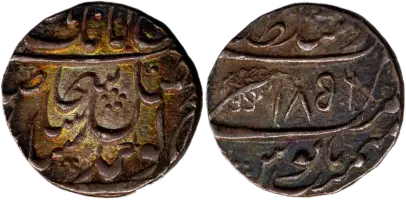
Obverse
Sikka zad bar Har do Alam, Tegh-i-Nanak wahib ast Fath Guru Gobind Singh Shah-i-Shahan, Fazl Saccha Sahib astReverse
Zarb Dar-ul-Sultanate LahoreLahore had been a mint town since the Ghaznawids; the Sikhs took it in 1765 and Ranjit Singh made it his capital in 1799. From VS 1856, the year of his conquest, he introduced the distinctive leaf mark that identifies the resumed uniform Khalsa coinage. The Lahore mint struck Gobindshahi and Nanakshahi rupees, mohurs and copper coins until the British annexation in 1849.
Browse Empire Collection →Amritsar Mint
Zarb Sri Amritsar jiyo · VS 1832–1906 · Most Complex Mint of Modern India
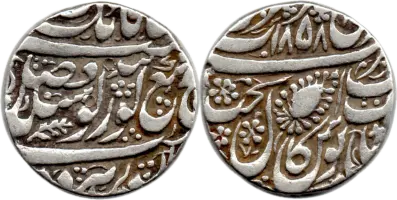
Obverse
Sikka zad bar Har do Alam, Tegh-i-Nanak wahib ast Fath Guru Gobind Singh Shah-i-Shahan, Fazl Saccha Sahib astReverse
Zarb Sri Ambratsar jiyoThe most productive mint of the empire, Amritsar produced an extraordinary variety of subtypes distinguished by leaf marks, additional symbols and parallel series running concurrently — a complexity Herrli called the most intricate mintmark system in modern India. The Amritsar Nanakshahi was the standard currency of the empire; 100 rupees equalled one seer, and 4,000 rupees made up one Lahori maund. The mint operated continuously from the Misl period through VS 1906.
Browse Empire Collection →The Ahluwalia Rupee of Lahore — A Historic Rarity
Zarb Lahore · VS 1818/1761 AD · The First Sikh Rupee of Lahore
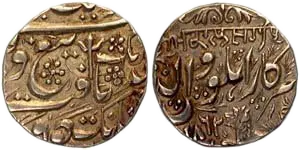
Obverse
Sikka zad dar Jahan ba-Fazl Akal Mulk-i-Ahmad giraft Jassa Kalal Coin struck by the grace of the Timeless / The realm of Ahmad [Shah Durrani] captured by Jassa KalalOn 11 November 1761, Jassa Singh Ahluwalia — Sultan al-qaum, King of the People — led the Dal Khalsa into Lahore and struck coins in his own name. The contemporary chronicler Ghulam Ali Azad recorded with horror that the Sikhs "blackened the face of the coin with his name." These rupees were not meant for commerce; they were a deliberate taunt of Ahmad Shah Durrani, whose realm they proclaimed captured. According to Ganesh Das, only twenty-one were coined. Not a single authentic specimen survives today — the Ahluwalia rupee of Lahore remains the most storied phantom of Sikh numismatics. The piece shown here is a later commemorative, issued in VS1862 by Fateh Singh Ahluwalia, "Akal Sahai Sarkar Ahluwalia" on the Reverse.
Browse Empire Collection →Provincial & Frontier Mints
The Mints of the Expanded Empire
As Ranjit Singh's empire absorbed former Mughal and Durrani territories, their existing mints came within its borders. Where these mints produced a long-established local or trade coinage — particularly in Kashmir, Peshawar and the Derajat — they retained their own weight standards and reverses but changed their legends. The result is a family of numismatically distinct coins, all identifying themselves as products of the Sikh state, yet each reflecting the distinct commercial and political character of its region.
Kashmir Mint
Zarb Kashmir · VS 1876 onwards
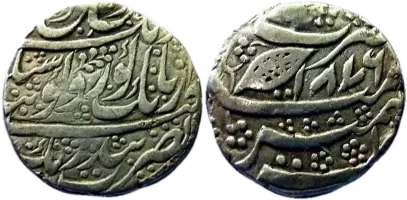
Obverse
Deg Tegh Fateh Nusrat bedarang Yaft az Nanak Guru Gobind SinghReverse
Zarb KashmirConquered in 1819, Kashmir struck on the Nanakshahi standard of Amritsar. Ranjit Singh appointed twelve governors at Srinagar over the twenty-seven years of Sikh rule, and each governor left a personal mark on the locally struck coins — making Kashmir numismatics a biographical record of its administrators. Diwan Moti Ram (two terms) and Diwan Kirpa Ram left no distinguishing symbol; Sardar Bhima Singh used the Persian letter ba, and later governors added distinctive devices of their own devising. Sher Singh's coins carry a tiger on the reverse — sher meaning lion or tiger in Persian, a direct heraldic signature. The sword-and-shield mark identifies Colonel Mehan Singh Kumedan, who held office from 1834 to his death in 1841 and was described by Khera as the best of the Sikh administrators, restoring trade, industry and agriculture across the valley. The first Muslim governor, Shaikh Gholam Muhyid Din, governed from approximately 1841 to 1845; his coins carry the Persian letter shin. The valley's enormous shawl industry — its products exported to Central Asia, Russia, China and Europe — made Kashmir among the empire's richest provinces.
Multan Mint
Zarb Dar-ul-Aman Multan · VS 1875 (2nd occ.) · Bhangi–Sikh–Durrani
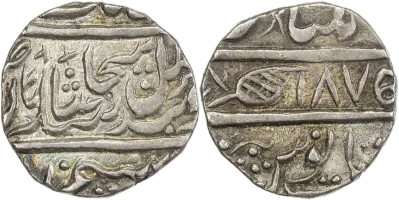
Obverse
Sikka zad bar Har do Alam Tegh-i-Nanak Wahib ast Fath Guru Gobind Singh Shah-i-Shahan fazl Saccha Sahib astReverse
Zarb Dar-ul-Aman Multan Struck at Multan, the City of PeaceMultan — one of the greatest cities of the subcontinent and a mint town since antiquity — had brief Sikh occupations in the Misl period before final conquest in 1818. Under Diwan Sawan Mal, its long-serving governor, it was administered with unusual fairness. In VS 1905 (1848 AD), during the Second Sikh War, Diwan Mulraj struck emergency gold rupees inside the besieged citadel — the last coins of the Sikh Empire to be struck at Multan.
Peshawar Mint
Zarb Peshawar · VS 1891 onwards · Afghan Standard
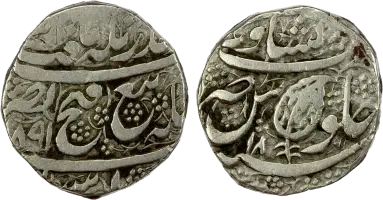
Obverse
Deg Tegh Fateh Nusrat bedarang Yaft az Nanak Guru Gobind SinghReverse
Zarb PeshawarThe former winter capital of the Durrani Empire, Peshawar was taken definitively in 1834. It was struck on the Kabul standard. Under Hari Singh Nalwa and then the Neapolitan General Avitabile, Peshawar was held as a fortress city on the empire's most contested frontier. The Sikh rupees of Peshawar circulated alongside older Durrani types throughout the region.
Derajat Mint
Zarb Derajat · VS 1895 · Dera Ismail Khan
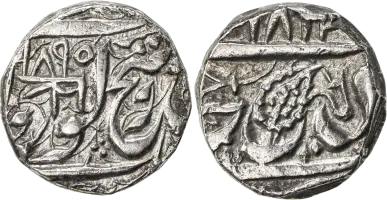
Obverse
Deg o Tegh o Fateh o Nusrat be-dirang Yaft az Nanak Guru Gobind SinghReverse
Zarb DerajatDera Ismail Khan and its Derajat district were absorbed between 1819 and 1821. The Nawab Sher Muhammad had previously struck Mahmudshahi rupees as a Sikh feudatory; after annexation the mint adopted the standard Sikh legend. Derajat rupees are substantially rarer than those of the principal mints and are prized by collectors.
Dera Mint
Zarb Dera · VS 1884/1894 · Dera Ghazi Khan
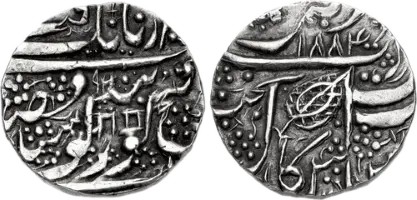
Obverse
Sikka zad bar Har do Alam Tegh-i-Nanak Wahib ast Fath Guru Gobind Singh Shah-i-Shahan fazl Saccha Sahib astReverse
Zarb DeraDera Ghazi Khan — then on the left bank of the Indus, subsequently swept away by the river — was administered as part of Multan province. Its rupees are among the rarest of all Sikh Empire coins; only a handful of confirmed pieces exist. The mint marks on the obverse were read by Rodgers as the word Ram in Nagari, though Herrli found this reading inconclusive.
Mankera Mint
Zarb [Sri Akal] Mankera · VS 1879–1880 · Sind-Sagar Doab
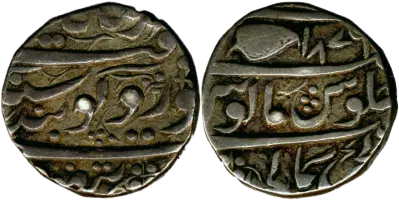
Obverse
Deg Tegh Fateh Nusrat bedarang Yaft az Nanak Guru Gobind SinghReverse
Sri Akal [Mankera?] · Year VS 1879Mankera — strategically placed in the Sind-Sagar Doab between the Indus and Chenab, controlling the Gomal Pass route from Afghanistan — was annexed by Ranjit Singh in 1821. Its rupees, long misidentified as "Malkerian" by Rodgers, are now attributed to Mankera. The fort, from which Nawab Sarbuland Khan surrendered to the Maharaja in person, lies today in ruins. Only two dates are recorded: VS 1879 and 1880.
Rare & Unidentified
The Minor Mints — Jhang, Mozang, Nimak & the Unknown
Beyond the principal and frontier mints, the Sikh Empire produced a small number of rupees from mints that operated briefly and left little administrative trace. Some of these — Jhang, Mozang, Nimak — are now identified; others remain disputed or wholly unidentified. They represent some of the most elusive pieces in the entire Sikh coinage and are of extraordinary rarity.
Jhang Mint
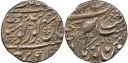
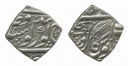
Dar Jhang · VS 1873 · Rechna Doab
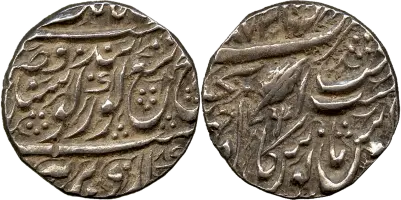
Reverse
Dar Jhang within the laam of Akal.Jhang, on the confluence of the Jhelum and Chenab in the Rechna Doab, struck Sikh rupees for what appears to have been a brief period during the transitional years of Ranjit Singh's consolidation of the western Punjab. Pieces dated VS 1873 are recorded; the mint's full working period remains uncertain.
Mozang Mint
Zarb Mozang · VS 1889 · Lahore Suburb
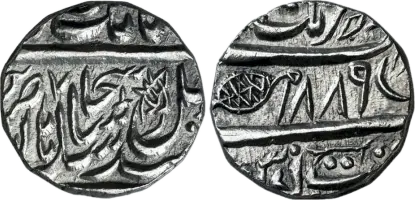
Reverse
Zarb MozangMozang was a suburb immediately south of Lahore city, within the Lahore Durbar's direct administrative territory. Its rupees are extremely rare and their exact administrative context is unclear — they may represent a brief auxiliary operation of the Lahore mint or a separate establishment. The VS 1889 date places them squarely within the mature empire period.
Nimak Mint
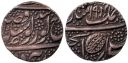
Zarb Nimakshahi · VS 1904 · The Salt Range
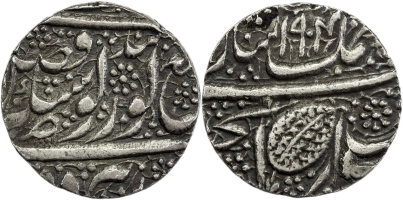
Reverse
Zarb Nimakshahi Struck in the Salt Range MountainsThe Salt Range — Kohistan-i-Namak — was one of the empire's great economic assets, supplying rock salt to the entire Punjab and beyond. The Nimak rupees, dated VS 1904, are among the latest coins of the Sikh Empire and were struck just two years before the annexation. Alexander Burnes left a famous description of the Salt Range and its mines (reproduced in Herrli, Appendix 6).
Unidentified Mint
VS 1888 · Attribution Uncertain
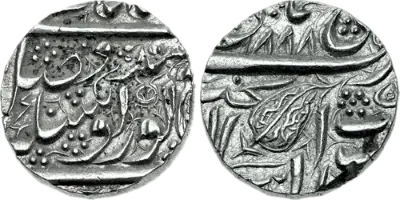
Obverse
Standard Sikh coupletReverse
Zarb [Mint Name partially legible]A number of Sikh rupees bear mint names that remain partially legible or wholly unread. Herrli catalogued several unidentified mints — designated Mint A, B, C, D, E, F — whose coins follow the standard Sikh fabric but cannot yet be assigned to a known location. New identifications continue to be made; this piece, dated VS 1888, awaits a definitive attribution.
Sources
References
- The Coins of the Sikhs. Second revised and augmented edition. Munshiram Manoharlal Publishers, New Delhi, 2004. The definitive catalogue of all known Sikh coin types, arranged by mint.
- Catalogue of Sikh Coins in the British Museum. British Museum Research Publication No. 190. London, 2011. Institutional catalogue of over 500 coins from the Bleazby, Whitehead, Baldwin, Talbot and associated collections; source for the annual Amritsar output estimate, the frozen-date discussion, purchasing-power data, the Morashahi four-theory summary, and the Kashmir governor attribution table.
- History of the Sikhs, Vol. V: The Sikh Lion of Lahore — Maharaja Ranjit Singh, 1799–1839. Munshiram Manoharlal, New Delhi, 1991.
- Coins of the Sikh Empire, Punjab and the Cis-Sutlej States Spink & Son, London, 2022. The most comprehensive modern catalogue of Sikh Empire & Cis-Sutlej States numismatic material.
- Ranjit Singh. Rulers of India series. Clarendon Press, Oxford, 1893. Griffin on the Peshawar campaigns: "It decided, once for all, whether Sikhs or Afghans should rule east of the Khyber."
- The Punjab Chiefs. Government of the Punjab, Lahore, 1865. Biographical dictionary of the principal Sikh families and sardars.
- Catalogue of Khalsa Darbar Records, Vol. I: Army Department. Government of the Punjab, Lahore, 1919. Catalogue of c. 100,000 administrative files covering the Sikh state, 1811–1849.
- Umdat-ut-Tawarikh (Chronicle of the Times). Persian-language chronicle of the Sikh state, composed by the court historian of Lahore. Primary source for the reigns of Ranjit Singh and his successors.
- Narrative of Various Journeys in Balochistan, Afghanistan and the Punjab. London, 1842. Eyewitness descriptions of Lahore, Multan and Peshawar under Sikh rule, c. 1827–1831.
- Kaschmir und das Reich der Siek. Stuttgart, 1840–1848. Eyewitness account of Kashmir and the Sikh court, c. 1835–1836; includes notes on the coinage of Kashmir.
- History of the Sikhs. London, 1849. First major English-language history of the Sikhs, written in the immediate aftermath of the annexation.
- Maharaja Ranjit Singh and his Times. 1990. Modern scholarly treatment of the reign; source for Ranjit Singh's remark about the coins struck in Guru Nanak's name.
Sikh Empire Coinage — VS 1856–1906
Select specimens from the SikhCoins.in collection. Click any image or title to browse the full album.


| Specimen | Mint | Date | |
|---|---|---|---|

|
Lahore, VS1864 Rupee | ||

|
Lahore, VS1863, Rupee | ||

|
Lahore, VS1856 Gold Mohur | ||

|
Lahore, VS1871, Rupee |
| Specimen | Mint | Date | |
|---|---|---|---|

|
Kashmir Mint, VS1876 Rupee, divided date | ||
|
Kashmir Mint, VS1886 Rupee | ||

|
Kashmir Mint, VS1876 Rupee, divided date | ||

|
Kashmir Mint, VS1878 Rupee, 'Har' in Gurmukhi |
| Specimen | Mint | Date | |
|---|---|---|---|

|
Multan, VS1905, Gold Rupee | ||

|
Multan Mint; VS1889 Rupee | ||

|
Multan Mint; VS1881 Rupee |
| Specimen | Mint | Date | |
|---|---|---|---|

|
Peshawar, ND, Copper Paisa, Gurmukhi couplets | ||

|
Peshawar, VS1891, Rupee | ||
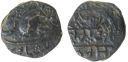
|
Peshawar, VS1891, Copper Falus |
| Specimen | Mint | Date | |
|---|---|---|---|

|
Derajat, VS1898, Rupee | ||
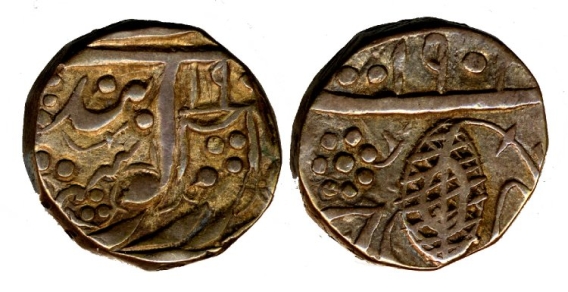
|
Derajat, VS1901, Rupee | ||
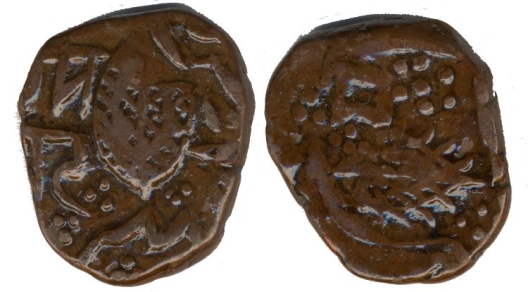
|
Derajat Mint; Copper Paisa; |
| Specimen | Mint | Date | |
|---|---|---|---|

|
Nimak, VS1905, Rupee | ||
|
Nimak, VS1905, Rupee | ||
|
Nimak, VS1904, Rupee | ||

|
Nimak, VS1905, Rupee, Ram Ji Sahai in Nagri |
| Specimen | Mint | Date | |
|---|---|---|---|

|
Jhang; VS1874 Rupee; Trident below leaf on Rev. | ||
|
Jhang, VS1873, Rupee. Trident Symbol | ||
|
Jhang; VS1874 Square Half Rupee |