The Counterfeit Coin Forgery in Sikh Numismatics
From 18th-century contemporary forgeries struck at illicit mints to modern CNC-milled replicas indistinguishable to the naked eye — a collector's guide to recognising the false coin
Why Sikh Coins Were Forged
Forgery is as old as coinage itself. Wherever a coin carries intrinsic value — silver, gold — there is an incentive to produce something that passes for it at less cost. Sikh coinage, struck primarily in high-purity silver and with a fairly standardised design vocabulary, was attractive to forgers from the moment it began circulating in the mid-18th century.
The Sikh rupee was unusual in the subcontinent in one important respect: its design changed very little across nearly a century of production. The Nanakshahi and Gobindshahi couplets, the Devanagari or Persian mint marks, the VS date — these elements remained constant from the Misl period through to annexation in 1849. That stability made Sikh coins easier to forge than most Mughal or Company issues, where a forger had to match a specific ruler's portrait or a highly varied calligraphic style.
Demand for Sikh coins has never been higher than it is today. Diaspora collectors, institutional buyers, and the general rise of South Asian numismatics have pushed prices for scarce types — gold mohurs, Nimak mint rupees, Peshawar series — to levels that make high-quality forgery commercially worthwhile. The threat is not merely historical.
Contemporary & Early Forgeries
The earliest forgeries of Sikh coinage were made not by later generations but by contemporaries — craftsmen operating outside the official mints who struck coins from inferior silver or base metal plated with silver. These contemporary forgeries entered circulation alongside genuine coins and are sometimes almost indistinguishable from official issues in style, since the forgers occasionally had access to the same artisans or copied genuine dies directly.
18th – 19th Century
Contemporary Circulation Forgeries
Struck from locally-made dies, often in low-grade silver or plated copper, intended to pass in the bazaar. The best examples are nearly identical in fabric to genuine coins; the poorest show crude lettering and irregular planchet preparation.
19th – Early 20th Century
Sand-Cast & Lead-Cast Copies
A genuine coin was pressed into fine sand or clay to create a negative mould; molten metal was poured in. The resulting coin shows a characteristic granular surface texture, slight loss of sharpness in the legends, and — critically — raised casting seams or sprues on the edge.
19th Century
Die-Struck Forgeries from Copied Dies
Produced by skilled craftsmen who hand-engraved new dies copying a genuine specimen. These can be extremely deceptive. Tell-tales include inconsistency in the couplet lettering, non-standard symbol placement, and dates that were never actually struck at a given mint.
20th Century
Electrotype Copies
A galvanic process depositing metal onto a wax impression of both faces, then joining the two shells with a lead or tin fill. Identifiable by the join seam running around the edge, slightly below the rim, and an unusually uniform surface with no die flow lines.
The most deceptive historical forgeries in Sikh numismatics are the die-struck copies of gold mohurs. Several 19th-century examples of the Amritsar and Lahore gold series circulate in the market today, made from genuine gold and struck with hand-engraved dies that are nearly period-accurate. The giveaway is the alloy: genuine Sikh mohurs were struck to a very consistent fineness; the forgeries, while gold, are typically of lower and inconsistent purity.
A specific and well-documented case in this collection is the forgery of the Khalsa Rupee Year 2 — a coin so rare that any specimen appearing in the market invites scrutiny. An auction example shown in the gallery below was identified as a cast forgery on the basis of surface porosity under magnification, an incorrect edge profile, and a weight that fell outside the known range for the type.
Documented Forgeries & Fakes
Select specimens from the Fakes & Forgeries section of the SikhCoins.in gallery. Each links to the full record with detailed notes.


High-End Modern Forgery
The forgeries most dangerous to today's collector are not crude cast copies — those are detectable with a loupe and a basic knowledge of coin surfaces. The serious threat comes from a small number of highly skilled operations using industrial and digital techniques to produce coins that defeat visual inspection entirely.
Contemporary — High Risk
Pressure Die-Casting
Molten metal injected under high pressure into precision steel moulds machined from genuine coin scans. Produces sharper detail than sand-casting and eliminates the raised seam. Still betrayed by flow lines in the metal inconsistent with die-striking, and micro-porosity invisible to the naked eye.
Contemporary — Highest Risk
CNC-Engraved Dies
Computer-controlled milling machines carve dies directly from high-resolution 3D scans or photogrammetric models of genuine coins. The resulting strikes can match genuine coinage in every measurable die characteristic. Detection requires comparison of edge profile, and alloy analysis.
Contemporary
Transfer Die Forgeries
A genuine coin is used as a hub to mechanically transfer its design to a working die via a reducing machine or pantograph engraver. The process introduces a slight but measurable reduction in diameter and relief — detectable by precise measurement against known genuine specimens.
Contemporary
Tooled & Altered Genuine Coins
A genuine coin of a common type is re-engraved — the date altered, a symbol added, or a mint name changed — to simulate a rarer variety. The most insidious category: the base coin is genuine, the metal is correct, only the engraving is false. Requires die-pairing study to expose.
The CNC-milled die represents a genuine step-change in the threat level. Prior to digital fabrication, every hand-engraved die carried the individual characteristics of its maker — microscopic tool marks, slightly uneven letter spacing, idiosyncratic symbol execution — that allowed an experienced eye to separate forgeries from originals by comparison. CNC removes this. A milled die is derived directly from a genuine specimen and produces strikes that share the precise geometry of the original.
What CNC cannot replicate is the metallurgical history of the original. A genuine Sikh rupee struck in the 1830s has 190 years of micro-crystalline change in its silver structure — a pattern of grain growth, stress relaxation, and surface chemistry that no modern coin can reproduce. This is the primary basis of scientific authentication today.
A note on online purchases: The overwhelming majority of Sikh coins sold on eBay, Etsy, and general auction platforms in the under-₹5,000 / under-$60 range are either genuine low-grade common types or outright fakes. The dangerous category is the mid-range lot — ₹15,000–₹80,000 / $180–$1,000 — where the price suggests authenticity but the seller has no verifiable expertise or provenance. This is where modern fakes are most profitably deployed.
Tell-Tale Signs by Forgery Type
No single indicator is definitive. Authentication is the accumulation of evidence. The table below summarises the primary physical signatures of each forgery category — what to look for, and what genuine coins show in contrast.
| Forgery Type | Key Tell-Tales | What Genuine Shows |
|---|---|---|
| Sand / lost-wax cast | Granular surface; casting seam on edge; slightly mushy legends; weight often low; porosity under 10× loupe | Flow lines from die-striking radiating from centre; sharp letter edges; clean rim |
| Pressure-cast | Sharper than sand-cast but still shows micro-porosity; no die flow lines; unnaturally uniform surface lustre; edge may be filed | Die flow lines visible at 10×; edge shows hammer or collar marks; natural wear pattern |
| CNC die-struck | Passes visual inspection; alloy may be correct weight but wrong purity; no genuine toning chemistry | Toning follows grain boundaries; XRF shows correct alloy profile |
| Transfer die | Slightly smaller diameter than genuine (typically 0.3–0.8mm); slightly lower relief; legends may be marginally compressed | Diameter within ±0.2mm of type standard; full relief; legends open and well-spaced |
| Electrotype | Join seam around the edge; unnaturally perfect surfaces on both faces; taps hollow; weight significantly under standard | Solid; weight within ±0.3g of type standard; no join seam; natural edge marks |
| Tooled genuine | Fresh tool marks in specific areas under loupe; inconsistency between the altered element and the coin's wear level; die-pairing mismatch | Consistent wear across all elements; die-pairing matches known combinations |
Detection for the Collector
The following steps can be performed without specialist equipment. They will not catch a well-made CNC-struck fake, but they will eliminate the vast majority of crude and mid-grade forgeries that account for most collector losses.
-
Weigh it. Every type of Sikh rupee has a documented weight range. A genuine Amritsar rupee of the Empire period should fall between 10.8g and 11.4g; a Peshawar series rupee between 8.1g and 8.6g. A coin outside this range by more than 0.5g demands an explanation. A precision digital scale accurate to 0.01g costs very little and is the single most useful tool a collector can own.
-
Measure the diameter. Sikh rupees are typically 23–26mm depending on mint and period. The Cis-Sutlej states frequently struck heavier, thicker coins of smaller diameter. Transfer die forgeries are consistently smaller by a measurable margin. Use callipers, not a ruler.
-
Examine the edge. Hold the coin edge-on under a raking light. A die-struck coin shows fine parallel flow marks and the slight compression of the collar. A cast coin shows a seam or a filed, unnaturally smooth surface. An electrotype shows a join line. Spend more time on the edge than on the faces.
-
Use a 10× loupe on the fields. The flat areas between legends on a genuine struck coin show die flow lines — fine parallel scratches radiating from the highest points of the design. Cast coins show a stippled or granular surface. This is the clearest single indicator available without scientific equipment.
-
Check die-pairing and symbol placement. For well-documented types — Amritsar, Lahore, Kashmir — the known die combinations and symbol positions are published in Herrli, Sidhu & Dalwinder Singh (Spink 2022), and the British Museum catalogue (Khera 2011). A coin with an undocumented symbol or type combinations is not automatically a forgery, but it requires explanation.
-
Examine the toning. Genuine old silver tones from the surface inward, following the metal's grain structure and concentrating in the recesses of the design. Artificially toned forgeries show an even chemical deposit that sits on the surface, often with an unnatural uniformity and without the characteristic darkening in the deepest letters. Toning can be removed with acetone; artificial toning will lift cleanly, genuine toning will not.
-
Demand provenance for expensive purchases. For any coin above ₹25,000 / $300, ask for the seller's acquisition history. A coin that cannot be traced to a named collection, auction, or dealer invoice prior to the last few years deserves additional scrutiny regardless of its visual appearance.
-
For scientific certainty: XRF analysis. X-ray fluorescence spectrometry gives the full alloy composition non-destructively in a few minutes. Genuine Sikh rupees show a characteristic silver-copper alloy profile consistent with known die-struck planchets. Modern forgeries frequently use commercially-sourced silver of different purity or alloy mix. Many major auction houses and some dealers offer XRF testing. For gold pieces above ₹1 lakh, it is non-negotiable.
Misattributed & Misread Coins
Not every suspect coin is a forgery. A significant category of error involves genuine coins of other series — Mughal, Durrani, or early Company — that are misread or misattributed as Sikh. These are not fakes; they are honest misidentifications, sometimes perpetuated in auction catalogues and dealer listings for decades. The collector who knows what a Sikh coin actually says is immune to this category of error.
The most persistent example is the Mughal bada bar type from Lahore mint — coins of Jahangir, Shah Alam I, and Aurangzeb bearing a floral cartouche device that has been repeatedly described as a Khanda symbol. These coins are genuine, often attractive, and worth collecting in their own right. They are not Sikh coins. A separate research page on this site documents the specific misreadings in detail.
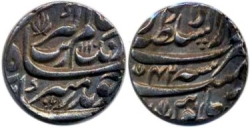
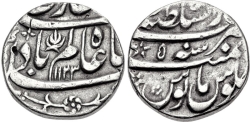

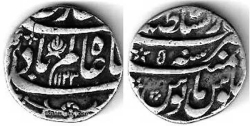
The Coin That Sold Twice: A Khalsa Rupee Year 2
Few cases in recent Sikh numismatics illustrate the limits of institutional authentication as clearly as the Khalsa Fauj rupee of Year 2 — a coin attributed to the brief sovereign coinage of Banda Singh Bahadur (AD 1710–1716), listed on Zeno.ru as photograph #261002, and sold twice by the same major auction house within twelve months at prices differing by a factor of nearly seven.
The Khalsa Rupee Year 2 is among the rarest types in all of Sikh numismatics. Only one specimen — held in the collection of Saran Singh FRNS — has been accepted as unambiguously genuine. The rarity of the type, combined with the near-absence of comparative reference material in the hands of most auctioneers, made it an obvious target.
Coin posted on Zeno.ru — immediate doubts raised
In October 2020, the coin was posted on Zeno.ru by its owner. Within hours, an experienced contributor on Zeno.ru — citing information from reputed US-based specialists who had examined the coin in hand — noted "serious allegations about the authenticity of the coin concerned" and suspected casting. Weeks later, the owner himself confirmed the verdict: "The final verdict, as confirmed by the owner, is that the coin is a cast. Please move to the appropriate category."
SEM metallurgical study commissioned — confirms cast and retooling
In mid-2023 the coin resurfaced and the owner commissioned a full scanning electron microscope (SEM) metallurgical study from a professional body, at a cost of several thousand dollars. The report's conclusion, shared publicly on Zeno by the site administrator: confirmation of a cast, with the presence of sand particles and evidence of retooling. The owner accepted the finding. The XRF data shared earlier in the thread had shown the alloy composition as Ag 23.8 / Au 0.091 / Cu 0.144 — absence of other trace elements, like Pb., consistent with the silver coins of this period, is an anomaly.
Major auction, 2024 — sold for $40,000
In August 2024 the coin was consigned to a major international auction house whose specialists examined the coin and listed it as genuine die-struck. The lot description read, with the description: "AR Rupee, 25mm, 11.98g, 6h. Amritsar mint. Dated Year 2 (AD 1711). Extremely rare. No others in CoinArchives." The coin sold in September 2024 for $40,000 plus buyer's commission. The auction house linked the Zeno discussion in their lot notes as an example of transparency — the ongoing authenticity debate was visible to all bidders.
At this point the SikhCoins group on Facebook and researchers familiar with the type identified the decisive calligraphic error: the forger had copied the reverse couplet from a published transcription of the Saran Singh specimen, but had misread or incompletely reconstructed the mint epithet. The genuine coin reads Mashwarat Shahr [مشورت شہر] — the Walled City of Counsel — a poetic designation for Amritsar. The forgery reads Surat Shahr [سورت شہر], an error that makes no geographic or poetic sense. William Irvine's account in Later Mughals vol. I gives the correct reading of the reverse legend as zarb ba-Aman-ud-dahr, Mashwarat-shahr, Zinat-ut-takht-i-mubarak-bakht — leaving no ambiguity about the correct text.
Same auction house, 2025 — re-listed in grading slab, sold for $6,000
In April 2025, It was reported on Zeno that the same coin — now encapsulated in a third-party grading slab, graded XF Details, Tooled — had been re-listed by the same auction house, with an estimate of $10,000. The grading note acknowledged tooling. Crucially, the re-listing made no mention of the prior sale at $40,000. The coin sold in May 2025 for $6,000 — roughly 15 cents on the dollar of its previous hammer price.
The price collapse reflects belated market recognition of what the metallurgical report, the calligraphic analysis, and the original 2020 community assessment had all established independently: the coin is not a genuine Banda Bahadur rupee of Year 2.
This case carries several lessons that no amount of general authentication guidance can substitute for. First, institutional examination is not infallible — two specialist auction house teams and a third-party grading service produced conflicting verdicts on the same coin. Second, community knowledge precedes institutional knowledge: the Sikh numismatic community had identified this coin as suspect in 2020, three years before the SEM study confirmed it and four years before the first major auction. Third, the calligraphic evidence was visible in photographs — no physical examination was required to read سورت where مشورت should appear.
The existence of at least one additional fake of this type in the market — documented in the comparison collage posted on Zeno — suggests a deliberate series rather than a single opportunistic copy. The only confirmed genuine Year 2 specimen remains the Saran Singh example. Any other offered specimen demands comparison against that coin on all measurable parameters before any other consideration.
The Heavy Peshawar Rupee VS 1894: Provenance, Calligraphy, and a Weakened Argument
The second case involves a rupee of Peshawar mint dated VS1894 (AD 1837) — the last active year of Hari Singh Nalwa's governorship, and the year of the Battle of Jamrud in which Nalwa was mortally wounded. The coin appears on Zeno.ru as photograph #85648 and was listed by a major international auction house in September 2024, graded AU 58 by a third-party grading service, described as "Very rare. Top Pop."
The primary technical issue is weight. The standard Peshawar series rupee weighs approximately 8.3–8.6g, containing roughly 7.0g of silver — a deliberately light standard established for commercial exchange on the North-West Frontier. Heavier Peshawar rupees of 10.4–11.0g do exist for VS1894 (Herrli 13.02.04 / 13.04.04). Current research now establishes their correct attribution: these heavy rupees were struck under British authority at Peshawar after annexation, for the specific purpose of withdrawing the lightweight Afghan coinage from circulation. They were never intended to circulate themselves and were demonetised almost immediately — which explains their extreme rarity. The coin under discussion weighs 11.07–11.10g, at or marginally beyond even the top of the known heavy-issue range.
The British Museum specimen — the sole published reference example — was acquired in 1912 from the collection of George B. Bleazby. The India Office List of 1902 identifies him precisely: under the Bengal Financial Department, he served as Chief Superintendent in the Punjab section under the Accountant-General. The London Gazette (21 September 1881) records his honorary rank on the Bengal Establishment. The Bleazby Collection of over 2,500 coins was presented to the British Museum by Henry Van Den Bergh in 1911 to commemorate the Delhi Durbar. Bleazby was not a military collector picking up curiosities in the field — he was a currency accountant working in the Punjab Financial Department, in the very administrative department responsible for currency circulation and withdrawal in the province. A Chief Superintendent in that department retaining specimens of coins struck specifically for demonetisation is not coincidence: it is the precise professional context in which such pieces would survive.
Coin posted on Zeno — weight anomaly immediately noted
The coin was uploaded to Zeno.ru in May 2010. An experienced contributor immediately flagged the weight question, providing the key reference data — standard Peshawar rupees ~8.5g; heavier VS1894 examples 10.4–11.0g attributed to a post-annexation recoining campaign — and asked the owner to confirm the weight. The recorded weight of 11.10g sits at the very top of that range.
Additional images provided — calligraphic detail visible
High-resolution images were submitted anonymously to the Zeno.ru administrator and posted in January 2023 and April 2024, enabling detailed calligraphic examination of the legends and date.
Auction listing — third-party graded slab — community flags calligraphy
In August 2024 the coin appeared at the same auction house that listed the Khalsa Rupee Year 2, graded AU 58 by a third-party grading service. The description noted reeded edges, the Gobindshahi couplet with Guru Nanak's name placed on top, and characterised it as a pattern coin of unique type.
This site's analysis at the time identified very different and sloppy calligraphy when compared to both the British Museum specimen and the regular circulation issues of the Peshawar mint, with the specific observation that even the date is written very differently from the standard Peshawar die style.
The Nau Nihal Singh wedding claim — and why the evidence does not support it
The pro-authenticity argument advanced in the Zeno discussion was that this coin was a presentation piece struck for the March 1837 wedding of Maharaja Ranjit Singh's grandson Nau Nihal Singh — an occasion attended by the British Commander-in-Chief — explaining the heavy flan, reeded edge, and modified legend placing Guru Nanak's name first. The timing appears to fit: Hari Singh Nalwa was mortally wounded at Jamrud on 30 April 1837, some seven weeks after the wedding.
The argument fails on two grounds. First, the Lahore mint, not Peshawar, was the mint of record for royal presentation coinage. We know the Maharaja had the portrait rupee with flag in the background struck at Lahore in VS1893 specifically for the Nau Nihal Singh wedding — that is the documented presentation coinage of the occasion. There is no precedent for a frontier garrison mint striking a separate commemorative series for a Lahore court wedding, and no parallel exists. Second, the Bleazby provenance of the BM specimen places it firmly in the post-annexation British administrative context, not in a Sikh court presentation tradition. A coin struck as a Sikh royal presentation in 1837 would not have entered a Punjab financial administrator's collection in the 1860s–1880s as an unremarked curiosity alongside 2,500 other coins — it would have been treasured, documented, and almost certainly known to the numismatic community of the period.
What the Bleazby context does explain perfectly is a small administrative strike made by British authorities after 1849, never released to circulation, surviving in very small numbers in official or military hands — which is precisely the profile of the BM specimen's known history.
The calligraphic divergence from known genuine Peshawar dies — documented by this site and visible in the high-resolution images — remains the most immediately accessible indicator. The BM specimen provides the comparison standard; the coin under discussion does not match it in letter forms or date style. The weight at 11.10g sits beyond even the post-annexation heavy-issue range. The presentation-coin narrative, once the Bleazby provenance and the documented Lahore presentation coinage for the same wedding are taken into account, does not hold.
The lesson for collectors is the same as in every case where a "unique type" claim is offered with institutional authentication: verify the narrative against the historical record independently, not just against the coin's surface. A grading service certifies condition; it does not research the provenance of the type claim.
The Necklace of Eight: VS 1843 Amritsar Gold Mohurs and the Weight Pattern
The third case is the most instructive precisely because it involves gold — the metal where the financial stakes are highest and where the forger's incentive to invest in quality is greatest. It also introduces a technique that the other two cases did not: the deliberate use of jewellery mounts to obscure the single most accessible authentication test available to a collector.
In September 2019, a well-known specialist auction house offered a necklace of eight AV mohurs, Amritsar mint, VS1843, described in their listing as a Bhangi Misl presentation issue — struck from the same dies used for the silver rupee of the type, attributed to Ghulab Singh Bhangi as a presentation to a chief official or family member. A ninth coin from the same necklace had been sold earlier in an earlier auction (Lot 2547). The listing described production as "limited to a very small group, probably just the nine examples attached to this necklace."
Multiple coins physically examined in India — weight pattern documented
Prior to the auction listing, at least 4–5 pieces from this group had entered the Indian market. Three were physically examined by this author. The finding was consistent: all specimens weighed 10.5–10.68g. A genuine Sikh gold mohur of the Amritsar series should weigh approximately 10.7–10.9g, close to the Mughal miskhal standard that Sikh mints inherited. The 10.5–10.68g band is measurably light — roughly 0.2–0.4g below the lower bound of genuine documented examples — but the more significant finding was that the identical weight appeared across coins purporting to be from entirely different types and mints: the VS1843 Amritsar, a Multan first-occupation mohur, and a VS1878 Amritsar mohur without the leaf device. Three distinct die pairs; one weight band. A Peshawar mohur from the same group showed additional physical signs of casting.
Auction listing — coins presented in necklace with mounts
The eight remaining necklace coins were offered at auction in September 2019. Their listing carried a plausible narrative: a small presentation series struck in gold from the standard silver dies, ordered by Ghulab Singh Bhangi, probably for Mai Sukhan. The coins were mounted in a necklace — a traditional form of Sikh gold coin jewellery. The mounting is relevant analytically: soldered mounts add weight to a coin; their removal reduces it. A coin weighing 10.5–10.68g after mount removal could, in principle, have weighed correctly before mounting if the solder added 0.2–0.4g. This is a valid argument that cannot be dismissed from photographs alone.
Discussion suppressed on the SikhCoins Facebook group
When the listing was posted to the SikhCoins Facebook group — one of the largest forums for Sikh numismatic discussion — the group administrator opened the thread with a directive: anyone who had not physically examined the coins in the necklace was to refrain from commenting on authenticity, and posts "casting aspersions" would be removed. The stated rationale was that the auction house is highly reputed and would not list without verification. The practical effect was to prevent the community knowledge about the circulating Indian-market pieces — and the documented weight pattern across multiple types — from reaching the broader audience of prospective bidders in time.
This pattern of institutional authority being invoked to suppress community-sourced technical analysis recurs across all three cases in this section. It does not reflect on the integrity of any individual — reputed auctioneers and group administrators act in good faith on the evidence available to them. But it illustrates a structural problem: community knowledge and institutional knowledge travel through different channels at different speeds, and in numismatics the gap between them is most dangerous precisely at auction.
Unresolved — but the weight pattern is the evidence
The VS1843 Amritsar mohur case does not have the closed verdict of the Khalsa Rupee Year 2. No metallurgical report has been published for the necklace pieces. The mount-removal weight reduction argument is technically valid. What cannot be argued away is the cross-type weight pattern: genuine gold mohurs from different Sikh mints and different periods do not cluster at the same sub-standard weight. The VS1843 Amritsar, the Multan first-occupation, and the VS1878 Amritsar without leaf are from different dies, different dates, and in the case of Multan a different mint entirely — yet all three share the same anomalous weight band. The simplest explanation for that convergence is a common modern production source working to a slightly-off gold standard.
The lesson for collectors is direct: "weight variations are a big red flag" in Sikh coinage, where standards were strictly maintained. For gold, the implication is absolute: weigh before you buy, and compare against multiple documented genuine specimens of the specific type, not against a general Mughal-standard expectation. A 0.3g shortfall on a single specimen might be explained by mount removal or planchet preparation variance. The same 0.3g shortfall appearing across three unrelated types cannot.
The broader series — VS1843 Amritsar, Multan first-occupation, VS1878 Amritsar without leaf, Peshawar gold — represents what appears to be a coordinated production run of Sikh gold forgeries, targeted specifically at the rare and high-value types where a collector's comparative reference is thinnest and the price premium for the type is largest. The Peshawar example showed casting signs on physical examination. The others did not display obvious casting markers — consistent with a die-struck or transfer-die process producing superficially convincing surfaces, but using a gold alloy slightly below the historical standard.
Three specimens from this forgery pattern are illustrated below, alongside a genuine comparison piece. The genuine VS1868 Amritsar gold mohur is from the British Museum collection — acquired in 1920 from R. Johnston, who purchased it from the collection of Doyle Smith, Fellow of the Royal Geographical Society and Royal Numismatic Society. The provenance is documented; the type is well-established. The differences between it and the forgery are apparent once placed side by side.
Amritsar Mint Gold Mohur VS 1868 — Genuine vs Forgery
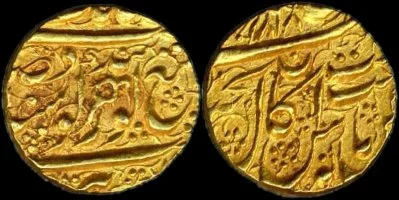
British Museum (ex Doyle Smith / R. Johnston, 1920). Open Nastaliq calligraphy with consistent pen-width variation and fine serifs. Natural die flow in fields. Clean leaf device.
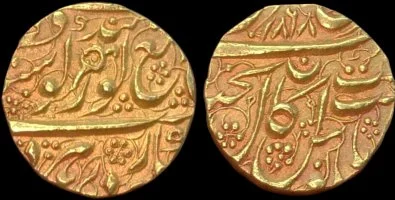
Same type. Letters thickened and compressed, serifs absent, leaf device heavier. Weight 0.31g below genuine — within the 10.5–10.68g band documented across this forgery series.
Ahluwalia Mint — Silver Rupee VS 1862 & Gold Mohur VS 1862 — Forgeries
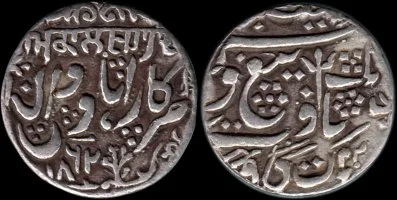
Cast. Granular fields, blurred letter edges, mushy relief throughout. Surface texture inconsistent with die-struck coinage.
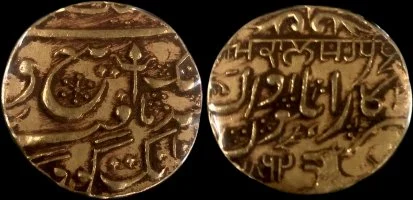
Die-struck from copied dies. Coarse calligraphy, compressed cartouche proportions, irregular pellets — a higher-effort forgery than the silver, but still identifiable from the die style.
The Repaired Coin: Condition, Disclosure, and What You Are Actually Buying
Forgery is the most dramatic threat to a collector, but it is not the most common one. Far more coins change hands every year with undisclosed repairs, removed mounts, tooled surfaces, and condition problems that a seller has chosen not to mention than are outright fakes. The financial impact on the buyer can be just as severe — and the legal recourse is even harder, because the coin is genuine. It has simply been misrepresented.
How Condition Drives Price in Sikh Coinage
Sikh coins were struck by hand on individually prepared planchets, struck with hand-engraved dies, and circulated in a cash economy that handled them without ceremony. The overwhelming majority of surviving examples are circulated — worn to varying degrees, often with banker's marks, sometimes with edge damage or flan flaws. A well-struck, unworn, original-surface example of almost any type commands a premium that can be five to ten times the value of the same type in average circulated condition. For the rarer types and gold series, the multiple is larger still.
The principal condition factors that affect value in Sikh coinage are:
-
Strike quality and centring. A well-centred strike with the full legends on both faces and a sharp impression commands a substantial premium over a weakly struck or off-centre piece. Many Sikh rupees — particularly the Peshawar and frontier series — are routinely found with weak strikes or legends partially off-flan. A fully struck example of these types is genuinely scarce and priced accordingly. An off-flan date or mint name is not merely an aesthetic issue: it removes the primary evidence of attribution, which matters to a scholar and to any future buyer.
-
Shroff marks. The sarraf (money-changer) tested coins for weight and fineness by making small punch-marks or cuts — shroff marks — in the fields or on the edge. These were the Indian subcontinent's equivalent of a banker's test cut. A heavily shroff-marked coin is fully genuine and historically interesting, but the marks reduce aesthetic appeal and therefore market value significantly. A collector buying for display should weigh this; a scholar buying for attribution should not be deterred. Shroff marks should always be declared in a listing and never described as "edge nicks" or passed over in silence.
-
Wear grades. The conventional grading scale (Poor through Uncirculated) applies to Sikh coins as to any other series, but needs calibrating for the type. A VS1822 Lahore rupee in Fine condition is common; the same coin in Extremely Fine is rare and worth several multiples. A VS1843 Amritsar gold mohur in any grade above Fine is extremely scarce because gold coins of the Sikh Empire were almost universally mounted as jewellery and few survived unmounted. Grade inflation — the practice of calling a coin VF when it is F, or EF when it is VF — is endemic in the Indian coin market and is one of the most consistent sources of buyer disappointment.
-
Original surfaces. A coin that has been cleaned — dipped in acid, polished, or scrubbed — loses the patina that forms over decades or centuries and which, on silver, is one of the most reliable indicators of age. Artificially brightened silver has a harsh, flat reflectivity quite different from the soft grey toning of a naturally aged coin. Cleaned coins should be described as such. Many are not. An experienced eye can identify cleaning readily; a photograph taken under directed light can mask it entirely, which is why buying from photographs alone is always a risk.
Mount Removal, Tooling, and the Problem of Silence
Gold coins of the Sikh Empire — mohurs, half-mohurs, nazarana rupees — were almost universally used as jewellery during and after the Empire's existence. A coin found today without any evidence of mounting is the exception. The problem is not that coins were mounted; the problem is that dealers and auction houses frequently do not declare mount removal or the repairs that follow it.
When a mount is removed, it leaves traces: a solder mark or scar at the rim, a filed edge where the solder was ground away, sometimes a small pit or depression where the mount was soldered directly to the coin's surface. A skilled restorer can reduce these marks to near-invisibility under normal viewing conditions — but they remain detectable under a loupe at the rim, in raking light, or by edge examination. The weight reduction from solder removal may be 0.1–0.3g, sometimes more if the rim was filed extensively.
What is not declared: In a significant proportion of Indian coin auction listings — and in private dealer offerings — mount removal is not mentioned. The coin is described as a mohur or rupee with a condition grade, with no reference to the scar at twelve o'clock on the rim or the slight flatness of the edge at that point. The buyer who does not physically examine the coin before bidding has no way of knowing. Upon receipt, they own a coin worth perhaps 30–50% less than what they paid for an undamaged example of the type.
Tooling is a related but distinct problem. A tooled coin is one where the surface has been re-engraved after striking — sharpening worn legends, re-cutting a date that had struck up weakly, deepening a device that had worn smooth. The intent is to make a circulated coin appear to be a higher-grade struck example. Tooling is detectable under magnification: genuine die-struck metal shows flow lines under the letters; re-engraved metal shows fresh cutting marks, sometimes across the natural flow lines. The two signatures are incompatible. Third-party grading services note tooling when detected — a "Details: Tooled" grade — but many tooled coins never reach grading services and are sold as genuine high-grade examples.
Plugged holes — where a coin pierced for suspension has had the hole filled with matching metal — are the most labour-intensive repair and the hardest to detect on a darkly toned coin. On gold, the repair is sometimes impossible to see from the face; the plug is detectable from the reverse or by weighing, since the plug metal is usually of slightly different composition and colour under strong light.
The Collection Sale: Inheritance, Dispersal, and the Condition Trap
A significant proportion of the Sikh coins that appear at auction in any given year come not from dealers' stocks but from collections — assembled over decades by serious collectors and now entering the market for one of two reasons: the collector has passed away and the heirs are liquidating, or a long-term collector has decided to realise the value of what they have built.
Both scenarios present the same risk to a buyer who is not paying attention. A collection assembled over thirty or forty years will contain coins acquired across a wide range of market conditions, levels of knowledge, and standards of disclosure. The collector who bought a gold mohur in 1985 may not have known that the mount scar at the rim had been filed and polished. The heirs who are now consigning the collection almost certainly do not know. The auction house, working quickly through a large consignment, may not examine every coin under a loupe. The result is that coins with undisclosed repairs, cleaned surfaces, and condition problems pass through estate sales and inheritance auctions with the implicit authority of a "collection piece" — a description that suggests it was vetted by a knowledgeable collector, when in fact it may have been bought in good faith from someone equally uninformed.
The practical implication is direct: condition is the first consideration, not the last. Before evaluating rarity, before considering die variety, before assessing historical significance — examine the physical object. A genuine, rare, historically important coin with an undisclosed mount removal and a polished surface is worth a fraction of what it would be worth intact. Buying it at a price appropriate to an intact example is a loss that cannot be recovered except by finding a buyer who either does not notice or does not care — neither of which is a satisfactory foundation for a collection.
For long-term collectors considering selling: full disclosure of condition issues, repairs, and mount history is both ethically correct and commercially sensible. A coin accurately described as "mount removed, professionally restored, surface lightly cleaned" will sell to the right buyer at the right price. The same coin described as a clean EF example will sell to the wrong buyer, generate a dispute, and damage the seller's reputation. The Sikh numismatic community is small. The same names recur across dealers, collectors, and auction buyers. Reputation travels faster than coins.
What to Check Before You Buy
The following applies to every purchase above a nominal value, whether from a dealer, at auction, or from a private seller. None of it requires specialist equipment beyond a basic loupe.
-
Examine the rim under a loupe, all the way round. Mount scars, filed edges, plugged holes, and solder residue are almost always at or near the rim. A smooth, consistent rim with no colour variation or surface discontinuity is a positive sign. Any anomaly at the twelve o'clock position on a gold coin should be questioned.
-
Check the fields under raking light. Tilt the coin under a single directed light source. Cleaned or polished surfaces show a uniform brightness; naturally toned surfaces show directional variation. Tooled areas show fresh cutting marks crossing the original die flow lines. Neither cleaning nor tooling can be hidden under raking light as easily as under direct overhead illumination.
-
Weigh before committing. For gold, this is non-negotiable. Know the documented weight range for the specific type — not the general Mughal miskhal standard, but the actual recorded range for coins of that mint, date, and denomination. A shortfall of more than 0.2g on a gold coin demands an explanation. Mount removal, filing, or a below-standard planchet are the three most likely causes; all three reduce value.
-
Ask for full condition disclosure in writing before bidding. A reputable seller will confirm in writing whether a coin has been cleaned, repaired, or had a mount removed. A seller who is evasive about this question is telling you something. For high-value purchases, request the opportunity to examine the coin in hand or under a return guarantee.
-
Apply a grading service grade sceptically. A third-party grade tells you the grader's assessment of the coin's condition on the day it was graded. It does not tell you whether the coin was cleaned before grading, whether the restorer's work passed undetected, or whether the type attribution is historically sound. "Details: Cleaned" or "Details: Tooled" grades are reliable; high straight grades on coins with unusual surfaces or anomalous weights should be independently verified before purchase.
-
For estate and collection sales, ask about the collection's provenance. When was the coin acquired? From whom? Is there any documentation — an old auction catalogue, a dealer invoice, a correspondence? The more that can be traced, the more confident you can be about its condition history. A coin with thirty years of undocumented private ownership could have been cleaned, repaired, or swapped at any point. A coin traceable to a named auction lot from 1975 with the original catalogue is far safer.
The Collector’s Defence
The forger's advantage is the collector's enthusiasm. The best defence is not scepticism of every coin — that way lies paralysis — but a disciplined habit of evidence: weigh, measure, examine the edge, study the fields, compare against documented specimens. For the vast majority of Sikh coins in circulation, these steps are sufficient.
For the small category of high-value rarities — gold series, Nimak mint, Khalsa period pieces, Peshawar series — the additional investment in XRF analysis and comparison with museum reference specimens is not optional. The British Museum collection (Khera 2011), the Spink reference (Sidhu & Dalwinder Singh 2022), and Hans Herrli's die study remain the primary resources for comparison. A coin that cannot be matched to a documented die combination, whose weight falls outside the recorded range, and whose alloy does not conform to the known standard, is not genuine until proven otherwise — regardless of how attractive it looks.
The Fakes & Forgeries section of this gallery documents confirmed and probable forgeries with full technical notes. It is a working reference, not a complete census. Contributions of documented forgeries with analysis are welcome.