The Medal
and the Sword
From the court honours of Maharaja Ranjit Singh to the campaign medals of the Anglo-Sikh Wars — and the extraordinary chain of events that links them to a well in Ajnala, a massacre in 1857, and a DNA laboratory in 2022.
Sikh Empire · Anglo-Sikh Wars · 1857 · The Princely States
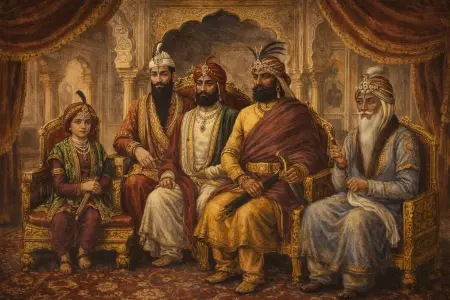
The Sikh Maharajas
From Ranjit Singh to Duleep Singh
The Sikh Empire · Court Honours
The Honours of the Durbar
Maharaja Ranjit Singh did not inherit the idea of formal military honours — he observed it, admired it, and created his own version of it. The catalyst was the arrival at his court of a stream of European officers from the 1820s onwards: veterans of Napoleon's campaigns who had fought from Spain to Moscow and who carried on their chests the evidence of their service in the form of medals, orders and decorations that the Maharaja had never seen before. The Légion d'honneur of General Jean-François Allard, the decorations of General Jean-Baptiste Ventura, the orders worn by General Claude Auguste Court — these were objects of considerable fascination in the Lahore Darbar. Ranjit Singh studied them carefully. He asked about them. He had them sketched and described.
The Sikh tradition of honouring distinguished service was older than the Empire — gifts of arms, horses, elephants, jewels and robes of honour (khilat) had been central to Punjabi court protocol for generations. But Ranjit Singh saw in the European medal system something more potent: a permanent, portable, visible mark of the sovereign's favour, worn on the body, publicly displayed, impossible to miss. It was, he understood, a technology of loyalty as much as a technology of honour.
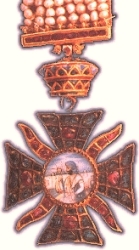
The result was a distinctive body of Sikh court honours that drew on Mughal khilat tradition, European medal conventions, and the Maharaja's own aesthetic sensibility — an aesthetic shaped by the most dazzling treasury of gems and gold in Asia. The honours he created were, in their finest examples, not merely decorations but works of art: miniature portraits in enamel surrounded by rose-cut diamonds, sunburst stars set with rubies and emeralds, medallions of gold bearing the Maharaja's likeness rendered on ivory. They were given not for longevity of service but for specific acts of valour, loyalty or diplomatic achievement — which made each one a story.
The Maharaja awarded these honours to Sikhs and non-Sikhs without distinction — to Dogra generals, Muslim nobles, Hindu administrators, and to the European officers who had given their professional lives to his service. The decoration created an equality of honour across religious and ethnic lines that was as deliberate as it was unusual. In the most expansive empire in Asia outside British India, a Muslim general's chest and a Sikh sardar's chest bore the same star.
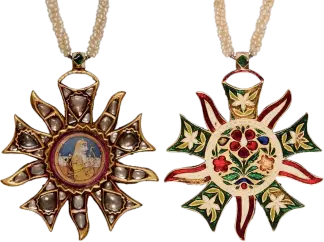 Kaukab-i-Iqbal-i-Punjab · Order of the Propitious Star of the Punjab
Kaukab-i-Iqbal-i-Punjab
Order of the Propitious Star of the Punjab · Highest Sikh Imperial Honour
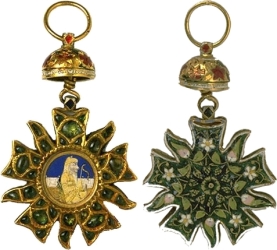
The supreme decoration of the Sikh Empire, instituted by Maharaja Ranjit Singh in March 1837 to mark the marriage of his grandson Nau Nihal Singh — reportedly at the suggestion of Sir Henry Fane, the British commander-in-chief who attended the wedding. A gold sunburst star whose form consciously echoed the Légion d'honneur the Maharaja had admired on General Allard's chest, it bore a central enamelled portrait of Ranjit Singh seated at his court, with his name on the reverse. It was conferred in three classes, distinguished by the stones set in them: diamonds alone for the first class — reserved for the royal family, allied princes and the greatest chiefs — diamonds and emeralds for the second, and a single emerald for the third, awarded to senior military and civil officers for valour and faithful service. The first recipient was Nau Nihal Singh himself; General Allard was among the European officers honoured with it. Fine examples survive in the Victoria and Albert Museum, London. (Its name — the "Star of the Prosperity of the Punjab" — is sometimes loosely rendered as an "Order of the Koh-i-Noor," but that is a modern gloss rather than a historical title.)
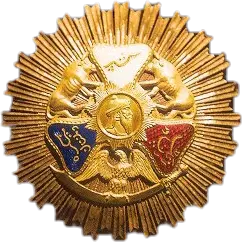 Gold Medallion · European Officers
Gold Medallions — European Officers
Allard · Ventura · Court · Avitabile · Gardner
The four principal European generals in Ranjit Singh's service — Jean-François Allard (French), Jean-Baptiste Ventura (Italian-French), Claude Auguste Court (French) and Paolo Avitabile (Italian, the iron governor of Peshawar) — each received multiple decorations from the Lahore Darbar, including gold medallions bearing the Maharaja's name or portrait. Allard, who arrived in 1822 and served until his death at Peshawar on 23 January 1839 — his body brought back to Lahore and buried with full military honours beside the tombs of his daughters — received the most comprehensive body of Sikh honours of any foreign officer. (He had taken two years' leave in France from 1834, building a palace for his wife at his native Saint-Tropez, before returning to the Punjab in early 1837.) The Scottish-American Colonel Alexander Gardner, who served the Empire for decades, also received court decorations. These medallions circulated back to Europe after the officers' deaths or the annexation of the Punjab, and several entered museum collections — the earliest documented objects of Sikh decorative metalwork in European hands. See Foreign Officers at the Lahore Court for full biographies.
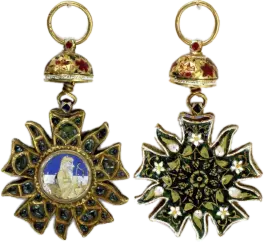 Portrait Miniature in Gold · Khilat
Portrait Miniatures in Gold — Khilat
Sovereign Gift · Ivory & Enamel & Rose-Cut Diamond
The most personal of the court honours: a miniature portrait of Ranjit Singh himself — painted in opaque watercolour and gold on ivory, typically set within a gold frame encrusted with rose-cut diamonds and sometimes coloured stones — given as a khilat, a robe of honour, to visiting dignitaries, distinguished generals and foreign emissaries. To receive the Maharaja's own likeness was the highest possible personal gift in the Punjabi court tradition: it signified that you were, in some sense, an extension of the sovereign's own gaze. Several of these portrait miniatures survive, the finest in the Victoria and Albert Museum, London, and the Lahore Museum. They remain the most intimate physical record of how Ranjit Singh wished to be seen by the world.
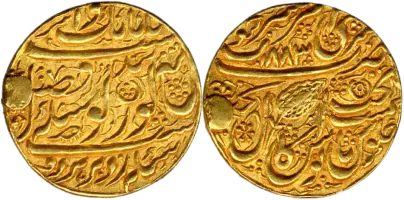 Nazarana Mohur · Court Honour
Nazrana Coins as Honours
Presentation Rupees & Mohurs · Military Gift Currency
The Sikh Empire drew no hard line between coin and honour. Nazrana rupees and mohurs — presentation-quality coins struck on broader, heavier flans with sharper dies — were routinely used as personal gifts by the Maharaja to visiting dignitaries, successful commanders and faithful servants. They circulated not as currency but as objects of personal prestige, worn on the turban or displayed at court. The Ahluwalia rupee of VS 1862 (the only Sikh coin to name a specific family, issued by Fateh Singh Ahluwalia with Ranjit Singh's personal permission) was precisely this: a coin as honour, a coin as political statement. The entire tradition of Sikh nazarana coinage — maintained by the Cis-Sutlej states well into the twentieth century — descends from this court practice of giving coins as gifts of honour.
The Campaign Medals · 1845–1849
The Army of the Sutlej & the Army of the Punjab
The two Anglo-Sikh Wars produced two of the most storied campaign medals in British Indian military history. Both were designed by William Wyon of the Royal Mint. Both bore the diademed head of Queen Victoria on the obverse. And both were awarded not just to British and Company troops but to tens of thousands of Indian soldiers of the Bengal Army — the Hindustani sepoys of eastern India whose role in the defeat of the Khalsa would, within a decade, acquire the most terrible of ironies.
The Sutlej Medal, approved on 17 April 1846, was the first British campaign medal ever issued with clasps to all ranks. This was itself a statement: every man who fought at Mudki, Ferozeshah, Aliwal or Sobraon received not merely a medal but a personalised record of exactly which battles he had survived, impressed on the rim in capital letters with his name and regiment. The clasp system was a permanent, legible biography of a soldier's courage. It made the Sutlej Medal something new in Indian military culture: an individual honour, not merely a collective award.
The Punjab Medal, approved on 2 April 1849, went further. Its reverse showed a scene almost without precedent in the iconography of British campaign medals: the actual surrender of the Sikh forces — General Sir Walter Gilbert on horseback receiving the submission of the Khalsa at Rawalpindi, with British colours flying in the background and the date MDCCCXLIX below. It was a medal that told a specific story of a specific defeat. Every soldier who wore it wore the moment of Punjab's fall on his chest.
This last fact is the crucial one. After annexation in 1849, the British moved with remarkable speed to recruit the soldiers of the defeated Khalsa into their own forces. The Punjab Irregular Force — the Piffers — was raised almost immediately. Sikh and Punjabi soldiers who had been fighting against the East India Company at Chilianwala in January 1849 were in British service by the following year, and many received the Punjab Medal for service in mopping-up operations after the formal annexation. They wore, on their chests, a medal showing the surrender of the very army they had served.
The British were not unaware of what they were doing. The deliberate, conspicuous awarding of campaign medals to newly-recruited Sikh irregulars — parading them in front of the older Bengal sepoys who had earned the same medals fighting against Sikhs — was a calculated act of military politics. It said: you are now of us. Your honour is now our honour. Your medal is now the same medal. It worked, in ways that would be fully apparent only in 1857.
The Sutlej Medal
First Anglo-Sikh War · 1845–46 · Approved 17 April 1846
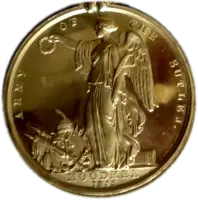
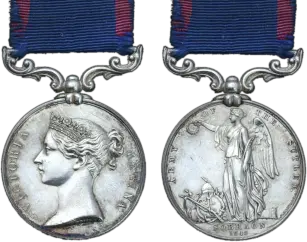 Sutlej Medal · Obverse & Reverse
Obverse
Diademed head of Queen Victoria. Legend: VICTORIA REGINA. Designed by William Wyon, stamped W. WYON R.A. Silver, 36mm diameter.
Reverse
A standing Victory, facing left, holding a wreath in her outstretched hand, with trophies of arms at her feet. Legend around circumference: ARMY OF THE SUTLEJ. The name and year of the first battle served by the recipient is inscribed below.
Ribbon
Dark blue with crimson edges, 31.7mm wide. Silver scroll bar and swivel.
Clasps issued
The first battle served — Mudki, Ferozeshah, Aliwal or Sobraon — is named on the reverse of the medal itself; further battles appear as clasps on the ribbon. No clasp was struck for Mudki, the first engagement, as every medal with subsequent clasps already records it on the reverse. A soldier who fought all four battles wore a medal with three clasps: the most complete record of the First Anglo-Sikh War that can be worn on a chest. Naming is impressed on the rim in roman capital letters: name, rank and regiment.
Browse Medal Collection →The Punjab Medal
Second Anglo-Sikh War · 1848–49 · Approved 2 April 1849
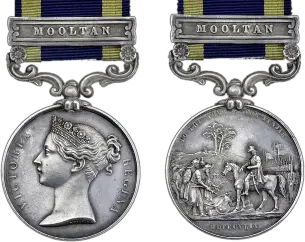 Punjab Medal · Obverse & Reverse · Mooltan clasp
Obverse
Diademed head of Queen Victoria. Legend: VICTORIA REGINA. Designed by William Wyon. Silver, 36mm diameter.
Reverse
General Sir Walter Gilbert on horseback receiving the surrender of the Sikh forces, with British colours flying and a palm tree on a hill behind. Legend above: TO THE ARMY OF THE PUNJAB. In exergue: MDCCCXLIX. The only British campaign medal whose reverse depicts the actual surrender of a specific enemy force.
Ribbon
Dark blue with a yellow stripe towards each edge, 31.7mm wide. An ornamental scroll swivel suspender.
Clasps issued
No recipient received all three clasps: the Mooltan and Chilianwala clasps were never awarded together, as no unit served at both. Of the Goojerat clasp, 32,960 were awarded — 6,200 to Europeans and 26,760 to Indian troops. The medal was also awarded without clasp to those present in the Punjab who did not take part in any principal battle, including many of the newly-raised Punjabi irregular units. These claspless medals, worn by Sikh soldiers recruited after the battles, are the physical record of the British strategy of absorption and reintegration.
Browse Medal Collection →The Uprising of 1857
The Loyal Province
On 10 May 1857, sepoys of the Bengal Native Infantry at Meerut mutinied — refusing a new cartridge they believed to be greased with cow and pig fat — and killed their British officers. The uprising spread rapidly through the North-Western Provinces and Awadh, engulfing Kanpur, Lucknow, Delhi and dozens of smaller garrisons in what the British would call the Mutiny and Indian nationalists would later call the First War of Independence.
Punjab did not rise. The Sikh soldiers newly recruited into the British forces did not join the sepoys. The Cis-Sutlej chiefs remained loyal to the Crown. The decision to stay aloof was not passive — it was active, deliberate, and shaped by calculations that were entirely rational from where the Sikhs stood in 1857.
The Punjab had been annexed only eight years before. The wounds of Chilianwala and Goojerat — the humiliation of watching a Sikh Empire that had taken a century to build dissolve in two campaigns — were not yet scars. They were still open. But the Sikh soldiers who had been recruited into the new Punjab Irregular Force and the Sikh regiments of the Bengal Army had been given something: they had been given the Punjab Medal, the same medal the British officers wore, the same medal that bore the date of their own empire's defeat on its reverse. They had been made, formally and publicly, part of the same military honour system as their former conquerors.
The Bengal sepoys who mutinied were largely upper-caste Brahmins, Rajputs and Bhumihars from eastern India — the same men who had fought alongside the British against the Sikhs at Mudki, Ferozeshah and Sobraon. The Sikh soldiers who now held their Punjab Medals and their Sutlej Medals had no cause to mourn those sepoys' grievances. The annexation of the Punjab was not the Bengal Army's loss. The Enfield cartridge was not the Punjab's religious crisis. And the Sikhs, who had faced a British army that included tens of thousands of those same Bengal sepoys just a decade earlier, had no reason to trust the sepoys' cause over the British medal-and-payment system that had, at minimum, treated them with visible honour since 1849.
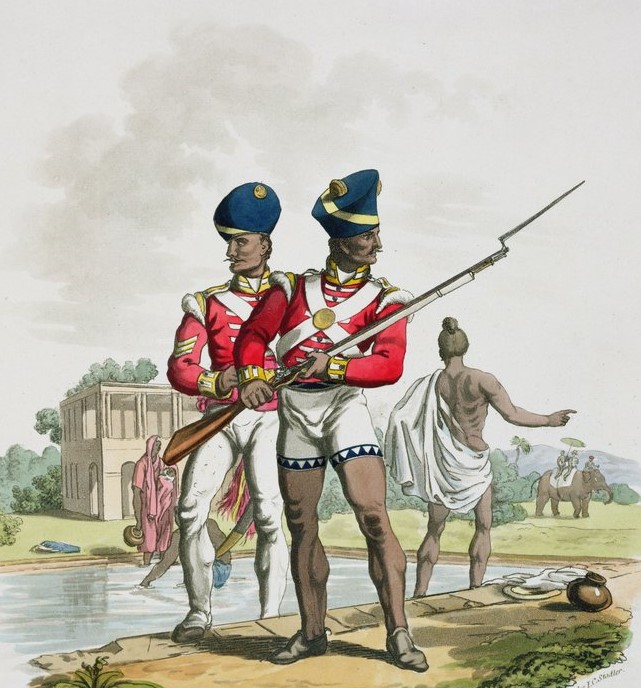
A Sergeant and a Private Grenadier Sepoy of the Bengal Army
Aquatint by Charles Hamilton Smith, published 1 March 1815 by Colnaghi & Co., London. These are the men of the Bengal Native Infantry who fought alongside the British at Mudki, Ferozeshah, Aliwal and Sobraon — and whose successors mutinied at Mian Mir in 1857.
The British understood this calculus perfectly. Lord Dalhousie's annexation policy had been complemented by John Lawrence's Punjab administration — a system that made the Punjab the most intensively administered and, deliberately, the most militarily rewarded province in British India. Lawrence mobilised Sikh levies immediately when the uprising began, secured the loyalty of the Cis-Sutlej chiefs, and used Punjab as the base from which the British recaptured Delhi in September 1857. The Sikh role was not incidental. It was decisive. And it was built, in part, on the foundation of the medal policy that had publicly enrolled Sikh soldiers into the British military honour culture in the years immediately after annexation.
Ajnala, Amritsar · 1 August 1857
The Kalianwala Khooh
On the night of 30 July 1857, the soldiers of the 26th Bengal Native Infantry stationed at Mian Mir Cantonment — three miles outside Lahore, now across the border in Pakistan — mutinied. They killed several British officers and fled. Around 500 men crossed the Ravi River and made for the town of Ajnala, some 25 kilometres from Amritsar, near the India-Pakistan border.
Frederick Henry Cooper, the Deputy Commissioner of Amritsar, moved against them at once. He assembled a force of Sikh levies — recently recruited, recently medal-awarded soldiers from precisely the region whose empire the 26th NI had helped defeat at Sobraon and Chilianwala — and hunted the fugitives down. At Dadian Sofian village near Ajnala, 218 were killed in a firefight. The remaining 282 were captured, imprisoned in a small room adjacent to the Ajnala police station, and on the morning of 1 August 1857, brought out and executed.
Cooper wrote about it himself, in his 1858 book The Crisis in the Punjab, from the 10th of May until the Fall of Delhi. He described it as a "spectacle". He recorded the method with pride: "Ten by ten the sepoys were called forth. Their names having been taken down in succession, they were pinioned, linked together, and marched to execution; a firing party in readiness." Two hundred and thirty-seven were shot in batches of ten by the Sikh firing parties. The remaining 45 suffocated in the locked room before they could be brought out. Their bodies — all of them — were thrown into an abandoned well. Cooper covered the well with mud and lime to suppress the smell. He received a personal letter of thanks from the Judicial Commissioner Robert Montgomery, conveying the "especial thanks" of the Punjab administration for his handling of the matter.
In Britain, Cooper's account drew condemnation. The Liberal MP Charles Gilpin, member for Northampton, denounced Cooper in Parliament in March 1859, calling the massacre "almost the very blackest page in the emphatically black book of the Indian rebellion." There was never any official censure.
The well was known locally as the Kalianwala Khooh — "the well of the Blacks", a derogatory British term for the Hindustani sepoys — and later as the Shaheedan da Khooh, the Martyrs' Well. A gurudwara was built over it. The story became local legend, then urban myth, then — for over 150 years — simply forgotten.
The Discovery & Scientific Verification · 2014 – 2022
In March 2003, amateur historian Surinder Kochhar found a discarded copy of Cooper's book outside the Town Hall library in Amritsar. The word Ajnala caught his eye. He spent eleven years piecing together the evidence — writing to the Prime Minister, state Chief Ministers, the Army Chief and Punjabi archaeologists, receiving no response — until, on 28 February 2014, he persuaded the committee of the Gurdwara Singh Sabha in Ajnala to allow an excavation.
Over three days, hundreds of Ajnala residents — gurdwara committee members, townspeople, even schoolchildren — volunteered and took turns carefully digging. What they uncovered was unprecedented: 90 intact skulls, elements of nearly 200 jawbones, thousands of other bone fragments — the remains of 282 men, adult males with good dental hygiene indicative of military service, thrown from height into a well. The bones had been covered with coal and lime. Among them were recovered 70 one-rupee coins minted by the East India Company, campaign medals — the Sutlej and Punjab medals among them — and pieces of personal jewellery.
The coins were East India Company rupees, and they carried the only dates the Company ever struck: 1835 under William IV and 1840 under Victoria — "frozen" dates retained on every strike for years afterward, until the Crown took over the coinage in 1862. No Company rupee bore a later date, so none of the coins could post-date the Company itself. This was the first forensic clue: it ruled out any link to the Partition violence of 1947 and placed the deaths squarely in the mid-nineteenth century. The campaign medals beside them — among them the Sutlej and Punjab medals — showed that these were men who had been soldiers in active service, carrying the decorations of the Anglo-Sikh wars, when they died.
The scientific confirmation came in April 2022, when a study published in Frontiers in Genetics by Dr J.S. Sehrawat of Panjab University, with collaborators from the Centre for Cellular and Molecular Biology, Hyderabad, and Banaras Hindu University, reported the results of DNA and isotopic analysis of 85 samples. Mitochondrial DNA traced genetic affinity to the Gangetic plains of eastern India — Bengal, Bihar, Odisha, eastern Uttar Pradesh. Isotopic analysis of tooth enamel confirmed long-term residence in those same regions. The radiocarbon dates from tooth collagen placed the deaths firmly in the mid-nineteenth century. Every independent method of analysis converged on the same answer: these were the soldiers of the 26th Bengal Native Infantry, men from eastern India, killed at Ajnala on 1 August 1857.
Skeletal remains
90 intact skulls, ~200 jawbones, thousands of bone fragments. All adult males. Good dental hygiene consistent with military service.
Numismatic evidence
70 one-rupee EIC coins (William IV frozen-dated 1835, Victoria frozen-dated 1840), Anglo-Sikh campaign medals — including Sutlej and Punjab medals — and personal jewellery recovered from the well.
DNA & isotopic confirmation (2022)
Mitochondrial DNA and tooth-enamel isotopes confirmed Gangetic plain origin. Radiocarbon dates: mid-19th century. Published: Frontiers in Genetics, April 2022.
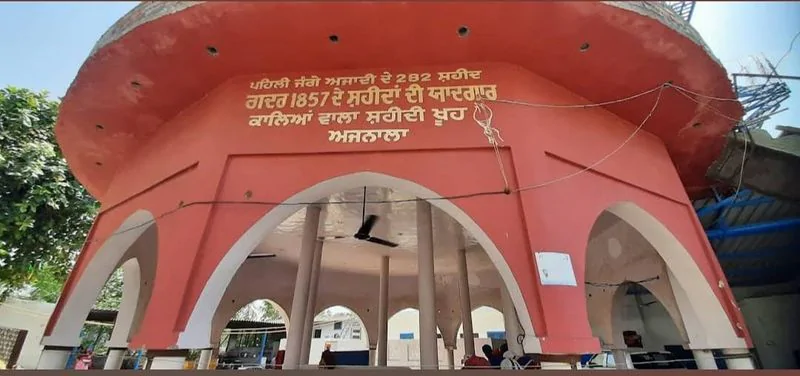
ਗ਼ਦਰ 1857 ਦੇ ਸ਼ਹੀਦਾਂ ਦੀ ਯਾਦਗਾਰ · ਕਾਲਿਆਂ ਵਾਲਾ ਸ਼ਹੀਦੀ ਖੂਹ, ਅਜਨਾਲਾ
The Shaheedan da Khooh · Ajnala, Amritsar · Memorial to 282 martyrs of the 1857 uprising
The soldiers Cooper used to execute the 26th NI were recently-recruited Sikh levies from the Majha region of Punjab — the same region, the same community, who had faced those same sepoys as enemies at Sobraon and Chilianwala. The 26th NI had helped break the Sikh Empire. Eight years later, Sikh soldiers executed them into a well near Amritsar. And among the objects recovered from that well — examined first-hand by this collection — were the Sutlej and Punjab campaign medals themselves: the very decorations these men had earned fighting the Khalsa, carried to their deaths and into the ground. The coins (Company rupees frozen-dated 1835 and 1840, none of which could post-date the Company), together with the later DNA, isotope and radiocarbon analysis, are what fixed the date and origin of the remains; but it is those medals that close the circle. The chain that begins with Ranjit Singh studying the Légion d'honneur on General Allard's chest ends here, in a brick-lined well on the outskirts of Amritsar.
The Princely States · 19th–20th Century
The State Medals
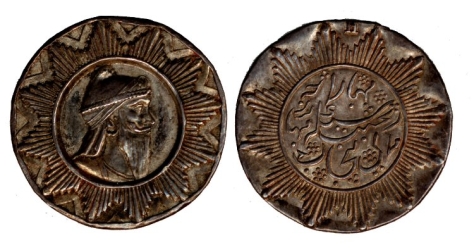
The Cis-Sutlej states and the Sikh princely states that survived into the twentieth century under British paramountcy issued their own medals and decorations — a tradition that ran in parallel with the British imperial medal system and drew on both the older Sikh court honour tradition and the Victorian medal conventions the Maharajas had absorbed through their long relationship with the Crown. These state medals are among the most visually distinctive objects in Sikh numismatics: they combine Punjabi royal iconography — the portrait of the reigning chief, the state coat of arms, the Gurmukhi legend — with the physical form of the British campaign medal, complete with ribbon, clasp and impressed naming.
The largest issuers were Patiala, where the Maharajas maintained a substantial court and military establishment and issued a range of orders and medals from the mid-nineteenth century; Jind, whose state medals document the dynasty's consistent loyalty to British interests from 1857 onwards; Nabha; and Kapurthala, where the Ahluwalia Maharajas created some of the most elaborate state decorations in British India, reflecting the dynasty's Francophile culture and the personal taste of Maharaja Jagatjit Singh. Faridkot issued a remarkable series in 1941, including a 5-rupee silver piece and gold mohurs bearing the portrait of Maharaja Sir Harinder Singh Brar, struck for a Viceregal visit and representing the final flowering of Sikh state numismatic tradition before the princely order was dissolved in 1947–48.
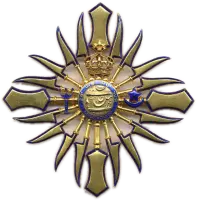
Patiala
Largest Cis-Sutlej medal issuer · Multiple orders & campaign medals
Patiala's medal tradition spans from the mid-nineteenth century to merger into PEPSU in 1948. The state issued orders for meritorious service, loyalty and gallantry, as well as decorations given to visiting dignitaries. The Maharajas of Patiala — particularly Bhupinder Singh (r. 1900–38) — maintained an exceptionally active court life and used medals and decorations as instruments of political prestige with the British administration. Patiala medals typically bear the state coat of arms on one face and the portrait or name of the reigning Maharaja on the other.
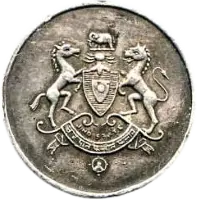
Jind
State medals & loyalty decorations · 1857 service recognised
Jind's loyalty during the 1857 uprising was publicly recognised by the British — the state received territorial rewards and its chiefs were publicly honoured. The Jind state medals document this relationship: several were issued specifically in recognition of service to the Crown during the uprising, making them the most historically specific of the Cis-Sutlej state medals. Jind's state medals also carry unusual historical weight given the dynastic connection — Gajpat Singh's daughter Raj Kaur, the Mai Malwain or lady from Malwa, was the mother of Maharaja Ranjit Singh, making Jind the maternal origin of the Sikh Empire itself.
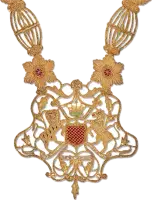
Nabha
State honours & gallantry decorations
Nabha issued state medals through the nineteenth and twentieth centuries, generally following the physical conventions of the British medal system — silver with named ribbon — while bearing distinctively Punjabi iconography. The Nabha medals are rarer than Patiala's and less studied. The state's unusual numismatic tradition — the Nabha Gobindshahi rupee was a regular circulation coin, not a nazarana, unlike Patiala's Gobindshahi series — gives its medals a context of active, continuing Sikh sovereignty rather than purely ceremonial production.
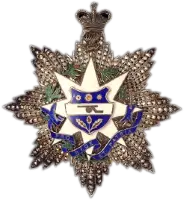
Kapurthala
Ahluwalia Misl dynasty · Most elaborate state decorations
The Ahluwalia Maharajas of Kapurthala created some of the most elaborate and beautiful state decorations in British India, reflecting Maharaja Jagatjit Singh's (r. 1877–1949) Francophile sensibility — he built a replica of Versailles at Kapurthala — and his exceptional personal taste. Kapurthala decorations combine French enamelwork conventions with Sikh royal imagery: the VS 1862 Ahluwalia rupee, the only Sikh coin to name a specific family, was struck with Ranjit Singh's personal permission, and the state's decorative tradition carries that same weight of specific, sanctioned prestige.
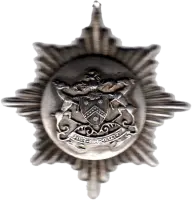
Faridkot
1941 Viceregal series · Last flowering of Sikh state numismatics
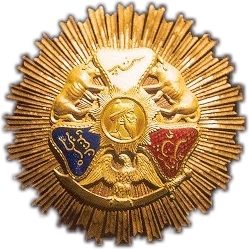
Faridkot's 1941 series — struck for the visit of the Viceroy — is the most numismatically spectacular of all the state medal issues. It comprises a ½ rupee, a 1 rupee, a massive 5-rupee silver piece (58 grams, 51mm diameter), a ⅓ mohur and a ⅔ mohur in gold. All bear the portrait of Maharaja Sir Harinder Singh Brar on the obverse and the state coat of arms on the reverse. A disputed ⅔ mohur dated 1932 appeared in New Delhi in the mid-1950s with unknown provenance. These are the last significant coins and medals issued by any Sikh-ruled state before the integration of the princely order into independent India in 1947–48.
Browse the Collection
81 medals · 9 albums · Anglo-Sikh Wars & State Awards
The SikhCoins.in medal collection spans the Sikh Empire, the Sutlej campaign of 1845–46, the Punjab campaign of 1848–49, and the medals issued by the Sikh princely states from the mid-nineteenth century to the end of the princely order in 1948. Browse by campaign, or by state.
Browse Medal Collection →"The Khalsa fought the British twice, and both times with great honour. When the British gave them the same medal for it, the Sikhs understood the gesture. The sepoys, who had fought on the British side, did not receive the same understanding in return."
— On the irony of 1857 in the Punjab
Sikh Honours, Decorations & Campaign Medals
Select specimens from the SikhCoins.in collection. Click any image or title to browse the full album.




| Specimen | Mint | Date | |
|---|---|---|---|
|
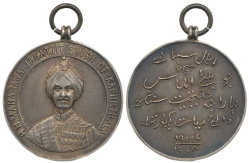
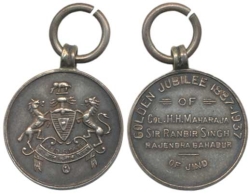
Jind; Maharaja Ranbir Singh, Golden Jubilee Medal | ||

|
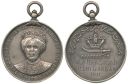
Jind, 1911 Coronation Medal | ||

|
Jind, Maharaja Ranbir Singh, Diamond Jubilee Medal |
| Specimen | Mint | Date | |
|---|---|---|---|

|
Faridkot - Star |
| Specimen | Mint | Date | |
|---|---|---|---|

|
The Sutlej Medal - 1845-46 | ||

|
Sutlej Medal, Clasps Ferozeshuhur, Aliwal, Sobraon | ||

|
Sutlej Medal, Clasps Sobraon & Ferozeshuhur | ||

|
Sutlej Medal, Clasp Sobraon |
| Specimen | Mint | Date | |
|---|---|---|---|

|
The Punjab Medal - 1848-49 | ||

|
Punjab Medal, Clasps Goojerat & Mooltan | ||

|
Punjab Medal, Clasps Goojerat & Chilianwala |
| Specimen | Mint | Date | |
|---|---|---|---|

|
Title Badge - Sardar Sahib, 1945 | ||

|
Title Badge - Sardar Sahib, King George V, 1st Issue | ||
|
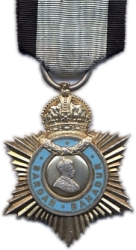
Title Badge - Sardar Bahadur, King George V | ||

|
Title Badge - Sardar Sahib, King George VI |