Diplomatic History · Material Culture
Gifts & Diplomacy
The Sikh Empire and the East India Company — A Language of Objects
AD 1809 – 1850 · Ropar · Ferozepur · Lahore · London

Maharaja Ranjit Singh in Darbar
Gouache on paper, Lahore, c.1838 — Government Museum & Art Gallery, Chandigarh
The Language of Objects
Diplomacy Through Gifts
The exchange of gifts between the Lahore Darbar and the East India Company was not mere ceremony. It was a carefully managed language of political signalling — each party using the objects it offered and received to assert status, communicate intent, and calibrate the balance of power between two sovereign states that both knew, without ever quite saying so, were on a collision course.
Diplomatic gift exchange in the early nineteenth century Punjab operated within a well-understood protocol inherited from the Mughal durbar tradition. The quality, quantity, and nature of gifts presented and received communicated the relative standing of the parties. Foreign visitors to the Sikh court were treated with a hospitality that was simultaneously genuine and theatrical — the display of regalia, the review of troops, the enumeration of jewels, the parade of elephants, all calibrated to ensure that no visitor could mistake the Sikh Empire for anything other than a sovereign power of the first order.
Ranjit Singh understood this calculus precisely. Every meeting with British officials was an occasion to establish, in the most concrete possible terms, that the Lahore Darbar was the equal of any power in India. The gifts he gave were extraordinary; the gifts he received were, by the consistent testimony of witnesses on both sides, modest in comparison. He used that disparity as theatre.
1809
The Metcalfe Mission & the Treaty of Amritsar
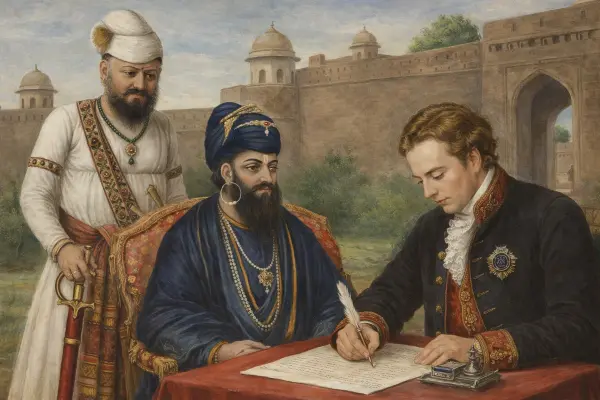
Charles Metcalfe signing the Treaty of Amritsar in the presence of Maharaja Ranjit Singh, 1809. The treaty fixed the Sutlej as the boundary between the two powers — the most consequential diplomatic exchange of the Sikh Empire
The first significant diplomatic encounter between Ranjit Singh and the Company came with Charles Metcalfe’s mission in 1809, which produced the Treaty of Amritsar fixing the Sutlej as the boundary between the two powers. Metcalfe was a negotiator rather than a head of state, and the exchange of gifts at this meeting was modest relative to what followed.
The treaty itself was, in one sense, the most consequential “gift” either party had yet exchanged. The Company gave Ranjit Singh freedom of action north and west of the Sutlej — effectively conceding the Punjab, Kashmir, Multan and Peshawar to his eventual conquest. Ranjit Singh gave the Company a stable northwestern frontier for a generation. Neither party put a price on these gifts, but both understood their value.
The Treaty of Amritsar also established the cis-Sutlej states as being under British protection — a provision that would eventually place Hoshiarpur, Patiala, Nabha, Jind and Faridkot outside Sikh sovereignty and within the Company’s monetary zone. The boundary drawn on paper in 1809 was also the boundary between the Amritsar standard and the EIC rupee.
October 1831
The Ropar Meeting — The Field of the Cloth of Gold
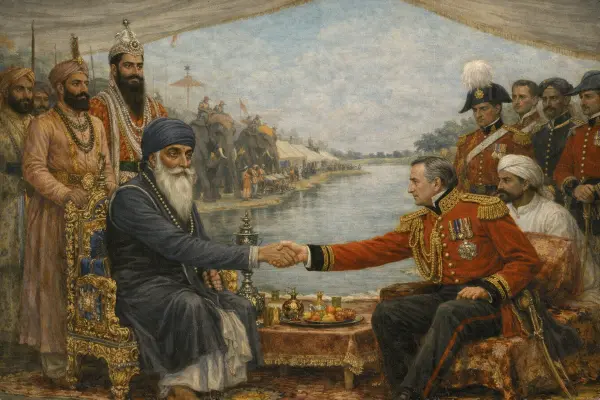
Artists impression of the meeting of Maharaja Ranjit Singh and Lord William Bentinck at Ropar. October, 1831
The Ropar Meeting of October 1831 is the most extensively documented gift exchange between the two powers. Misr Beli Ram, keeper of the Maharaja’s Toshakhana, was ordered to prepare seventy-one garments bound in pashmina wrappers for the Governor-General’s entourage. The Sikh platoons and horsemen were dressed in brocade suits and ornaments, standing in a row from the portico to the bridge to fire a salute on the guest’s arrival.
The physical scale of the display was staggering. Ranjit Singh brought his silver bungalow — a double-storeyed structure on wheels, pulled by eight elephants — all the way from Lahore to Ropar. A peacock-shaped boat was ordered so the Maharaja could meet the Governor-General in midstream of the Sutlej. A British historian compared the grandeur of the occasion to the Field of the Cloth of Gold.
Alexander Burnes, accompanying the British party, remarked that the English gentlemen appeared a sorry contrast to the gilded splendour of the Sikh elephants. Noticing this, Ranjit Singh quietly invited the Englishmen to transfer to his lavishly adorned elephants — a gesture of both generosity and quiet humiliation.
- 71 garments bound in pashmina wrappers
- Jewelled weapons and armlets
- Saddled elephants
- Military review of the Dal Khalsa in full regalia
- The silver bungalow spectacle — eight elephants
- Peacock boat on the Sutlej
- Feasts lasting eight days
- Five cart-horses from King William IV
- A British-made coach
- Written assurance of “eternal friendly relations”
- Agreement for British officers to attend the Durbar
Primary Source · Colonel James Skinner · Ropar, October 1831
“The meeting with Runjeet was very grand on his side, on ours, very poor… Wheat had been sown, in the shape of men, birds and animals, in which form it grew up for the amusement of the chief, as well as gave verdure to this royal and magnificent encampment… The whole formed a perfect specimen of Indian luxury and magnificence.”
James Skinner, CB — Ropar account, published in USI Journal, 1932 — original MS in the Wood family collection
The political subtext of Ropar was concealed beneath the magnificence. Lord Bentinck had arranged the meeting in part to distract Ranjit Singh while Henry Pottinger quietly rode south to negotiate a commercial treaty with the Amirs of Sind — a move Ranjit Singh had been seeking to forestall. The written assurance of “eternal friendly relations” given at Ropar was, as one historian noted, “a vague assurance” designed to lull Sikh concerns while the Company moved on Sind. The lavishness of the Sikh gifts and the modesty of the British ones reflected not only the relative wealth of the two courts, but also their relative need: Ranjit Singh was the host demonstrating power; Bentinck was the guest concealing intention.
1837
The Marriage of Nau Nihal Singh — The Koh-i-Noor on Display
The Koh-i-Noor diamond — 186 carats as worn by Ranjit Singh
Ranjit Singh wore it on his upper arm at the marriage of Nau Nihal Singh in 1837, where British officers saw it for the first time
The marriage of Prince Nau Nihal Singh in 1837 was a major occasion of diplomatic gift exchange, with British officers and hill rajas among the guests. Sir Henry Fane, the British Commander-in-Chief, presented eleven thousand rupees — a substantial sum, but still far below the scale on which the Sikh nobles gave: Dhian Singh presented one lakh and twenty-five thousand rupees; Gulab Singh, Suchet Singh and Misr Rup Lal fifty-one thousand each.
Fane also brought personal presents for the Maharaja: an elephant, eight horses, a double-barrelled gun and a brace of pistols. He apologised that the presents had been “collected in a hurry” as he had not had sufficient warning. The gap between preparation and improvisation told its own story.
More significant than the gifts was what the British observers saw. At this event, Ranjit Singh wore the Koh-i-Noor openly on his arm — the great diamond, at 186 carats the largest in the world, visible to the British officers who attended. The intelligence value of what they saw was not lost on them.
November – December 1838
Ferozepur — The Last Grand Meeting
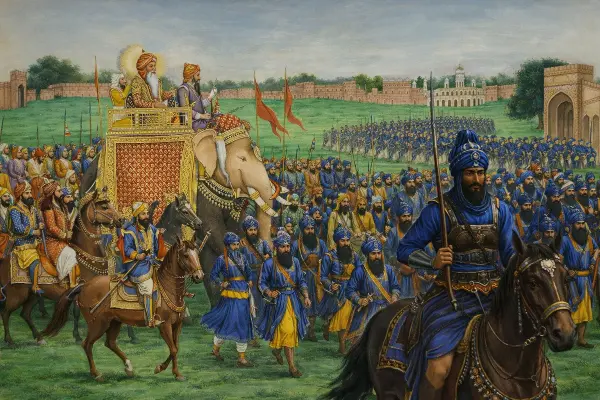
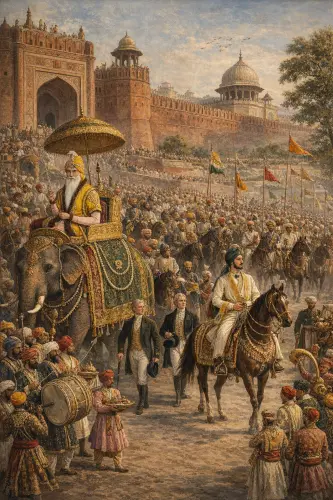
Entourage of Maharaja Ranjit Singh, riding to Ferozepur with his ministers and the Akali Jathedar Baba Hanuman Singh, for meeting Lord Auckland
The Maharaja brought along the Akali Nihangs to the meeting, creating the most spectacular display of the military migjht of the Lahore Durbar.
The Ferozepur meeting of November–December 1838 — the last great diplomatic encounter of Ranjit Singh’s reign, held just months before his death — was the most spectacular military display the Lahore Darbar ever staged for a British audience. On 25 November 1838, the two most powerful armies on the Indian subcontinent assembled in a grand review as Ranjit Singh brought out the Dal Khalsa to march alongside the sepoy troops of the EIC.
W.G. Osborne, Military Secretary to Lord Auckland, left the most vivid account: “Sikh chieftains, all clinquant, all in gold, or clothed in every diversity of colour, and every imaginable variety of picturesque costume, armed to the teeth with spears, sabre, shield and lighted matchlock, scrambled onwards.” He was, he wrote, “utterly beyond description” in his astonishment.
Colonel Steinbach, also present, recorded the scene in similar terms. Ranjit Singh sat in a plain armchair — his habitual contrast of personal simplicity against the magnificence of his court — while around him the jewelled armour, helmets and weapons of his sardars made the British officers, in their uniform red coats, appear plain by comparison.
- To Macnaghten: 15 garments, pearl necklace, jewelled armlet, jewelled gold bangles, elephant with silver saddle, jewelled sword
- To Lord Auckland: a bed with gold legs, encrusted with rubies and emeralds
- To Auckland: his own portrait set in diamonds with two rows of pearls (30 Dec 1838)
- Full military review of the Dal Khalsa — 25 November 1838
- Individual gifts to each officer of the British party
- Portrait of Ranjit Singh set with diamonds, containing his name (presented by two Company officers, May 1838)
- Firearms and military equipment
- The Tripartite Treaty — British military co-operation in the Afghan campaign
Primary Source · Misr Beli Ram, Toshakhana · Ferozepur, December 1838
“Macnaghten, the senior most officer accompanying the Governor General, was given fifteen garments, a pearl necklace, a jewelled armlet and a jewelled pair of gold bangles, an elephant with a silver saddle, and a jewelled sword.”
Misr Beli Ram, keeper of the Maharaja’s Toshakhana — cited in Tribune India, and in accounts of the Sikh Toshakhana legacy
The gold-legged bed encrusted with rubies and emeralds given to Auckland on 30 December 1838 illustrates how the EIC handled such gifts: it was surrendered to the Company’s own Toshakhana, and two years later the bed was recycled as a Company gift to the ruler of Gwalior. The Lahore Darbar gave uniquely; the Company recycled.
This was also the last occasion on which Ranjit Singh and an EIC Governor-General met as sovereign equals. Six months later, the Maharaja was dead.
1838 — The Observer’s Gift
Emily Eden & the Portrait Exchange
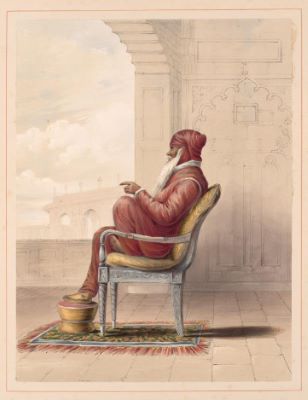
The Late Maharajah Runjeet Singh — Plate 13
Emily Eden, Portraits of the Princes and People of India, J. Dickinson & Son, London, 1844
Eden drew him at the Rambagh Palace, Amritsar, December 1838 — one of the last portraits made from life
Emily Eden — novelist, amateur artist, and sister of Lord Auckland — accompanied her brother to the Punjab in the winter of 1838. She was no casual observer: she had already published fiction and maintained a correspondence with Queen Victoria, and her access to the Lahore Darbar was unlike that of any other European artist of the period. She produced 193 drawings during the tour, 28 of which were published as hand-coloured lithographs in Portraits of the Princes and People of India (J. Dickinson & Son, London, 1844) — among the most important visual records of the Sikh court in its final sovereign years.
She met Ranjit Singh for the first time at the Rambagh Palace in Amritsar in late November 1838. The Maharaja was by then partially paralysed, conducting his durbar through signs made with his forefinger. What she saw was a man of formidable intelligence conducting himself with absolute composure in the shadow of death — and she drew him as she found him: in his usual plainness of dress, one foot tucked beneath him in his European chair, the Koh-i-Noor on his arm.
— Emily Eden, Portraits of the Princes and People of India, 1844
Primary Source · Emily Eden, Up the Country (1866) · Amritsar, 29 November 1838
“Runjeet had no jewels on whatever, nothing but the commonest red silk dress. He had two stockings on at first, which was considered an unusual circumstance; but he very soon contrived to slip one off, that he might sit with one foot in his hand comfortably… He asked if I painted, and on being told I did, he said he should like to have his picture painted, which was the beginning of our acquaintance. He seemed pleased with the idea of having his likeness taken, and it was arranged that I should draw him the next morning.”
Emily Eden — Up the Country: Letters Written to Her Sister from the Upper Provinces of India, Vol. II, Richard Bentley, London, 1866 (out of copyright)
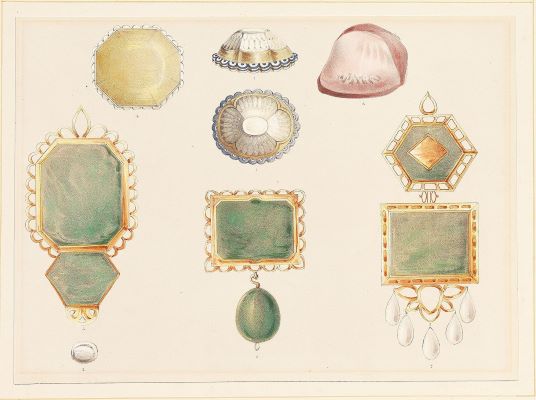
The Jewels of Ranjit Singh — Plate 14 (detail)
Emeralds, diamonds and the Koh-i-Noor, drawn by Eden at the Rambagh
Emily Eden, 1844 — Wikimedia Commons (public domain)
Eden also drew Rajah Hira Singh — son of Wazir Dhian Singh and Ranjit Singh’s particular favourite at court — as Plate 7 of the Portraits. The inclusion of Hira Singh rather than his father is itself significant: Eden drew who she was given access to, and Hira Singh was among the most visible figures at the 1838 meetings, described by one observer as “loaded with emeralds” and described by Bonhams as “swaggering, rather dandyish” in Eden’s portrayal. Dhian Singh himself — the wazir, the figure who had argued with Ranjit Singh about the coins — does not appear in the published album. He was the power behind the durbar rather than its visual face, and Eden’s omission reflects the limits of what a female visitor, even one with unprecedented access, could record.
The jewels plate (Plate 14) is among the most historically specific items in the album: Eden drew the Koh-i-Noor in its armlet setting as she had seen it worn, alongside other principal gems of the Lahore Toshakhana. It is one of the few contemporary European visual records of the diamond in Sikh possession — made eleven years before it was taken to London.
Primary Source · Emily Eden · On the portrait gift, December 1838
“On the 30th he sent G. his own picture set in diamonds with two rows of pearls round it. The diamonds are magnificent, but Runjeet himself is not, in my opinion, particularly like the picture; however, as he chose it himself, perhaps it is flattering to his fancy.”
Emily Eden — Up the Country, Vol. II, 1866 — recording Ranjit Singh’s gift of his diamond-set portrait to Lord Auckland, 30 December 1838
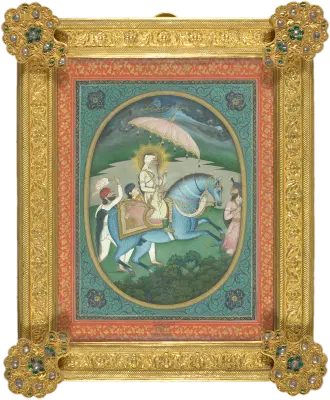
Maharajah Ranjit Singh on horseback — Imam Bakhsh Lahori, Lahore, c.1838
Opaque watercolour with gold & silver on paper, in original jewelled diplomatic frame
Gifted by Maharajah Ranjit Singh to Lord Auckland, 30 December 1838
Royal Collection Trust, RCIN 452414 — Attribution confirmed by Emily Eden’s inscription on the reverse
This portrait — Royal Collection Trust, RCIN 452414, now at Windsor — is the equestrian miniature that Ranjit Singh himself gave to Lord Auckland on 30 December 1838: the very gift that Emily Eden recorded in her letters. The RCT catalogue has attributed it to a later gift from Sher Singh in 1843, but Eden’s own inscription on the back of the painting establishes the correct provenance, and the RCT’s own scholarly footnote to the catalogue entry confirms that Ranjit Singh gave Auckland his picture on 30 December 1838 “set in diamonds with two rows of pearls” — citing Eden’s published account, p. 234. The jewelled frame shown here is the original diplomatic frame.
Painted by Imam Bakhsh Lahori — one of the principal artists of the Lahore court, who worked for Generals Ventura and Court as well as the Maharaja — it shows Ranjit Singh mounted on a blue horse with a parasol-bearer and attendants, his figure surrounded by the divine halo of Mughal imperial convention. He is shown in right profile, concealing his blind left eye. The painting is in opaque watercolour with gold and silver metallic paints and decorative incising on paper, 28.5 × 22.1 cm, within its original gold frame set with pearls and emeralds, 34.7 × 28.2 cm. This is the object that left Lahore in the Maharaja’s hand and arrived in London in Auckland’s.
The choice of an equestrian portrait is itself significant. Ranjit Singh was celebrated above all as a horseman — the saddle was where his authority was most naturally located, and the equestrian format places him in the tradition of Mughal imperial portraiture while asserting something specifically his own. He chose this image of himself to give to the Governor-General of the East India Company. It is not the plainly-dressed figure in the European chair that Eden drew; it is the sovereign on horseback, halo and parasol, the full vocabulary of legitimate kingship. The gift was a statement about how Ranjit Singh wished to be seen — and remembered.
The Portraits was published in 1844 — five years after Ranjit Singh’s death, three years after Eden returned to England, and five years before the annexation of the Punjab. It appeared precisely as British public interest in the Sikh state — and British military attention toward it — was reaching its peak. The album’s lithographs fixed the image of the Sikh court for the British reading public: splendid, exotic, the possession of a ruler who was plainly singular. Eden admired Ranjit Singh genuinely. Her written account in Up the Country carries a note of unease about the politics of the mission that the published lithographs do not fully convey. She understood, more clearly than most of her contemporaries in print, that the grandeur she was recording was also what was being assessed.
Note: Dhian Singh — Ranjit Singh’s longest-serving wazir and the minister who conducted the gift exchanges at Ropar and Ferozepur — does not appear in Eden’s published album. The most important figure of the 1838 diplomatic encounters, after the Maharaja himself, was drawn only in Hira Singh, his son. Eden drew access; the wazir guarded it.
1849 – 1850
The Koh-i-Noor — The Gift That Was Not a Gift
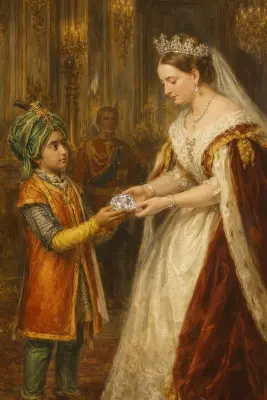
Maharaja Duleep Singh — aged eleven at the time of the Koh-i-Noor’s removal
Artists Impression — Duleep Singh handing over the Koh-i-Noor to Queen Victoria
The most consequential “gift” in the entire history of Sikh-British relations was extracted rather than given. The Treaty of Lahore of 29 March 1849, the legal instrument formalising the British annexation of the Punjab, stated it in plain terms:
Lord Dalhousie, the Governor-General who oversaw the transfer, was candid about his reasoning. He wrote that it was “more for the honour of the Queen that the Koh-i-Noor should be surrendered directly from the hand of the conquered prince into the hands of the sovereign who was his conqueror, than that it should be presented as a gift — which is always a favour — by any joint-stock company among her subjects.”
Ranjit Singh is said to have, on his deathbed in 1839, willed the Koh-i-Noor to the Jagannath Temple at Puri. The British administrators did not execute his will. Dr John Login, custodian of the Lahore Fort Toshakhana, received the diamond under a receipt dated 7 December 1849.
A “facade of a ceremony” was arranged. Duleep Singh, the eleven-year-old last Maharaja of the Sikh Empire, was convened before the Lahore Durbar and ordered to surrender the armlet containing the diamond. On 6 April 1850, it sailed from Bombay aboard HMS Medea, bound for England. On 3 July 1850 — the 250th-anniversary year of the East India Company — the Koh-i-Noor was presented to Queen Victoria at Buckingham Palace by the Deputy Chairman of the EIC.
Dalhousie himself later wrote that “the talk about the Koh-i-Noor being a present from Dhuleep Singh to the Queen is arrant humbug.” He knew what it was. What he did not perhaps anticipate was that when Duleep Singh, years later as a young man at the English court, was shown the stone — recut under Prince Albert’s instructions from 186 carats to 105.6, barely recognisable — he “was apparently unable to speak for several minutes afterwards.”
The remaining jewellery in the Maharaja’s Toshakhana was either taken over by British officials or auctioned to the public. The Toshakhana of the Sikh Empire was dispersed in the same year that the SikhCoins.in collection begins to document its numismatic legacy.
Lord Dalhousie on the Koh-i-Noor Transfer · Governor-General of India · 1849
“It would not be politic to permit any Sikh institution to obtain either by way of gift (for the intrinsic value of them is significant) or by means of sale these sacred and warlike symbols of a warlike faith.”
Lord Dalhousie — on the relics of the Lahore Toshakhana, 1849 — cited in Tribune India and Sikh heritage records
Chronicle
The Diplomatic Gift Record, 1809–1850
April 1809 · Treaty of Amritsar
The Sutlej Boundary — The Most Consequential Exchange
Metcalfe mission concludes the Treaty of Amritsar. The Company gives Ranjit Singh freedom of action north and west of the Sutlej; Ranjit Singh accepts the Sutlej as the frontier. The gift of a generation of peace, and the boundary that would later separate the Amritsar monetary zone from the EIC rupee territory.
Treaty1826 · Medical Diplomacy
Dr Murray — The EIC Sends a Physician
The British send Dr Murray to treat Maharaja Ranjit Singh during an illness — a gesture of diplomatic significance, establishing a relationship of personal trust and creating access to the Lahore court that purely commercial contact could not have provided.
British to Sikh1828 · The Crown Correspondence
Gifts to King George IV — Ranjit Singh Writes to the Crown
Ranjit Singh sends gifts directly to King George IV — asserting that his relationship is with the British sovereign, not merely the trading company. A signal of diplomatic self-positioning: the Maharaja of the Punjab sees himself as the equal of the King of England, not the subordinate of a joint-stock company.
Sikh to Britain26 October 1831 · Ropar
The Grand Meeting — 71 Pashmina-Wrapped Garments
The Ropar meeting on the Sutlej. Ranjit Singh stages the silver bungalow, the peacock boat, 71 garments in pashmina wrappers, brocade-dressed cavalry, and eight days of feasts. The Company offers five horses and a coach from the King of England, and a vague written assurance of eternal friendly relations — while Henry Pottinger rides south to negotiate with the Amirs of Sind.
Sikh to EIC1837 · Lahore
Marriage of Nau Nihal Singh — The Koh-i-Noor Seen
Sir Henry Fane presents 11,000 rupees, an elephant, eight horses, and a double-barrelled gun — apologising for the haste of assembly. The Sikh nobles give 50,000–125,000 rupees each. At this event the British first see Ranjit Singh wearing the Koh-i-Noor openly on his arm at 186 carats.
Both DirectionsMay – December 1838 · Ferozepur
The Last Meeting — The Gold-Legged Bed
The grand review of 25 November 1838. Macnaghten receives a jewelled sword, a pearl necklace, an elephant with a silver saddle, and gold bangles. Auckland receives the gold-legged bed encrusted with rubies and emeralds (30 December). Ranjit Singh gives his own portrait set in diamonds with two rows of pearls. The EIC Toshakhana later recycles the bed as a gift to Gwalior.
Sikh to EIC7 December 1849 · Lahore Fort
The Toshakhana Emptied
Under a receipt signed by Dr John Login, the Koh-i-Noor is taken from the Lahore Fort Toshakhana. The remaining jewellery of Maharaja Ranjit Singh is either taken by British officials or auctioned publicly. The entire accumulated treasure of the Sikh Empire — centuries of gifts, tributes, conquests and devotions — dispersed in a single administrative act.
EIC Takes3 July 1850 · Buckingham Palace
The Koh-i-Noor Presented to Queen Victoria
The Koh-i-Noor is presented to Queen Victoria by the Deputy Chairman of the East India Company, in the Company’s 250th-anniversary year. Dalhousie had ensured it was surrendered, not given: “arrant humbug” to call it a present. When Victoria later shows the recut diamond to Duleep Singh — now reduced from 186 to 105.6 carats — he is unable to speak for several minutes.
ExtractedAnalysis
What the Gifts Reveal
Read together, the gift exchanges between the Sikh Empire and the EIC form a consistent pattern. The Lahore Darbar gave lavishly — pashmina-wrapped garments by the dozen, jewelled weapons, saddled elephants, pearls, gold bangles, a diamond-set self-portrait, a ruby-and-emerald bed — and received comparatively modestly: five horses, a carriage, a double-barrelled gun, a portrait set with diamonds.
Ranjit Singh’s purpose was not reciprocity but demonstration. Every meeting with British officials was an occasion to establish that the Sikh Empire was a sovereign power of the first order, wealthy, militarily formidable, and culturally confident. The very accounts that record the magnificence of the Sikh court — Osborne’s Court and Camp of Runjeet Sing, Emily Eden’s Up the Country, Skinner’s diary — also carry within them the intelligence assessments of observers who knew they would one day want what they were admiring.
The British received these gifts with a mixture of awe, envy, and calculation. The disparity in giving was never corrected — not because the Company could not have afforded greater gifts, but because the Protocol of the encounter placed the Maharaja as host and the Governor-General as guest, a framing Ranjit Singh maintained with great care at every meeting.
The Toshakhana — the treasury at the heart of Sikh material sovereignty, from which every diplomatic gift was drawn and into which every tribute and conquest was deposited — was emptied by administrative receipt, auctioned by public notice, and dispersed to collectors whose descendants have since placed its contents in museums across three continents. The coins remain the most legible survivors: anonymous, undatable by owner, unconfiscatable by receipt. They carry the Guru’s name, not the Maharaja’s, and that made them harder to extinguish.
Sources
Primary & Secondary Sources
Primary Sources
- The Court and Camp of Runjeet Sing. Henry Colburn, London, 1840. [Military Secretary to Lord Auckland; eyewitness at Ferozepur 1838]
- Up the Country: Letters Written to Her Sister from the Upper Provinces of India. Richard Bentley, London, 1866. [Sister of Lord Auckland; eyewitness at Lahore and Ferozepur 1838]
- Umdat-ut-Tawarikh, Vol. III. Persian-language chronicle of the Sikh court. [Records gift exchanges at both Ropar and Ferozepur in detail]
- Account of the Ropar Meeting, October 1831. Original MS, Wood family collection; published in USI Journal, 1932, by Col. E.B. Maunsell.
- Toshakhana records of the Maharaja’s gifts at Ferozepur, 1838. Cited in Tribune India and in Maharaja Ranjit Singh — Jewels and Relics, allaboutsikhs.com.
- Article on the Koh-i-Noor reproduced in Koh-i-Noor, Wikipedia; Koh-i-Noor, World History Encyclopedia.
- Official notes and correspondence on the transfer of the Koh-i-Noor and the Lahore Toshakhana, 1849–1850.
Secondary Sources
- History of the Sikhs, Vol. V: The Sikh Lion of Lahore — Maharaja Ranjit Singh, 1799–1839. Munshiram Manoharlal, New Delhi, 1991.
- The Sikhs of the Punjab. The New Cambridge History of India, II.3. Cambridge University Press, 1990.
- Maharaja Ranjit Singh: Lord of the Five Rivers. Oxford University Press, 2002.
- Koh-i-Noor: The History of the World’s Most Infamous Diamond. Bloomsbury, London, 2017.
- ‘Costly Secrets’. Dawn, 30 September 2021. [On the gold-legged bed and EIC Toshakhana recycling]