The Sikh Commonwealth
The Sikh Misls
Rise of the Dal Khalsa Confederacy & its Coinage
AD 1716 – 1799 · VS 1773 – 1856 · Lahore · Amritsar · Multan · Anandghar
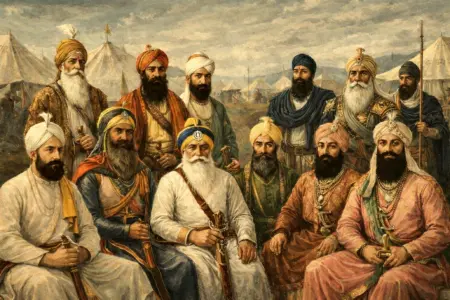
The Sardars of the Dal Khalsa in open durbar
Artist's reconstruction after historical sources
Origins
What is a Misl?
The word misl is common to Arabic, Persian, Urdu and Punjabi — it means alike, equal, similar. In Sikh history the term was first used by Guru Gobind Singh at the Battle of Bhangani in 1688, when a large body of young men had gathered to serve under him. He organised them into groups of roughly equal number, each under a leader granted absolute equality with all others.
Sainapat, the court poet who witnessed Bhangani, records the scene: at the strike of the war-drum (Ranjit Nagara), the horsemen gathered under their own banners and the chiefs at the head of their misls took their positions. Eleven misls fought at Bhangani — five of the Guru's relatives under Sango Shah on the right, five of Muslim irregulars under Pir Budhu Shah and his sons on the left, and the Guru's own misl at the centre. This tripartite formation — centre, right wing, left wing — would define Sikh military organisation for a century.
When Banda Singh Bahadur departed Nanded in 1708, Guru Gobind Singh gave him an advisory council of five — Baj Singh, Ram Singh, Binod Singh, Kahan Singh and Fatah Singh — and organised his forces in the same eleven-misl pattern. At the Battle of Sarhind in May 1710, Banda broke the Mughal power. For five years the Sikhs ruled from the Ravi to the Jamuna and struck their own coins. Then Banda was captured, executed on 9 June 1716, and the misls ceased to exist for nearly two decades.
For seventeen years the Sikhs were outlaws, hunted by Mughal governors Abd us Samad Khan and Zakariya Khan, hundreds brought daily to Lahore and executed at the Nakhas horse market. Yet their faith was unbroken. When Zakariya Khan offered Kapur Singh a nawabship and jagir to induce submission, Kapur Singh accepted the title outwardly — and used the resource and relative freedom it provided to secretly rebuild the Khalsa.
Reorganisation
Buddha Dal, Tarna Dal & the Dal Khalsa, 1734–1748
In 1734, Nawab Kapur Singh — the acknowledged supreme leader of the Khalsa — divided the Sikh forces into two great bands on the basis of age. The Buddha Dal (Veterans) under older commanders held its position at the Harmandir Sahib, Amritsar. The Tarna Dal (Verdants) under younger leaders maintained five rotating encampments at the five sacred tanks of Amritsar — Bibeksar, Kaulsar, Lachhmansar, Ramsar and Santokhsar. Each Dal was sub-divided into five units on the misl model, re-establishing eleven misls in the tradition of Guru Gobind Singh and Banda Bahadur. Kapur Singh retained supreme command of both.
By Baisakhi 1748, sixty-five Sikh bands had formed under various leaders across the Punjab. On 29 March 1748, at the Akal Takht, Kapur Singh reduced the sixty-five bands to eleven misls and named this body the Dal Khalsa — the Army of the Khalsa — placing it under the supreme command of Jassa Singh Ahluwalia, whom he had raised since childhood as his foster son and to whom, on his deathbed in 1753, he passed the steel mace of Guru Gobind Singh himself.
The Buddha Dal consisted of six misls: Ahluwalia, Dallewalia, Singhpuria (Faizalpuria), Karorsinghia, Nishanwala and Shahid. The Tarna Dal comprised five: Bhangi, Kanhiya, Nakai, Ramgarhia and Sukerchakia. The Phulkian chiefs of Patiala, Nabha, Jind and Faridkot, though Sikh, were never part of the Dal Khalsa — they maintained allegiance to both Mughals and Durranis simultaneously, appealing to the Dal Khalsa for military assistance through religious bonds and marriage alliances while paying tribute to its enemies.
| Misl | Founder / Chief | Principal Territory | Dal |
|---|---|---|---|
| Ahluwalia | Jassa Singh Ahluwalia (Sultan-ul-Qaum) | Kapurthala, Fatahabad, lower Jalandhar Doab; at peak — Jalandhar, upper Bari Doab | Buddha Dal |
| Dallewalia | Gulaba Singh / Tara Singh Ghaiba | Nakodar, Rahon, Nawanshahr, Phillaur, northern Ludhiana & Ambala | Buddha Dal |
| Singhpuria | Nawab Kapur Singh / Khushhal Singh | Southern Jalandhar Tahsil, southwestern Hoshiarpur, Dasuha Tahsil | Buddha Dal |
| Karorisinghia | Karora Singh / Baghel Singh | Hoshiarpur, Hariana; Baghel Singh controlled Delhi for nine months in 1783 | Buddha Dal |
| Nishanwalia | Dasaundha Singh | Amritsar reserve and guard of Guru Ki Nagri | Buddha Dal |
| Shahid | Baba Deep Singh | Amritsar, Damdama Sahib, Malwa — also crossed Sutlej to Ludhiana & Ferozepur | Buddha Dal |
| Bhangi | Hari Singh / Gujjar Singh / Lehna Singh | Lahore, Amritsar (admin.), Multan, Bari Doab, Rachna & Chaj Doabs — deepest Muslim heartland penetration | Tarna Dal |
| Kanhiya | Jai Singh / Gurbaksh Singh | Batala, Gurdaspur, upper Jalandhar Doab, Hoshiarpur — one of the two largest misls | Tarna Dal |
| Nakai | Hira Singh / Bhagwan Singh | Naka country south of Lahore (Montgomery district), Chunian Tahsil | Tarna Dal |
| Ramgarhia | Jassa Singh Ramgarhia | Sri Hargobindpur, Ghuman, Batala, Hoshiarpur; at peak — Hansi-Hisar & part of Ganga Doab | Tarna Dal |
| Sukerchakia | Charat Singh / Maha Singh / Ranjit Singh | Gujranwala, Eminabad, Wazirabad, Rachna & Chaj Doabs — direct precursor of the Sikh Empire | Tarna Dal |
Governance
The Rakhi System — Economic Foundation of the Sikh Commonwealth
After Mir Mannu's death in November 1753, the Punjab plunged into complete anarchy — nine changes of governor in three years. Revenue farmers, invaders, Central Asian refugees and plundering bands had ruined the Jat peasantry. Trade had stopped; roads were unsafe. Into this vacuum stepped the Sikhs — the only organised, disciplined force in the Punjab, inspiring awe even in government officials.
The Sikh leaders offered villages a compact: place yourself under the protection of the Dal Khalsa, owe obedience to a particular chief, and your persons and property are guaranteed. The village headman would collect from all inhabitants a sum equal to one-fifth of the government revenue, paid twice yearly at harvest — called Rakhi (protection money). Kambali (blanket money) was charged from artisans — two to three rupees per family. In return, complete safety was guaranteed. Delays were fatal; refusals were answered by fire and sword.
This system worked so spectacularly that entire tracts accepted Sikh protection. Forts arose at commanding sites across the Punjab; merchants built houses around them. Amritsar became the largest and richest city in the Punjab. By 1781, the Mughal Prime Minister Najaf Khan issued a royal patent formally granting the Dal Khalsa the right to collect Rakhi and Kambali — de facto imperial recognition of Sikh sovereignty. Even Zabita Khan, son of the mighty Najib-ud-daulah, the Dictator of the Mughal Empire, tamely conceded this right.
The Rakhi system transformed the Dal Khalsa from a guerrilla resistance into a class of landlords, administrators and rulers — the economic foundation upon which the Sikh Commonwealth was built, and upon which the coins of the misls had their practical value and authority.
Chronicle
Military & Political History, 1716–1799
1716 – 1733
The Dark Years — Persecution & Survival
Following Banda Singh Bahadur's execution, Mughal governors wage systematic extermination of the Sikhs. Hundreds are brought daily to Lahore's horse market and beheaded. Zakariya Khan deploys Salabat Khan to blockade Amritsar. The Khalsa retreats to hills, forests and the desert — yet never abandons its political ideal.
Persecution1734
Nawab Kapur Singh Reorganises the Khalsa
Kapur Singh divides the Khalsa into Buddha Dal and Tarna Dal — eleven misls on the model of Guru Gobind Singh. The Rakhi system begins. Zakariya Khan, recognising the futility of extermination, offers Kapur Singh a nawabship — which Kapur Singh accepts outwardly while using the resource to rebuild the Khalsa in secret.
Reorganisation1748 – 1753
Mir Mannu's Persecution
Muin-ul-Mulk (Mir Mannu), after defeating Ahmad Shah Durrani at Manupur on 11 March 1748, proves the most ferocious persecutor the Sikhs have faced. He deploys 900 specially-trained Jizairchi musketeers, offers ten rupees per Sikh head, imprisons women and children and has their infants killed before their eyes. Yet Sikh ranks swell — the Jat peasantry takes baptism daily. The verse they compose resonates through their history: "Mannu is our sickle — the more he cuts us, the more we grow." On 3 November 1753 Mir Mannu is thrown from his horse and dies. The prisoners are freed.
Persecution29 March 1748 — Baisakhi
Formation of the Dal Khalsa
At the great Baisakhi gathering at Amritsar, Kapur Singh addresses the Khalsa brotherhood before the Akal Takht. The Dal Khalsa is formally constituted; sixty-five Sikh bands are consolidated into eleven misls. Jassa Singh Ahluwalia is declared supreme commander — Sultan-ul-Qaum, King of the Community. This is the political birth of the Sikh Confederacy.
Founding1748 – 1765
The Afghan Invasions of Ahmad Shah Durrani
Durrani invades repeatedly. Lahore and Multan are ceded to him by Mughal treaty in 1752. In the Wadda Ghallughara of 5 February 1762, he kills nearly 25,000 Sikhs near Kup in a surprise dawn attack. The survivors gather at Muktsar and declare the alloy has burned and only the purified Khalsa remains — within months they resume operations with renewed determination. The Persian chronicler Qazi Nur Muhammad, who fought on the Durrani side and harboured deep anti-Sikh feeling, writes of Jassa Singh Ahluwalia: "In the centre was Jassa Kalal, who fearlessly stood like a mountain."
Afghan InvasionsNovember 1761
First Dal Khalsa Coin Struck at Lahore
After the Diwali celebration, the Dal Khalsa attacks Lahore. Khwajah Abed Khan, the Afghan governor, is killed and the fort seized. In the triumph, the Sikhs declare Jassa Singh Padshah and strike coins in his name — the first Dal Khalsa coins from Lahore. The contemporary chronicler Ghulam Ali Azad, writing months later, records: "They raised Jassa Singh to the status of a king and blackened the face of the coin with his name." Note - No examples of this coin have yet been found.
First Coins Struck14 January 1764
Conquest of Sarhind
Jassa Singh leads seven misls of the Buddha Dal plus the Bhangi Misl in a final assault on Sarhind — the city where Guru Gobind Singh's two younger sons had been bricked alive sixty years before. Governor Zain Khan is killed. The province is divided among seven misls and the Phulkian states. The conquest marks the transformation of the Dal Khalsa from resistance movement to territorial power.
VictoryBaisakhi 1765 — VS 1822
Gurmatta — Formal Declaration of Dal Khalsa Coinage
At the great Gurmatta of Baisakhi 1765, the Dal Khalsa collectively resolves to strike coins in the name of the Guru — not any single chief but the entire Khalsa Panth. The standard Dal Khalsa rupee bearing the Nanakshahi-Gobindshahi couplet is formally adopted for all mints. VS 1822 coins from Lahore are the earliest of this type. This collective act of coinage — unprecedented in Indian political history — declares that sovereignty belongs to the Guru's Khalsa as a whole.
Sovereignty DeclaredMarch 1783
Baghel Singh Controls Delhi — Nine Months of Sikh Rule
Baghel Singh Karorisinghia enters the Red Fort with the Dal Khalsa. Jassa Singh Ahluwalia is placed on the Mughal throne — his men call him Badshah Singh. Baghel Singh occupies Delhi for nine months, levying tribute from the Mughal treasury and overseeing the construction of seven gurdwaras at the sites associated with the Sikh Gurus in Delhi. Emperor Shah Alam II offers him the governorship of the Upper Ganga Doab three times. Each time Baghel Singh declines — he will not serve under a Muslim ruler. The Mughal Empire pays tribute to the Sikh Confederacy.
Victory1761 – 1803 — Buddha Dal East
The Eastern Campaign — From Amritsar to the Ganga
The Buddha Dal attacks the Delhi province and the Ganga Doab two, three, even four times a year continuously from 1764 to 1803. The great Najib-ud-daulah is so harassed that he submits his resignation as Dictator of the Mughal Empire, retires to Najibabad and dies in October 1770. His son Zabita Khan saves himself by publicly embracing Sikhism as Dharam Singh in 1777. His grandson Bhambhu Khan remains a Sikh pensioner until 1803. Emperor Shah Alam II once goes without food for three days.
Eastern Campaigns7 July 1799
Ranjit Singh Takes Lahore — End of the Misl Period
Ranjit Singh of the Sukerchakia Misl, barely nineteen, takes Lahore from the Bhangi chiefs and is declared Maharaja of the Punjab at Baisakhi 1801. What the eleven misls had collectively built over half a century — a sovereign Punjab, a functioning system of governance and revenue, a coinage recognised across northern India — now passes into the single hand of the Sikh Empire. The Misl period is over; the Empire begins.
End of an EraNumismatics
The Coinage of the Dal Khalsa — Four Mints, One Declaration
The coins of the Misl period are unique in Indian numismatic history. They are not the coins of a king — they are the coins of a brotherhood. The same standard couplet, the Nanakshahi-Gobindshahi legend, appears on all four mints across four decades, with only the mint epithet varying. Sovereignty belongs not to any sardar but to the Guru's Khalsa as a whole. This constancy was the deliberate message of every coin struck. Where Banda Singh Bahadur's coins declared an individual sovereign, the Dal Khalsa coins declared a collective one: the Panth itself, acting in the name of the Guru. These coins carry the date of issue in Vikrami Samvat.
The earliest dated rupee from the Lahore mint — bearing the Gobindshahi couplet on the obverse and Zarb Dar-ul-Sultanate Lahore on the reverse — is VS 1822 (AD 1765). The British Museum collection holds an unbroken year-by-year sequence from VS 1822 to VS 1835, providing the most precisely documented run of Misl-period Lahore rupees in any published institutional catalogue (Khera 2011, nos. 343–356). Amritsar followed a full decade later: the earliest confirmed strike from that mint is VS 1832 (AD 1775), reflecting the city's consolidation as the Dal Khalsa's spiritual and commercial centre under Bhangi Misl control. In the intervening ten years Lahore was the sole functioning Dal Khalsa mint.
One further numismatic feature of the Misl period deserves attention. The punch-dagger (kartar) symbol appears on the reverse of certain silver rupees from VS 1841 to VS 1842, and careful examination of the British Museum's eleven specimens of this type establishes that it occurs exclusively on coins bearing the Gobindshahi couplet — never on the Nanakshahi type. The most likely reading is that the punch-dagger was adopted as an emblem of victory in harmony with the Gobindshahi legend's invocation of Degh Tegh Fateh — the kettle, the sword, and triumph. This attribution rule is a useful tool for distinguishing the two Misl-period legend types in worn or imperfectly struck specimens.
Lahore Mint
Zarb Lahore · From VS 1822 (AD 1765) · Bhangi Misl
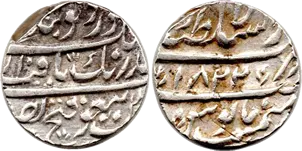
Obverse
Deg o Tegh o Fateh o Nusrat be-dirang Yaft az Nanak Guru Gobind SinghReverse
Zarb Dar-ul-Sultanate LahoreFormally adopted at the Gurmatta of 1765. The Lahore mint operated under Bhangi Misl control until Ranjit Singh's entry in 1799. Earliest pieces dated VS 1822 are the foundational coins of the Sikh Confederacy.
Browse Misl Collection →Amritsar Mint
Zarb Amritsar · VS 1832 (AD 1775) · Bhangi Misl
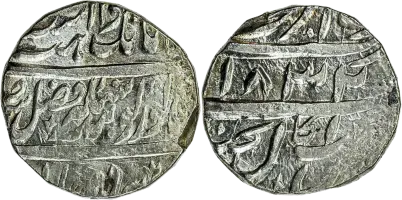
Obverse
Sikka zad bar Har do Alam, Tegh-i-Nanak wahib ast Fath Guru Gobind Singh Shah-i-Shahan, Fazl Saccha Sahib astReverse
Zarb Sri Ambratsar jiyoAmritsar was declared the common city for both the Buddha Dal and Tarna Dal. The Bhangi Misl held its administration because its members were active in both the eastern and western theatres simultaneously — they commanded the Indus crossing at Attock in the west and the Jamuna ferry at Buriya in the east.
Browse Misl Collection →Multan Mint
Zarb Multan · VS 1829 (AD 1772) · Bhangi Misl
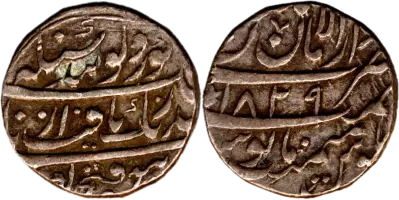
Obverse
Deg o Tegh o Fateh o Nusrat be-dirang Yaft az Nanak Guru Gobind SinghReverse
Zarb Dar-ul-Aman MultanThe Bhangi Misl — the most daring and adventurous of all — penetrated deep into the overwhelmingly Muslim Bari, Rachna and Chaj Doabs. Their occupation of Multan, one of the greatest commercial cities of the subcontinent, gave the Dal Khalsa command of the southern approach to India via the Bolan Pass.
Browse Misl Collection →Anandghar Mint
Zarb Anandghar · VS 1841 (AD 1784) · Location uncertain — probably Amritsar region
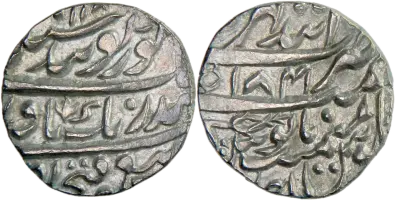
Obverse
Deg o Tegh o Fateh o Nusrat be-dirang Yaft az Nanak Guru Gobind SinghReverse
Zarb AnandgharThe precise location of the Anandghar mint remains uncertain. Based on the style of calligraphy and the execution of the dies — closely resembling Amritsar mint workmanship — it is likely that the Anandghar mint operated in the Amritsar region. Herrli, writing in 2004, concluded that the fortress built by Guru Gobind Singh at Anandpur(Qila Anandgarh) never had a functioning rupee mint; the Gobindshahi pieces attributed to Anandghar differ from the corresponding Amritsar series only in reverse design, mint name, mint mark and an unexplained era year (Herrli 2004, p. 100; Khera 2011, p. 10). Anandghar (City of Bliss) may have been an honorific epithet for Amritsar itself, or for a specific precinct within it.
Browse Misl Collection →The Phulkian States
A Dynasty Apart — The Phulkian Chiefs
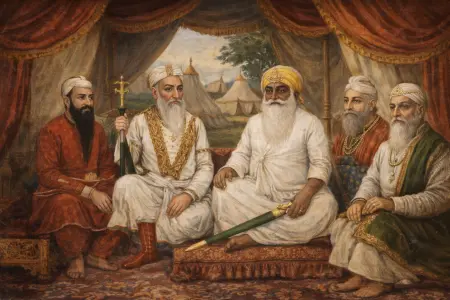
The Phulkian chiefs — sardars of Patiala, Nabha, Jind and Faridkot
Artist's reconstruction after historical sources
The Phulkian states — Patiala, Nabha, Jind and Faridkot — were never part of the Dal Khalsa. They descended from Phul, a Jat blessed by Guru Hargobind, and developed from the beginning as petty kingdoms rather than as misls of the Khalsa Confederacy. Their political philosophy was fundamentally different: where the Dal Khalsa refused submission to any Muslim ruler, the Phulkian chiefs simultaneously maintained allegiance to both the Mughal court at Delhi and the Durrani Empire at Kandahar-Kabul.
They purchased titles from the Mughals and the Durranis, paid tribute to invaders and kept their options open. Ala Singh of Patiala, when Ahmad Shah Durrani passed near his capital in March 1761, waited upon the invader, presented rich gifts and acknowledged him as overlord, promising five lakhs of rupees annually. This was precisely the conduct the Dal Khalsa would never countenance — and it brought Jassa Singh Ahluwalia marching on Patiala. Ala Singh averted punishment only by personally receiving baptism from Jassa Singh's hands.
Yet the Phulkian chiefs were not without political cunning. They leveraged their Sikh identity when it served them — inviting Dal Khalsa sardars to administer pahul, offering daughters in marriage to Trans-Sutlej sardars, donating to the shrines, and calling on the Dal Khalsa for military assistance when threatened. When the British arrived, they were among the first to offer collaboration, culminating in the Treaty of Amritsar of 1809 which placed the Cis-Sutlej states under British protection. H.R. Gupta notes that this diplomatic flexibility, while anathema to the true misls, allowed the Phulkian states to survive and ultimately outlast the Sikh Empire itself.
Scholarship
References & Bibliography
- History of the Sikhs, Vol. IV — The Sikh Commonwealth or Rise and Fall of Sikh Misls. Munshiram Manoharlal Publishers, New Delhi, 2007. [Primary source for this page]
- The Coins of the Sikhs.
- Catalogue of Sikh Coins in the British Museum. British Museum Research Publication No. 190. London, 2011. The authoritative institutional catalogue of the British Museum's 500-coin Sikh holding; source for the earliest dated Lahore (VS 1822) and Amritsar (VS 1832) rupees and for the punch-dagger attribution rule.
- Coins of the Sikh Empire, Punjab and the Cis-Sutlej States. Spink, London, 2022.
- Prachin Panth Prakash. Amritsar, 1914 / 1962.
- Sri Gur Sobha (Gur Sobha). Punjabi University, Patiala, 1967. — Earliest use of misl in Sikh literature; eyewitness account of Guru Gobind Singh's court.
- Twarikh Guru Khalsa. Patiala, 1970; and Panth Prakash.
- Khazana-e-Amira. — Contemporary Persian source, describes the 1761 Lahore coins within months of their striking.
- Persian MS — Eyewitness account of Mir Mannu's campaigns and Dal Khalsa operations, compiled c.1765.
- Umdat-ut-Twarikh.
- History of the Sikhs, Vol. I: 1469–1839.
- The Heritage of the Sikhs.
- India Tracts, Vol. II. — British observer's account of the Dal Khalsa and Jassa Singh Ahluwalia, 1783.
Misl Period Coinage — VS 1822–1865
Select specimens from the SikhCoins.in collection. Click any image or title to browse the full album.
| Specimen | Mint | Date | |
|---|---|---|---|
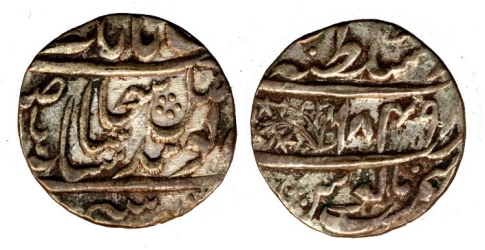
|
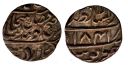
Lahore, VS1849 Rupee | ||

|
Lahore, VS1822 Rupee | ||
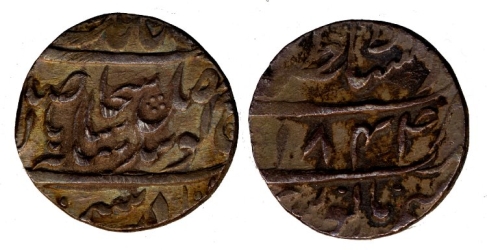
|
Lahore, VS1844 Rupee | ||

|
Lahore, VS1834 Rupee | ||
|
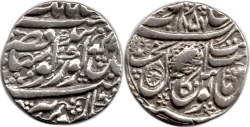
Lahore, VS1841 Rupee |


| Specimen | Mint | Date | |
|---|---|---|---|

|
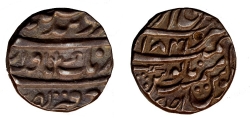
Multan, VS1835, Gold Mohur, 1st Occupation | ||

|
Multan, VS1836 Rupee, 1st Occupation | ||

|
Multan, VS1830, Rupee, 1st Occupation | ||

|
Multan, VS1834, Rupee, 1st Occupation |
| Specimen | Mint | Date | |
|---|---|---|---|

|
Anandghar, VS1841, Rupee, RY1(Ahd) on Rev. | ||

|
Anandghar, VS1841, Rupee, RY1(Ahd) on Rev. | ||

|
Anandghar, VS1842, Rupee | ||

|
Anandghar, VS1842, Rupee |