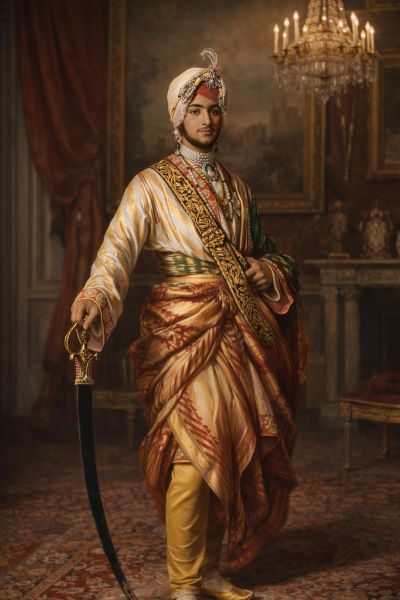
Maharaja Duleep Singh
Sovereign at five, deposed at ten, and the ruler in whose name the last Sikh coins were struck — none of which carry his name. With his two wives, his eight children, and the extinction of the house of Ranjit Singh in a Lahore drawing room in 1957.
Maharaja of Lahore · Elveden · The Line That Ended6 September 1838 – 22 October 1893
I · Introduction
The Sovereign Who Never Appears on His Own Coinage
Duleep Singh reigned for five and a half years, from September 1843 to March 1849, and in that time the mints of the Sikh kingdom struck a substantial coinage in his name. Not one surviving coin carries it. Sikh legends belonged to the Gurus; no Sikh ruler was ever named on a Sikh coin, and the last of them is therefore invisible in the only official issue of his own reign.
That absence is the right way into him. Everything about Duleep Singh is a matter of things done in his name by other people — a throne he was placed on at five, a treaty he signed at ten, a religion he was moved into at fifteen, an estate chosen for him in Suffolk, and a body that was buried by a rite he had explicitly repudiated. This page follows that pattern through to its end: two marriages, eight children, and a dynasty that expired without issue in 1957.
It also does something the rest of the literature rarely bothers with, which is to look at what the mints were actually doing while all this happened. The answer is surprising, and it is the subject of section III.
II · The Boy Sovereign
Lahore, 1838–1849
Maharaja Duleep Singh
b. 6 September 1838, Lahore · d. 22 October 1893, Paris
- Parents
- Maharaja Ranjit Singh and Maharani Jind Kaur
- Proclaimed
- September 1843, aged five
- Regent
- His mother, to December 1846
- Wazirs
- Hira Singh Dogra, Jawahar Singh, Lal Singh, Gulab Singh
- Deposed
- 29 March 1849, aged ten
- Faith
- Sikh to 1853; Christian 1853–86; took pahul again in 1886
- Married
- Bamba Müller, 1864; Ada Douglas Wetherill, 1889
- Children
- Eight, all of whom died without legitimate issue
- Buried
- Elveden, Suffolk, by Christian rite
He was born at Lahore on 6 September 1838, the youngest son of Ranjit Singh, nine months before his father died. The four years that followed removed every other claimant by violence: Kharak Singh confined and dead, Nau Nihal Singh killed by falling masonry, Sher Singh shot with his wazir. In September 1843 the Khalsa army proclaimed the five-year-old Duleep Singh sovereign, and his mother made herself regent by argument with the regimental panchayats.
He therefore never governed. Between his accession and his deposition the state was run by his mother, then by a Council of Regency, then by a British Resident; four men held the wazirate; two wars were fought; the Jalandhar Doab was annexed and Kashmir was sold. The Maharaja was between five and ten years old throughout.
The end came on 29 March 1849. Aged ten, he put his name to a document renouncing all claim to the sovereignty of the Punjab, and surrendered the Koh-i-Noor to the East India Company — the transfer this site follows in Gifts & Diplomacy. What was not sent to England was sold: over the following two years the contents of his household were auctioned in the Lahore Fort in at least eight public sales, a dispersal examined from the surviving catalogues in The Lahore Sales. His mother had been exiled to Chunar the previous year; three weeks after his signature she escaped it. He would not see her for another twelve years.
III · The Coinage of a Minority
What the Mints Did While the Kingdom Fell
Set the political chronology of 1843 to 1849 beside the numismatic one and something odd emerges. The political record is a catalogue of collapse: three wazirs murdered, a regent deposed and exiled, two wars lost, a crore and a half of indemnity, provinces sold and annexed. The numismatic record shows an institution carrying on as though none of it were happening.
The Nanakshahi rupee held a weight of 11.0–11.35 grams from VS1856 through to the final issues before annexation in VS1906 — a consistency that survived four maharajas, the fall of the Dogra ministry, the loss of Kashmir and Multan, and the payment of an indemnity in coin out of the Lahore treasury. In the collapse of a state, the mint was the last thing to break.
The mints working in his name across those years include Lahore and Amritsar throughout, Kashmir until the cession of 1846, Multan until its fall in 1849, and the salt-range mint at Nimak, whose rupees are recorded for VS1904 and VS1905 — that is, 1847 and 1848, the years of the Residency and the Multan revolt. A Multan gold rupee of VS1905 belongs to the period of Mulraj’s rebellion, struck in the name of a boy who was by then effectively a British ward while the city that struck it was under siege by a British army.
This is the reason the last Maharaja belongs on a numismatic site, and it is not sentiment. His reign is the cleanest available demonstration that a monetary system and a political system are different things and can fail at different speeds. The dies at Lahore did not know there was a crisis. They went on producing a rupee of the correct weight, in the name of the Gurus, for a sovereign whose name they never carried, until a foreign government closed them.
IV · The Manufacture of an English Gentleman
Fatehgarh, Conversion, Elveden
After the annexation he was removed from Lahore and placed at Fatehgarh under the guardianship of Dr John Login. He was baptised in 1853, at fourteen, and brought to England in 1854. Queen Victoria received him with real warmth and he became a fixture of court society; he was also, in every practical sense, a political prisoner, with controls on where he could travel and whom he could see. This site’s Fall of the Sikh Empire page treats those years at length, through the reading that describes the colonial project in the Punjab as a theft of bodies rather than of territory.
In 1863 he bought Elveden in Suffolk and rebuilt it. The money was a pension paid out of Punjab revenue, and what he did with it is the most eloquent thing he ever said about his position: he had the interior carved into a Mughal-Indian idiom — cusped arches, columns, floral panels — by craftsmen brought from India. Punjab revenue, converted into a Suffolk shooting estate, converted back into Lahore in plasterwork by a man not permitted to go home.
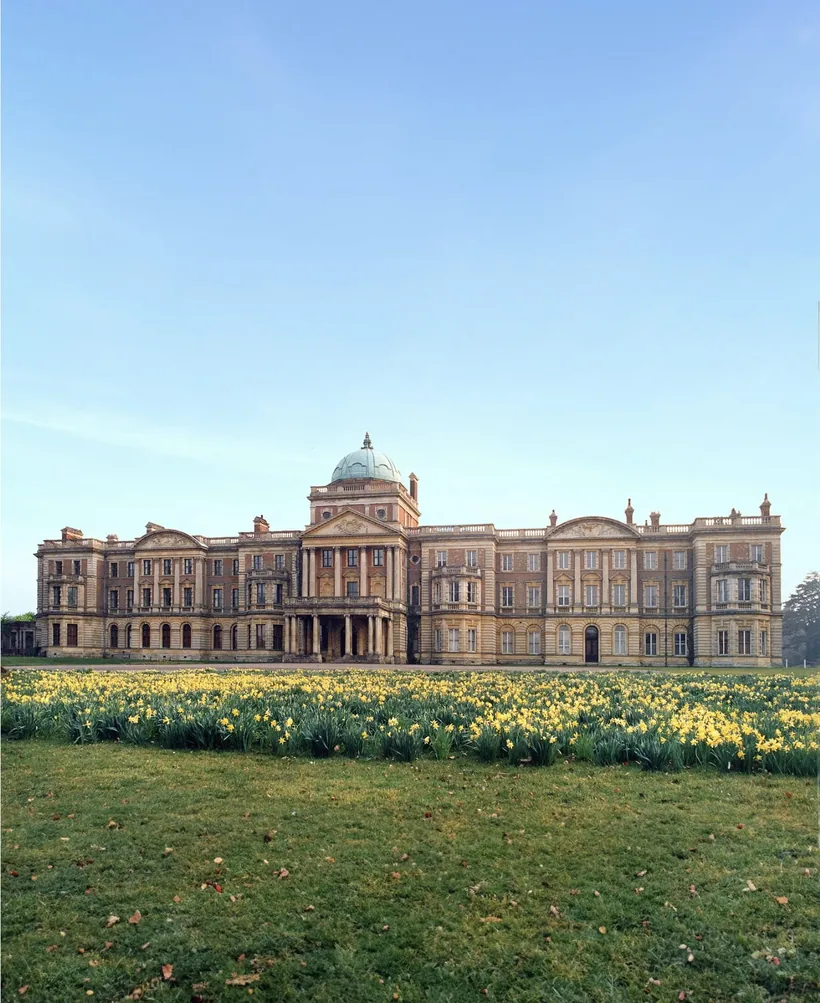
Elveden Hall · The exteriorFrom the park, Elveden gives nothing away. It is an English country house of the ordinary Victorian sort — Italianate, symmetrical, unremarkable except for its length — and a visitor arriving up the drive would have no reason to expect anything else inside. The copper dome over the centre is the only hint, and it reads as classical.
Then you go in. The rooms Duleep Singh had made are not English at all: cusped and scalloped arches, engaged columns, dense carved foliate panels, a coved and domed hall worked in white plaster with muqarnas brackets stepping down into the corners. It is the vocabulary of the Mughal and Punjab palace, executed in Suffolk by craftsmen brought from India, and it is not a room or two but the principal interiors of a large house.
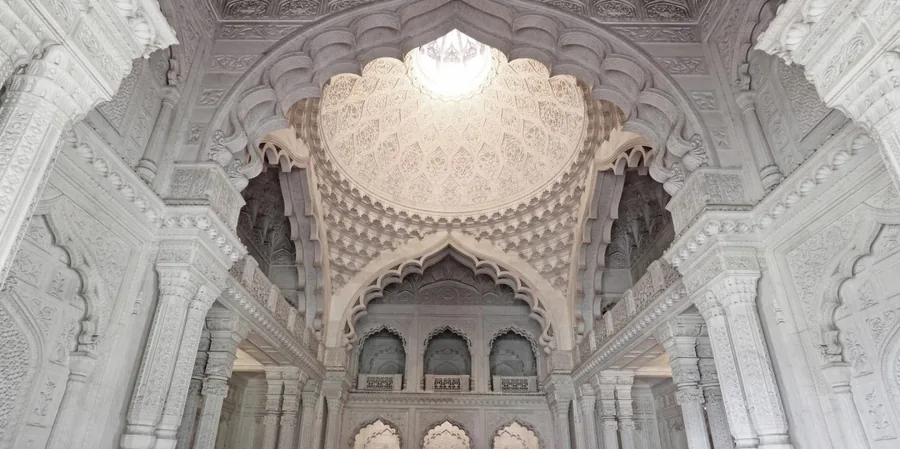
The central hall, looking up into the dome. The lantern above the crown is the source of the light that reaches the Maharaja’s marble downstairs.
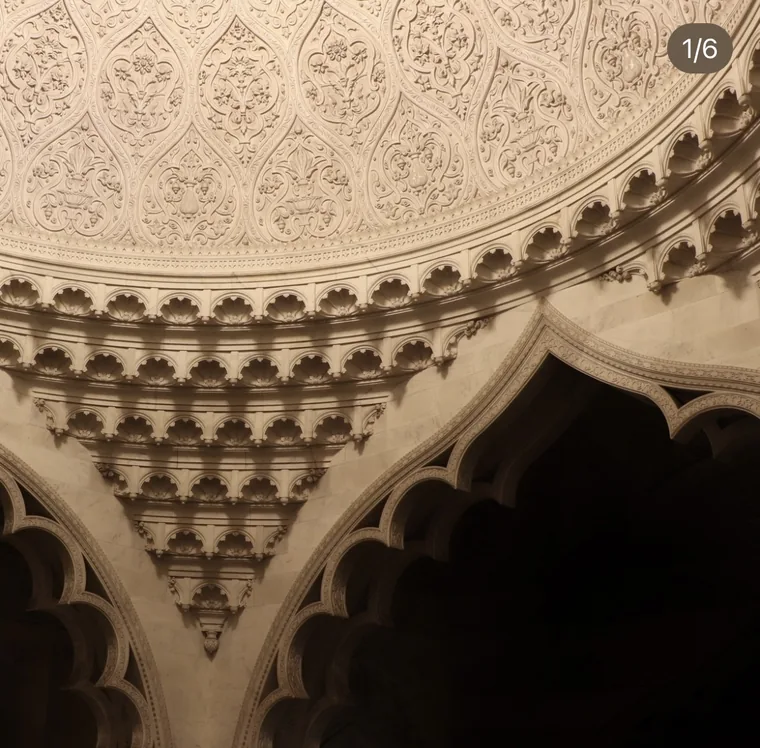
Tiers of muqarnas stepping down to the arch — a Mughal device executed in Victorian plaster.
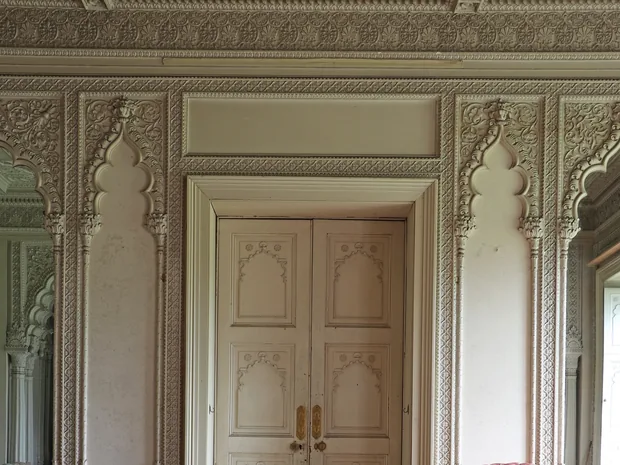
A doorway, with the panelling carrying the same arched motif as the walls.
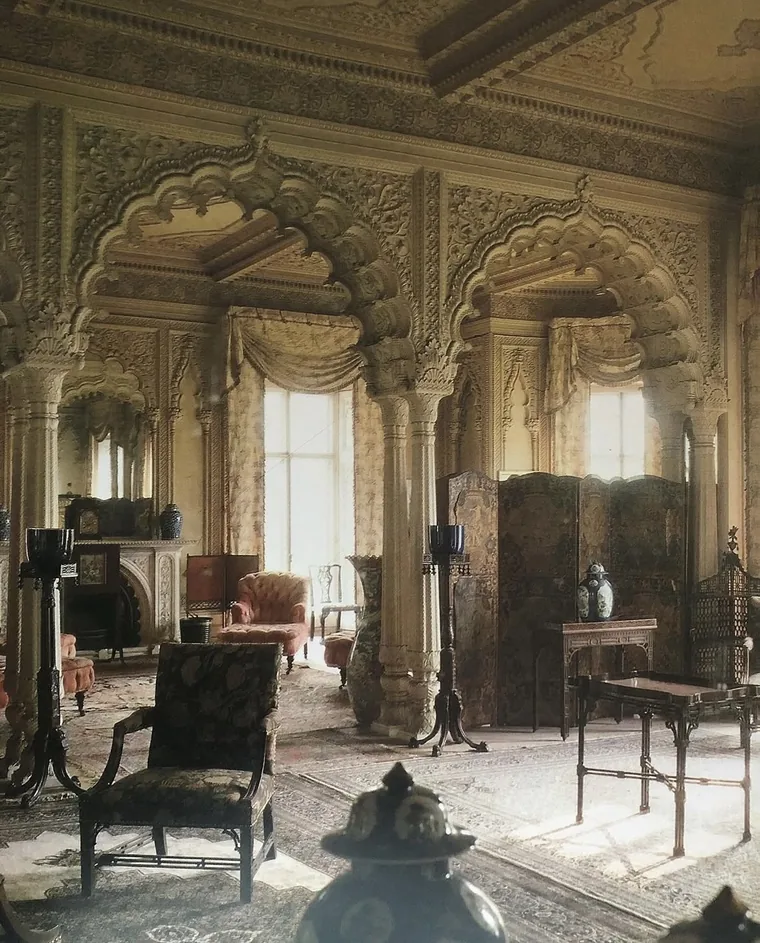
A drawing room, with the collision stated plainly: Punjab arches and columns around the windows, and English drawing-room furniture, screens and lamp standards set out beneath them.
The order of things is what makes it eloquent. An English shell that satisfies every expectation of the county, and inside it a Lahore that satisfied nobody but the man who paid for it. The money was a pension drawn on Punjab revenue; it went into Suffolk stone; and the Suffolk stone was carved back into the Punjab by a man who was not permitted to go there.
The turn came from his mother. Brought to England in 1861, blind and two years from death, she spent those years telling him what he had been. Two decades later he was working through the records in the British Library and petitioning the Queen for redress. Part of that effort was documentary: in 1885 he had two surviving catalogues of the Lahore auctions reprinted, his advisers having failed to trace the other six, so that what had been sold could at least be read. In 1886 he packed up his household and sailed for India.
V · The Wives
Bamba Müller and Ada Douglas Wetherill
He married twice, and both marriages were made outside the class of woman a maharaja in exile was expected to marry — which is worth noticing, since the British establishment had spent twenty years shaping his choices and did not shape these.
Maharani Bamba Müller
6 July 1848 – 16 September 1887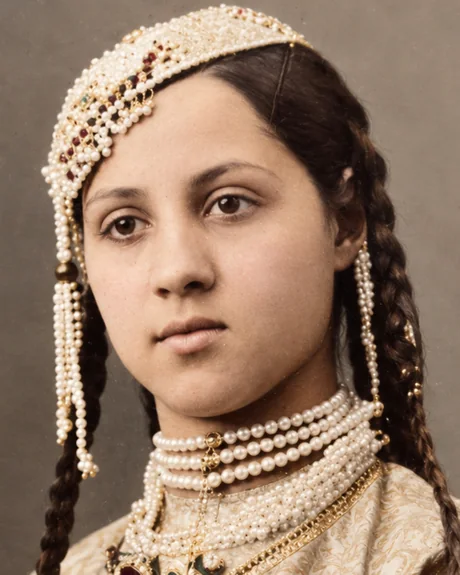
Born in Cairo, the daughter of Ludwig Müller, a German merchant and banker, and an Abyssinian Coptic Christian mother named Sofia. She was raised at a mission school in Cairo and spoke Arabic; she had no English when they married. Duleep Singh had travelled to Egypt in 1864 explicitly looking for a Christian bride and met her there; the marriage took place on 7 June 1864, at Alexandria by most accounts and at Cairo by some. She bore him seven children in thirteen years, of whom six survived infancy, and died in 1887 aged thirty-nine. She is buried at Elveden, where her husband and her youngest son were later laid beside her.
Ada Douglas Wetherill
m. 1889 – d. 1930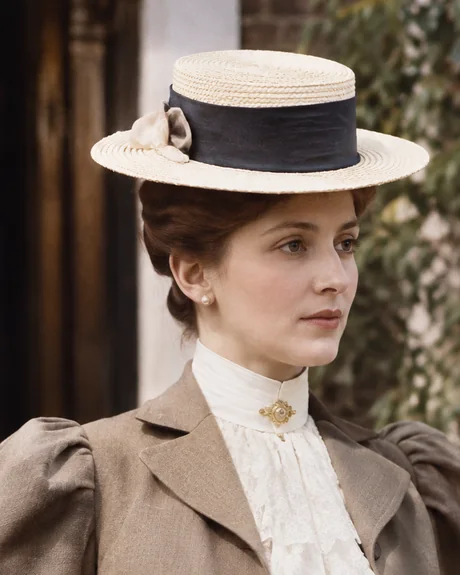
An Englishwoman whom he had met when she was a chambermaid at a hotel in St James’s, and who had been his mistress for some years before Bamba’s death. They married in Paris in 1889 and she bore him two daughters. She stayed with him through the Paris years and the poverty at the end, and travelled with him to St Petersburg on the errand that defines his last decade — the attempt to persuade the Tsar to invade India through the north and restore him at Lahore.
VI · The Children
Eight Lives, and No Grandchildren
There were eight surviving children, six by Bamba and two by Ada, and an unnamed first-born son who died in 1865. They were raised as English gentry, given titles by courtesy rather than by right, and every one of them died without legitimate issue. The house of Ranjit Singh ended with the last of them.
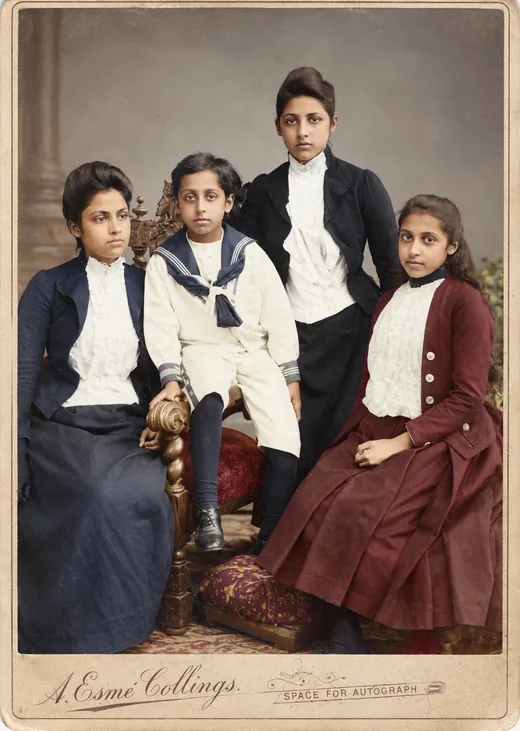
The children of ElvedenA studio cabinet card from the Brighton photographer A. Esmé Collings, colourised. Three of the daughters with their youngest brother, who is in the sailor suit — the boy who would be dead of pneumonia at thirteen. They are dressed exactly as the children of any English county family, which was the entire point of the upbringing arranged for them.
Prince Victor Albert Jay
1866 – 1918 · by Bamba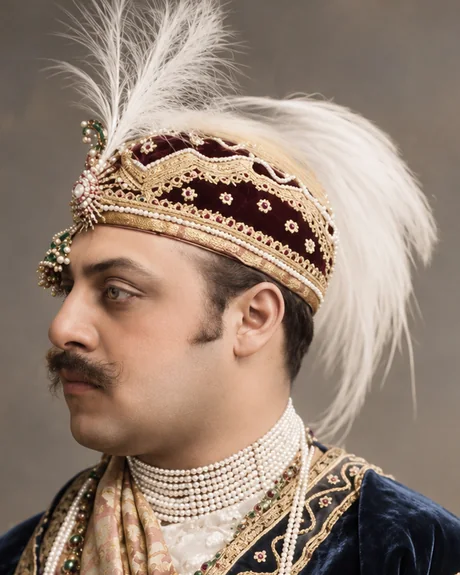
The eldest surviving son and, after 1893, nominal head of the house. Educated at Eton and Cambridge, commissioned in the army, chronically in debt. He married Lady Anne Coventry, daughter of an earl, in 1898 — a marriage the Queen consented to on the condition that there be no children who might inherit a claim. There were none. He died at Monte Carlo in 1918.
Prince Frederick Victor
1868 – 1926 · by Bamba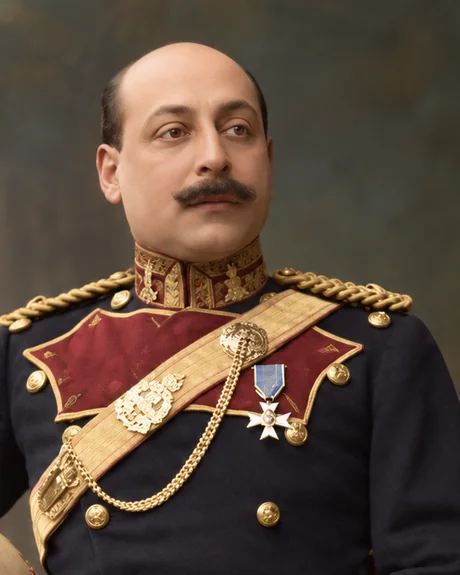
The scholar of the family and the one who made something durable. A serious antiquary and collector, he assembled and catalogued a major collection of East Anglian portraiture and left it to the town of Thetford, where it remains. He served in the First World War, never married, and is the reason a good deal of the family’s own documentation survives at all.
Princess Bamba Sofia Jindan
1869 – 1957 · by Bamba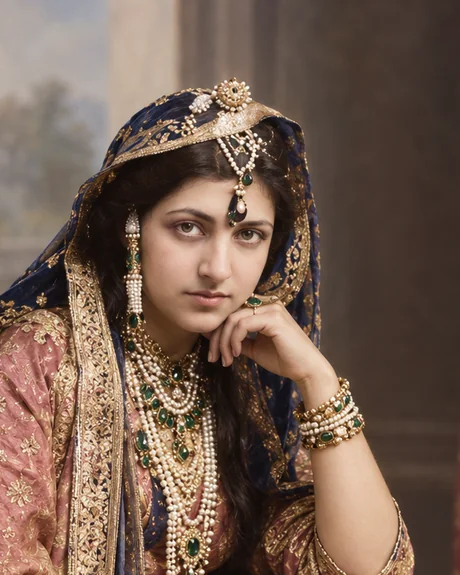
The last of the line, and the only one who went back. She married Lieutenant-Colonel David Sutherland and settled in Lahore, where she lived for decades and died in 1957. In 1924 she moved her grandmother Jind Kaur’s remains to Ranjit Singh’s samadhi. The paintings, photographs and relics she had gathered passed to the government of Pakistan as the Princess Bamba Collection and are held at Lahore Fort — the single most important body of Sikh court material to have returned to the Punjab.
Princess Catherine Hilda
1871 – 1942 · by Bamba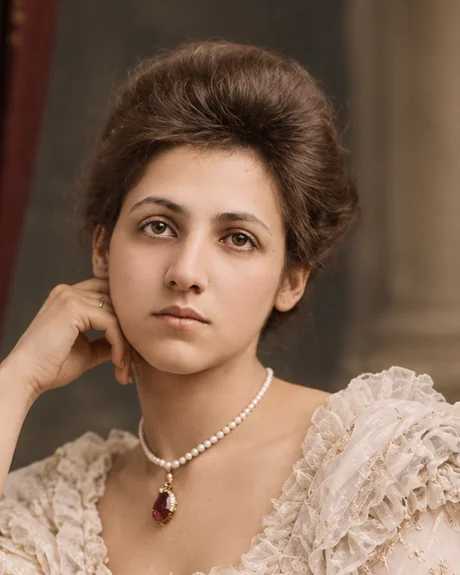
Born at Elveden, educated in England and Germany, and a suffragist. She spent much of her adult life in Germany with her former governess Lina Schäffer, and in the 1930s used her money to help Jewish families get out of the country. She died in Buckinghamshire in 1942.
Princess Sophia Alexandra
1876 – 1948 · by Bamba
The best known of the eight, and the one whose life most resembles her grandmother’s. A goddaughter of Queen Victoria with a grace-and-favour apartment at Hampton Court, she became a militant suffragette, an associate of the Pankhursts, a member of the Tax Resistance League and a participant in the Black Friday protest of 1910. She nursed Indian soldiers during the First World War. Anita Anand’s biography of her is listed on this site’s Popular Culture page.
Prince Albert Edward Alexander
1879 – 1 May 1893 · by Bamba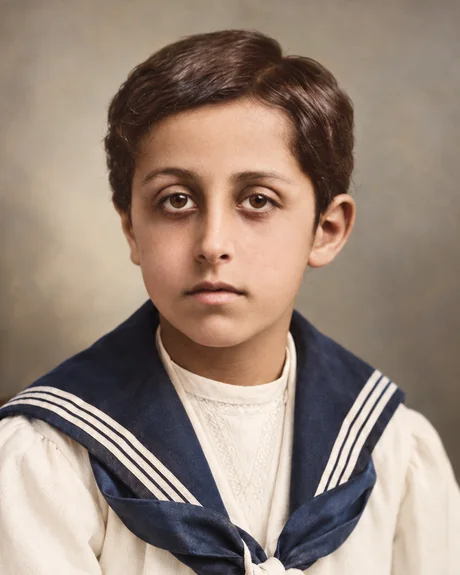
The youngest of Bamba’s children. He did well at school and was bound for Eton; he contracted pneumonia and died at Hastings on 1 May 1893, aged thirteen. His father died in Paris less than six months later, and was buried beside him.
Princess Pauline Alexandra
1887 – 1941 · by Ada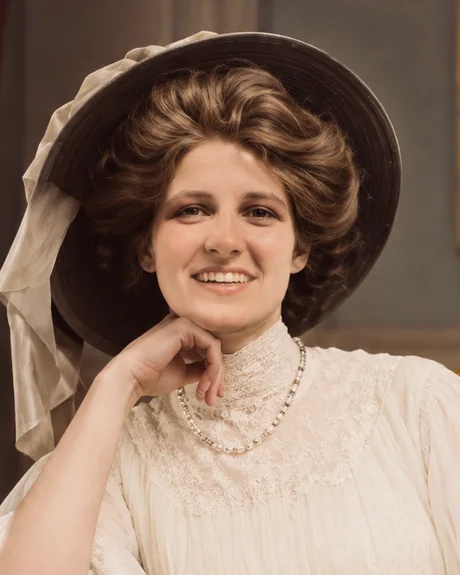
The elder of the two daughters of the second marriage, born before it. She lived quietly and died in 1941, without issue.
Princess Ada Irene Beryl
1889 – 1926 · by Ada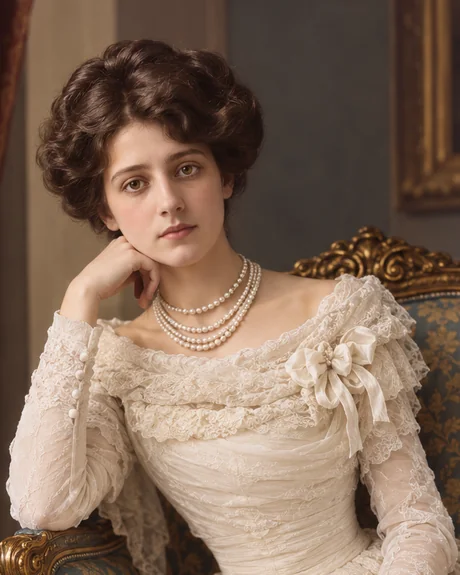
The youngest child of the last Maharaja, born the year of his second marriage. She married twice, had no children, and died in 1926.
VII · The Return
Aden, 1886
In 1886 he sailed for India with his family, intending to resume his position and his religion. The ship was stopped at Aden and he was detained there. It is the pivot of his life, and it produced the one act of his adulthood that was entirely his own: at Aden, on British-held ground and under British detention, he took pahul and returned to the Sikh faith he had been moved out of at fifteen.
He sent his family back to England and did not go home. What followed was seven years of increasingly desperate manoeuvre — Paris, an approach to the Tsar at St Petersburg, appeals to whoever in Europe might be persuaded that an invasion of India through the north was in their interest. None of it came to anything. He suffered a stroke and died in a Paris hotel room on 22 October 1893, aged fifty-five, in poverty and largely alone.
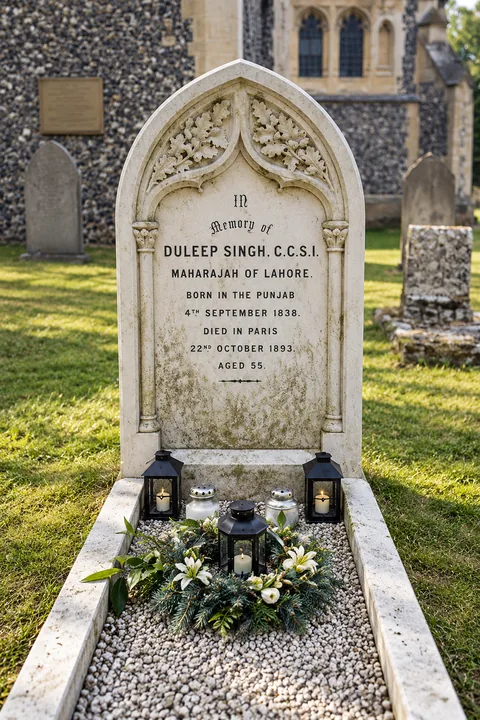
The grave · Elveden churchyardA Gothic headstone carved with English oak leaves, against the flint of a Suffolk parish church. It reads: In memory of Duleep Singh C.C.S.I., Maharajah of Lahore, born in the Punjab … died in Paris 22nd October 1893, aged 55. The lanterns and flowers are recent; the grave is still visited. Note the birth date cut into the stone — 4th September 1838, where the sources give the 6th. The error has stood for over a century.
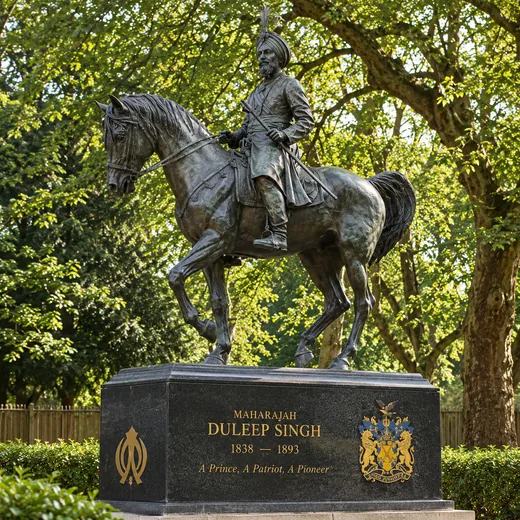
The memorialThe equestrian memorial, showing him mounted and in Sikh dress — the sovereign he was not permitted to be, rather than the Suffolk squire he was made into. The plinth carries the khanda beside the arms granted to him in England, and the line A Prince, A Patriot, A Pioneer. It stands in the East Anglian country where he spent thirty years, and it was raised a century after he died.
VIII · Extinction
Lahore, 10 March 1957
The line ran out over sixty-four years. Albert Edward died in 1893, Victor in 1918, Ada Irene in 1926, Frederick in the same year, Pauline in 1941, Catherine in 1942, Sophia in 1948. Bamba Sutherland outlived them all and died at Lahore on 10 March 1957, in the city her grandfather had ruled, a decade after it had ceased to be in India at all.
Whether the absence of heirs was accident or design is a question the sources do not settle, and this page will not pretend otherwise. What can be said is that the British authorities were consistently attentive to the possibility of a legitimate heir — the condition attached to Victor’s marriage is documented — and that a family of eight producing no legitimate children across two generations is, at minimum, an unusual outcome. The evidence supports the observation. It does not support a conspiracy, and the page stops where the evidence does.
The dynasty’s one substantial repatriation is Bamba’s. The paintings, photographs, documents and relics she assembled and took to Lahore passed to the government of Pakistan on her death and are held at Lahore Fort as the Princess Bamba Collection. It is the closest thing the house of Ranjit Singh has to a surviving treasury, and it exists because the last of his great-grandchildren chose to go and live in his capital.
IX · What Remains
A Reign Legible Only in the Mint List
Duleep Singh is the most photographed, most painted and most written-about figure in this series, and the least present in its primary material. The coins of his reign do not name him. The treaties that disposed of his kingdom were signed for him. The house he built and the faith he was raised in were chosen for him, and the grave he lies in was refused the form he asked for.
What his reign leaves the numismatist is a clean and slightly bleak lesson. Between 1843 and 1849 the Sikh state lost its regent, its army, two provinces, a war and finally its existence, and through all of it the rupee held its weight. Institutions do not fail together. The mint outlasted the monarchy, and then a foreign government closed it, which is a different kind of ending from collapse and worth distinguishing.
And the family that ended in 1957 left one thing behind that the empire itself did not: a daughter of the house who went back to Lahore, gathered what she could of it, and made sure it stayed there.
Sources
Sources and Further Reading
- Peter Bance. Sovereign, Squire and Rebel: Maharajah Duleep Singh. The standard modern account of the family, drawing on the author’s own collection of family papers and photographs.
- Christy Campbell. The Maharajah’s Box. HarperCollins. On the Russian approaches and the surveillance of his last decade.
- Anita Anand. Sophia: Princess, Suffragette, Revolutionary. The fullest life of any of the children.
- E. Dalhousie Login. Lady Login’s Recollections. Smith Elder, 1916. The guardian’s side of the Fatehgarh and English years, to be read as such.
- Harbans Singh (ed.). The Encyclopaedia of Sikhism. Punjabi University, Patiala.
- The Princess Bamba Collection, Lahore Fort, Lahore.
- On the coinage of the reign, see this site’s pages on the Nimak mint, on coin, commerce and control, and on the Second Anglo-Sikh War for the Multan issues of VS1905.