The Second Anglo-Sikh WarApril 1848 – March 1849
The war that closed the Sikh mints forever. At Chilianwala, the British army suffered its worst single-day defeat in Asia since the First Afghan War. At Gujrat, they destroyed what remained of the Khalsa in an artillery battle of overwhelming scale. On 29 March 1849, it was over.
4 Battles · 11 Months · 14 Mints Silenced · 1 Empire Extinguished
The Manufactured Pretext
A war whose cause was sought before its occasion arose
The Second Anglo-Sikh War did not begin with an act of Sikh aggression. It began with a disturbance in Multan that the British Resident had the means to contain and chose not to — and with a policy in Lahore that had been systematically alienating the Sikh sardars since the Treaty of Bhairowal in 1846. Lord Dalhousie, who had succeeded Hardinge as Governor-General in January 1848, had written privately six months before the war began that he would "avoid annexation to the last moment" — a formulation that acknowledged annexation as the destination while claiming reluctance about the timing. When the occasion arose, he ensured that it could not be resolved without war.
The interregnum between the two wars — 1846 to 1848 — had been a period of calculated humiliation for the Sikh state. The British Resident at Lahore, operating under the Treaty of Bhairowal, had assumed effective control of the government. Maharani Jindan had been removed, imprisoned, and exiled. The Sikh sardars found their authority reduced at every turn. Henry Lawrence, who had attempted a more conciliatory policy, was replaced by officers less interested in Sikh cooperation. By early 1848 the resentments that would fuel the second war were fully formed; only an occasion was needed.
It arrived in Multan in April 1848, in circumstances that remain disputed. The occasion was not chosen by the Sikh leadership at Lahore, who were in no position to fight a second war. It arose from the specific grievances of Diwan Mulraj, the Governor of Multan, and was transformed into a general war by the active cultivation of Sikh discontent by elements of the British political establishment who understood that a general rising was the only justification for total annexation.
Diwan Mulraj and the Multan Rising
Diwan Mulraj had governed Multan for the Sikh Empire since 1844. He was a capable administrator who had maintained one of the most prosperous provinces of the empire through the chaos of the succession crisis and the First War. In 1848, facing new British-imposed financial terms that would have stripped him of most of his revenue, he resigned — preferring to step down rather than accept conditions he regarded as ruinous.
The British sent two political agents — Patrick Vans Agnew of the Civil Service and Lieutenant William Anderson — to oversee the transition of power at Multan. On 19 April 1848, both men were attacked during a disturbance outside the city; they were dead within two days. Whether Mulraj ordered or was even aware of the killings has never been definitively established. Contemporary British accounts differed; the inquiry that followed was perfunctory. What was established is that Mulraj, once accused, had no option but to defend himself — and that the British Resident chose not to send the forces available to him to suppress the disturbance immediately, allowing it to develop into a siege.
The siege of Multan lasted from May to January — eight months during which a relatively modest British and Indian force under General Whish invested the city while the political situation across the Punjab deteriorated. The delay was not militarily necessary; it was politically useful. A prolonged siege kept the disturbance alive and gave time for the wider Sikh rising that would justify full annexation.
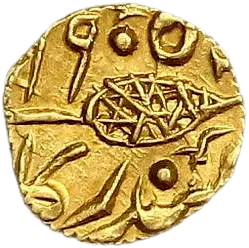
The Multan mint had operated under the Sikh Empire since the conquest of Multan in 1818. It produced a distinctive rupee with specific legend arrangements that set it apart from the Lahore and Amritsar issues. The VS 1905 (AD 1849) Multan gold rupees — struck in the final months of the siege or immediately before it — are among the last coins of the Sikh Empire minted under conditions of actual military conflict. The couplet on the coins is distinctive, 'Sahai Satguru' on the Obverse and 'Mundraka' with the leaf and date on the Reverse. The mint ceased operation with the fall of the city in January 1849.
Chatar Singh and Sher Singh Attariwala
The transformation of the Multan disturbance into a general war came through the Attariwala sardars of Hazara. Sardar Chatar Singh Attariwala — a distinguished general of the First War who had served the empire loyally — had been progressively humiliated by the British political officers in Hazara. When Captain James Abbott, the British officer assigned to Hazara, accused Chatar Singh of plotting against British authority in a series of dispatches that Sir Herbert Edwardes later described as near-incoherent, Chatar Singh was left with a choice between submission and rebellion. He chose rebellion.
His son Sher Singh Attariwala, commanding Sikh forces in the field against Mulraj, took the decision to join his father's rising in September 1848. Sher Singh was a capable and courageous commander who had served the British cause in the early months of the disturbance; his defection was a direct consequence of the British policy of removing every Sikh commander who showed independent judgment. With Chatar Singh and Sher Singh both in the field, the rising had commanders of genuine quality for the first time.
The Afghan ruler Dost Mohammad Khan also entered into negotiation with the Sikh sardars, raising the prospect — for the first time — of a combined Sikh-Afghan front against British expansion. The prospect alarmed Dalhousie sufficiently to accelerate the military campaign. The troops that had been delayed at Multan were urgently needed on the main front along the Jhelum.
Ramnagar
Battle of Ramnagar
Indecisive — Khalsa held the north bankThe opening engagement of the Second War's main campaign, fought at the Chenab crossing near Ramnagar. Sher Singh's army occupied the north bank of the Chenab in a strong defensive position. General Gough — commanding the British force for the second war as he had the first — sent cavalry across the river in a reconnaissance that developed into a serious engagement.
The British cavalry suffered heavily. Brigadier Cureton, commanding the cavalry division, was killed; so was Colonel William Havelock, cut down at the head of the 14th Light Dragoons. Havelock was the elder brother of the Henry Havelock who would relieve Lucknow in 1857 — but it was the brother, not the future hero of the Mutiny, who fell here. The Sikh position on the north bank held; Gough's army could not force the crossing. The engagement was a tactical Sikh success and demonstrated that the Khalsa army, despite the losses of the First War, retained its fighting capacity under capable commanders.
British casualties: ~200 killed and wounded including two senior officers · Sikh casualties: moderate
Chilianwala
The worst single-day British defeat in Asia since the First Afghan War
Battle of Chilianwala
Sikh tactical success — British withdrew from the fieldChilianwala is the battle that nearly ended Gough's career and forced the largest political crisis of the Second War in London. After manoeuvring across the Chenab, Gough's army encountered Sher Singh's force in dense jungle near the village of Chilianwala on the bank of the Jhelum. Gough — characteristically — launched an immediate attack without adequate reconnaissance, sending his infantry into jungle so thick that regiments lost cohesion within minutes of advancing.
The battle became a series of isolated, confused engagements fought in dense undergrowth. Dalhousie's private account — written to a personal friend in January 1849 and published decades later in the Private Letters — is the most damning contemporary record of what happened: the heavy guns were silencing the Sikh artillery beautifully when Gough stopped them and ordered a general advance in line with only two reserve regiments. The result was that every regiment in the action fought a battle itself, separated from its neighbours, overlapped on all sides, fighting front, flanks and rear simultaneously. The cavalry on the right — the 14th Light Dragoons, 9th Lancers and two regiments of regular horse — halted before even meeting the Sikh irregular horse facing them, turned about, and "galloped to the rear as hard as they could ride", breaking the British artillery, cutting the harness, and riding through the field hospital before a chaplain, pistol in hand, stopped them. Four British guns were lost, twelve Sikh guns were taken and spiked but then recovered by the Sikhs overnight. At nightfall Sher Singh's army held the field.
The casualty figures sent to London caused a parliamentary crisis. The 24th (2nd Warwickshire) Regiment of Foot, ordered to take the Sikh guns at bayonet point, lost over half its strength — 515 casualties, including 238 killed — in a single charge. Total British and Indian casualties exceeded 2,300 — the highest single-day loss of any engagement of either war. News of Chilianwala reached London before news of Gujrat; for several weeks, the British public believed the Punjab campaign had ended in disaster. Gough was replaced by Sir Charles Napier — but the order arrived after the war was over.
"The Sikh nation has been seized with a sudden frenzy. Sikh officers and soldiers who have been serving us faithfully for years have thrown off their allegiance. We have to fight not an army but a nation."
— Lord Dalhousie, dispatch to the Court of Directors, November 1848
The Fall of Multan
Siege and Fall of Multan
British victoryOn 22 January 1849, after a siege spanning several months, General Whish's force breached the walls of Multan and stormed the city. Diwan Mulraj, whose personal position had become untenable after the disturbance of April 1848, surrendered. He was subsequently tried for the murders of Agnew and Anderson; the trial was deeply compromised by the political necessity of producing a conviction. He was found guilty and transported for life — a sentence later commuted.
The fall of Multan freed Whish's substantial force — including reinforcements that had been waiting for the siege to conclude — to march north and join Gough for the final campaign. The timing proved critical. Gough, having suffered Chilianwala less than two weeks earlier and facing a Sikh army that had demonstrated it could fight him to a standstill in the jungle, urgently needed the additional artillery that Whish's siege train could provide.
Multan garrison casualties: heavy during the siege · British assault losses: ~700 killed and wounded
Gujrat
The artillery battle that ended the Sikh Empire
Battle of Gujrat
Decisive British victory — complete rout of the KhalsaGujrat was the battle that Chilianwala had prevented Gough from winning. Reinforced by Whish's siege artillery and reorganised after the shock of the January disaster, Gough assembled the largest British force yet deployed in the Punjab — nearly 24,000 men and close to a hundred guns — for a methodical artillery battle that left nothing to chance and nothing to infantry courage alone.
The British artillery bombardment opened the battle and lasted more than two hours before a single infantryman advanced. Ninety-six British and Indian guns — including Sikh pieces captured in earlier engagements — fired into the fifty-nine guns of the Khalsa, systematically destroying the artillery that had been the empire's greatest military asset. The Sikh guns, outranged and overwhelmed, were silenced one by one. When the British infantry advanced, it walked over a position that had already been broken.
Sher Singh's army broke and fled northward. The British cavalry pursued without pause for twelve miles. Dalhousie's private letter that evening captured the relief in a single sentence: "HURRAH for our side! This time we have got a victory and a sniffler." The Khalsa was driven through its own camp and out the other side, dropping weapons and standards as it ran; fifty-three Sikh guns were taken. The army that had held its own at Mudki, Ferozeshah, Ramnagar and Chilianwala ceased to exist as a coherent fighting force in the space of a single morning.
British casualties: 96 killed, ~700 wounded — the lightest of any engagement of either war · Sikh casualties: ~3,000 killed and wounded; 53 guns and all standards captured
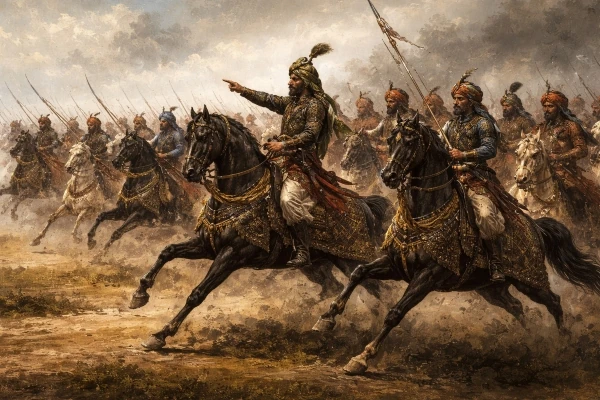
The charge of Sher Singh Attariwala's cavalry at Chilianwala — commemorated in Sikh painting as among the most dramatic moments of the Second War — exemplifies the paradox of the conflict: the Khalsa had commanders of genuine quality in the field at last, and at Ramnagar and Chilianwala those commanders demonstrated it. The paintings of Sher Singh's charge and of Chatar Singh's stand capture what the official dispatches were careful to avoid acknowledging: that the Khalsa fought the Second War better, and with more coherent leadership, than the First.
The surrender of the remaining Sikh forces at Rawalpindi on 14 March 1849 — Sher Singh and Chatar Singh Attariwala laying down their arms to General Gilbert — formally ended the military campaign. The Sikh sardars who had fought with courage and without treachery at every engagement of both wars were now prisoners. The sardars who had betrayed the Khalsa at Mudki, Ferozeshah and Sobraon were rewarded with titles and territories. The pattern was entirely consistent.
Annexation and the Last Coins
The silencing of the fourteen mints
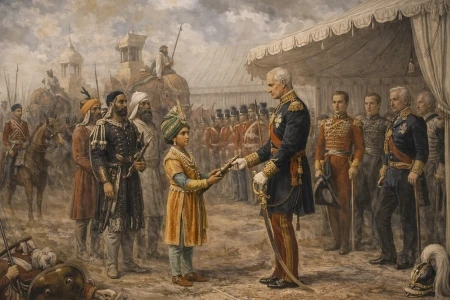
On 29 March 1849 the last Durbar was held at Lahore. Maharaja Duleep Singh, ten years old, sat on the throne of his father for the last time. The instrument of annexation was placed before him. He signed. The Punjab was declared British territory. The Koh-i-Noor was surrendered. The Maharaja was removed to British custody and eventually to England. Dalhousie recorded the moment in a private letter with characteristic self-satisfaction: "I had now caught my hare... the Council of the Regency and the Maharajah signed their submission to the British power, surrendered the Koh-i-noor to the Queen of England; the British colours were hoisted on the Citadel of Lahore, and the Punjab, every inch of it, was proclaimed to be a portion of the British Empire in India." He reflected that it was not every day that an officer of the Crown adds four million subjects to the Empire and places "the historical jewel of the Mogul Emperors in the Crown of his own Sovereign." It was over.
The numismatic consequence was immediate and total. Every one of the fourteen mints of the Sikh Empire — Lahore, Amritsar, Multan, Peshawar, Kashmir, Derajat, Dera, Mankera, Jhang, Mozang, and the rest — ceased to strike coins bearing the couplets of the Gurus. The sovereign Sikh coinage that had begun with Banda Singh Bahadur at Lohgarh in 1710, that had been struck continuously through the Misl period and the Empire, came to an end in 1849.
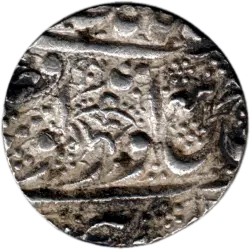
The Amritsar mint — struck in the city of the Harmandir Sahib, the holiest site of the Khalsa — produced its last coins in VS 1906. The Amritsar rupee had carried the legend Sikka zad bar Har Do Alam — coin current in both the worlds — on its obverse, and the Gobindshahi couplet on its reverse, since the earliest Dal Khalsa issues. After 1849 the sacred mint was silent. The Cis-Sutlej states — Patiala, Nabha, Jind — would continue striking rupees under British protection for another century; but the coins of the Sikh Empire proper ended here, in VS 1906.
The VS 1906 coins of Amritsar mint — are, in the terminology of numismatics, terminal issues: the final coins of a sovereign tradition. They command a premium in collections not merely for their rarity but for what they represent. Each one is a coin struck under the Khalsa sovereignty, bearing the invocation of the Gurus, in the year that sovereignty was extinguished. The mints that had proclaimed Sikka zad bar Har Do Alam — "coin current in both the worlds" — in their legends fell silent on 29 March 1849, and were silent thereafter.
Sources
- Seetal, Sohan Singh. How Fell the Sikh Kingdom. Ludhiana: Lyall Book Depot, 1970. Chapters XIV–XIX cover Multan, Chatar Singh, and the battles of the Second War in detail.
- Dalhousie, Marquess of. Private letters and dispatches, 1848–49. Edited by J.G.A. Baird: Private Letters of the Marquess of Dalhousie. Edinburgh: William Blackwood, 1910.
- Gough, Sir Charles, and Innes, Arthur D. The Sikhs and the Sikh Wars. London: A.D. Innes & Co., 1897.
- Bell, Major Evans. The Annexation of the Panjab and the Maharaja Duleep Singh. London: Trübner, 1882. The most thorough analysis of Dalhousie's justifications and their weaknesses.
- Smyth, Major G. Carmichael. A History of the Reigning Family of Lahore. Calcutta: W. Thacker, 1847.
- Cook, Hugh. The Sikh Wars 1845–49. London: Leo Cooper, 1975.
- Singh, Amarinder (Captain). The Last Sunset: The Rise and Fall of the Lahore Durbar. New Delhi: Roli Books, 2010.
- Major, Andrew. Return to Empire: The Sikhs and the British in the Punjab 1839–1849. New Delhi: Sterling, 1996.
- Singh, Khushwant. How the Sikhs Lost Their Kingdom. New Delhi: UBSPD, 1996.
- Herrli, Hans. The Coins of the Sikhs. Zurich, 1993 (2nd ed. 2004). For the VS 1906 terminal issues and mint sequences.
- Sidhu, Saran Singh & Dalwinder Singh. Coins of the Sikh Empire, Punjab and the Cis-Sutlej States. London: Spink & Son, 2022.
Punjab Campaign Medal 1848–49
Select specimens from the SikhCoins.in collection. Click any image or title to browse the full album.
| Specimen | Mint | Date | |
|---|---|---|---|

|
The Punjab Medal - 1848-49 | ||

|
Punjab Medal, Clasps Goojerat & Mooltan | ||

|
Punjab Medal, Clasps Goojerat & Chilianwala |