The Fall of the
Sikh Empire1839 – 1849
The most powerful state in South Asia outside British India — an empire stretching from the Khyber to the Sutlej, from Kashmir to Sindh — dissolved within a decade of its founder's death. This is how it happened.
Ten Years · Four Maharajas · Two Wars · One Annexation
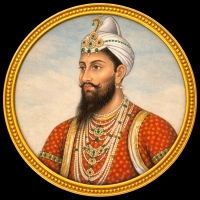 Kharak Singh
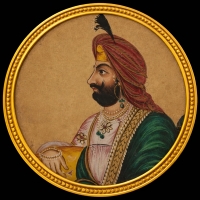 Nau Nihal Singh
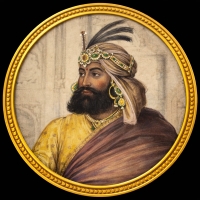 Sher Singh
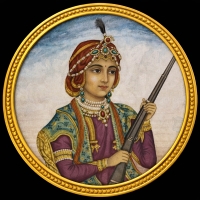 Duleep Singh
The Paradox of Sudden Collapse
How the strongest army in Asia was defeated not on the battlefield but at the council table
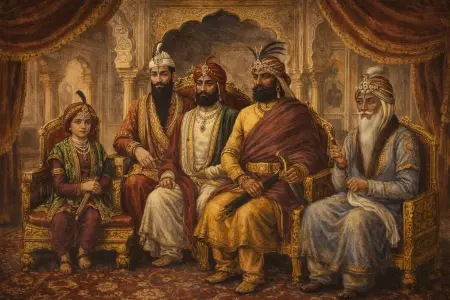 The five Maharajas of the Sikh Empire
In the spring of 1839, the Sikh Empire was at the apex of its power. Its treasury held the Koh-i-Noor and a surplus accumulated over four decades of conquest. Its army — the Fauj-i-Ain, reorganised by French and Italian veterans — was the finest fighting force on the subcontinent. Its fourteen mints struck rupees bearing the Gurus' couplets from Peshawar to Multan, from Kashmir to the Sutlej. No Indian power outside British India could threaten it.
By 29 March 1849 — a single decade later — the empire was extinguished. Four Maharajas had reigned and died or been deposed. The Koh-i-Noor had been taken to London. Maharaja Duleep Singh, aged ten, had been exiled to England. Maharani Jindan, the regent who had governed for her child son, had been imprisoned, drugged, and expelled. The fourteen mints had fallen silent.
How fell the Sikh kingdom? Sohan Singh Seetal, who devoted a lifetime to this question, found the answer both simple and devastating: treachery — not the treachery of enemies, but of the empire's own ministers and generals. The English statesmen themselves, he notes, admitted they had not defeated the Khalsa at the point of the sword. The Dogras of Jammu — Dhian Singh, Gulab Singh, Hira Singh — who had risen from obscurity to become the wirepullers of the Punjab, had enlisted in British service at three rupees a month before catching the eye of the Lion of the Punjab. They raised their palaces on the ruins of the kingdom whose trust they had betrayed.
Yet the historiography resists simple answers. Khushwant Singh locates the primary cause in the lethal combination of Dogra treachery and the structural collapse of leadership after Ranjit Singh's death, finding the Army Panchayats — the democratic soldiers' councils that filled the political vacuum — as ungovernable as they were formidable. More recently, post-colonial scholars have read the story differently: not as a military or political failure at all, but as a colonial theft of sovereignty, body, and identity — the stolen body of Maharaja Duleep Singh as the paradigmatic expression of British imperial desire.
The Death of Ranjit Singh
The valedictory of the Lion of the Punjab
On the evening of 27 June 1839, Maharaja Ranjit Singh died at Lahore after months of declining health following a series of strokes. He was fifty-eight years old. He had ruled the Punjab for forty years, unified the Sikh Misls into a single sovereign state, extended his domains to the Khyber Pass and the frontiers of Afghanistan, and through his entire reign struck coins bearing not his own name but the couplets of Guru Nanak and Guru Gobind Singh — the most deliberately self-effacing numismatic tradition in Indian history.
His valedictory address, delivered in the presence of his court, was characteristically without vanity. In his final days the Brahmin priests gathered at his bedside declared that the dying Maharaja had bequeathed his most prized possession — the Koh-i-Noor diamond — to the Jagannath Temple at Puri; the courtiers present, said to have included Dhian Singh Dogra, intervened to insist that so great a gift must be left to the heir, Kharak Singh, to decide. The bequest was never carried out. Instead the Koh-i-Noor remained in the treasury, a prize that would, within ten years, be placed on the chest of Queen Victoria at a London exhibition as a gift from a child Maharaja who had never been asked for it.
Ranjit Singh had named his eldest son, the mild and easily manipulated Kharak Singh, as his successor. The choice reflected dynastic convention over political wisdom. Kharak Singh was pleasant, pious, and entirely unsuited to the role his father had created for him. Into the vacuum around him stepped the most powerful family in the Punjab: the Dogra brothers of Jammu.
Four Maharajas in Six Years
The Dogra conspiracy and the systematic destruction of Ranjit Singh's heirs
The succession crisis that consumed the Sikh Empire in the four years following Ranjit Singh's death was not accidental. It was engineered. At its centre stood the Dogra triumvirate: Dhian Singh, Prime Minister; Gulab Singh, Governor of Jammu; and Hira Singh, Dhian Singh's son, who would briefly hold the reins of government. Their method was consistent: identify the heir least capable of independent rule, place him on the throne, position themselves as indispensable intermediaries, and eliminate all rivals.
August 1839
Kharak Singh — Prisoner in His Own Palace
Within weeks of his accession Kharak Singh was effectively a prisoner. His able son Prince Nau Nihal Singh was sidelined. Real power passed to Chet Singh Bajwa, a favourite of the new Maharaja, whom Dhian Singh despised. Dhian Singh engineered Chet Singh's assassination before Kharak Singh's eyes in October 1839. The shock permanently broke Kharak Singh's spirit and health. He died in November 1840, possibly poisoned.
November 1840
The Death of Prince Nau Nihal Singh
On the same day he attended his father's cremation, Prince Nau Nihal Singh — the most promising heir of the house of Ranjit Singh — was killed when a gateway at the Lahore Fort collapsed on him as he walked beneath it. Seetal records that the Dogra conspiracy was immediately suspected; the circumstances were never satisfactorily explained. He was nineteen years old.
1841 – 1843
Sher Singh — The Reluctant Maharaja
After a brief struggle in which Chand Kaur (the widow of Kharak Singh) briefly attempted to hold power, Sher Singh — another son of Ranjit Singh — was proclaimed Maharaja in January 1841. His reign was relatively stable until September 1843, when he was shot dead at close range by Ajit Singh Sandhanwalia during a review of troops, along with his son. Dhian Singh, who witnessed the assassination, was himself killed by Sher Singh's supporters within the hour. The Maharaja, his heir apparent and the Prime Minister died in a single afternoon.
16 September 1843
The Misr Brothers Killed — The Last of Ranjit Singh's Administrators
On this precise date, confirmed by Sohan Lal Suri's Umdat-ut-Tawarikh Daftar IV, Misr Beli Ram and his brother Misr Ram Kishan were put to death — victims of the Dogra intrigues that consumed all those who had been too closely identified with the old order. Beli Ram had held the Toshakhana keys through the entire reign of Ranjit Singh; Ram Kishan had served as royal Chamberlain. Their deaths effectively ended the institutional continuity of the Sikh imperial administration that Bhawani Das had built from 1808 onward. The men who remained alive and capable — above all Diwan Dina Nath — had survived precisely by making themselves impossible to classify as enemies of any faction.
September 1843
Duleep Singh — Five Years Old, on the Throne
The youngest son of Ranjit Singh, Duleep Singh, was placed on the throne at the age of five. His mother, Maharani Jindan — the youngest and most spirited of Ranjit Singh's wives — became regent. Hira Singh, son of the murdered Dhian Singh, became Prime Minister. On the night of 30 August 1845, in a scene of extraordinary brutality, Prince Peshaura Singh — a claimant to the throne — was beheaded at the Attock Fort and his body thrown into the river. He was twenty-two years old.
A majority of Ranjit Singh's most capable Hindu courtiers and officials had either predeceased him or retired before the crisis broke. Diwan Mohkam Chand, Misr Diwan Chand, Diwan Bhawani Das, Diwan Ram Dayal and Diwan Ganga Ram all died during the reign. Diwan Moti Ram and Diwan Kirpa Ram withdrew to Banaras. The Misr brothers were killed in September 1843. What the empire retained was Dina Nath — its financial memory and its last competent administrator — who survived by refusing to be anybody's partisan.
By 1845, of the sons of Ranjit Singh who might have led a mature and coherent government, none survived or were capable. The empire had been decapitated. Its army, the most powerful force it possessed, now moved into the political vacuum with an instrument of its own.
The Army Panchayats
The Khalsa democracy — strength and instability in equal measure
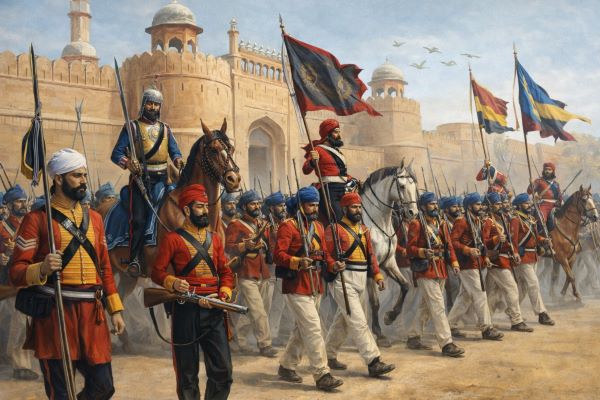 The Fauj-i-Ain — the regular army of the Sikh Empire
With the court in chaos and each successive government more fragile than the last, the Khalsa army reorganised itself on an older model: the Panchayat, the council of equals. Every regiment elected a committee from its own ranks; these committees communicated with one another and with the broader army; the assembled voice of the soldiery became, in effect, the most powerful political institution in the Punjab — more powerful than the regency, more powerful than the remaining ministers.
The Panchayats drew on a deep tradition. The Dal Khalsa of the Misl period had governed itself on precisely this principle — no king, only the collective will of the Khalsa. Seetal records that the Khalsa army, tempered by the teachings of Guru Gobind Singh, possessed a democratic instinct that no amount of Europeanisation under Allard, Ventura, and Court had entirely extinguished. The soldiers were extraordinarily disciplined in battle; politically, they were ungovernable by any individual.
The British watched the Panchayats with a mixture of alarm and calculation. A Khalsa army governed by democratic councils, suspicious of its own officers, resentful of the Dogra ministers who had sold the empire piece by piece, and increasingly inflamed by British provocations along the Sutlej frontier — this was an army looking for a war. The British resident, Major Broadfoot, was content to provide one. His dispatches, Seetal demonstrates, consistently exaggerated Sikh aggression and minimised British provocation.
Maharani Jindan and the Regency
The most formidable opponent the British encountered in the Punjab — and the most methodically destroyed
Maharani Jind Kaur — Jindan — was in her mid-twenties when she became regent for her five-year-old son. She was literate, politically acute, courageous, and possessed of a force of personality that unnerved the British agents who dealt with her. Lord Dalhousie, writing privately in 1854, observed that the beautiful eyes with which Duleep Singh had captivated the London court were his mother's eyes — the same eyes with which Maharani Jindan had once captivated and controlled Ranjit Singh himself.
Jindan's position was structurally impossible. She governed through ministers she could not fully trust, commanded an army whose Panchayats acknowledged no civil authority, faced British encroachments that grew bolder with each passing month, and did so as a woman in a court where powerful men were accustomed to ruling. That she held the regency together as long as she did is remarkable. Her attempts to navigate between the army's demand for confrontation with the British and the ministry's covert dealings with them left her politically isolated at the moment the First Anglo-Sikh War began.
The First Anglo-Sikh War
The war the Khalsa could have won — and the treachery that ensured it did not
On 11 December 1845 the Khalsa army crossed the Sutlej at Hari ke Pattan, formally beginning the First Anglo-Sikh War. The crossing itself was preceded by one of the most documented acts of treachery in Indian military history: the Wazir, Lal Singh, sent a message to the British before the battle of Ferozepur warning them of the Sikh army's movements and requesting instructions. The British reply, relayed through Captain Nicholson, was unambiguous: do not attack Ferozepur; lead your forces away from the garrison.
Seetal quotes Colonel Monton's account directly: Lal Singh rushed up to the Khalsa and dampened their ardour by assuring them of the defection of four Indian battalions in the English army — assurances he knew to be false. Meanwhile he was sending urgent messages to the British camp telling them the army had crossed without his orders. The Khalsa fought brilliantly without its generals. At Ferozeshah, so ferocious was the Sikh assault that Governor-General Hardinge privately wrote that the British army had come closer to catastrophic defeat than at any point since Waterloo. The Sikh artillery was, by all accounts, superior to the British in both quality and execution.
Mudki
18 December 1845
First engagement of the war. Khalsa forces under Lal Singh fought the British to a standstill at dusk. British casualties were heavy; the Sikh withdrawal was not a defeat but a disengagement. Lal Singh had already opened his correspondence with the British camp.
Ferozeshah
21–22 December 1845
Two-day battle in which the Khalsa nearly broke the British army. Hardinge wrote privately that he had seldom seen so severe an action. The Sikh artillery was devastating. Lal Singh's deliberate failure to press the advantage on the second day was the difference between Sikh victory and survival.
Aliwal
28 January 1846
A British force under Harry Smith routed a Sikh division at Aliwal, cutting off a portion of the Khalsa army from the main body. The Sikh commanders in this sector, unlike Lal Singh, fought without calculation or reserve.
Sobraon
10 February 1846
The final and decisive engagement. Tej Singh, the Commander-in-Chief, is held in the Sikh tradition to have deliberately weakened the pontoon bridge before the battle. When the British broke through the Sikh lines, the bridge collapsed, drowning thousands. Sardar Sham Singh Attariwala died here, returning from retirement to lead a last charge.
Sardar Sham Singh of Attari was sixty years old when he rode into the battle of Sobraon in his white dress on his white horse. He had retired from active service years earlier. He returned because the army had no general. Seetal describes him appearing among the breaking Sikh lines at the critical moment: bringing new hope to men, like a heavenly angel, in his bright white beard. He shouted words of encouragement like a martyr to patriotism. He died leading a final charge against the British lines. To Seetal, who dedicated his entire work to his memory, Sham Singh Attariwala was the hero of the war — not its generals, who had sold it; not its ministers, who had engineered its loss; but an old man who refused to let the Khalsa die in disgrace.
The Treaty of Lahore on 9 March 1846 imposed punishing terms. The Sikh army was reduced to 20,000 infantry and 12,000 cavalry. A British Resident was installed at Lahore. The Jalandhar Doab — the territory between the Beas and Sutlej — was annexed outright. And in one of the most cynical transactions in the history of South Asia, Gulab Singh of Jammu, who had done nothing during the war except communicate secretly with both sides, was sold the kingdom of Kashmir for seventy-five lakh rupees — a sale that validated Dogra treachery with territorial reward and created a political problem that endures to the present day.
The Interregnum
British occupation by treaty — and the destruction of Maharani Jindan
The Treaty of Bhairowal in December 1846 replaced the regency of Maharani Jindan with a Council of Regency supervised by the British Resident. The Resident — initially Henry Lawrence, later John Lawrence — became in practice the ruler of the Punjab. Jindan was removed from the regency, confined to Sheikhupura, subjected to what Seetal documents as deliberate harassment and degradation, separated from her son and confined at Sheikhupura in August 1847, and finally banished from the Punjab to Benares in 1848.
The treatment of Maharani Jindan during this period was calculated. She remained the most politically dangerous person in the Punjab because she remained the symbol of legitimate Sikh sovereignty — the mother of the Maharaja, the widow of Ranjit Singh, the one figure whose removal could not be explained away as a military necessity. The British Resident's own dispatches, quoted by Seetal, reveal an anxiety about her influence that borders on obsession. She was eventually drugged to prevent her communicating with anyone outside her confinement. She later escaped to Nepal, where she lived in exile until her reunion with her son in Calcutta in 1861.
The Second Anglo-Sikh War
Multan, Chilianwala, and the final defeat
The occasion for the Second Anglo-Sikh War was the revolt of Diwan Mulraj at Multan in April 1848. Mulraj had resigned as Governor of Multan rather than accept new terms that would have stripped him of revenue. When two British political agents, Agnew and Anderson, were killed during a disturbance in the city, the British seized the pretext for intervention. Whether Mulraj ordered or merely failed to prevent the killings remained contested, but by the summer of 1848 it had ceased to matter.
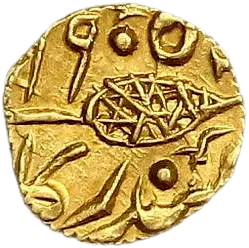
The Multan mint operated under the Sikh Empire from the conquest of Multan in 1818. Its last rupees under the Sikh Empire were struck in VS 1905 — emergency gold rupees produced as the British forces laid siege to Multan.
The revolt spread. Sardar Chatar Singh Attariwala in Hazara and his son Sher Singh Attariwala raised their standards, drawing in much of what remained of the Khalsa army in a final bid to expel the British from the Punjab. The British Resident had consistently provoked and alienated the Sikh sardars in the preceding two years; the rising had deep roots in accumulated resentment.
Ramnagar
22 November 1848
Opening engagement on the Chenab. An indecisive action in which Brigadier Cureton and Lieutenant-Colonel Havelock were killed. Sher Singh's army held the north bank and inflicted significant British losses before withdrawing.
Chilianwala
13 January 1849
The bloodiest battle of either Anglo-Sikh War. British forces under Gough suffered over 2,300 casualties in a single afternoon. Three British regiments broke and fled. The Sikh army held the field at nightfall. News of the battle provoked a political crisis in London serious enough to result in Gough's replacement.
Multan
22 January 1849
After a siege of several months, Multan fell to British forces under General Whish. Diwan Mulraj surrendered and was tried for the murders of the British agents. The fall of Multan freed Whish's force to march north and join Gough for the final battle.
Gujrat
21 February 1849
The decisive and overwhelming final battle, fought with a vastly superior British artillery. Sher Singh's army was routed and pursued without pause. Within two weeks the Khalsa army had surrendered and laid down its arms at Rawalpindi. The Second Anglo-Sikh War was over.
Annexation
The last Durbar — and the last coins of the Sikh sovereign mints
On the morning of 29 March 1849, a Durbar was convened at Lahore at seven o'clock. Maharaja Duleep Singh, ten years old, occupied his father's throne for the last time. Seetal, drawing on the eyewitness account of Resident Elliot, records that the court members wore clothes fit for a condolence occasion, as if they had met to express their deep sorrow at the death anniversary of Maharaja Ranjit Singh. Elliot himself walked in with the British officers. Duleep Singh and the Sardars went to the outer gate to receive them.
The document that was placed before the ten-year-old Maharaja declared the complete subjugation of the Punjab to British authority. The Koh-i-Noor was to be surrendered to the Queen of England. An annual pension was fixed. Duleep Singh would be educated under British supervision and later removed to England, where he would remain for the rest of his life. He signed — or his hand was guided to sign — the instrument of his own political extinction.
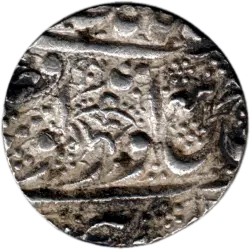
The Amritsar mint operated under the Sikh Empire from the early years of Ranjit Singh's reign. Its last rupees under the Sikh Empire were struck in VS 1906 — a shortlived issue with a Chhatra symbol above 'Ram' in lande script.
The numismatic consequence was immediate. The mints of the Sikh Empire — Lahore, Amritsar, Multan, Peshawar, Derajat, Dera, and the rest — ceased to strike coins bearing the Gobindshahi and Nanakshahi couplets of the Gurus. Kashmir alone was not silenced: it had passed to Gulab Singh three years earlier, and its mint carried on under the Dogras. Some mints had already struck their last coins in VS 1906 (1849) as the war drew to its close, including emergency issues from Multan produced under siege conditions. The VS 1906 Amritsar rupee is among the most poignant objects in Sikh numismatics: a coin whose legends invoke Guru Nanak's sovereignty, struck in the very year that sovereignty was extinguished.
Dalhousie's formal justification for annexation — that the Sikh government had violated the Treaty of Lahore — was demolished by Evans Bell in his contemporary analysis: Lord Dalhousie totally fails to make out any violation of the Treaty against the Lahore State, Bell wrote. The debt obligations cited by Dalhousie as the proximate cause were, by the British Resident's own correspondence, a matter of accounting under revenue arrangements the Resident himself had introduced. The Punjab was annexed because Dalhousie wanted to annex it — not because a treaty had been broken.
"We had drifted into being enslaved. That was no impossibility. But the manner in which slavery engulfed our nation must give us now enough reason to feel shocked. The English statesmen even now admit that they had not defeated us at the point of the sword."
— Sohan Singh Seetal, Preface to How Fell the Sikh Kingdom (1970)
How the Historians Disagree
Three readings of the same catastrophe
Sohan Singh Seetal — the most exhaustively documented account — places primary blame on the Dogra ministers and the treachery of Lal Singh and Tej Singh during the First War. His analysis is comprehensive and unsparing: the Dogras had aligned with the British before the war; the generals were paid to lose it; Gulab Singh's reward of Kashmir was the price of that service. The English, in his view, won through bribery and betrayal rather than military superiority. The Khalsa army, fighting without commanders worthy of the name, came close enough to victory at Ferozeshah and Chilianwala to make the point unanswerable.
Khushwant Singh — *How the Sikhs Lost Their Kingdom* (1996) — agrees on the treachery thesis but weighs the structural factors more heavily. The Army Panchayats, in his reading, were as much a cause of defeat as the generals' treachery: an army that voted on whether to advance or retreat, that executed officers who displeased it, was an army that had made itself unmanageable regardless of what Lal Singh or Tej Singh did. The fundamental cause was the collapse of political authority after Ranjit Singh's death — a collapse so complete that no individual, however capable, could have arrested it.
Post-colonial scholarship — exemplified by Prabhsharanbir Singh's essay in *Sikh Formations* (2009) — relocates the question entirely. Drawing on Agamben's concept of the Homo Sacer and on Papadopoulos and Tsianos's analysis of sovereignty founded not on disciplined bodies but on stolen ones, this reading argues that the British colonial project in the Punjab was constituted fundamentally as a theft of bodies. The annexation is not the story's climax; the story's climax is what happened to Maharaja Duleep Singh and his mother after it — stripped of sovereignty, separated, converted, exiled, their identities methodically dissolved by a power that was threatened precisely because it could not entirely extinguish them.
The three readings are not incompatible. Seetal explains how the kingdom fell. Khushwant Singh explains why it was structurally vulnerable. Prabhsharanbir Singh explains what the falling meant — not as a military event but as a colonial act of appropriation whose consequences are still felt.
The Stolen Body
Maharaja Duleep Singh, Maharani Jindan, and the colonial theft of sovereignty
The incorporation of the Sikhs into modern political sovereignty was constituted through a theft of bodies — and strikingly, through the theft of the body of the last ruler of the Sikh kingdom, Maharaja Duleep Singh (1838–1893). This framing, developed by Prabhsharanbir Singh in his reading of Agamben's *Homo Sacer*, gives to the post-1849 narrative of Duleep Singh and Maharani Jindan a philosophical weight that the conventional military history cannot provide.
Duleep Singh was taken to England in 1854, converted to Christianity, treated as a royal curiosity, given an estate at Elveden in Suffolk and a warm welcome at court, and for all practical purposes held as a political prisoner. There were strict controls on whom he could meet and where he could travel. His conversion was managed. His memories of the Punjab faded. For seventeen years he was what Agamben would call a Homo Sacer: included in the political order through his exclusion from it — alive but stripped of the bare life that had made him dangerous.
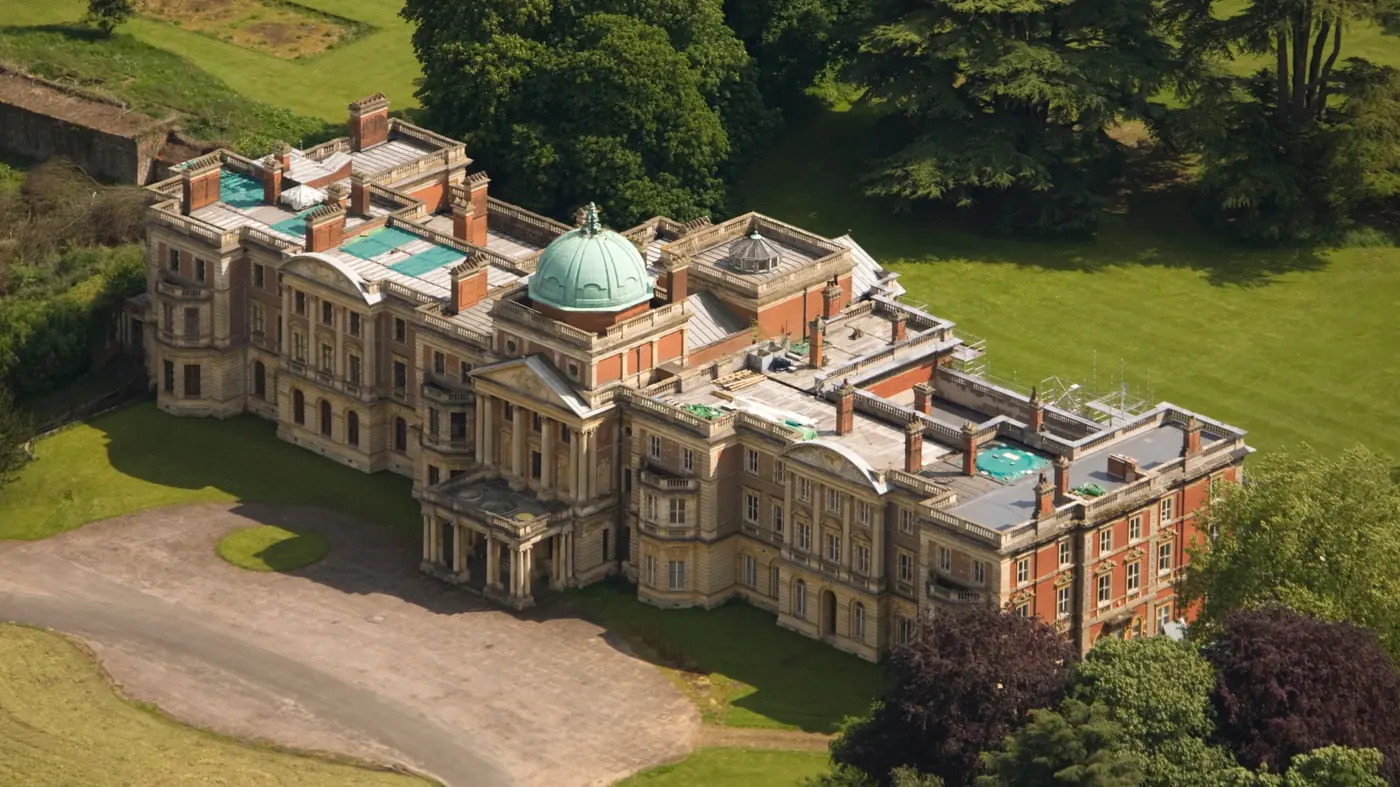
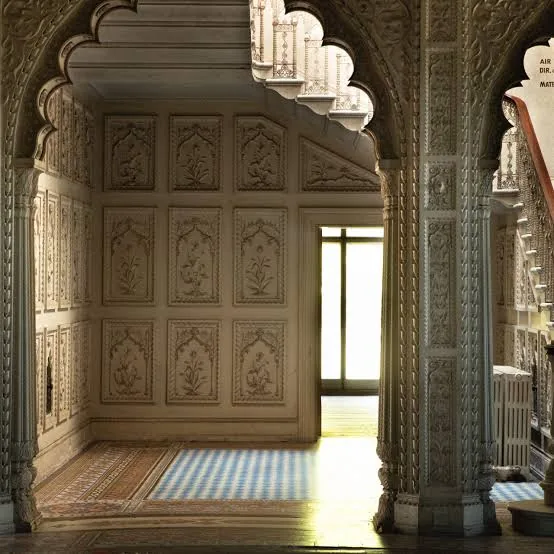
They took the Punjab from him at ten and gave him a shooting estate in its place. He answered by carving the Punjab into the house — not the Sikh idiom of Lahore exactly, but a Mughal-Indian one assembled from memory and pattern books, executed by craftsmen brought from India and paid for out of the pension of a man who was not permitted to go home. They could take Duleep Singh out of the Punjab. They could not take the Punjab out of Duleep Singh.
In 1861, Duleep Singh was permitted to visit India to meet his mother. Maharani Jindan — who had escaped from British confinement in Benares, crossed the frontier in disguise, and taken refuge in Nepal — came from Kathmandu to Calcutta where her son was held. By this time she was nearly blind. Giani Sohan Singh Sital, the Dhadhi historian, describes their meeting in words that have since become a touchstone of Sikh collective memory: Jindan embracing her son, her hands slowly reaching for his head, finding no hair — the hair she had once tended — and wailing. Her son had been converted. The veins of Kalgidhar's blood had been emptied from her child.
Lady Login, who had supervised Duleep Singh's English upbringing, wrote anxiously in her Recollections that the Maharani's presence had undone much of the benefit of his English upbringing. Dalhousie had grasped the threat years earlier: those beautiful eyes, he wrote, with which Duleep had captivated the court, were his mother's eyes — the same eyes with which she had captivated and controlled the Lion of the Punjab. The colonial anxiety was not about military threat — Duleep Singh commanded no army, held no territory. The anxiety was about potentiality: what this man, with this mother, with this history, might still become.
In 1886, Duleep Singh reconverted to Sikhism, attempted to return to India, was intercepted by the British at Aden, and died in Paris in 1893 in circumstances of material comfort and political desolation. He never regained his kingdom. He never saw the Punjab again. His mother had succeeded, by Prabhsharanbir Singh's account, in giving a new direction to his life — the sovereign revolt of the stolen body, the sublime resistance of the imprisoned and ravished, powerless before every material instrument of colonial power but impossible to finally extinguish.
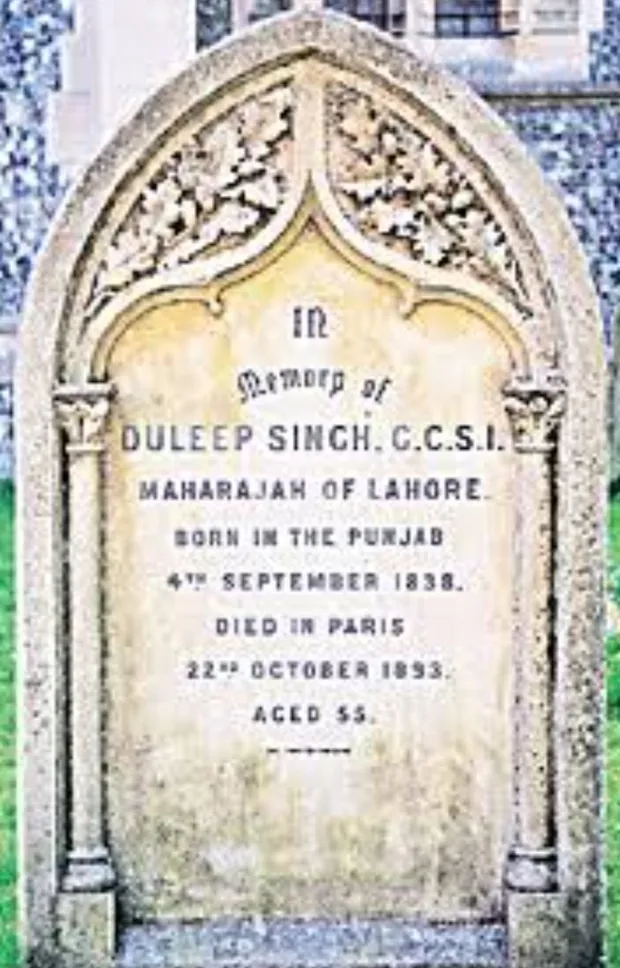
He had asked to be returned to the Punjab and cremated as a Sikh. He was buried instead beside Bamba, under a Gothic arch, by Christian rite — the last decision about his body taken, like the first, by someone else.
A note on the date
The stone reads born in the Punjab, 4th September 1838. Most modern authorities — the Encyclopaedia of Sikhism, SikhiWiki, Historic Royal Palaces and the standard biographies — give 6 September 1838, and that is the date used elsewhere on this site. The memorial was raised by his children after his death in 1893, more than half a century after the event and a continent from the registers; the divergence has never been resolved. Where a memorial and the scholarship disagree, it seems better to record the disagreement than to quietly prefer one.
The Koh-i-Noor remains in the Tower of London.
References
- Seetal, Sohan Singh. How Fell the Sikh Kingdom. Ludhiana: Lyall Book Depot, 1970. [Dedicated to the memory of Sardar Sham Singh Attariwala, the Hero of the First Sikh War, martyred at Sobraon.]
- Singh, Prabhsharanbir. 'Stolen Bodies and Ravished Souls: Sikh Experience Meets Colonial Power.' Sikh Formations 5:2 (December 2009), pp. 103–113. DOI: 10.1080/17448720903408299.
- Singh, Khushwant. How the Sikhs Lost Their Kingdom. New Delhi: UBSPD, 1996.
- Cunningham, Joseph Davy. A History of the Sikhs. London: John Murray, 1849; revised edition 1918.
- Smyth, Major G. Carmichael. A History of the Reigning Family of Lahore. Calcutta: W. Thacker, 1847.
- Bell, Major Evans. The Annexation of the Panjab and the Maharaja Duleep Singh. London: Trübner, 1882.
- Login, Lady. Lady Login's Recollections: Court Life and Camp Life, 1820–1904. London: Smith, Elder & Co., 1916.
- Baird, J.G.A., ed. Private Letters of the Marquess of Dalhousie. Edinburgh: William Blackwood, 1910.
- Sital, Giani Sohan Singh. Dukhiye Maan-Put. Ludhiana: Lahore Book Shop, 2003.
- Kohli, Sita Ram. Sunset of the Sikh Empire. Hyderabad: Orient Longman, 1967.
- Singh, Patwant. The Sikhs. London: John Murray, 1999.
- Singh, Amarinder (Captain). The Last Sunset: The Rise and Fall of the Lahore Durbar. New Delhi: Roli Books, 2010.
- Major, Andrew. Return to Empire: The Sikhs and the British in the Punjab 1839–1849. New Delhi: Sterling, 1996.
- Singh, Ganda. Private Correspondence Relating to the Anglo-Sikh Wars. Amritsar and Patiala: Sikh History Society, 1995.
- Stronge, Susan, ed. The Arts of the Sikh Kingdoms. New Delhi: V&A Publications for Prakash Books, 1999.
- Axel, Brian Keith. The Nation's Tortured Body: Violence, Representation and the Formation of a Sikh Diaspora. Durham: Duke University Press, 2001.