VS 1904 – 1905 · AD 1847 – 1849 · Original Scholarship
The Nimak Mint
Pind Dadan Khan and the British Recoinage Campaign of 1847–49 — an Instrument of Pre-Annexation Monetary Disruption
The Argument
A Mint at the Salt Range
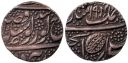
The Nimak rupees — designated types 03.01.04 and 03.02.04 in Herrli's definitive catalogue — are dated VS 1904 and VS 1905, placing them in the final two years before the annexation of the Punjab by the British East India Company on 29 March 1849. They bear the Nanakshahi couplet V on the obverse and on the reverse, at the place where other Sikh mints name their location, the word Nimak — salt, in Persian. The mint that struck them was at Pind Dadan Khan, the principal town of the Salt Range on the west bank of the Jhelum river, known before annexation under its Persian name.
For over a century these coins puzzled numismatists. Rodgers identified them in 1881 and again in 1894. Wiggins and Goron in 1984 conceded that "no information concerning the issue of these coins has been discovered and the question why they were struck for a very limited period at Pind Dadan Khan is a matter of conjecture." Herrli in 1993 even suggested they might prove to be "just another special issue of Nanak Shahis of the Amritsar mint." In 1995 Jyoti Rai published the documentary proof of their existence in ONS Newsletter 143. The sources she drew on — and further primary documents recovered in this research — now make possible a complete account of this mint's origins, purpose and significance.
The thesis of this article is that the Nimak mint was not a Sikh administrative initiative. It was established in October 1847 at British direction — specifically, by John Lawrence, officiating Resident at Lahore, acting on a formal enquiry from the Court of Directors of the East India Company. Its purpose was to recoin the light Afghan-weight silver then circulating in Hazara and the Sind Sagar Doab into full-weight Nanakshahis of the Amritsar standard. In doing so, it imposed a monetary standardisation on the frontier population that extracted 25% of their silver by count — and prepared the monetary ground for the replacement of Sikh coinage by Company rupees after annexation.
Context
The Monetary Landscape of the Interregnum
The Treaty of Bhairowal, signed 16 December 1846, completed the settlement that followed the First Sikh War. It installed a British Resident at Lahore with powers that the Secretary with the Governor-General defined in a letter of 3 July 1847 as "full authority to direct and control all matters, in every department of the State." The nominally Sikh Council of Regency governed under this supervision: not a rupee was paid without the Resident's countersignature.
The Punjab's monetary geography at this moment was one of layered complexity. At least five coin standards circulated simultaneously, each at a different discount against the metropolitan Amritsar Nanakshahi:
| Coin Type | Region | Weight | Silver Content | Discount Against Nanakshahi |
|---|---|---|---|---|
| Chitta Nanakshahi (Amritsar) | Central Punjab | 11.1 g | Almost pure | Par — the standard |
| Goonduh rupee | Hazara and border districts | Lighter | Debased | 13 annas 3 pice (discount ~4%) |
| Mihurabee rupee (Afghan/Durrani) | Hazara, Derajat, NW frontier | 8.5 g | c. 7.0 g silver | 14 annas 3 pice (discount ~11%) |
| Zeman Shahi rupee | Rawalpindi, Salt Range | Lighter | Variable | 6–9 pice discount |
| Kashmir chota rupiya | Kashmir | ~11 g | ~65% silver only | 11/16 of Nanakshahi |
This multiplicity created administrative chaos for the British as they attempted to standardise land-tax collection across the Punjab. Revenue agreements were struck in one standard and paid in another; discounts were levied at the pay-table to the detriment of soldiers and cultivators alike. The Lahore Political Diaries record John Lawrence at the Anarkali Durbar on 21 September 1847 formally requesting that the Goonduh and Mihurabee rupees be withdrawn from the districts of Rawalpindi — and the same day informing Captain Abbott in Hazara that the Durbar had agreed to establish a mint at Pind Dadan Khan.
Pind Dadan Khan was the obvious choice. Under Maharaja Ranjit Singh it had been farmed to Raja Gulab Singh as part of the Salt Range monopoly; it had returned to Lahore Durbar administration in 1847 and was simultaneously being brought under British revenue settlement. A mint there would serve Hazara, the Sind Sagar Doab, and the salt-mines economy — the same fiscal zone that British officers were actively reforming.
Primary Sources
The Documentary Chain: January 1847 to March 1848
The following chain of primary documents traces the Nimak mint from its conception in a Court of Directors circular to its documented operation in Fleming's diary. Each entry is keyed to its archive source.
Court of Directors Circular No. 19
The Court of Directors of the East India Company issues a circular asking about: (1) the influence of Company currency on that of neighbouring independent states, and (2) the possibility of reducing those currencies to uniformity. Henry Lawrence replies with a report on mint operations in the Punjab.
Press Lists of Old Records in the Punjab Secretariat, Vol. IX, Lahore Agency and Residency 1846–1847, No. 90, p. 304
Dewan Deena Nat Proposes Currency Uniformity at Durbar
At Lahore Durbar, Dewan Deena Nat — Finance Minister of Maharaja Ranjit Singh and subsequently a Member of the Council of Regency — formally proposes calling in all silver coins of various denominations circulating in the Punjab, especially towards the north and across the Indus, and establishing one uniform currency (the Nanakshahi) throughout the kingdom. Lawrence records his diary: "I purposed making the proposition myself, but am glad that the Dewan has broached it." The reform is framed as originating within the Durbar; Lawrence has ensured the proposal comes from the right quarter.
Lahore Political Diaries, p. 189 (Lawrence diary, June 20, 1847), cited in Rai, ONS 146
Henry Lawrence's Diary — First Recoinage Order
The Resident records sending orders to the Kardar of Rawalpindi to establish a mint "for melting down the miscellaneous rupees current in Huzara and the North-West and issuing Nanuckshahees in their stead." He adds that he is trying to persuade Maharaja Gulab Singh to do likewise in Kashmir. The Rawalpindi order comes to nothing — no coins are known from that mint.
Lahore Political Diaries 1846–1849, p. 190
Governor-General's Simla Directive
The Secretary with the Governor-General writes to the Resident at Lahore: "It may be suggested to the Durbar, when it carries out its intention of calling in the various coins now in circulation in the Punjab, that the value of the new coin to be substituted instead, be made precisely the same as the Company's rupee." This is not a suggestion: it is an exercise of the treaty authority that gives the Resident unlimited control over every department of state.
Papers Related to the Punjab 1847–1849, No. 7, Inclosure 3 (Simla, 21 July 1847)
Lawrence Moves at Lahore Durbar — Rawalpindi and Hazara
At Anarkali on 21 September, John Lawrence formally requests the Durbar to stop circulation of Goonduh (13 annas 3 pice) and Mihurabee (14 annas 3 pice) rupees in the district of Rawalpindi. On 24 September a roobakaree is received requesting the same for Hazara and other districts, specifying that future revenue collections in those districts are to be made in Nanakshahi rupees.
Lahore Political Diaries, pp. 293, 295
Letter No. 153 — The Founding Document of the Nimak Mint
J. Lawrence to Captain J. Abbott, Boundary Commissioner in charge of Hazara: "The Durbar has consented to establish a mint at Pind Dadan Khan for the re-coinage of all short weight rupees and miscellaneous coins such as the Goonda and Zaman Shahi rupees. Suggests that in making the revenue settlement of Hazara, Capt. Abbott should determine that the revenue for the ensuing year be paid in Goonda or Nanakshahi rupees and hereafter in the latter coinage."
Press Lists, p. 435, No. 616
Durbar Record — Misr Sahib Diyal Appointed to Superintend
Bhag Singh Vakeel reports that J. Lawrence has requested the Durbar to stop circulation of Muhammad Shahi, Zemanshahi, Goonduh and Mihurabee rupees in the district of Pind Dadan Khan and to introduce the Chitta Nanakshahi instead. "Misr Saheb Diyal was accordingly directed to superintend the introduction of the latter rupee, for which purpose a mint at Pind Dadan Khan will be established." Misr Sahib Diyal is the same official who administered the Punjab's customs reform under the Resident's countersignature.
Lahore Political Diaries, p. 300
Treasury at Pind Dadan Khan Operational
Sirdar Chuttar Singh, Bhaee Dul Singh and others are ordered to send all Gundahshahi and Zemanshahi rupees in their possession to the Pind Dadan Khan treasury, "whence they will be converted to Nanukshahees." The treasury is therefore already collecting the old coinage before the mint begins striking.
Lahore Political Diaries, p. 321
Edwardes' Diary — Nimak Operational; Dera Parallel Mint
Lt. Herbert Edwardes writes from Bannu: "General Cortlandt has received orders to send all Mihrabee rupees to Pind Dadun Khan to be recoined into Nanuck Shahees by Misr Rullya Ram, [but] the Misr's own man has already converted his former Mihrabee mint at Dera Ismael Khan into a Nanuck Shahee mint which is now busily at work." Edwardes ratifies the Dera Ismail Khan operation on logistical grounds. The Derajat type 07.07.04 (VS 1904–1906) is attributed by Herrli to this parallel operation.
Lahore Political Diaries of Lieut. H.B. Edwardes, 1847–49, p. 207
Fleming's Diary — The Mint in Operation
Dr Andrew Fleming, Punjab Geological Survey, visits the mint at Pind Dadan Khan: "Visited the mint here, which is under the superintendence of [Misr Rula Ram]. Silver is collected in all directions in the shape of old rupees, bangles and silver ornaments, which after being refined are converted into the new Lahore Rupee. At present the silver from which rupees are being manufactured, are Mahmoud Shah Rupees from the Hazara and countries to the North, and of the value of about 12 annas." He records that the silver is refined by cupellation to remove copper and lead, and that from 1,000 Mahmoud Shah rupees, 750 new Lahore rupees are manufactured — a loss of 25% by count to the holder.
RASB, Vol. XVIII, Part II (July–Dec. 1849), "Diary of a Trip to Pind Dadud Khan and the Salt Range," pp. 667–68
Numismatic Evidence
The Nimak Rupees — Types and Characteristics
Two types are catalogued in Herrli (types 03.01.04 and 03.02.04), both AR rupees struck at the full Nanakshahi weight standard of 11.1 g — the same weight as the Amritsar Chitta Nanakshahi and the Mankera rupees. This is not a frontier standard; it is the metropolitan standard of Amritsar deliberately imposed on the frontier economy.
VS 1904
AR · 11.19 g · Pind Dadan Khan
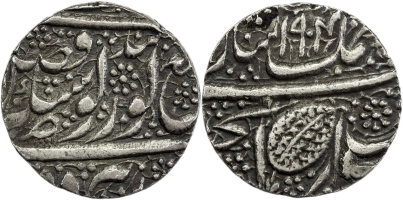
Obverse
Nanakshahi Couplet V Sikka zad bar har do 'alam Tegh-i-Nanak wahib ast · Fath Guru Gobind Singh Shah-i-Shahan fazl Saccha Sahib astReverse
Zarb Nimak […] Second word partially read, VS1904VS 1905
AR · 11.1 g · Pind Dadan Khan
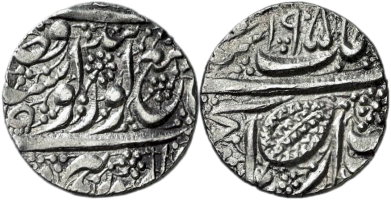
Obverse
Nanakshahi Couplet V Standard obverse — as VS 1904 typeReverse
Zarb Nimak […] Second word partially read, VS1905VS 1905
AR · 11.04 g · Pind Dadan Khan · Variant
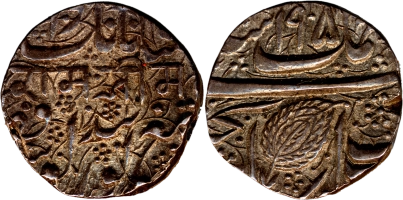
Obverse
Variant inscription Nanakshahi couplet with Sri Ramji Sahai in Śāradā script. Note - Misr Rulia Ram, the mint administrator, was a Kashmiri Pandit, the region where this script was.Reverse
Zarb Nimak […] Second word partially read, VS1905Catalogue of the Nimak Rupees (Herrli 03.01.04 and 03.02.04)
Type 03.01.04
AR Rupee · 11.1 g · VS 1904 and 1905
Obverse: Nanakshahi couplet V
Reverse: Two-word inscription, first word Zarb NIMAK; second word partially read as SHAHI (Rodgers). Full reading of the reverse legend remains unconfirmed.
Type 03.02.04
AR Rupee · 11.1 g · VS 1905 only
Obverse: Nanakshahi couplet, additional Śāradā legend Sri Ramji Sahai
Reverse: Reverse: Two-word inscription, first word Zarb NIMAK; second word partially read as SHAHI (Rodgers). Full reading of the reverse legend remains unconfirmed.
Legend — Obverse (Nanakshahi Couplet V)
Sikka zad bar har do 'alam Tegh-i-Nanak wahib ast
Fath Guru Gobind Singh Shah-i-Shahan fazl Saccha Sahib ast
Coin struck through each of the two worlds, Sword of Nanak is the guarantor. / Of the victory to Guru Gobind Singh King of Kings, by the grace of the True Lord.
Couplet Significance
The Nimak rupees use Nanakshahi — the couplet of the standard Amritsar Chitta series (Herrli 01.04–01.15). The Peshawar mint (VS 1891–1894) series used the Gobindshahi couplet. The choice of Nanakshahi explicitly places the Nimak rupees within Amritsar's monetary tradition, not the frontier Gobindshahi tradition. This is a numismatic marker of deliberate standardisation policy.
The weight of 11.1 g at full Amritsar Nanakshahi standard is critical. Fleming's diary records that from 1,000 Mahmoud Shah (Afghan Durrani) rupees of 8.5 g each, the Nimak mint produced 750 new Lahore rupees. The Afghan rupees contained approximately 7.0 g silver each (per Herrli, citing Burnes); 1,000 of them contained 7,000 g silver. At 11.1 g each, 750 rupees contain 8,325 g — a discrepancy explained by Fleming's observation that the silver was refined to near-purity before striking. The holder of 1,000 Mihurabee rupees who submitted them for recoinage received 750 Nanakshahis in return. The 25% loss in count, combined with the additional 11% discount at which Mihurabee rupees already traded, constituted a substantial monetary extraction from the frontier population.
The Wider Campaign
Five Nodes — One Operation
The Nimak mint was not an isolated initiative. It was one node in a coordinated recoinage network directed by Lawrence and administered through Misr Rulia Ram. By January 1848 five operations were active or planned — all directed at the same objective of replacing light Afghan-standard silver with Amritsar Nanakshahis:
| Node | Status | VS Dates | Weight | Authority |
|---|---|---|---|---|
| Rawalpindi | Seperate coinage not known | — | — | Possibly used the Amritsar dies. |
| Nimak / Pind Dadan Khan | Operational Oct 1847 — c. Jun 1849 | 1904, 1905 | 11.1 g | Misr Rulia Ram (superintendent) |
| Peshawar | Opened second half 1847, closed May 1849 | 1894 (recoinage type) | 10.4–11.0 g | Unknown — documented by Jyoti Rai, ONS 146 |
| Dera Ismail Khan (parallel) | Jan 1848, ran to end of Sikh rule | 1904, 1905, 1906 | 10.7–10.9 g | Misr Rulia Ram's agent (ratified by Edwardes) |
| Kashmir | Never established | — | — | Lawrence's proposal; Gulab Singh declined |
The Derajat parallel operation is particularly significant. Herrli attributes the distinct Derajat type 07.07.04 (VS 1904–1906) — distinguishable from the standard type 07.06.04 by its mark — to Misr Rulia Ram's agent operating after Edwardes authorised the continuation. This type runs to VS 1906, one year beyond the last Nimak rupees, because the Pind Dadan Khan mint closed earlier than the Dera Ismail Khan operation. Rai's paper gives June 1849 as the closure date for Nimak specifically; the Dera Ismail Khan Nanakshahi mint apparently ran until formal Sikh withdrawal from the Derajat.
The Peshawar recoinage mint is documented independently of Pind Dadan Khan. H.M. Lawrence's diary of 10 December 1847 records that "in melting down old money for the new coinage in the Peshawar mint, a loss of 1 rupee per cent has been sustained on the coinage of Sumbut 1888 and of rupees 1.8 per thousand on that of 1894" — confirming recoinage had begun at Peshawar before December 1847 (Lahore Political Diaries, p. 381). The mint continued until May 1849 when Major G. St. P. Lawrence, Deputy Commissioner of Peshawar, wrote to the Board of Administration requesting abolition of the mint; the Secretary concurred on 21 May 1849 (Press Lists, Supplementary April 1849 to Feb. 1853, p. 11). Type 13.04.04 (10.4–11.0 g, VS 1894, milled edge) is in Jyoti Rai's collection.
A numismatic puzzle of some importance: no Peshawar mint coins exist with dates VS 1904, 1905, or 1906 — the years when recoinage was active. Rai (ONS 146) proposes three possibilities: that such coins await discovery; that Amritsar or other dies were used; or that the VS 1892–1894 coins were actually struck in both AD 1835–37 and AD 1847–49, the mint restruck using the original dates. The White King Sale (Amsterdam, 1905, Part IV, p. 54) attributed VS 1893 and VS 1894 Peshawar rupees to "Régence après la mort de Runjit Singh" — the Regency period. If White King's attribution is correct, the explanation for the missing dates is that the coins struck during VS 1904–1906 were minted on dies carrying the earlier dates VS 1892–1894. This remains a hypothesis.
The Broader Context
Salt Revenue, Currency Reform & the Annexation
The Nimak mint stood at the geographical centre of the single most rapidly appreciating revenue asset seized by the British in the Punjab. The salt mines at Khewra — six miles from Pind Dadan Khan — had been budgeted by the Lahore Durbar at Rs 4,00,000 per year. Under the contractor system the British introduced during the interregnum, the contracted revenue rose immediately to Rs 6,00,000. After annexation the trajectory was extraordinary:
| Period | Salt Revenue (Rs) | Source |
|---|---|---|
| Sikh Durbar budgeted | 4,00,000 | Punjab Papers, 1847 |
| Interregnum contractor system | 6,00,000 contracted | Punjab Papers, Nov 1847 |
| Oct 1849 – Apr 1850 (7 months) | 8,06,852 | General Report on Punjab Administration |
| 1851–52 (full year) | 12,81,295 | 1854 Selections from Records |
| 1852–53 | 16,84,216 | 1854 Selections from Records |
| 1853–54 | 19,50,535 | 1854 Selections from Records |
| Growth from Sikh budget to 1853–54 | +387% |
The Marquess of Dalhousie had predicted this in a private letter of November 1849 (Baird, ed., Private Letters of the Marquess of Dalhousie, 1910): salt revenue would "more than equal all that we sacrificed in customs." In the same letter he recorded that he had "got the 'ill hawbees' in the Punjab out of circulation, and have ordered the escorts to take them to Allahabad fortress" — the surviving Sikh coinage being removed under armed escort from the Punjab.
The Board of Administration's General Report on the Administration of the Punjab (1852–53) confirms the mechanism. Paragraph 108 records that currency reform was the defining act of the "second year" of British rule: "A great variety of coinage had prevailed in the Punjab, producing mercantile confusion, disadvantageous exchanges, and facilitating fraud. These dead currencies were gradually withdrawn; large bullion remittances of the old coin, aggregating about fifty lacs, were transmitted to Calcutta, and also down the Indus, to be returned from the Bombay Mint with the British stamp."
The Indus route is significant. The pre-annexation recoinage campaign had moved old Afghan silver up the Indus valley to Nimak, Peshawar and Dera Ismail Khan, converting it to Nanakshahis. Post-annexation, those Nanakshahis moved down the Indus to Bombay to be restruck as Company rupees. The same geography served both phases; the Nimak mint was the first node of a two-step absorption of frontier monetary sovereignty into the imperial currency.
Conclusion
What the Nimak Mint Was
The Nimak mint operated for approximately twenty months — October 1847 to approximately June 1849. It struck two types of Nanakshahi rupees at full Amritsar standard weight (11.1 g), dated VS 1904 and VS 1905. Its administrator was Misr Rulia Ram. Its feedstock was Mahmoud Shah (Afghan Durrani) rupees drawn from Hazara and the Sind Sagar Doab; its output was the Chitta Nanakshahi of the Amritsar standard. The conversion ratio was 4:3 — holders of 1,000 Mihurabee rupees received 750 Nanakshahis.
It was not a Sikh administrative initiative. It was established on the direction of John Lawrence, officiating British Resident at Lahore, acting initially on a January 1847 circular from the Court of Directors of the East India Company. The Durbar "consented" (Lawrence's word) to its establishment. The Durbar's consent was the consent of a body over which the Resident held unlimited executive authority and whose every rupee of expenditure bore his countersignature.
The Nimak mint joins the "ill hawbees" confiscation of November 1849, the Board of Administration's 50-lakh bullion remittance, and the Company rupee's imposition as documented instruments of a pre-annexation strategy that was monetary and fiscal as well as military. The Second Sikh War (April 1848 – March 1849) is conventionally treated as the cause of annexation. The evidence of the Nimak mint — and the parallel recoinage operations at Peshawar and Dera Ismail Khan — suggests the annexation infrastructure was being laid in the interregnum, coin by coin.
Notes on Sources
- Jyoti Rai, "Unidentified Sikh mints — proof of the existence of the mint at Nimak," ONS Newsletter No. 143 (Winter 1995), pp. 13–15. This is the foundational paper for the documentary evidence of the Nimak mint. All archival citations in the present article have been verified against the sources quoted by Rai.
- Hans Herrli, The Coins of the Sikhs, 2nd ed. (Munshiram Manoharlal, 2004), pp. 107–110. Types 03.01.04 and 03.02.04. The first edition (1993) listed these as "Unknown Sikh Mint A" and suggested they might be Amritsar specials. Herrli updated his attribution and commentary to incorporate Rai's findings. Note: Rai's own footnote 2 in ONS 146 cites her Nimak paper as "ONS Newsletter 141" — this appears to be a misprint; all other secondary sources confirm ONS 143.
- Papers Related to the Punjab 1847–1849, presented to Parliament, May 1849. The Simla directive of 21 July 1847 is Inclosure 3 in No. 7. The passage on currency reform and "calling in all the depreciated coinage" appears in the major administrative report of late 1847.
- Andrew Fleming, "Diary of a Trip to Pind Dadud Khan and the Salt Range," RASB, Vol. XVIII, Part II (July–Dec. 1849), pp. 667–68. Communicated by Sir H.H. Elliot, Secretary, Government of India. The full cupellation process is described in detail; the article reproduces the key passages.
- General Report on the Administration of the Punjab (Board of Administration, 1852–53), para. 108. The "fifty lacs" figure for bullion remitted to Calcutta and Bombay Mint is stated explicitly; the Nanukshahi rupee is predicted to be "numbered with the things of the past" within two or three years.
- District and State Gazetteers of the Undivided Punjab, Jhelum District, Vol. XXVIII A (1904), p. 52; also Gazetteer of 1930, p. 291. The identification of Pind Dadan Khan with its pre-annexation name Nimak is confirmed in both editions.
- J.G.A. Baird, ed., Private Letters of the Marquess of Dalhousie (Blackwood, Edinburgh, 1910). The "ill hawbees" letter is dated November 1849, seven months after annexation. Dalhousie uses the Scots pejorative for small or debased coins.
Bibliography
Primary and Secondary Sources
- "Unidentified Sikh mints — proof of the existence of the mint at Nimak." ONS Newsletter No. 143, Winter 1995, pp. 13–15.
- "Rediscovering Sikh Mints — Peshawar, Dera, Rawalpindi." ONS Newsletter No. 146, Autumn 1995, pp. 10–12. Documents the Peshawar reopening and closing (1847–49), the Dera/Derajat distinction, and the Rawalpindi order. The Peshawar closing correspondence (May 1849) is cited from Press Lists, Supplementary April 1849 to Feb. 1853, p. 11.
- "Coins of the Durranis and Barakzais." Numismatic Chronicle, 1888, p. 330. Records a Derajat rupee of VS 1906 (AD 1849), the latest known date for any Sikh mint: "when the Khalsa army was making its last struggle against the British Government."
- "Rediscovering Sikh Mints — Peshawar, Dera, Rawalpindi." ONS Newsletter No. 146, Autumn 1995, pp. 10–12. Documents the reopening and closure of the Peshawar rupee mint, 1847–49, including the specific closing correspondence of May 1849.
- The Coins of the Sikhs. 2nd revised and augmented edition. Munshiram Manoharlal Publishers, New Delhi, 2004. Types 03.01.04–03.02.04 (Nimak); 07.07.04 (Derajat parallel); 13.04.04 (Peshawar recoinage).
- Coins of the Sikh Empire, Punjab and the Cis-Sutlej States. Spink & Son, London, 2022.
- Lahore Political Diaries 1846–1849: Political Diaries of the Agent to the Governor-General, N.W. Frontier, and Resident at Lahore, 1st January 1847 to 4th March 1848. Published 1909. Pages 190, 207, 293, 295, 300, 321.
- Press Lists of Old Records in the Punjab Secretariat, Vol. IX: Lahore Agency and Residency 1846–1847. No. 90, p. 304; No. 616, p. 435.
- "Diary of a Trip to Pind Dadud Khan and the Salt Range." Royal Asiatic Society of Bengal, Vol. XVIII, Part II, July–December 1849, pp. 667–68. Communicated by Sir H.H. Elliot.
- Papers Related to the Punjab 1847–1849. Presented to both Houses of Parliament by Command of Her Majesty, May 1849. Harrison and Son, London.
- General Report on the Administration of the Punjab. Calcutta, 1852–53. Para. 108 (currency reform and withdrawal of dead currencies).
- Selections from the Records of the Government of India, No. VI: General Report on the Administration of the Punjab Territories, 1851–52 and 1852–53. Calcutta: JONES, Calcutta Gazette Office, 1854.
- Private Letters of the Marquess of Dalhousie. William Blackwood and Sons, Edinburgh and London, 1910. The "ill hawbees" letter, November 1849.
- "On the coins of the Sikhs." Journal of the Asiatic Society of Bengal, Vol. L, 1881. First identification of the Pind Dadan Khan rupees.
- "The Gold and Silver Coinage of the Sikhs, Part IV: Miscellaneous Mints." ONS Information Sheet No. 26, March 1984.
Nimak (Pind Dadan Khan) Mint Coinage
Select specimens from the SikhCoins.in collection. Click any image or title to browse the full album.
| Specimen | Mint | Date | |
|---|---|---|---|

|
Nimak, VS1905, Rupee | ||
|
Nimak, VS1905, Rupee | ||
|
Nimak, VS1904, Rupee | ||

|
Nimak, VS1905, Rupee, Ram Ji Sahai in Nagri |