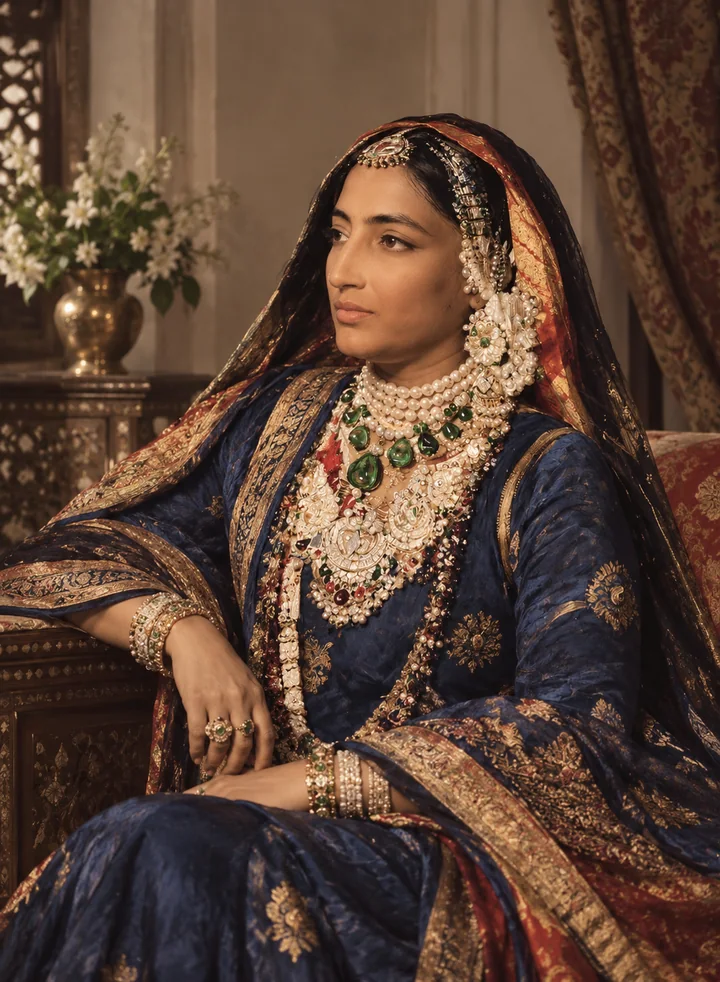
Maharani Jind Kaur
Regent of the Sikh Empire, and the subject of two incompatible verdicts — the resistance the British could not leave in the Punjab, and the ruler blamed for marching the Khalsa to the Sutlej. Both are older than the evidence usually cited for them.
Regent · Exile · The Last Queen of the Punjab1817 – 1 August 1863
I · Introduction
The Woman Who Was Written Twice
Two portraits of Jind Kaur have been in circulation for a century and a half, and they cannot both be right. In the first she is the last real resistance in the Punjab: the regent who told the sardars plainly that the British meant to annex the country, who was proved correct, and who was separated from her nine-year-old son and exiled for it. In the second she is the author of the disaster: a woman who despised the Khalsa army, feared what it might do to her son, and sent it across the Sutlej in the expectation that the Company would destroy it for her.
Both readings were in print before most of the relevant documents were. Both were shaped, in their first formulations, by men with a direct interest in the outcome — the British officers who removed her, and the Lahore courtiers who needed the defeat to belong to somebody else. This page does not attempt a life so much as an audit: what she actually controlled between 1843 and 1846, what the surviving record shows her doing with it, and which of the charges against her survive contact with the evidence.
A word first about why she appears on a numismatic site at all, because the honest answer is not the obvious one.
The central problem of Jind Kaur's regency was monetary before it was anything else. She inherited an army that had to be paid and a treasury that had been stripped, and every significant decision she took between 1843 and 1846 — the fine levied on Gulab Singh, the settlement with the panchayats, the handling of the jagirdars — was an attempt to close that gap. The war that ended her regency ended with an indemnity of a crore and a half of rupees, and the Punjab's inability to find the silver is precisely why Kashmir was sold. On this site the coinage of the late 1840s is discussed in terms of drained reserves and constrained mints. Those conditions have a political history, and this is it.
II · Origins
The Kennel-Keeper’s Daughter
Maharani Jind Kaur
b. 1817, Gujranwala district · d. 1 August 1863, Kensington
- Known as
- Rani Jindan; Rani Mai to contemporaries
- Father
- Manna Singh Aulakh, overseer of Ranjit Singh’s kennels
- Birthplace
- Given as Chachar or Chichrianwali, Gujranwala — sources differ
- Married
- Ranjit Singh, 1835 (some sources 1829)
- Son
- Duleep Singh, b. 6 September 1838
- Widowed
- June 1839, aged about twenty-two
- Regent
- September 1843 – December 1846
- Contemporary likeness
- Portrait by George Richmond, c. 1862; a photograph by John McCosh is recorded but lost
She was born in 1817 in the Gujranwala district, into an Aulakh Jat family of no standing whatever. Her father, Manna Singh, held a post in Ranjit Singh’s household as overseer of the royal kennels — a real position with access to the Maharaja, but a servant’s one. She had an elder brother, Jawahar Singh, who would become wazir of the empire and be murdered for it, and an elder sister who married into the Padhania family of Lahore district.
The marriage came about, by the account preserved in the Sikh sources, because Manna Singh commended his daughter to the Maharaja directly, and Ranjit Singh sent his arrow and sword to the village — the form of proxy marriage used when the bridegroom did not attend. The date is usually given as 1835, though some references place it as early as 1829. Duleep Singh was born on 6 September 1838. Nine months later Ranjit Singh was dead, and Jind Kaur was a widow of about twenty-two with an infant son and no faction.
This origin matters for what follows, and not for the reasons the romantic accounts give. A widow from a kennel-keeper’s family had no clan army behind her, no jagir income of consequence, and no natural allies among the great sardars. When she emerged as regent five years later it was not because a faction elevated her. It was because the one power in the Punjab that had no aristocracy of its own — the Khalsa army, governing itself through regimental panchayats — found a use for a sovereign who owed nothing to anybody else.
III · The Rise
Lahore, September 1843
For four years after Ranjit Singh’s death she and her son lived in near-obscurity, for part of that time under Dogra protection at Jammu. The throne meanwhile changed hands by violence three times: Kharak Singh confined and dead, Nau Nihal Singh killed by falling masonry on the day of his father’s cremation, Sher Singh shot along with his wazir Dhian Singh in September 1843. On 16 September the army proclaimed the five-year-old Duleep Singh sovereign, and Hira Singh Dogra took the wazirate.
Hira Singh’s calculation was the standard one: an infant on the throne and a mother of no consequence beside him. Jind Kaur broke it by going directly to the only constituency that could overrule him. She put the question to the regimental committees in terms they could not evade — whether Duleep Singh was the real sovereign or Hira Singh was, and if the former, whether the Khalsa intended to let him be a king with an empty title. The panchayats came down on her side.
For a woman in the Lahore of the 1840s this was not a gesture; it was a constitutional claim, and it was understood as one. She reconstituted the Supreme Council of the Khalsa and worked to restore some balance between the army and the civil administration — the balance that had been collapsing since 1839 and whose collapse is the real subject of this whole decade. Whatever else is disputed about her, the record that she personally conducted the business of the state, in public, is not.
It is worth being precise about the date her real power begins, because the loose formula “regent from 1843” obscures a great deal. Duleep Singh was proclaimed in September 1843, but Hira Singh held the wazirate until December 1844. It is only after his fall that Jind Kaur is governing in any substantive sense, with her brother Jawahar Singh as wazir. Her effective regency is therefore something closer to two years than three, and every judgement of her competence has to be measured against that compressed span.
IV · The Inheritance
An Army to Pay, and an Empty Treasury
Set out the position she actually took charge of, because the received verdicts rarely do. Pashaura Singh, a half-brother of Duleep Singh, was pressing a claim to the throne. The feudal chiefs wanted the taxes Hira Singh had levied on them lifted and their jagirs restored. The army wanted a pay increase and had the organised means — the panchayats — to insist on one. The cost of the civil and military establishment had risen sharply. And the Lahore treasury had been substantially emptied: Gulab Singh Dogra, Raja of Jammu, had removed the greater part of it to his own territory.
That last item is the one that governs all the others. An army of the Khalsa’s size, organised on European lines and conscious of its own bargaining power, is a standing monthly obligation in silver. A regent who cannot meet it does not have an army; she has a creditor with artillery. Every measure Jind Kaur took in 1844 and 1845 reads as an attempt to close that gap.
Gulab Singh was brought to Lahore to answer charges of treachery and permitted to return to Jammu on payment of a fine of sixty-eight lakh rupees. Whatever else that transaction was, it was a bullion recovery — an attempt to pull back into the Lahore treasury a substantial part of what had been carried out of it. It is the largest single fiscal act of her regency, and it is routinely reported as a political episode with the money treated as incidental. It was not incidental. It was the point.
Alongside it she raised army pay, restored the political weight of the council, and moved to secure the dynasty by alliance: Duleep Singh was betrothed to a daughter of Chattar Singh Attariwala, governor of Hazara and one of the few great sardars whose loyalty was worth having. These are not the actions of a woman indifferent to government, and they are not improvised. They are a coherent programme — pay the army, recover the silver, buy a powerful ally, restore the council — pursued by a regent with about two years in which to make it work.
It did not work, and the reason it did not is the subject of the next section. But the failure needs to be weighed against the position, and the position was close to unrecoverable before she took it.
V · The Charge Sheet
Four Accusations, Weighed
The case against her can be reduced to four propositions. Taken one at a time, they do not stand or fall together.
One: that she sent the army across the Sutlej to have it destroyed. This is the serious charge, and the evidence for it is entirely inferential. It rests on a motive attributed to her — fear of what an unpaid, politically organised army might do to her son — combined with the fact that the crossing happened and the army was duly destroyed. What it lacks is a document. The strongest evidence against it is what the same army had already done to her: in September 1845 the soldiery stabbed her brother Jawahar Singh to death in front of her, for his part in the killing of Pashaura Singh. A regent who could not prevent her own wazir being murdered in her presence was not in a position to manoeuvre that army into a war of her choosing.
Two: that she was complicit in the treachery of Lal Singh and Tej Singh. Here the underlying fact is not in dispute at all. Lal Singh, the wazir, was in communication with Captain Nicholson at Ferozepur before the fighting; Tej Singh withdrew at Ferozeshah at the moment the British army was closest to collapse; at Sobraon the bridge of boats failed behind a retreating army. This site treats that betrayal as established on its First Anglo-Sikh War page. The question is whether it extends to her, and the honest answer is that the link is supplied by rumour of a personal relationship with Lal Singh rather than by any evidence of her knowledge of the correspondence. That is a thin foundation for the gravest charge that can be made against a head of state.
Three: that she was licentious and ungovernable — the “Messalina of the Punjab.” This is not a historical finding. It is a phrase from the British side, applied to a woman whose political effectiveness was the actual objection, and it did the work such phrases are designed to do: it converted a competent adversary into a scandal. It is worth noting that it was never applied to Gulab Singh, whose conduct in the same years is far better documented and far worse.
Four: that she provoked an unnecessary war. The most useful comment here comes from the British side of the line. G. Carmichael Smyth, a Company political agent, recorded his own view that the Sikhs had not made an unprovoked attack, that the British had not shown forbearance, and that if the question was who first departed from the rules of friendship, his opinion was that it was the British. That is a witness testifying against his own side’s case.
VI · The Reckoning
What the Treaty Cost in Silver
The Treaty of Lahore was signed in March 1846. Its terms are set out in full elsewhere on this site; what belongs here is the monetary arithmetic, because that is where the regency’s failure becomes legible in the coinage. The Khalsa army was cut to twenty thousand infantry and twelve thousand cavalry. The Jalandhar Doab was annexed outright. And an indemnity of one and a half crore rupees was imposed on a treasury that had been unable to meet its own payroll two years earlier.
The Punjab could not find the silver. That single fact produced the treaty’s most consequential clause: unable to pay, the Lahore court ceded Kashmir, which the British at once sold to Gulab Singh — the same man who had emptied the treasury and been fined sixty-eight lakh for it — for seventy-five lakh rupees. He acquired a kingdom for roughly half the sum he had been made to disgorge two years earlier, and he acquired it because the state he had helped bankrupt could not pay a debt it had incurred losing a war he had helped it lose.
Much of the indemnity was paid in coin out of the Lahore treasury. The drain on silver reserves, the loss of the Jalandhar Doab and the passage of several smaller mints out of Sikh control together constrained the coinage of the remaining mints through the final years of the kingdom — the conditions under which the last Sikh issues were struck. Coin, Commerce & Control → · The Nimak Mint →
VII · The Removal
Bhairowal, and the Separation
The treaty of March 1846 left Duleep Singh on the throne and his mother as regent. That arrangement lasted nine months. In December, at Bhairowal, she was replaced by a Council of Regency under the control of a British Resident and granted a pension of a hundred and fifty thousand rupees a year. The Bhairowal settlement is treated at length elsewhere on this site; what concerns this page is that the removal was not the end of the matter, because her influence did not end with her office.
The break came in August 1847. Tej Singh — whose conduct at Ferozeshah had made him the most detested man in the Punjab — was to be invested as Raja of Sialkot, a reward from the British to a man the Sikh army regarded as a traitor. The nine-year-old Maharaja refused to perform the investiture. The Resident, Henry Lawrence, held the mother responsible for the son. She was confined in the Samman Burj of the Lahore Fort, moved ten days later to the fortress at Sheikhupura, and her pension was cut from a hundred and fifty thousand rupees to forty-eight thousand.
Then they took her son. She wrote to Lawrence asking to have him back, in a letter whose force is in its plainness: the boy had no brother or sister, no uncle senior or junior, and had lost his father — to whose care, she asked, had he been entrusted? She did not see him again for thirteen and a half years.
The following year the new Resident, Sir Frederick Currie, described her as the rallying point of rebellion and exiled her from the Punjab altogether. She was taken to Chunar Fort near Benares, her jewellery was confiscated, and the pension was reduced again, to twelve thousand. The treatment was conspicuous enough to draw a protest from outside the Sikh world entirely: Dost Mohammad Khan of Afghanistan observed that such usage was objectionable to every creed.
VIII · The Escape
Chunar to Kathmandu, 1849
On 18 April 1849, three weeks after the annexation of the Punjab, she left Chunar Fort disguised as a servant and travelled roughly eight hundred kilometres north to Nepal. She was thirty-two.
The choice of destination was not random, and the accounts that treat it as a desperate flight to the nearest sanctuary miss the politics in it. Nepal and Lahore had a history of quiet alignment against the Company going back to Ranjit Singh’s reign, and during the war Lahore had appealed to Kathmandu for help. On arrival she was sheltered in the Narayanhiti house of Amar Bikram Shah, son of a former Nepalese prime minister who had been among the officials working on that alignment — introduced to visitors, when any came, as a maid from Hindustan. Only after some months did she emerge and approach the prime minister, Jung Bahadur Rana, who received her as a queen consort of Ranjit Singh, built her a residence within the Thapathali palace complex and settled an allowance on her.
She stayed eleven years, watched throughout by the British Resident in Kathmandu, who continued to report that she was intriguing to restore the dynasty. She probably was. What she gradually established was that Nepal would not move, and that the restoration she had come for was not going to happen from there.
IX · The Reunion
Calcutta, Kensington, and the Long Consequence
Duleep Singh had by then been raised in British hands, converted, and settled in England. Getting to his mother took him four years and three attempts: an intercepted letter dismissed as a forgery in 1856, an emissary forbidden to make contact, and finally a direct approach in 1860 enclosed within a letter from his guardian Sir John Login so that it could not be turned aside. The Resident’s report on her decided the matter: she was much changed, was blind, and had lost the energy that had formerly characterised her. The British concluded she was no longer a threat and let him come.
They met on 16 January 1861 at Spence’s Hotel in Calcutta. The timing was an accident of empire — several Sikh regiments were passing through the city on their way home from the China war — and the result was that the hotel was surrounded by thousands of armed Sikhs celebrating the presence of their royal house. Lord Canning asked Duleep Singh, as a favour, to take his mother to England by the next boat. The judgement that she was no longer dangerous had lasted a matter of days.
She lived two more years, at Lancaster Gate and then Mulgrave Castle and finally Kensington, refusing every proposal that she be housed separately from her son. Her jewellery, recovered from the treasury at Benares, arrived at Lancaster Gate before a visit from Lady Login, and she put it on. She died in her sleep at Abingdon House on 1 August 1863, aged forty-six, having asked that her bones not be left to rot in an inhospitable country.
What she did in those two years mattered more than anything else that happened in them. She told her son, in detail and for the first time, what he had been and what had been taken. Twenty years later he was in the British Library working through the record himself and petitioning the Queen. The claim that ended in the failed rebellion of the 1880s begins in a drawing room in Kensington with a blind woman recounting an empire to a man raised as an English squire.
X · The Verdict
What the Record Will Support
A reassessment is only worth writing if it can come out either way, so here is what this one concludes.
The evidence supports Jind Kaur as an active and substantially competent regent working an unrecoverable position. She obtained power by argument rather than faction, governed in public in a society that gave her no precedent for doing so, identified the fiscal problem correctly and attacked it directly, and read British intentions accurately at a time when a good many Sikh sardars did not. The programme was coherent. The time available was about two years.
The evidence does not support the charge that she designed the destruction of the Khalsa. The army that is supposed to have been her instrument murdered her brother in front of her; the treachery that lost the war is documented against two named men and attached to her only through rumour; and the sharpest contemporary judgement on the war’s origins, from a Company political agent, blames his own government. What survives against her is failure, which is a real charge, and complicity, which is not a proven one.
And the label that has done the most damage to her reputation was coined by the people who exiled her, cut her pension by more than nine-tenths, took her jewellery and removed her nine-year-old son. It should be read as what it is: an instrument of policy, and evidence about its authors rather than about her.
Sources
Sources and Further Reading
- B. J. Hasrat, “Jind Kaur,” in Harbans Singh (ed.), The Encyclopaedia of Sikhism, vol. II. Punjabi University, Patiala. The standard reference account, and the source for her appeal to the panchayats, the reconstitution of the Supreme Council, and the conduct of business in public.
- Bhupinder Singh Bance, “Jind Kaur (1817–1863), maharani and regent of Lahore,” Oxford Dictionary of National Biography, 2004.
- Khushwant Singh. The Fall of the Kingdom of the Punjab. The narrative of the exile, the successive reductions of the pension, and the escape from Chunar.
- Priya Atwal. Royals and Rebels: The Rise and Fall of the Sikh Empire. Hurst, 2020. The most useful recent reassessment of the post-1839 court and of the women in it.
- M. L. Ahluwalia. Maharani Jind Kaur. Singh Brothers.
- E. Dalhousie Login. Lady Login’s Recollections. Smith Elder, 1916. An eyewitness of the London years, and the source of the description of her in 1861 — to be read as the testimony of the guardian’s wife that it is.
- Christy Campbell. The Maharajah’s Box. HarperCollins. For Duleep Singh’s later career and the long consequence of the Kensington conversations.
- J. D. Cunningham. A History of the Sikhs. Contemporary, and unusually willing to name the conduct of Lal Singh and Tej Singh for what it was.
- On the wider documentary problem, see this site’s pages on the Khalsa Sarkar records and on Sikh numismatic scholarship.