December 1846 – March 1849 · Original Scholarship
The Bhairowal Interregnum
How the British East India Company Dismantled Sikh Sovereignty, Instrument by Instrument, in the Twenty-Seven Months Between the Treaty and the Annexation
Foundation
The Treaty of Bhairowal — What It Said and What It Meant
The Treaty of Bhairowal, signed on 16 December 1846 and ratified at Bhairowal Ghat ten days later, was presented to the world as a settlement. The First Sikh War had ended; the Lahore Durbar would pay its indemnity; a Regency Council would govern during the minority of the young Maharaja Duleep Singh; a British Resident would be installed at Lahore to oversee the transition. The treaty text was reassuring in its language of trusteeship and guardianship.
The Secretary with the Governor-General, writing to the Resident at Lahore on 3 July 1847, stripped away that language in a confidential memorandum that is one of the most candid statements of imperial intent in the Punjab Papers:
Punjab Papers, No. 6, Inclosure 8 — Simla, 3 July 1847
"Our position is not that of active agents, but of friendly advisers, with the power, where necessary, of enforcing our advice... The treaty gives to the Government of India, represented at Lahore by its Resident, full authority to direct and control all matters, in every department of the State. He may interfere as much, or as little, as he chooses... In military affairs, his power is as unlimited as in the civil administration — he can withdraw Sikh garrisons, replacing them by British troops in any, and every, part of the Punjab."
Secretary with the Governor-General to the Resident at Lahore, 3 July 1847. The passage was written 16 days after the first formal revenue settlement officer was dispatched to the Sind Sagar Doab.
The Durbar was not a government under British protection. It was a government under British occupation, operating as the administrative instrument of the Residency. The Resident's countersignature was required on every jagheer grant, every military movement, every significant disbursement. "Not a rupee is paid away but on an order countersigned by the Resident," the Resident himself wrote in late 1847 — and he added that the daily receipts and expenditure were personally examined by him every morning.
The twenty-seven months between Bhairowal and the annexation proclamation of 29 March 1849 were not an interregnum in the sense of a pause in history. They were a programme. The Sikh state was systematically reduced — its army demobilised, its feudal revenues brought under British oversight, its currency withdrawn, its customs system restructured, its frontier economy penetrated, its political elite divided and exiled. What the Second Sikh War triggered, the interregnum had already made structurally inevitable.
The roots of the Bhairowal dispensation lie in the hours immediately following Ranjit Singh's death on 27 June 1839. That evening, before the news had spread beyond the fort, a meeting took place that set the template for the decade that followed. Diwan Dina Nath, Misr Beli Ram, Fakir Aziz-ud-Din, Fakir Nur-ud-Din, Jamadar Khushal Singh, Raja Dhian Singh and Raja Hira Singh gathered and agreed unanimously on a single priority: to secure from Kanwar Kharak Singh a confirmatory deed guaranteeing the continuation of their respective jagirs before Kanwar Nau Nihal Singh could arrive and potentially rescind them. Dina Nath, Fakir Aziz-ud-Din and Munshi Akram were tasked with drafting the document. The Maharaja's body was not yet cold. The deed was prepared, but the Maharaja's health collapsed further before it could be sealed. The plan was deferred — and then abandoned. The Punjab Akhbarat records the meeting in detail; B.R. Chopra's Kingdom of the Punjab first brought it to wider attention.
The significance lies not in the specific document but in the pattern it established: Dina Nath's defining characteristic for the next decade was neutrality as policy. He served Kharak Singh, Nau Nihal Singh, Sher Singh and Duleep Singh without visible partisanship, making no enemies and acquiring a reputation for financial indispensability that survived every change of regime — including, after 1849, the British one. He was not more honest than his contemporaries, as Lepel Griffin tartly observed, but he was more useful; and usefulness was the only currency that retained its value through the anarchy of the succession crisis.
The Programme
Seven Instruments of Dissolution
Examined against the primary sources — the Punjab Papers, the Lahore Political Diaries, the Board of Administration's General Report, and Dalhousie's private correspondence — the interregnum reveals a coherent programme of administrative, fiscal, monetary, military, and political dissolution. It operated across seven distinct but interlocking instruments, each documented in British correspondence and each directly preparatory for the annexation that followed.
I
Legal Subordination via Treaty Interpretation
The Bhairowal Treaty was interpreted — in internal British correspondence — as conferring unlimited executive authority on the Resident over every department of state. The Durbar's "consent" was structurally coerced; it governed only with the Resident's countersignature.
II
Demilitarisation of the Khalsa Army
The Sikh irregular cavalry — the remnant of the Khalsa's fighting power — was progressively reduced from within. By late 1847 the Resident had personally supervised the pay, discharge, and pensioning of thousands of soldiers. The saving exceeded twenty-two lakhs per annum.
III
Feudal Revenue Subordination
No jagheer grant was valid without the Resident's countersignature. A land revenue settlement was imposed across the Punjab during the interregnum, fixing assessments and bringing the fiscal relationship between the Durbar and its subjects under British oversight — the administrative skeleton of the post-annexation revenue system.
IV
Customs and Trade Restructuring
The old system of internal transit duties was replaced, under the Resident's direction, with a frontier duty line. The reform was acknowledged to harm Afghan transit merchants ("act as a total prohibition to the trade"). The frontier trade corridor that the western Sikh mints had monetised was simultaneously disrupted commercially.
V
Monetary Recoinage and Standardisation
Following a Court of Directors circular of January 1847, Lawrence directed the establishment of recoinage mints at Pind Dadan Khan (the Nimak mint), Peshawar, and Dera Ismail Khan to replace light Afghan-weight silver with full Nanakshahis pegged to the Company's rupee. The conversion ratio was 4:3 — holders of 1,000 Mihurabee rupees received 750 Nanakshahis.
VI
Seizure of Strategic Fiscal Assets
The salt mines of the Kohistan-i-Namak (Salt Range) — the empire's most valuable single revenue source — were brought under direct British-controlled contractor management in late 1847. Revenue grew from Rs 4,00,000 under the Durbar to Rs 19,50,535 by 1853–54, a growth of 387%.
VII
Elimination of the Political Opposition
The Maharani Jind Kaur — the one figure capable of organising resistance — was separated from her son in August 1847, confined at Sheikhupura, and banished to Benares in 1848. The Governor-General explicitly invoked "the unlimited powers which the Governor-General possesses by the Treaty of Bhyrowal" to authorise her removal.
The Documentary Record
Instrument by Instrument: What the Sources Say
I. Legal Subordination
The Bhairowal Treaty was signed by a Durbar operating under military occupation after the defeat of the First Sikh War. The Court of Directors had by 8 January 1847 — barely two weeks after the Treaty — issued a circular asking the Resident about the influence of Company currency on neighbouring independent states and the possibility of reducing them to uniformity. The enquiry treated the Punjab not as an independent state under treaty protection but as a territory whose monetary sovereignty was already available for adjustment.
The Governor-General's memorandum of 3 July 1847 confirmed in writing that the Resident could "withdraw Sikh garrisons, replacing them by British troops in any, and every, part of the Punjab." The Council of Regency — described in the same memorandum as "entirely under his control and guidance — he can change them, and appoint others" — was the administrative instrument of the Residency, not a Sikh deliberative body. When the Punjab Papers record the Durbar "consenting" to policies, the consent is the consent of an occupied government responding to the Resident's direction.
II. Demilitarisation
The Sikh army that had fought at Mudki, Ferozeshah, Aliwal, and Sobraon was the most dangerous political institution in the Punjab. It had, in the years between Ranjit Singh's death and the First War, overawed and replaced governments; it had been the source of the Dal Khalsa's democratic energy and its most destructive instability. The Resident understood this precisely.
From late 1847, British officers personally supervised the disbanding of the Sikh irregular cavalry at Lahore. The Punjab Papers record the process in careful administrative detail: soldiers paraded, accounts examined, men discharged with gratuities or pensions, moonshees (the pay department) reduced. The Resident noted with satisfaction that the men submitted to the process without disturbance, and that the saving on irregular cavalry alone exceeded twenty-two lakhs per annum. By the outbreak of the Second War in April 1848, the Sikh state's own military had been systematically weakened by institutional design rather than battlefield defeat.
Punjab Papers — Resident's Report, late 1847
"These old soldiers, the companions and partners of Runjeet Sing, in all his conquests, presented a noble spectacle; the majority ranged from 50 to 70 years of age, and many were covered with wounds, and, as they pointed to each, they recounted the place and time they received it. I confess, the Sikh irregulars created a favourable impression on my mind... Though very few voluntarily accepted the pension, a great number have, subsequently, signified their gratification at the arrangement."
The Resident's own account records the emotional reality of the disbandment he was administering.
III. Fiscal Subordination — Jagheers and Land Revenue
The single most important administrative act of the interregnum — one that has not received adequate attention in accounts of the period — was the directive that no jagheer (land revenue assignment) would be valid during the British occupation without the Resident's countersignature. This was communicated by the Governor-General's Secretariat on 21 July 1847 — the same letter that directed the Durbar to peg new coinage to the Company's rupee. Together, these two instructions in a single letter represent the simultaneous seizure of the Punjab's fiscal and monetary sovereignty in one administrative act.
Simultaneously, the Resident dispatched British officers to every division of the Punjab to conduct summary land revenue settlements. These were framed as relief measures — assessments were in many cases reduced — but their effect was to fix the fiscal relationship between the state and the peasantry in permanent records that would serve the post-annexation administration directly. The revenue settlement of the Punjab was not begun after annexation; it was begun during the interregnum, under the Resident's direction, using British officers. The Board of Administration, established after March 1849, inherited a half-completed fiscal architecture.
Punjab Papers, No. 7, Inclosure 3 — Simla, 21 July 1847
"The plan which you intend to adopt for the grant of future sunnuds to Jagheerdars, viz., that the title of no Jagheer shall be considered valid, during British occupation of the Punjab, without the counter-signature of the Resident, His Lordship considers to be a good one."
In the same letter, the Durbar was instructed to peg new coinage to the Company's rupee. Two instruments of sovereignty — fiscal and monetary — were directed simultaneously.
IV. Customs Reform and the Afghan Trade Corridor
The Sikh customs system — forty-eight separate duties at internal points — was replaced, under Resident direction, by a frontier duty line. The reform was presented as a benefit to the Punjab's people, abolishing the most burdensome internal transit taxes. But its structural effect was to establish three new collection lines: along the Beas-Sutlej, along the Indus for northern trade, and along the north-east frontier for Kashmir. The Indus line — which ran through the same corridor as the western Sikh mints at Dera, Derajat, and Pind Dadan Khan — directly intercepted the Afghan transit trade.
The Punjab Papers record the British administration's own acknowledgement of this effect. In instructions to the new Nazim of Multan in early 1848, the Resident explicitly noted that the high frontier import duty "will, it is to be feared, act as a total prohibition to the trade, or turn its course to Shikarpur and Kelat." The Afghan trader who had previously paid only light transit duties now faced a heavy frontier impost. The commercial geography of the frontier was being restructured in the same months as its monetary geography — the two acting in conjunction.
V. The Monetary Recoinage Campaign
In January 1847 the Court of Directors issued a circular asking about the possibility of reducing the Punjab's currencies to uniformity with the Company's rupee. Henry Lawrence, the Resident, responded with a report on mint operations and then, on 26 June 1847, sent orders to the Kardar of Rawalpindi to establish a mint for converting "miscellaneous rupees current in Huzara and the North-West" into Nanakshahis. When the Rawalpindi attempt failed, a new mint was established at Pind Dadan Khan in October 1847 — the Nimak mint — under the administrator Misr Rulia Ram. Parallel recoinage operations followed at Peshawar (second half of 1847) and Dera Ismail Khan (January 1848).
The explicit purpose was to replace light Afghan-weight silver (the Mihurabee and Goonduh rupees circulating in Hazara and the Sind Sagar Doab) with full-weight Amritsar Nanakshahis. Dr Andrew Fleming's diary records the mint at Pind Dadan Khan in operation on 22 March 1848: the feedstock was Mahmoud Shah (Durrani) rupees from Hazara, refined by cupellation and restruck. The conversion ratio he documented was 4:3 — from 1,000 Afghan rupees, 750 new Lahore rupees. The holders of the old coinage lost 25% of their money by count.
The Governor-General's Secretariat had simultaneously directed that any new Sikh coinage be pegged to the Company's rupee — not merely to the Nanakshahi standard. The Nimak rupees (Herrli 03.01.04 and 03.02.04, 11.1 g, VS 1904–1905) bear the Nanakshahi couplet V of the Amritsar standard. They are the coins of an absorbed monetary system, not a living Sikh one.
The Peshawar mint was simultaneously reopened for the same purpose. Its VS 1894 coins at the 11.11 g Amritsar standard — separated by a decade from the original Hari Singh Nalwa-era strikes at the Afghan commercial weight — are the Peshawar node of the same network. Dr L. White King placed both VS 1893 and VS 1894 Peshawar rupees explicitly in the post-Bhairowal Regency period; the coin below illustrates that heavier standard.
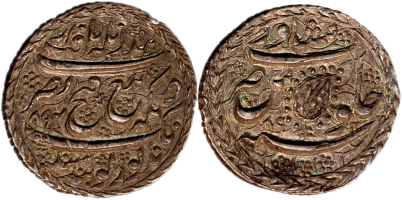
Peshawar · VS 1894
AR · 11.11 g · Recoinage-era restrike
Weight
11.11 g — Amritsar standard Not the Afghan trade weight of 8.33–8.49 g. Wreath-border fabric; milled edge on some specimens.The Peshawar mint, dormant since VS 1894 (AD 1837), was reopened under British direction in 1847–49. The Amritsar-standard weight marks these as recoinage-era restrikes on old VS 1894 dies — the Peshawar node of the same programme that produced the Nimak rupees at Pind Dadan Khan.
Dr Andrew Fleming, Diary, 22 March 1848 — RASB Vol. XVIII
"Visited the mint here, which is under the superintendence of [Misr Rulia Ram]. Silver is collected in all directions in the shape of old rupees, bangles and silver ornaments, which after being refined are converted into the new Lahore Rupee. At present the silver from which rupees are being manufactured, are Mahmoud Shah Rupees from the Hazara and countries to the North, and of the value of about 12 annas... From 1000 Mahmoud Shah rupees, 750 new Lahore rupees are manufactured."
Fleming was visiting the salt range on a geological survey; his diary entry is the only first-hand account of the Nimak mint in operation.
Nimak · VS 1904
AR · 11.1 g · Pind Dadan Khan
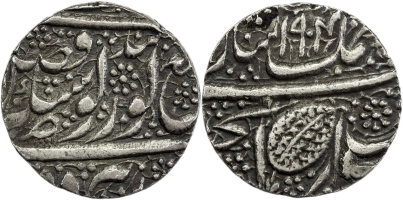
Obverse
Nanakshahi Couplet VReverse
Zarb Nimak, VS1904 […]The founding year of the Nimak mint. Feedstock: Mahmoud Shah (Durrani) rupees from Hazara at 12 annas. Output at full Amritsar Nanakshahi standard.
Nimak · VS 1905
AR · 11.1 g · Pind Dadan Khan
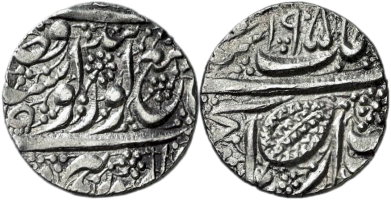
Obverse
Nanakshahi Couplet VReverse
Zarb Nimak, VS1905 […]Second year of operation. The mint ran from October 1847 until approximately June 1849 — closing with the end of Sikh rule.
Nimak · VS 1905
AR · 11.1 g · Pind Dadan Khan · Variant
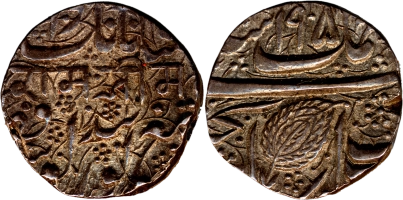
Obverse
Variant inscription Nanakshahi couplet with additional Śāradā legend Sri Ramji SahaiReverse
Zarb Nimak, VS1905The rarer variant type, VS 1905 only. The Śāradā inscription distinguishes it from the standard series.
VI. Seizure of the Salt Range Economy
The Kohistan-i-Namak — the Salt Range — was the Lahore Durbar's most valuable single revenue asset. Under Maharaja Ranjit Singh, the mines had been farmed to Raja Gulab Singh and Munshi Ram Das at Rs 8,00,000 annually. By the time of Bhairowal, under chaotic management, the revenue had collapsed; Mulraj, the Kardar of Rawalpindi and the salt mines, owed several lakhs of rupees and had paid, "during the past year, literally, nothing."
The British restructured the salt mines economy during the interregnum. A new contractor system was imposed in late 1847 at Rs 50,000 per month (Rs 6,00,000 per year), paying cash at the mine on removal. Simultaneously, Mr Bowring was dispatched on 8 November 1847 to conduct a formal revenue settlement of Pind Dadan Khan and the districts south of the Salt Range — the first direct British administrative penetration of the region. The Nimak mint was established simultaneously, its operation under Misr Rulia Ram collocated with the newly reorganised salt revenue collection.
Dalhousie's private letter of November 1849 anticipated exactly this trajectory: salt revenue would, he expected, "more than equal all that we sacrificed in customs." The figures that followed confirmed his calculation precisely.
| Period | Salt Revenue (Rs) | Note |
|---|---|---|
| Sikh Durbar budgeted | 4,00,000 | Punjab Papers revenue table, 1847 |
| Interregnum — new contractor | 6,00,000 p.a. | Contracted, Nov 1847 |
| Oct 1849 – Apr 1850 (7 months) | 8,06,852 | General Report, para. 310 |
| 1851–52 | 12,81,295 | 1854 Selections from Records |
| 1852–53 | 16,84,216 | 1854 Selections from Records |
| 1853–54 | 19,50,535 | +387% on Sikh budget in 6 years |
VII. The Elimination of Political Opposition
The Maharani Jind Kaur was the most capable political figure remaining after the Treaty of Bhairowal. She had been the effective regent during the most turbulent years after Ranjit Singh's death; she understood the Company's intentions and had not been afraid to say so. Her letter to the Resident — preserved in the Punjab Papers — is one of the most striking documents of the period: "You say that I have no share whatever in the Government!… what arrangements you make for governing the country during the Maharajah's minority, will, doubtless, be solely for his advantage and security."
In August 1847 the Resident moved to separate the Maharani from her son. The Governor-General authorised this explicitly "under the unlimited powers which the Governor-General possesses by the Treaty of Bhyrowal." The Durbar initially resisted sending her out of the Punjab; she was instead confined at Sheikhupura. By December 1847 letters that the Resident attributed to her — urging Sikh chiefs to resist — had been intercepted, and in 1848 she was banished to British territory, to Benares. On her removal, property worth "many lakhs of rupees" including one lakh and ten thousand rupees in Nanakshahis was discovered and confiscated by the Resident as Durbar state property.
With the Maharani removed, the Maharaja a child surrounded by British guardians, and the Council of Regency under the Resident's direction, there was no Sikh political figure with the authority or freedom of action to resist the programme being implemented around them.
Punjab Papers — Governor-General authorising the Maharani's separation, 1847
"I have desired that, in all public acts relating to Her Highness's separation from her son, the measure taken may be proclaimed to have been ordered by my authority, exercised for the benefit of the Prince and the State, under the unlimited powers which the Governor-General possesses by the Treaty of Bhyrowal."
The Treaty of Bhairowal — a treaty of trusteeship — was thus invoked to authorise the removal of the infant Maharaja's mother.
The Question
The Second War — Contingency or Prepared Ground?
The Second Sikh War began in April 1848 with Diwan Mulraj's troops killing two British political officers, Mr Patrick Vans Agnew and Lt. William Anderson, at Multan. The official British account treated this as an unprovoked rebellion that forced the annexation. Dalhousie, arriving as Governor-General in January 1848, was initially cautious: he chose not to send a major force to Multan immediately, preferring to contain the rebellion while gathering strength. His private letters suggest he understood, from early on, that the rebellion offered grounds for annexation he had not yet decided to seek.
But the question the primary sources raise is not whether Dalhousie engineered the Second War — there is no evidence that he did — but whether the twenty-seven months of interregnum had made some form of violent rupture structurally near-inevitable. The Sikh army had been progressively demobilised but not destroyed; the chiefs had lost their jagheers to British countersignature; the frontier population had been subjected to monetary extraction; the Maharani — the one figure around whom resistance could coalesce — had been removed; and the administrative infrastructure of a British province had been quietly assembled during the period of nominal Sikh sovereignty. The state had been hollowed out before the war that finished it.
Even the Multan situation bore the fingerprints of the interregnum programme. Diwan Mulraj — the hereditary governor of Multan, son of Diwan Sawan Mal, and a different man from the Mulraj who held the Rawalpindi salt farm — tendered his resignation of the Multan governorship in late 1847 under the weight of escalating fiscal demands: a heavy succession nazarana, a revision of his terms that cut his territory and raised his annual payments, and, among his grievances, the new export and import duties the Durbar had introduced in his province. The Punjab Papers record his complaint that the customs changes "had affected his revenue." The murder of the British officers in April 1848 occurred in the context of a succession dispute Currie had handled clumsily. The "rebellion" was the predictable consequence of two years of systematic pressure applied to a frontier governor whose province had been progressively destabilised.
March 1849 and After
The Annexation — and the Confirmation of the Programme
The Battle of Gujrat, fought on 21 February 1849, was the decisive military event. The Sikh army's surrender at Rawalpindi on 14 March, and the flight of the principal sirdars, ended active resistance. The Punjab was formally annexed on 29 March 1849. Maharaja Duleep Singh was required to sign a document renouncing his sovereignty; the Koh-i-Noor was transferred to the East India Company.
What followed confirmed that the interregnum programme had been exactly what the primary sources described. The Board of Administration — established immediately after annexation with Henry Lawrence, his brother John Lawrence, and Charles Mansel — did not need to build the administrative infrastructure of a new province from scratch. It existed. The revenue settlements were half-completed. The customs framework was in place. The army was already disbanded. The jagheer register was under British countersignature. The salt mines were already under British-directed contract. The currency reform was already in progress.
The Board's General Report records the measures of the first year of British rule as if they were acts of creation — disarming proclamations, disbanding of troops, investigation of jagheers, currency reform. But each of these had been begun during the interregnum; the first year of formal British rule was the completion of a programme, not its initiation.
Board of Administration, General Report on the Administration of the Punjab, para. 108
"The commencement of the second year was signalized by currency reform. A great variety of coinage had prevailed in the Punjab, producing mercantile confusion, disadvantageous exchanges, and facilitating fraud. These dead currencies were gradually withdrawn; large bullion remittances of the old coin, aggregating about fifty lacs, were transmitted to Calcutta, and also down the Indus, to be returned from the Bombay Mint with the British stamp. The old coinage has been to a great extent absorbed and recalled. Three-fourths of the revenue are now paid into the Treasury in British coin. In two or three years more, the Nanuk Shahi rupee, the symbol of the Sikh religion and power, will be numbered with the things of the past."
The fifty lakhs of old Sikh coin flowed down the Indus — the same Indus valley where the Nimak, Peshawar, and Dera Ismail Khan recoinage nodes had been established two years earlier. The direction of flow had reversed; the geography was the same.
Dalhousie's private letter of November 1849 — seven months after annexation — confirmed what the programme had always been about. He had "got the 'ill hawbees' in the Punjab out of circulation" and ordered them taken under escort to Allahabad fortress. Punjab revenue was "performing better than it promised." Canals had been begun. Salt revenue was already set to "more than equal all that we sacrificed in customs." The Nanakshahi rupee — "the symbol of the Sikh religion and power" — was to be gone within three years. Half a million sterling per annum in net profit was projected for the annexed territory within fifteen years. The Board of Administration's own General Report made the calculation explicit and published it.
Conclusion
The Interregnum as a Category of Imperial History
The standard historiography of the fall of the Sikh Empire places the Second Sikh War as the cause and the annexation as its consequence. The primary source record suggests a different structure: the interregnum was the cause, the Second War was the proximate occasion, and the annexation was the administrative completion of a programme already substantially implemented.
Seven interlocking instruments — legal subordination through treaty interpretation; demilitarisation of the Khalsa; fiscal subordination of jagheers and land revenue; customs and trade restructuring; monetary recoinage and standardisation; seizure of strategic fiscal assets; elimination of political opposition — operated simultaneously across the twenty-seven months of the Bhairowal interregnum. Each is documented in British correspondence. Each was implemented under the authority of the Bhairowal Treaty's clause giving the Resident "full authority to direct and control all matters, in every department of the State."
The coins in a collection dated VS 1904 and VS 1905 — the Nimak rupees, the last Peshawar rupees, the final Derajat issues — are not merely the terminal specimens of a coinage series. They are the material evidence of a monetary programme: the conversion of frontier silver into the Amritsar Nanakshahi standard as a preparatory step for its subsequent absorption into the Company's rupee. The mint that struck them was not a Sikh institution. It was a British administrative instrument operating within a nominally Sikh state, during the twenty-seven months in which the Sikh state was being unmade.
Primary Sources
Sources
- Papers Related to the Punjab 1847–1849. Presented to both Houses of Parliament, May 1849. Harrison and Son, London. The primary source for the interregnum administration — 756 pages of correspondence between the Resident at Lahore and the Governor-General's Secretariat.
- Lahore Political Diaries 1846–1849. Published 1909. Political diaries of the Agent to the Governor-General, N.W. Frontier, and Resident at Lahore. The foundational source for the day-to-day decisions of the Residency.
- General Report on the Administration of the Punjab. Calcutta, 1852–53. The Board's own retrospective account of annexation and its first three years.
- Selections from the Records of the Government of India, No. VI: Administration of the Punjab Territories, 1851–52 and 1852–53. Jones, Calcutta Gazette Office, 1854.
- "Diary of a Trip to Pind Dadud Khan and the Salt Range." RASB, Vol. XVIII, Part II, July–December 1849, pp. 667–68. First-hand account of the Nimak mint at Pind Dadan Khan, March 1848.
- Private Letters of the Marquess of Dalhousie. William Blackwood and Sons, Edinburgh, 1910. The Governor-General's private correspondence, including the "ill hawbees" letter of November 1849 and the salt revenue prediction.
- "Unidentified Sikh mints — proof of the existence of the mint at Nimak." ONS Newsletter No. 143, Winter 1995, pp. 13–15. The foundational numismatic paper, drawing on the Punjab Secretariat Press Lists and Lahore Political Diaries.
- "Rediscovering Sikh Mints — Peshawar, Dera, Rawalpindi." ONS Newsletter No. 146, Autumn 1995, pp. 10–12. Documents the Peshawar reopening (prior to December 1847) and closing (21 May 1849), the Dera/Derajat distinction, and the Rawalpindi order.
- "Coins of the Durranis and Barakzais." Numismatic Chronicle, 1888, p. 330. Records the Derajat VS 1906 rupee, the latest known coin of any Sikh mint.
- The Coins of the Sikhs. 2nd revised edition. Munshiram Manoharlal, New Delhi, 2004. The definitive numismatic catalogue; types 03.01.04–03.02.04 (Nimak), 07.07.04 (Derajat parallel), 13.04.04 (Peshawar recoinage).
- Coins of the Sikh Empire, Punjab and the Cis-Sutlej States. Spink & Son, London, 2022.
- How Fell the Sikh Kingdom. Lyall Book Depot, Ludhiana, 1970. Seetal's account of the political narrative of the fall, essential context for the administrative record.