The Sikh Empire · The Lahore Darbar · AD 1780–1849
Women of the Lahore Darbar
The queens, consorts and power-brokers who shaped the Sikh Empire — from the mother who gave Ranjit Singh his ambition, to the regent who resisted the British with everything she had
Mai Raj Kaur · Sada Kaur · Mehtab Kaur · Datar Kaur · Moran · Rani Jindan
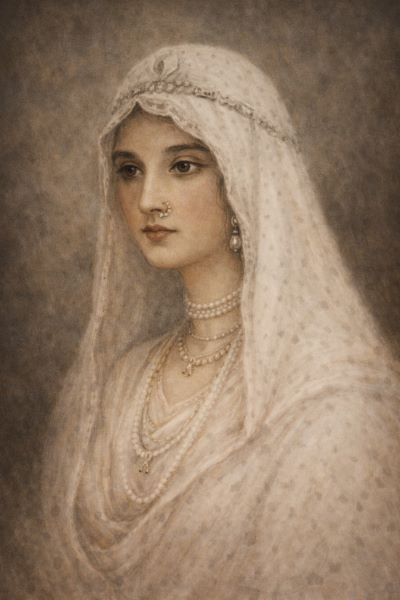 Mai Raj Kaur
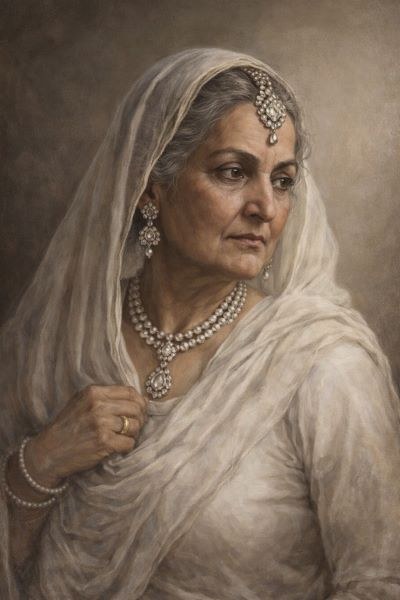 Sada Kaur
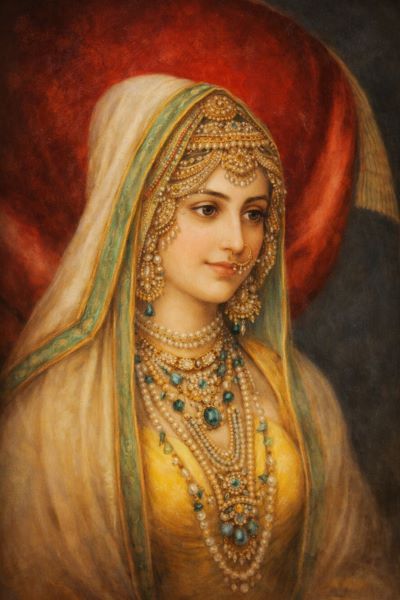 Mehtab Kaur
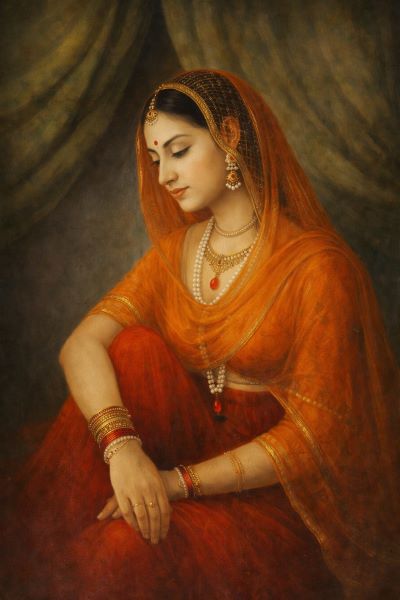 Datar Kaur
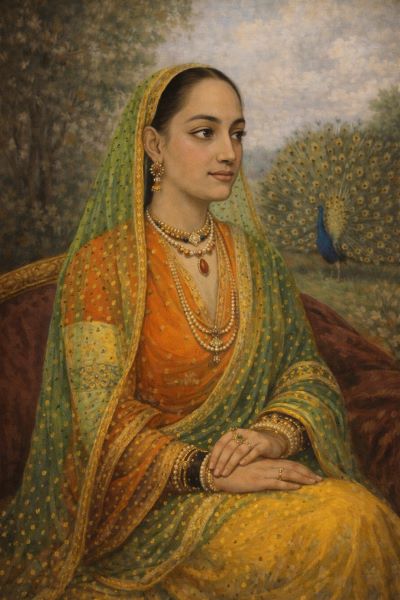 Moran
Moran
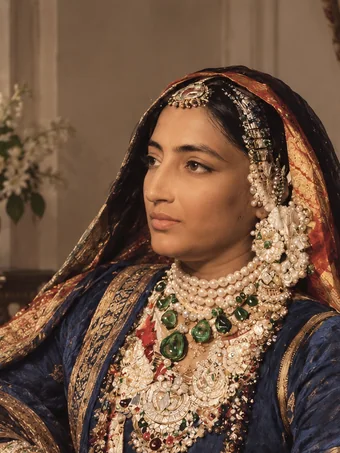 Rani Jindan
The Argument
The Women Who Made the Empire
The standard account of the Sikh Empire is told in male terms: generals, governors, battles, treaties. The women of the Lahore Darbar appear in the margins — the wives enumerated, the favourite dancer commemorated on a coin, the regent mentioned as the prelude to disaster. This account inverts that priority.
Without Mai Raj Kaur, there is no Ranjit Singh who survives childhood and becomes a ruler. Without Sada Kaur, there is no consolidated Punjab — she provided the military alliance and political calculation that made his early campaigns possible. Mehtab Kaur was the marriage that brought Kanhaiya misl resources within his orbit. Datar Kaur (the Nakain) was the domestic anchor of forty years. Moran is commemorated on a coin that broke the most fundamental rule of Sikh monetary theology. And Rani Jindan — youngest queen, mother of the last Maharaja, exiled by the British, separated from her son for years — was the most formidable political actor the empire produced after Ranjit Singh himself.
These are not peripheral figures. They are, in several cases, the story itself.
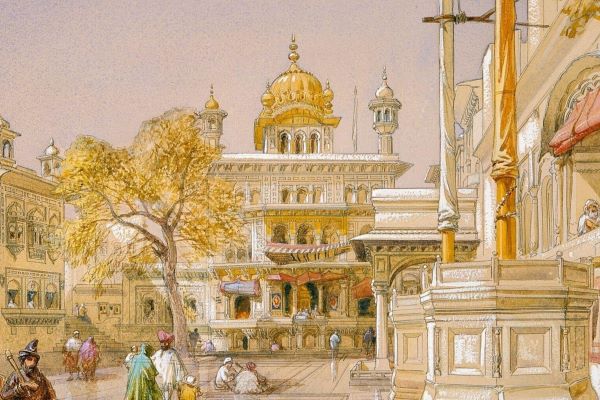
The Akal Takht and Harmandir Sahib, Amritsar — the institution that summoned Ranjit Singh to answer for the Moran coins and before whose authority even the Maharaja bowed
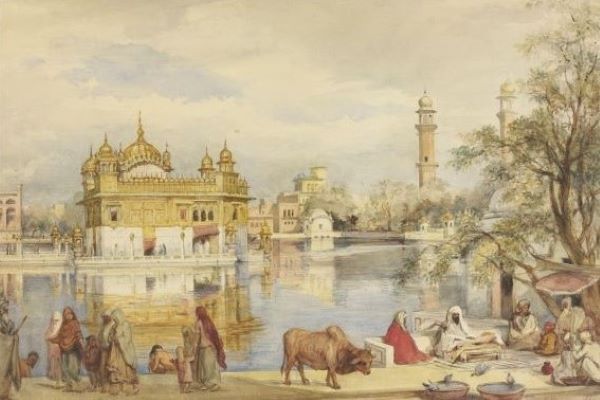
The Harmandir Sahib from the sarovar — the sacred centre around which the Amritsar mint, the Arsiwala coins, and the lives of the Darbar's women all revolved
The Mother
Mai Raj Kaur
Mai Raj Kaur — mother of Maharaja Ranjit Singh, daughter of Raja Gajpat Singh of Jind. On her husband’s death in 1792 she became regent of the Sukerchakia misl, governing through her son’s minority until her own death around 1798.
Mai Raj Kaur
Mother of Maharaja Ranjit Singh · Regent, Sukerchakia Misl · d. c. 1798
Mai Raj Kaur was the daughter of Raja Gajpat Singh of Jind and the wife of Maha Singh, chief of the Sukerchakia misl. Her son Ranjit Singh was born on 13 November 1780. When Maha Singh died in 1792, she did not retreat into widowhood but stepped forward as regent of the misl, taking charge of its affairs while her twelve-year-old son was still far too young to rule.
The circumstances of Ranjit Singh's early life were harsh. He survived smallpox as a child, losing the sight of his left eye, and at twelve became nominal chief of the Sukerchakia misl — with his mother as his guardian and regent, assisted by Diwan Lakhpat Rai. For some six years Raj Kaur held the confederacy together against rival factions at court, and oversaw the alliances, including his marriages, on which his rise would rest. The political education of those years — contested authority, competing factions, the need to build alliances through marriage and strategy — was the foundation of everything he later became.
Raj Kaur died around 1798, when Ranjit Singh was about eighteen and on the point of taking the misl fully into his own hands. Her importance to the story of the Sikh Empire is twofold. She gave him his blood connection to the Phulkian chiefs, and with it his earliest networks of obligation and alliance in the Punjab's tangled confederate politics; and she personally governed that inheritance through the most dangerous years of his minority. Without her lineage — and without the regency that kept the Sukerchakia misl intact until he was ready to claim it — the coalitions his father had built, and that he would inherit and dramatically extend, might never have survived to reach him.
The Kingmaker
Sada Kaur
Sada Kaur — chief of the Kanhaiya misl, widow of Gurbaksh Singh Kanhaiya. Her decision to ally with Ranjit Singh rather than against him in the 1790s was the single most consequential political act in the formation of the Sikh Empire.
Sada Kaur
Chief, Kanhaiya Misl · Mother-in-law of Ranjit Singh · c.1762–1832
Sada Kaur is the most underrated figure in the entire history of the Sikh Empire. She was the widow of Gurbaksh Singh Kanhaiya and, after his death in 1785, the effective ruler of the Kanhaiya misl in her own right — not as regent for a minor, but as the chief who led armies, negotiated treaties, and made strategic decisions that shaped the Punjab.
When her daughter Mehtab Kaur was married to Ranjit Singh in 1796, Sada Kaur did not retreat into the background of the alliance. She remained its most active architect. She stood with Ranjit Singh in the Bhasin confrontation of 1800, providing the cavalry that turned a difficult engagement in his favour. She was present at the occupation of Lahore in July 1799 — the moment that defines the beginning of the Sikh Empire — and her misl's resources were essential to that campaign.
Without Sada Kaur's alliance, Ranjit Singh could not have taken Lahore in 1799. He was nineteen years old. The Kanhaiya misl was one of the most powerful in the Punjab. Her decision to back him rather than resist him — and then to remain actively engaged in his military campaigns for more than a decade — was not sentiment. It was politics of the highest order.
The relationship eventually soured. After Mehtab Kaur's death in 1813, Sada Kaur's position at the Lahore court became increasingly marginal. By the 1820s she had been placed under house arrest, her jagirs confiscated. She died in 1832, estranged from the empire she had helped create. A full study of her life — the marriage that founded the alliance, the two gates at Lahore, and the dynastic project her grandson completed nine years after her death — is at Sardarni Sada Kaur. Ranjit Singh wept at her death.
The First Wife
Mehtab Kaur
Mehtab Kaur — daughter of Sada Kaur and Gurbaksh Singh Kanhaiya, first wife of Ranjit Singh. Married 1796. Their relationship was reported in the chronicles as cold; her mother's political weight meant far more to Ranjit Singh than the marriage itself.
Mehtab Kaur
First Wife of Ranjit Singh · Kanhaiya Misl · d. 1813
Mehtab Kaur was the daughter of Sada Kaur and the instrument — in the cold political calculus of misl alliances — through which Ranjit Singh secured the Kanhaiya connection. The marriage in 1796 bound two of the most powerful families in the Punjab confederacy. She was approximately fifteen; he was fifteen or sixteen.
The primary chronicles are not kind about the marriage's personal dimension. Sohan Lal Suri's Umdat-ut-Tawarikh records the union but does not describe it as a love match. Ranjit Singh's energies — political, military, and personal — were directed elsewhere almost from the beginning. Mehtab Kaur bore him a son, Ishar Singh, who did not survive infancy.
She died in 1813, the same year as her own daughter (also named Mehtab Kaur) by Ranjit Singh. Her death, and the simultaneous death of his daughter, is said to have struck Ranjit Singh with genuine grief — whatever the emotional temperature of the marriage, the losses of that year were real. Her mother Sada Kaur survived her by nearly two decades, the alliance that had justified the marriage long outlasting the marriage itself.
The Principal Wife
Datar Kaur — The Nakain
Datar Kaur, known as the Nakain (the lady of the Nakai misl) — Ranjit Singh’s principal wife, mother of Maharaja Kharak Singh, and the holder of the highest formal rank among the Darbar’s women throughout his reign.
Datar Kaur — The Nakain
Principal Wife · Nakai Misl · Mother of Kharak Singh
Datar Kaur, daughter of the chief of the Nakai misl, was the wife who held the highest formal rank in the Lahore zenana throughout Ranjit Singh's reign.
She was the mother of Kharak Singh, who would become Maharaja on his father's death in 1839 — though his reign lasted barely a year before palace intrigue and illness ended it. That she produced the heir apparent gave her a political importance independent of Ranjit Singh's personal regard, and her position at court was one of sustained formal dignity rather than romantic intensity.
The Nakain's significance is partly structural: she demonstrates that the Lahore zenana was not chaos but a ranked institution, with defined precedences, formal titles, and political stakes attached to each position. The coins of the Amritsar mint — struck in the Guru's name throughout the empire — carried no woman's name except Moran's, and the theological controversy that caused demonstrates precisely how exceptional any personal commemoration on Sikh coinage was.
The Court
The Women of the Inner Circle
Beyond the principal wives, the Lahore zenana held a constellation of women whose relationships with Ranjit Singh ranged from formal marriage alliances to deeply personal attachments. The court paintings that survive from this period record them in the conventions of Sikh court portraiture — jewelled, veiled, formal — but the primary chronicles fill in the human dimensions their portraiture withholds.
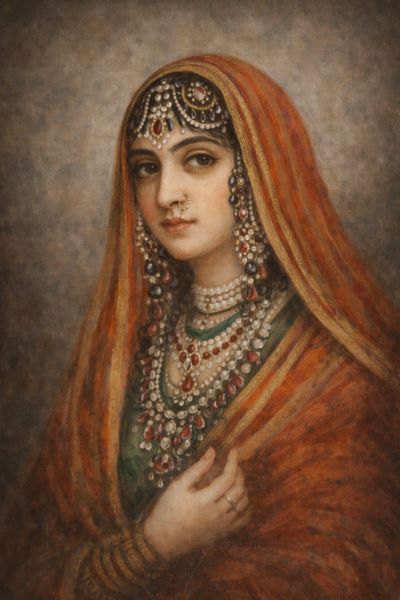
Har Devi
One of the Lahore Darbar's women, painted in the formal convention of Sikh court portraiture — the downcast gaze, the pearl and ruby jewellery, the deep orange veil that marks her courtly status.
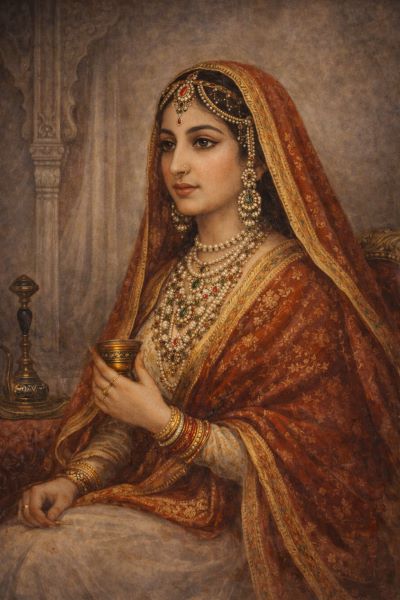
Gul Bahar Begum
Gul Bahar Begum, a Muslim wife of the Maharaja, holding the gold katori of formal portraiture. She was among those who followed Moran in demonstrating Ranjit Singh’s willingness to marry across religious boundaries.
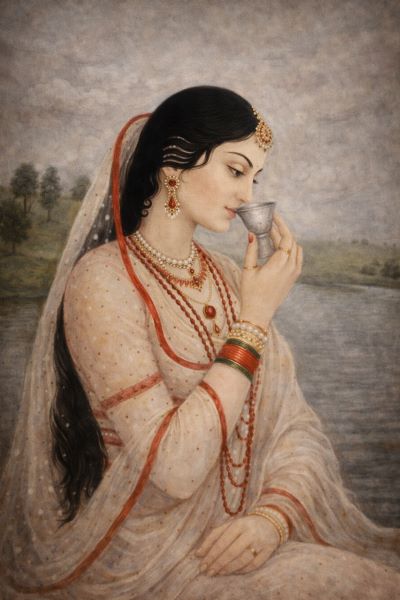
Rani Katochan
Rani Katochan, also known as Rani Guddan or Mehtab Devi, painted here in the subtle elegance of white — the pearls, the simple veil, the gaze that meets the viewer directly. She would be among those who chose to die with Ranjit Singh at his funeral in June 1839.
Mai Raj Kaur
The mother of the Maharaja, in formal court portraiture convention. The orange veil, the downcast posture, the quiet containment of a woman whose son would build the greatest Sikh political structure in history.
The Courtesan · The Coin
Moran of Batala
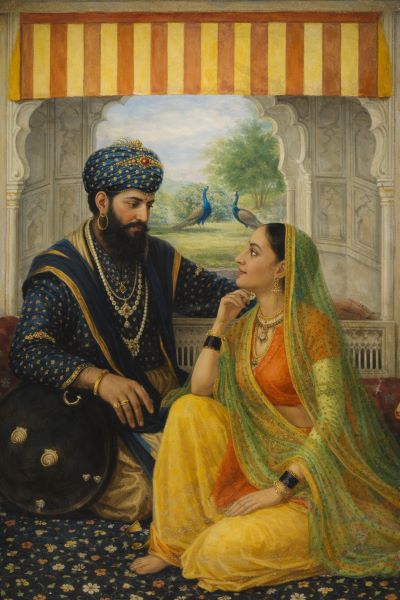
Ranjit Singh and Moran, with two peacocks visible in the garden behind them — the same bird the mint calligraphers hid in silver on the Morashahi rupees of VS 1861–1868. The painting encodes the numismatic story without meaning to.
Moran of Batala
Muslim Courtesan · Kanchni · fl. AD 1801–1811 at the Lahore Court
Moran was a Muslim kanchni — a dancing girl and singer — from Batala who came to the Maharaja's attention around VS 1858 (AD 1801). Her presence at the Lahore court for the following decade provoked sustained discomfort among the Sikh clergy and led to one of the most remarkable events in the history of the empire: the public submission of an absolute monarch to religious accountability.
What makes Moran historically extraordinary is not her relationship with Ranjit Singh — royal courts across the world had such relationships — but the numismatic evidence she left behind. Between VS 1861 and VS 1868, the calligraphers of the Amritsar mint hid a peacock (mor) within the body of the Persian calligraphy on the reverse of selected rupees — concealed within the letterforms of the legend that acknowledged the Guru's sovereignty. The coins were struck, distributed, and circulated across the Punjab. Most people never saw the peacock. Those who knew where to look did.
When the Akal Takht intervened, Ranjit Singh submitted to public punishment — a demonstration, without parallel in his reign, that even absolute political authority had its limits. The mint production was discontinued. Five years later, in VS 1868 — the year Moran departed for Pathankot under clerical and political pressure — a peacock appears once more on an Amritsar rupee, placed this time below the words of the Gobindshahi legend. The gesture was quieter, more deeply hidden. But it was made.
The Muslim Wives
Gul Bahar Begum & the Later Marriages
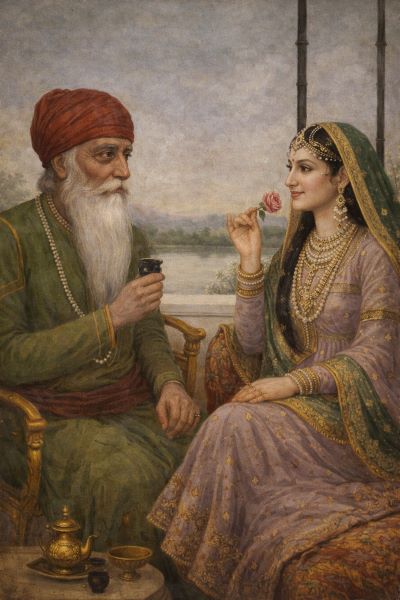
Ranjit Singh in his final years with Gul Bahar Begum — the aged Maharaja and his young wife, a rose and a cup of wine between them. The river behind them, the canopied setting, the domestic intimacy of the scene are characteristic of late Sikh court painting.
Gul Bahar Begum
Muslim Wife · Later Reign · Among the Zenana's Senior Members by 1839
Ranjit Singh married across religious boundaries throughout his life — an act that had both personal and political dimensions. His Muslim wives were not converts; they continued to practise Islam within the zenana. This was not tolerance as a modern concept but the pragmatic pluralism of a ruler whose domain included substantial Muslim populations, whose commercial networks depended on Muslim merchants, and who personally had no difficulty in holding the Sikh theological framework alongside a domestically mixed household.
Gul Bahar Begum is among the better-documented of the later Muslim wives. This painting, showing Ranjit Singh in the final decade of his life — white-bearded, the Koh-i-Noor on his arm not visible but implied — captures the intimacy of the relationship without romanticising it. The wine cup in her hand is a detail the court painters used without apparent concern; Ranjit Singh's consumption of alcohol was well documented and entirely compatible with how he understood his own Sikh identity.
Moran was the first Muslim woman at the Lahore court whose presence provoked institutional crisis. The women who followed her — Gul Bahar among them — existed within a court that had already, through the Akal Takht proceedings, established the limits of what the clergy would tolerate. Their presence was quieter, less publicly marked, and entirely without numismatic commemoration.
The Court in Its Fullness
The Lahore Zenana
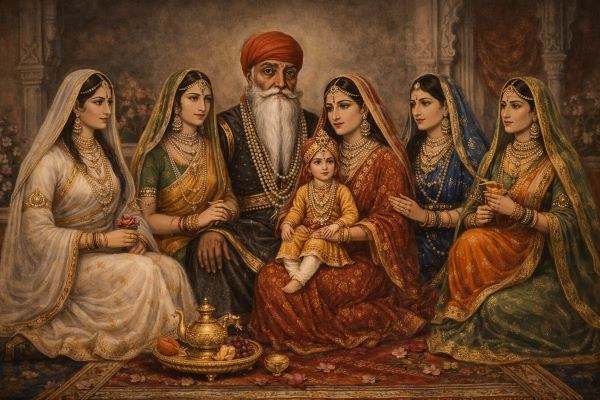
Ranjit Singh with his wives and Duleep Singh — the youngest son, child of Rani Jindan, seated at the centre of the court group. The hierarchical arrangement of the women around the Maharaja reflects the formal structure of the zenana, though court paintings of this kind are diplomatic documents as much as records.
The Lahore zenana at its fullest extent in the 1830s held dozens of women of varying formal status — principal wives with defined titles and jagir income, secondary wives, concubines, attendants. The hierarchy was clear in protocol if not always in personal influence: the Nakain held the highest formal rank; the women with male children held political weight; those with the Maharaja's current personal attention held informal power that could shift rapidly.
The court painter who produced this group portrait — the aged Maharaja, his wives arranged around him, the infant Duleep Singh at the centre — was recording the institutional structure of the zenana as much as its human reality. Rani Jindan, Duleep Singh's mother, is likely among those depicted here, though the painting's formal conventions make individual identification uncertain without documentation.
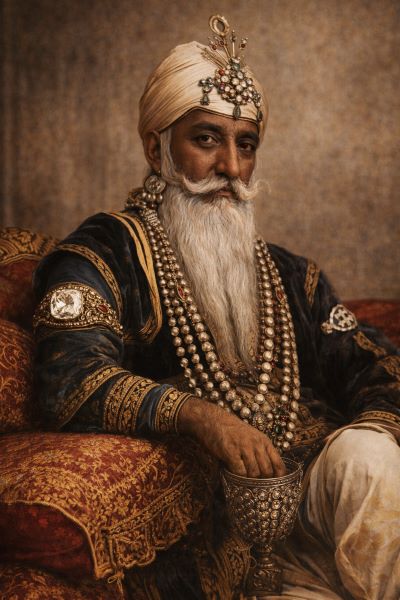
Ranjit Singh in court dress, the Koh-i-Noor worn as an armlet on his upper arm — the jewel that passed from the Durranis through the Sikh treasury and ultimately, under the Treaty of Lahore signed after Rani Jindan’s regency, to the British Crown. It remains in the Crown Jewels.
The Regent · The Exile · The Lion’s Widow
Rani Jindan Kaur
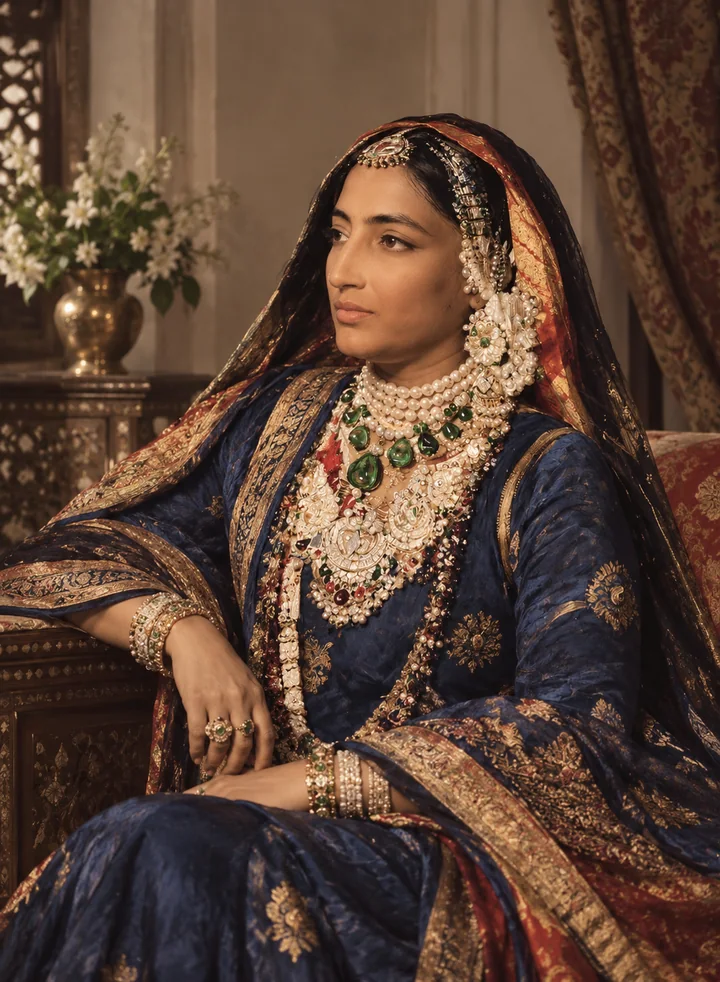
Rani Jindan Kaur (Jind Kaur) — youngest wife of Ranjit Singh, mother of Maharaja Duleep Singh, regent of the Sikh Empire 1843–1846. Exiled by the British to Sheikhupura in 1847, she escaped to Nepal in 1849 and was reunited with her son in Calcutta in 1861. Digital art created for this site, reaching for the regent of the 1840s; the one likeness of her taken from life is George Richmond’s portrait of about 1862, made in London in the last year of her life.
Rani Jindan Kaur
Youngest Wife · Regent of the Sikh Empire 1843–46 · c.1817–1863
Rani Jindan Kaur was the daughter of Manna Singh, the Maharaja's kennel-keeper, and was married to Ranjit Singh in 1835 when she was approximately eighteen. Their son Duleep Singh — the last Sikh Maharaja — was born in 1838, a year before Ranjit Singh's death. She was twenty-two when she was widowed.
What followed was the most remarkable political career produced by the Lahore zenana. After the assassinations of Maharajas Nau Nihal Singh and Sher Singh in the palace intrigues of 1840–43, Duleep Singh — not yet six years old — was placed on the throne and Rani Jindan became regent. She governed a court in which the Khalsa army was an independent power, the Dogra ministers were intriguers, and the British Residency at Lahore was a permanent intelligence operation watching for the moment to advance.
The British found her formidable and responded accordingly. Henry Lawrence, the Resident, described her in terms that are simultaneously admiring and hostile — admiring because he could not dismiss her intelligence, hostile because she consistently worked against British interests and understood exactly what those interests were. She told the Sikh sardars that the British intended to annex the Punjab. She was correct. They exiled her for saying so.
A full critical study of her regency — what she governed, and which charges against her survive the evidence — is at Maharani Jind Kaur: A Reassessment. Rani Jindan died in London in 1863, two years after the reunion. She had last lived in Lahore in 1847. Duleep Singh brought her body back to India and cremated her at Nasik. He was twenty-five years old.
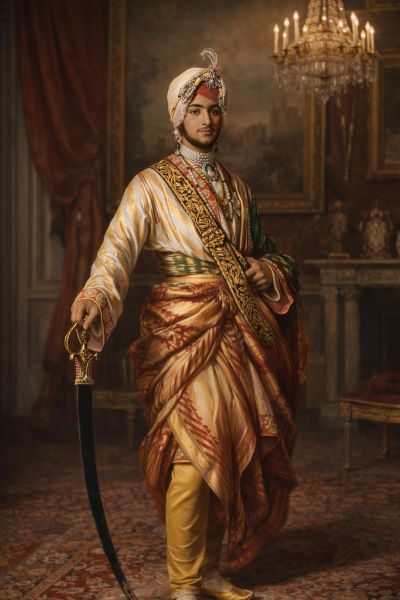
Maharaja Duleep Singh
Son of Rani Jindan and the last Sikh Maharaja, painted in London. Separated from his mother at age ten, converted to Christianity, educated as an English gentleman. He and Rani Jindan were reunited in Calcutta in 1861, after which she accompanied him to England.
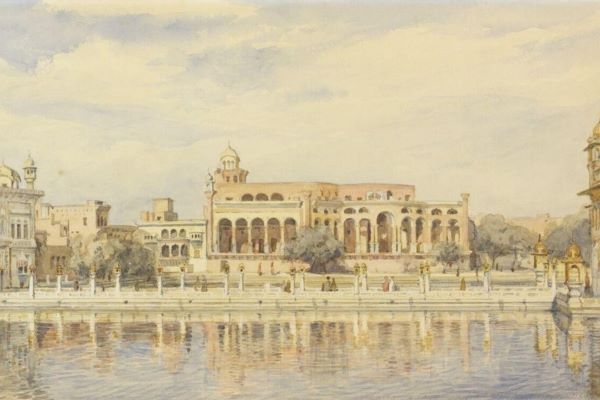
The Harmandir Sahib Causeway
The causeway leading to the Harmandir Sahib, Amritsar — the sacred approach that Rani Jindan and the Lahore court would have walked in the years of her regency, before the British took the Punjab and took her son. The Bunga Shahi or the Royal Residence visible in the background.
Primary Source · Rani Jindan to the Sikh Sardars · c. 1846
“The British are not our friends. They want our kingdom. They will take the Punjab from Duleep Singh as they took everything from us. Do not trust their Resident. Do not trust their treaties. I tell you this because I know it to be true and because when it happens you will have no one left to tell you I was right.”
Reconstructed from British Residency intelligence reports and Sikh chronicle accounts — the substance, if not the exact words, is documented in multiple sources
June 1839 · Lahore
The Funeral Pyre
Maharaja Ranjit Singh died on 27 June 1839 at Lahore. He was fifty-eight years old and had ruled the Sikh Empire for forty years. His death set in motion the decade of political collapse that ended with the British annexation of the Punjab in 1849.
At his funeral, eleven women died alongside him on the pyre: four wives and seven concubines. Among those who chose — or were constrained — to perform Sati was Mai Katochan, painted here in the white of her mourning, whose portrait shows a face of composed self-possession that the historical record can neither confirm nor deny. The practice, which the British would formally abolish in the territories under their control, was not illegal within the Sikh Empire, though it ran counter to Sikh doctrine. The Akal Takht, which had summoned Ranjit Singh over the Moran coins, did not intervene.
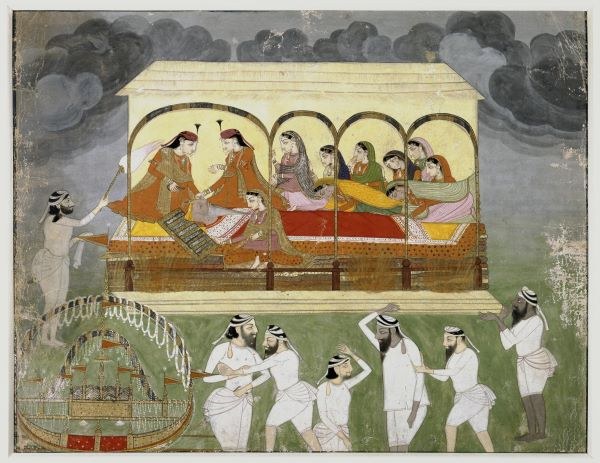
The funeral of Maharaja Ranjit Singh, Lahore, June 1839 — a period painting showing the bier, the mourners, and the women seated in the canopied palanquin above. Ten women — four wives and six concubines — performed Sati. Mai Katochan is among those depicted. This painting is one of the most significant documents of the end of the Sikh Empire.
Rani Jindan was not among those who died. She was twenty-two years old with a one-year-old son, and — whatever the pressures of the court — she survived. In the decade that followed she would govern an empire, resist the most powerful colonial power in the world, be imprisoned, escape, and live long enough to see her son again in a country she had never imagined visiting. The women who died on that pyre in June 1839 have no further history. Rani Jindan's history had barely begun.
Scholarship
Sources and Further Reading
Primary Chronicles
- — Umdat-ut-Tawarikh (Chronicle of Events from the Earliest Period to the Year of the Christian Era 1831–32), Lahore. The authoritative court chronicle of Ranjit Singh's reign, written by his court historian. Primary source for the marriages, the Moran affair, and the structure of the zenana.
- — The Court and Camp of Runjeet Sing, 1840. British political officer's account of the Lahore court, including observations on the women of the zenana during the 1838 visit.
Modern Scholarship
- — History of the Sikhs, Vol. I & II, Princeton University Press, 1963–66. The standard narrative history; Moran, Sada Kaur and Rani Jindan all receive substantial treatment.
- — Maharaja Ranjit Singh. Treatment of the domestic and political dimensions of the Maharaja's court.
- — The Duleep Singhs: The Photographic Album of Queen Victoria's Maharaja, 2004. Essential for the Duleep Singh / Rani Jindan reunion and the later period.
Numismatic Cross-References
- The Morashahi rupee — the coins struck at the Amritsar mint between VS 1861 and VS 1868 carrying the concealed peacock in honour of Moran — are documented in full on the Morashahi Rupee page. See also Gujral, Gurprit Singh — “The Enigma Called Moran,” Journal of the Oriental Numismatic Society, No. 198.
- Coinage of the regency period (VS 1896–1903, AD 1839–1846) continued to be struck at Amritsar in the Guru's name throughout Rani Jindan's governance — the theological continuity of the Nanakshahi standard surviving even as the political structure it represented collapsed.