The First Anglo-Sikh WarDecember 1845 – March 1846
The war the Khalsa nearly won. At Ferozeshah, the British army came closer to catastrophic defeat than at any engagement since Waterloo. The difference was not courage — the Khalsa possessed that in abundance — but the treachery of its own commanders.
4 Battles · 3 Months · 2 Treaties · 1 Betrayal
A War Engineered and Then Betrayed
How the most powerful army in Asia was defeated without being beaten
The First Anglo-Sikh War lasted barely three months — from the crossing of the Sutlej on 11 December 1845 to the Treaty of Lahore on 9 March 1846. In those three months, the British East India Company fought four major engagements against the Khalsa army: at Mudki, at Ferozeshah, at Aliwal, and at Sobraon. They won all four. But the manner in which they won, and the evidence that accumulated in the years that followed, established beyond serious scholarly dispute that the war was lost by the Khalsa's own commanders before it was lost on the battlefield.
The Khalsa army of 1845 was the finest fighting force on the Indian subcontinent. Reorganised over two decades by French and Italian veterans — Allard, Ventura, Court, Avitabile — it possessed a disciplined infantry, a professional artillery that was in several respects superior to the British, and a cavalry that had operated across the entire subcontinent without a defeat in the field. Its soldiers were veterans of campaigns from Kashmir to Sindh, from Peshawar to the Sutlej. They fought at every engagement of the First War with extraordinary courage and effectiveness, and at Ferozeshah they came within one failing of destroying the British army in India.
That failing was not theirs. Lal Singh, the Wazir, was in communication with the British camp before the first shot was fired. Tej Singh, the Commander-in-Chief, withdrew a fresh division at Ferozeshah at the moment the British were spent, and is held in the Sikh tradition to have had the pontoon bridge at Sobraon weakened before the battle, drowning thousands of Sikh soldiers in the Sutlej as they attempted to retreat. Both men were subsequently rewarded by the British: Lal Singh was made governor of Kashmir (briefly); Tej Singh was confirmed as chief of Sialkot. The pattern was set from the beginning.
The Road to War
British provocation, the Sutlej frontier, and a court without a government
The conditions that produced the First Anglo-Sikh War were the deliberate creation of the British political establishment in India, accelerated by the collapse of Lahore's governing authority after Ranjit Singh's death in 1839. The two processes reinforced each other: the weaker the Lahore court became, the more aggressively the British pressed on the Sutlej frontier; the more aggressively the British pressed, the more the Army Panchayats demanded war as the only answer to the creeping encirclement.
Major George Broadfoot, appointed British Political Agent on the Sutlej frontier in 1844, pursued a deliberate policy of provocation. His dispatches to Calcutta consistently exaggerated Sikh aggressive intent and minimised British frontier violations. He refused to acknowledge Sikh jurisdiction over islands in the Sutlej. He encouraged the Cis-Sutlej chiefs — already under British protection — to treat the river as a British border rather than the boundary fixed by the Treaty of Amritsar in 1809. When the Khalsa army eventually crossed the river, Broadfoot's dispatches framed it as unprovoked aggression against British territory. He died at Ferozeshah, killed by Sikh artillery.
On the Sikh side, the Army Panchayats — the democratic soldiers' councils that had filled the political vacuum left by the succession crisis — had by late 1845 concluded that war with the British was inevitable and preferable to the slow strangulation of the frontier policy. The court under the child Maharaja Duleep Singh and the regent Maharani Jindan was too weak to restrain them, and too divided to govern them. The ministers Lal Singh and Tej Singh — neither a Dogra, both raised by the Dogra interest, and both in secret communication with the British — encouraged the army's war fever precisely because they knew the war would be lost, and that its loss would be their reward.
Crossing the Sutlej
On the night of 11 December 1845 the Khalsa army crossed the Sutlej at Hari ke Pattan in force, formally beginning the First Anglo-Sikh War. The crossing itself was the subject of immediate controversy. Lal Singh, even before the army had completed the crossing, sent a message to Captain Nicholson — British Charged Affairs at Ferozepur — informing him of the army's movements, its strength, and its direction of march, and asking for instructions.
Nicholson's reply, preserved in the British records and quoted in detail by Sohan Singh Seetal, was unambiguous: do not attack Ferozepur; lead the army away from the garrison; meet the Commander-in-Chief who is coming from Ambala. Lal Singh did exactly this. He dampened the ardour of the Khalsa at the decisive moment before Ferozepur by assuring the soldiers — falsely — that four Indian battalions of the British army would defect to the Sikh side. The Khalsa, which had 60,000 men to the British garrison's 6,000, did not attack. The opportunity was lost.
Governor-General Sir Henry Hardinge, writing privately after the war, acknowledged that the Sikh failure to press the attack on Ferozepur before the main British force arrived was the single act that saved the British position in the Punjab. He did not — could not — publicly acknowledge why it had happened. His successor Dalhousie, writing in private letters collected by J.G.A. Baird, recorded the broader strategic picture with unusual candour: the slow, deliberate failure of Sikh commanders at every critical junction was the thread that connected each engagement of the war, and that thread led to Lahore.
Mudki
Battle of Mudki
British tactical victoryThe opening engagement of the war, fought late in the afternoon as the two forces stumbled upon each other near the village of Mudki. The British force under General Sir Hugh Gough, accompanied by Governor-General Hardinge, had been marching since dawn and was exhausted. The Khalsa cavalry under Lal Singh attacked as Gough's column was still deploying.
The battle was confused, fought largely in clouds of dust thrown up by the cavalry. The Sikh artillery — directed by European gunners — inflicted severe casualties on the British. Two British major-generals and several colonels were killed or wounded. Gough's infantry eventually pushed the Khalsa artillery back, but the Sikh withdrawal was orderly, not a rout. Lal Singh had again failed to press what tactical advantages existed.
British casualties: ~900 killed and wounded · Sikh casualties: estimated 500–800
Ferozeshah
The night the British army nearly ceased to exist
Battle of Ferozeshah
British pyrrhic victory — Khalsa held the field at nightfall on Day 1Ferozeshah is the battle that defines the First Anglo-Sikh War. On the evening of 21 December, Gough launched an assault on the heavily entrenched Sikh camp at Ferozeshah — against the advice of Hardinge, who wanted to wait for Littler's column from Ferozepur. The assault went in at dusk into prepared Sikh positions defended by 108 guns.
The British attack was shattered. Regiment after regiment broke against the Sikh entrenchments. The British artillery — outranged and outgunned by the Sikh heavy guns — could not suppress the Sikh batteries. By nightfall, the British force had lost cohesion entirely. Officers and men were intermingled, ammunition was running low, and the Sikh army held the camp. Hardinge, believing the battle lost, sent his personal papers to the rear and prepared a despatch acknowledging defeat.
The morning of 22 December was the crisis. As the British reorganised for a final assault — with what ammunition remained — Tej Singh arrived with a fresh Sikh army from the south. Had he attacked at this moment, the British force, exhausted and disorganised, would have been destroyed. Tej Singh did not attack. He withdrew his fresh army, claiming his guns had run out of ammunition — a claim disproved by subsequent examination of the ground. The British, given this reprieve, pressed a desperate final assault on the weakened Sikh position and took the camp.
The chaos of the Ferozeshah night was later dramatised by the novelist G.A. Henty in Through the Sikh War — regiments fighting front, flanks, and rear at once in the darkness, the line so broken that the Governor-General himself is said to have ridden forward to rally the 80th Regiment because no staff officer remained to carry orders. Henty's book is historical fiction built on the earlier histories, not a documentary record; but it captures what the dispatches confirm: nearly every political officer on the field had been killed or wounded, the earthwork-protected Sikh guns could not be silenced by counter-battery fire, and the British infantry had to take the batteries at bayonet point in the dark.
Hardinge's private letters after Ferozeshah are the most revealing documents of the First Anglo-Sikh War. He acknowledged freely in private what official dispatches could never say: that the Khalsa had fought superbly, that the British position had been desperate, and that the outcome had turned on factors he could not explain publicly. The Sikh artillery at Ferozeshah was, by the testimony of every British officer who faced it, superior in range, accuracy, and volume to anything the British possessed in India. The gunners — many of them trained by French and Italian officers — handled their pieces with professional competence that drew reluctant admiration from their opponents.
The British casualty figures at Ferozeshah — over 2,400 killed and wounded in two days — represented a rate of loss that had not been sustained in any British engagement in India since the battle of Assaye in 1803. The scale of the disaster was deliberately minimised in official dispatches to prevent a collapse of confidence in London and Calcutta.
"We have gained a victory like that of the ancients — it is such a one that another such would ruin us."
— Governor-General Lord Dalhousie on the news of Chilianwala, January 1849 — a verdict that echoed the British position after Ferozeshah three years earlier
Aliwal
Battle of Aliwal
Decisive British victoryAfter the mutual exhaustion of Ferozeshah, operations on the Sutlej were reduced for several weeks to manoeuvre and skirmishing. The Battle of Aliwal was fought to the south of the main Sikh position, where a Sikh force under Ranjodh Singh Majithia had crossed the river to threaten the British line of communications.
Sir Harry Smith — commanding a British division in one of the more straightforwardly conducted engagements of the war — attacked the Sikh position at Aliwal with infantry and cavalry in a co-ordinated assault that broke the Sikh force and drove it back across the Sutlej. The battle is remembered in British military history principally for the charge of the 16th Queen's Lancers against the Sikh infantry squares — a charge that broke them. Aliwal was the cleanest British victory of the war, fought against a Sikh commander who had not been purchased.
British casualties: ~580 killed and wounded · Sikh casualties: ~3,000 killed, wounded and drowned in the Sutlej
Sobraon
The martyrdom of Sham Singh Attariwala — and Tej Singh's final treachery
Battle of Sobraon
British victory — secured by Tej Singh's sabotage of the Sikh bridgeBy February 1846 the main Khalsa army had withdrawn into a fortified bridgehead on the south bank of the Sutlej at Sobraon, connected to the north bank by a pontoon bridge. The British — reinforced and resupplied — assembled the largest force yet deployed in the war for the final assault.
Before the battle, Tej Singh — commanding the Sikh force — had secretly weakened the central section of the pontoon bridge. This was not discovered until the battle was over. On the morning of 10 February, Gough launched a massive artillery bombardment followed by an infantry assault on the Sikh entrenchments. The Khalsa fought with the desperation of men who understood that this was the last battle. The Sikh artillery, which had devastated British formations at Mudki and Ferozeshah, had been provided with ammunition boxes filled with sand by Tej Singh — packed under his personal order to sabotage the Sikh fire.
When the British broke through the Sikh lines, the army attempted to retreat across the bridge. The weakened section collapsed. Thousands of Sikh soldiers drowned in the Sutlej — not defeated in battle but killed by their own commander's treachery.
British casualties: ~2,400 killed and wounded · Sikh casualties: estimated 8,000–10,000 killed, wounded and drowned
Sardar Sham Singh of Attari — sixty years old, long retired, a veteran of every major campaign of the empire — rode into the battle of Sobraon when the Khalsa lines began to break. He wore white: white dress, white beard, a white horse. Sohan Singh Seetal, who dedicated his entire history of the fall of the kingdom to his memory, describes him appearing among the breaking lines like a heavenly angel, rallying men who had lost heart, leading a final charge against the British positions. He did not return from it. His body was found on the battlefield. He is the only commander of either side who died at Sobraon fighting without reservation for the cause he served.
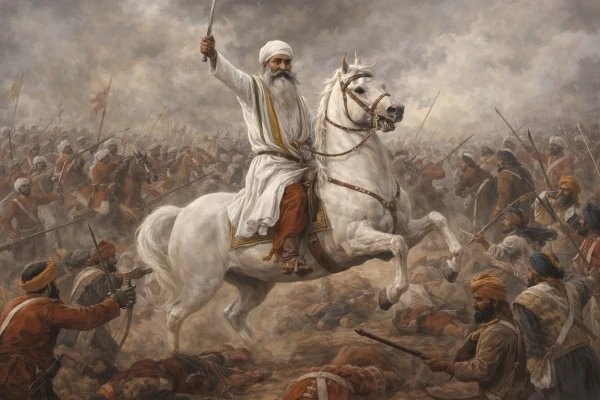
The moment of Sham Singh's last stand has been commemorated in Sikh art; the painting of his final charge at Sobraon — on his white horse, in white dress, rallying the breaking Khalsa lines — is one of the most reproduced images in Sikh historical iconography. The catastrophe of the day was the bridge: the Sikhs fought until the entrenchments were overrun, and the retreat across the Sutlej turned to disaster when the pontoon gave way. The British assault was costly too — Major-General Sir Robert Dick, who had commanded the 42nd Highlanders in the Waterloo campaign, was among those killed. The Khalsa infantry had fought with a desperation that inflicted losses on the British out of all proportion to the final result.
The Treaties of Lahore and Bhairowal
The Treaty of Lahore, signed on 9 March 1846, imposed terms designed not to destroy the Sikh state — Hardinge judged that premature annexation would be politically unmanageable — but to reduce it to permanent dependence. The principal terms: the Khalsa army was reduced to 20,000 infantry and 12,000 cavalry; a war indemnity of 1.5 crore rupees was imposed; the Jalandhar Doab — the territory between the Beas and Sutlej rivers — was annexed to British India outright; and a British Resident was to be stationed at Lahore.
The treaty's most cynical provision was the disposal of Kashmir. Unable to pay the full indemnity, the Lahore court agreed to cede Kashmir to the British — who promptly sold it to Gulab Singh of Jammu for 75 lakh rupees. Gulab Singh had spent the war communicating with both sides while committing to neither. His reward was a kingdom. The transaction — the sale of a people and their territory as chattel between two powers that had conspired against them — was completed within days of the final battle.
The Treaty of Bhairowal in December 1846 went further. It replaced Maharani Jindan's regency with a Council of Regency supervised by the British Resident. The Resident — Henry Lawrence, then John Lawrence — became in practice the ruler of the Punjab. Jindan was removed, confined, and eventually exiled to Benares. The second war had been prepared before the first had been fully digested.
What the Coins Record
The coinage of the war years and its immediate aftermath
The First Anglo-Sikh War left its mark on the coinage of the Sikh Empire in two distinct ways: in the coins that continued to be struck during and immediately after the war, and in those that were extinguished by its consequences.
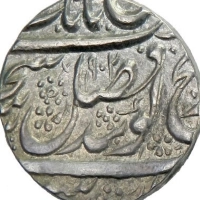
The VS 1902 (AD 1845) Lahore rupees bear the Nanakshahi couplet — Sikka zad bar Har Do Alam — struck in the very year of the First Anglo-Sikh War. They are coins of a sovereign empire fighting for its existence, minted while the Khalsa army was crossing the Sutlej. The Lahore mint continued through the interregnum; the VS 1902 issues being its last strikes from the war year itself — the last coins of an undefeated empire before the treaties began their work.
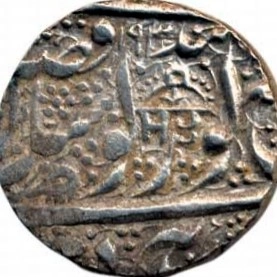
The Amritsar mint — the sacred mint of the Khalsa, struck in the city of the Harmandir Sahib — continued operating after the Treaty of Lahore. Its rupees of the interregnum period (VS 1903–1906) carry the same Nanakshahi legends that had appeared on every Amritsar coin since 1775, but now with added symbols, the period of war issues from VS1902-1903 show a Flag symbol, the ones after, dated VS1903-1906, show a parasol(chattar) above a gurmukhi 'Sat', 'Shiv' & 'Ram', symbolising the changing characters of the Regency council.
The most significant numismatic consequence of the First War was not in the coins struck but in those that could no longer be struck. The annexation of the Jalandhar Doab & the British controlled regency council removed several of the smaller mints of the empire from Sikh control. The 1.5 crore rupee indemnity — much of it paid in coin from the Lahore treasury — drained the empire's silver reserves and constrained the coinage of the remaining mints in the interregnum years. The coins of VS 1904 and 1905 from Amritsar are notably less numerous in collections than those of earlier years, a reflection of the depleted silver supply of a state stripped of half its revenues.
Sources
- Seetal, Sohan Singh. How Fell the Sikh Kingdom. Ludhiana: Lyall Book Depot, 1970.
- Gough, Sir Charles, and Innes, Arthur D. The Sikhs and the Sikh Wars. London: A.D. Innes & Co., 1897.
- Hardinge, Viscount (Henry Hardinge). Private papers and dispatches, 1845–46. Published in part in: Hardinge and His Friends. London, 1891.
- Cunningham, Joseph Davy. A History of the Sikhs. London: John Murray, 1849 (revised 1918). Contains the first numismatic chapter on Sikh coinage and the fullest contemporary account of the political background.
- Smyth, Major G. Carmichael. A History of the Reigning Family of Lahore. Calcutta: W. Thacker, 1847.
- Bell, Major Evans. The Annexation of the Panjab and the Maharaja Duleep Singh. London: Trübner, 1882. Contains the most thorough demolition of the British official justifications for both wars.
- Cook, Hugh. The Sikh Wars 1845–49. London: Leo Cooper, 1975.
- Hernon, Ian. Britain's Forgotten Wars. Stroud: Sutton Publishing, 2003.
- Singh, Khushwant. How the Sikhs Lost Their Kingdom. New Delhi: UBSPD, 1996.
- Sidhu, Saran Singh & Dalwinder Singh. Coins of the Sikh Empire, Punjab and the Cis-Sutlej States. London: Spink & Son, 2022. For the coinage of the interregnum period.
Sutlej Campaign Medal 1845–46
Select specimens from the SikhCoins.in collection. Click any image or title to browse the full album.
| Specimen | Mint | Date | |
|---|---|---|---|

|
The Sutlej Medal - 1845-46 | ||

|
Sutlej Medal, Clasps Ferozeshuhur, Aliwal, Sobraon | ||

|
Sutlej Medal, Clasps Sobraon & Ferozeshuhur | ||

|
Sutlej Medal, Clasp Sobraon |