Personalities  ·  The Fall  ·  The Charge of Treachery

Betrayal and Reward

Every account of the fall of the Sikh Empire carries a list of traitors, and every list is different. This page grades the charge instead of repeating it — what was documented at the time, what rests on tradition, and what will not stand at all — and then reads the whole thing against the one record that cannot be argued with: who was left holding a mint.

Graded by evidence  ·  The ledger of reward  ·  The counterweights

AD 1839 – 1856

I  ·  Method

A List Is Not an Argument

The Punjab did not fall the way kingdoms usually fall. Its army was intact, its artillery was the best in India, and at Ferozeshah in December 1845 it came within one night of destroying the British army in India. What it did not have was a government that wanted it to win. That much is not seriously disputed by anyone, in any tradition. What is disputed — and disputed sharply — is who exactly did what, and on what evidence.

The usual treatment is a list of names under a heading like this one. The difficulty with a list is that it grades nothing. Lal Singh's correspondence with the British camp before the first shot survives in the record. Gulab Singh's motives are inferred from his conduct. The claim that Tej Singh personally ordered sand packed into the Khalsa's ammunition boxes comes from a tradition consolidated a century after the event. Put those three on one list and the weakest sets the standard for all: the page becomes arguable in general instead of unanswerable in particular.

So this page grades them. Tier one is what the British and Sikh records both carried at the time. Tier two is conduct that is strong on the facts but where the charge of treason has to be built rather than cited — and where, in several cases, the honest verdict is a different crime altogether. A third section deals with three names that are routinely included and should not be. A fourth restores the men on the other side of the ledger, because a page that lists only the sellers implies there was nobody left to sell out.

And then there is the numismatic test, which is the reason this page belongs on this site at all. Motive is unrecoverable and loyalty is unfalsifiable, but payment leaves a physical record. A man who was rewarded for his conduct in 1846 was rewarded in territory, and territory in the Punjab meant a mint or the absence of one. Follow the mints and the moral argument becomes an accounting one. It is a harder question to answer and a much harder one to dismiss.

II  ·  Tier One

Documented at the Time

Two men meet the highest standard of proof available for this period: their conduct was recorded by the side that benefited from it, in writing, while the war was still being fought. Neither was a Dogra, though both are habitually described as such. Both were clients of the Dogra interest, raised into command by it, and both were rewarded by the British afterwards — which is the part of the record that requires no interpretation at all.

Raja Lal Singh

Wazir, Nov 1845 – Feb 1846  ·  d. 1866
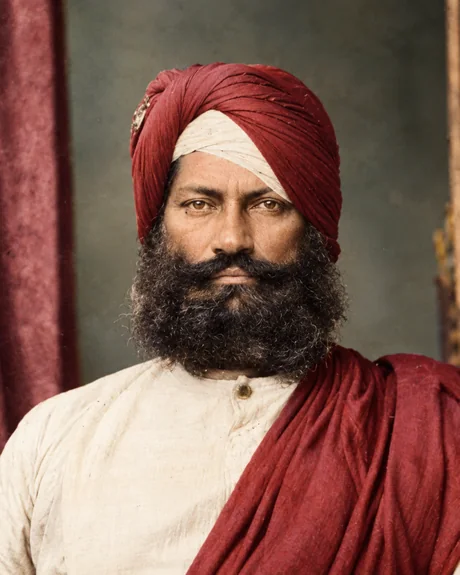
Lal Singh, wazir of the Lahore Darbar, in a crimson and white turban and a crimson shawl over a plain white tunic
Reconstruction after a mid-nineteenth-century likeness. Digital work created for this site.
Tier one  ·  Documented

Raised to the wazirate in November 1845, in the vacuum left by the murder of Jawahar Singh, and in command of the Khalsa force that crossed the Sutlej a fortnight later. Before the first engagement he was in communication with Captain Peter Nicholson, the political assistant at Ferozepur. The instruction he received back is preserved in the British records and quoted at length by Seetal: do not attack Ferozepur, lead the army away from the garrison, and meet the Commander-in-Chief coming up from Ambala. He did exactly that.

At the decisive moment before Ferozepur he assured his own soldiers — falsely — that four Indian battalions of the British army would come over to the Sikh side. The Khalsa had sixty thousand men within reach of a garrison of a fraction that size, and did not take it.

His reward was the governorship of Kashmir. He held it for months. When the British sold Kashmir over his head to Gulab Singh and the transfer was resisted, they tried Lal Singh themselves in December 1846, found him responsible, deposed him and exiled him to Agra. He was the first of the two to discover what the arrangement had actually been worth, and he is the cleanest illustration on this page of what the Company did with an instrument once it had finished using it.

Raja Tej Singh

Commander-in-Chief  ·  c. 1799 – 1862
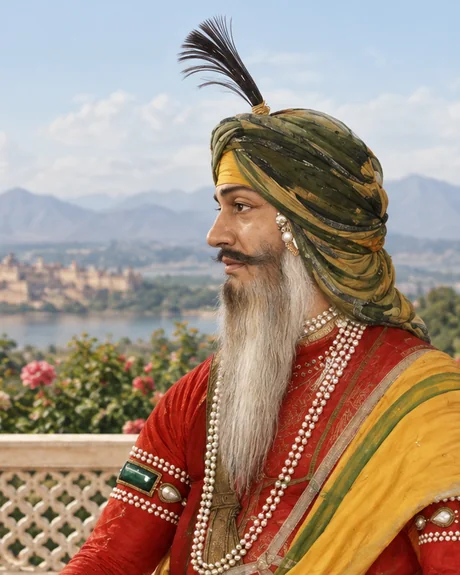
Tej Singh, commander-in-chief of the Khalsa army, seated in a red tunic and yellow sash with a plumed olive turban and a long white beard
Reconstruction after a Company-school portrait type. Digital work created for this site.
Tier one  ·  Documented

Born Tej Ram in the Meerut district, nephew of the Darbar's chamberlain Khushal Singh, and commander-in-chief of the Khalsa army in the winter of 1845. At Ferozeshah on the night of 21 December his fresh division stood between an exhausted British army and its destruction. He withdrew. British accounts written afterwards are candid about what that withdrawal saved them; it is the single most consequential decision of the war and it was taken by the Sikh commander.

At Sobraon on 10 February the Khalsa fought in a bridgehead on the south bank with a single pontoon bridge behind it. The bridge failed during the retreat and the river took thousands of men. That the bridge failed is not in question. That Tej Singh had the central section deliberately weakened beforehand, and that the artillery's ammunition boxes had been packed with sand on his order, comes from the Sikh tradition as consolidated by Sohan Singh Seetal — a serious and exhaustively documented account, but one written from that tradition rather than from a contemporary British or Darbar file. This site treats the treachery as established and those two specifics as traditional. The distinction costs the argument nothing and protects it.

He was made Raja of Sialkot for it. In August 1847 the nine-year-old Duleep Singh was required to perform the investiture and refused to make the mark on his forehead. The Resident held the mother responsible for the son, and Jind Kaur was removed from Lahore. The separation that ended with a woman dying in exile in London began with a ceremony honouring this man. The full account is on the Maharani Jind Kaur page.
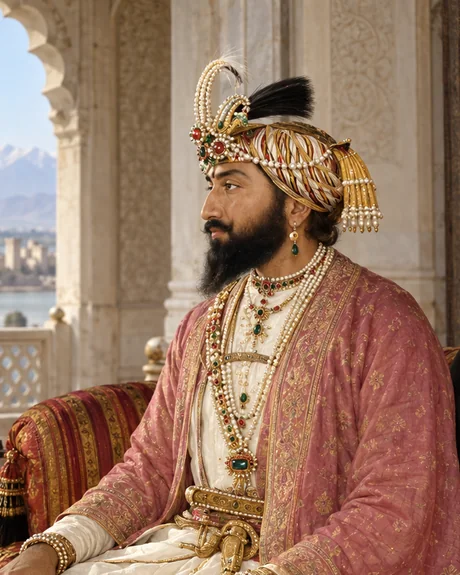
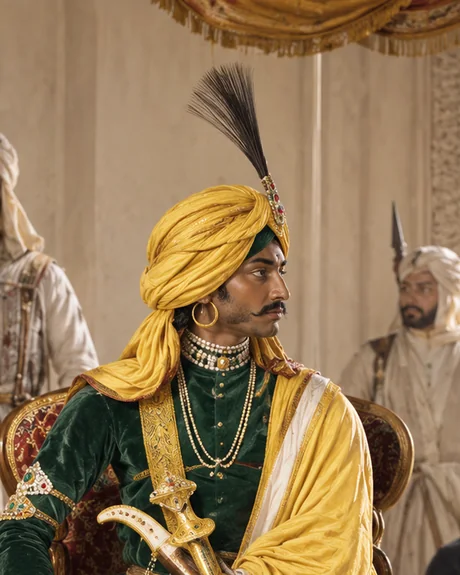
A note on the word Dogra. Both men are described on older pages of this site, and throughout the popular literature, as the “Dogra ministers.” Neither was a Dogra. Lal Singh was a Brahmin from the Jammu hills who rose as Dhian Singh's client; Tej Singh was a Brahmin from the Doab who rose as Khushal Singh's nephew. They were the Dogra interest's instruments, which is a sharper charge than membership of a community and a more accurate one.

III  ·  Tier Two

Strong on the Facts, Harder on the Charge

The four men below are named in every account of the collapse, and the facts against each are substantially agreed. What varies is the crime. Two of them were dead before the first Anglo-Sikh war began and cannot have sold it; what they did was make the succession lethal, which is a different offence and arguably a graver one, since it produced the court that lost the war. A third took no side in the war and was paid a kingdom for it. The fourth had a prince murdered and was killed for it by his own army. Filing all four under a single word flattens exactly the distinctions that make the case.

Raja Dhian Singh Dogra

Wazir 1828 – 1843  ·  1796 – 15 Sept 1843
Dhian Singh Dogra, wazir of Lahore, seated in a rose shawl and white robes with a jewelled and plumed turban
Reconstruction after a Pahari-school portrait type. Digital work created for this site.
Tier two  ·  Dynastic, not colonial

Wazir to Ranjit Singh for the last decade of the reign, and the man who held the office through the three that followed. Within fourteen months of Ranjit Singh's death, Kharak Singh's favourite Chet Singh Bajwa had been killed in the citadel, Kharak Singh himself had been confined and was dead, and Nau Nihal Singh had been killed by falling masonry on the day of his father's cremation — an accident the sources have never agreed to call one. Dhian Singh's faction was the beneficiary of each of those deaths in turn.

He was shot on 15 September 1843, within the hour of Sher Singh's murder by the Sandhanwalias, and killed by Sher Singh's own men. What he was not is an agent of the Company. He died more than two years before the Sutlej was crossed and there is no evidence that he ever sought a British connection; his ambition was a Dogra hereditary interest inside a Sikh empire, not the end of one. The charge that holds against him is that he made the throne a thing that could be taken by murder, and that every court after him worked on the precedent.

Raja Hira Singh

Wazir Sept 1843 – Dec 1844  ·  1816 – 1844
Hira Singh, wazir of Lahore, seated in dark green velvet with a yellow turban and sash, attendants standing behind
Reconstruction after a Pahari-school portrait type. Digital work created for this site.
Tier two  ·  Dynastic, not colonial

Dhian Singh's son, and the wazir who placed the five-year-old Duleep Singh on the throne in September 1843 on the standard calculation: an infant sovereign and a mother of no consequence beside him. The calculation failed. Fifteen months later he was dead on the Jammu road, killed by the army he had tried to leave, carrying what he could of the treasury with him.

His inclusion here is warranted by what his ministry did to the state's finances rather than by any dealing with the British. The silver that went north in those fifteen months is the reason the regency that followed could not pay its own soldiers, and an unpaid army is the precondition for everything that happened in 1845. The chain from the Jammu treasure carts to the crossing of the Sutlej is real, but it runs through solvency, not through correspondence.

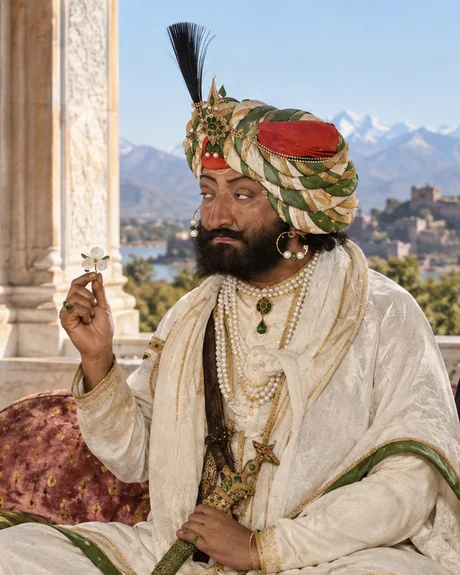
Maharaja Gulab Singh

Raja of Jammu  ·  1792 – 1857
Gulab Singh of Jammu seated in white robes with a green and white turban, holding a flower, a shield propped behind him
Reconstruction after a Company-school portrait type. Digital work created for this site.
Tier two  ·  The central figure

The eldest of the three Jammu brothers, and the only one who was still alive when the accounts were settled. He was brought to Lahore under the regency to answer for what had left the treasury for Jammu, and permitted to return home on payment of a fine of sixty-eight lakh rupees — a figure that tells you the scale of what had gone.

Through the war he committed to neither side while remaining in contact with both. When it was lost, the Darbar sent him to negotiate its surrender: the state's representative at the Treaty of Lahore was the man whose own conduct was among the reasons there was anything to negotiate. Unable to raise the indemnity, Lahore ceded Kashmir; on 16 March 1846 the British sold it to him for seventy-five lakh. He acquired a kingdom for a little over half the sum he had been fined for emptying the treasury of the state that lost it.

This is where the numismatic test bites hardest, and it is set out in the ledger below. Of every man named on this page, he is the only one whose reward included a working mint — and the Dogra coinage founded on it outlived the Sikh Empire by ninety-eight years.

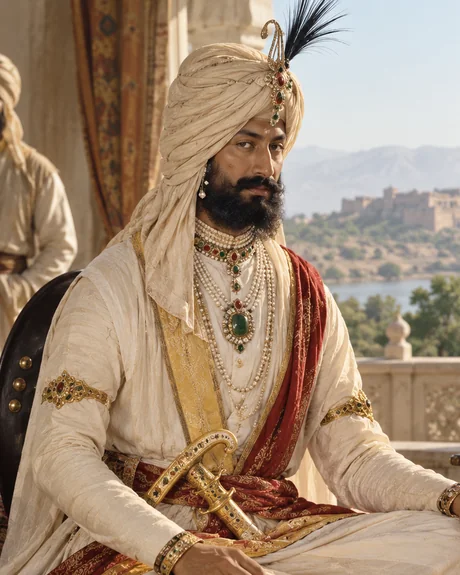
Jawahar Singh Aulakh

Wazir May – 21 Sept 1845
Jawahar Singh Aulakh, wazir of Lahore, in a cream turban with a black plume and strands of pearls and emeralds
Reconstruction after a Sikh-school portrait type. Digital work created for this site.
Tier two  ·  A different crime

Jind Kaur's elder brother, raised to the wazirate in May 1845 on no qualification but the relationship. On the night of 30 August 1845 Prince Pashaura Singh, a son of Ranjit Singh and a claimant to the throne, was killed at Attock and his body put into the river. The army held Jawahar Singh responsible. On 21 September it summoned him to the cantonment at Mian Mir and speared him there, in front of his sister and the child Maharaja.

He belongs on this page because he is on every list. He does not belong in it for treachery with the British, of which there is no evidence whatsoever. His offence was to turn the wazirate into a family instrument and a prince into an obstacle, and the significance of his death is what it proves about the state of the army eleven weeks before the war: a soldiery that would kill the head of government in front of the sovereign was not an army anyone at Lahore was in a position to manoeuvre.

IV  ·  The Numismatic Test

Who Was Left Holding a Mint

Arguments about loyalty run out of evidence quickly. Arguments about payment do not, because payment in the Punjab of the 1840s took the form of territory, and territory carried a mint or it did not. A mint is a fact about sovereignty that survives in metal: someone had the right to put a legend on silver, or lost it. Reading the settlement of 1846 as a table of mints produces a version of this page's argument that requires no assumption about anybody's intentions.

NameConduct, 1845–46Reward or penaltyMint outcome
Gulab Singh Committed to neither side; negotiated for Lahore at the surrender Kashmir, purchased 16 March 1846 for 75 lakh Acquires the Kashmir mint. Dogra coinage runs to 1947
Tej Singh Withdrew at Ferozeshah; commanded at Sobraon Raja of Sialkot, 1847 A title and a jagir. No coinage is known in his name
Lal Singh Corresponded with Ferozepur before the first engagement Governor of Kashmir; tried, deposed and exiled within the year Held the province months before it was sold over his head. Nothing
Patiala & Jind Under British protection since 1809; supported the Company as their treaties required Territory, including land confiscated from Nabha Mints continue. The last Phulkian rupees are struck in 1948
Nabha Jaswant Singh corresponded with the trans-Sutlej Sikhs Removed; close to a quarter of the state's territory confiscated Mint survives, reduced. Still striking for Gurdwara offerings in the 1930s
Ladwa Crossed the Sutlej to fight for Lahore State confiscated 1846; the Raja imprisoned Struck nothing. The state is erased from the map
Lahore Lost Annexed, 29 March 1849 The imperial mints fall silent in VS 1906

Read down the last column and the shape of the settlement is unmistakable. The only participant who ended the affair with a functioning mint in his own hands was the one who never committed to either side. The two men whose conduct is documented in writing were paid in titles — Sialkot for one, a governorship the Company took back for the other — and neither ever struck a coin. Treachery, on this evidence, was worth rather less than patience.

There is a detail here worth stating precisely, because it is easy to get wrong. Kashmir is often counted among the mints silenced by the annexation of 1849. It was not. Kashmir left Sikh control in 1846, three years before the annexation, and its mint did not fall silent at all — it changed owner and carried on. Of every mint the Sikh Empire possessed, exactly one survived the fall, and it survived by passing to the man this page has the most difficulty grading.

The order that shows what a mint was for

In 1847 the Resident's establishment ordered a mint set up at Rawalpindi to melt down the miscellaneous rupees circulating in Hazara and the north-west and to issue Nanakshahis in their place — and recorded that he was trying to persuade Maharaja Gulab Singh to do the same in Kashmir. Gulab Singh declined. The Rawalpindi order itself came to nothing; no coins are known from that mint. But the exchange states the case in the Company's own words: control of a mint was control of what money meant, and the new Maharaja of Kashmir was not minded to hand his over to the people who had sold it to him. The full documentary chain is on the Nimak Mint page.

V  ·  Excluded

Three Names That Do Not Belong Here

Lists of this kind routinely carry three entries that will not survive contact with the record. Each is worth removing for the same reason: including them concedes ground that does not need to be conceded.

The Cis-Sutlej chiefs. Patiala, Jind, Nabha and Faridkot were placed under British protection by the Treaty of Amritsar in 1809 and were not subjects of Lahore for the thirty-six years that followed. To call them traitors in 1845 is to assert a Lahore sovereignty over them that the Sikh Empire itself had signed away — and it is the weaker charge in any case. The stronger one is the one the record actually supports: they were rewarded for doing precisely what their treaties obliged them to do, their mints ran on untroubled for another century, and one of them was handed territory confiscated from a neighbour who had leaned the other way. That is not treason. It is the protectorate working exactly as designed, which is a more damaging thing to be able to demonstrate.

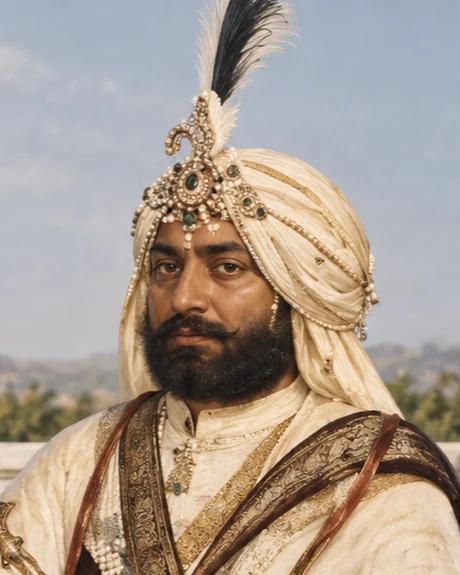
Ajit Singh Sandhanwalia

Raja Sansi  ·  d. 16 September 1843
Ajit Singh Sandhanwalia in a cream turban with a jewelled sarpech and black plume, a baldric across his shoulder
Reconstruction after a Sikh-school portrait type. Digital work created for this site.
Excluded  ·  Anti-Dogra, not pro-British

Son of Basawa Singh of Raja Sansi, and a kinsman of Ranjit Singh from the senior collateral branch of the family. On 15 September 1843, while Maharaja Sher Singh was reviewing troops at the Shah Bilawal baradari, he offered an English rifle for the Maharaja's inspection, shot him with it, and cut off his head. Inside the Lahore fort the same afternoon, while the office of wazir was being carved up, he shot Dhian Singh.

He was dead within a day. Hira Singh and Suchet Singh raised a section of the army, brought up Avitabile's battalions, and stormed the fort on the 16th; Ajit Singh was killed going over the wall. Both bodies were quartered and displayed on the city gates.

The killings are routinely folded into the general indictment, and they should not be. The Sandhanwalias were the faction that had backed Chand Kaur against Sher Singh, and Dhian Singh was the man who had backed Sher Singh and who was widely held responsible for Chand Kaur's murder in her own palace the year before. This was a blood feud inside the Punjab about who should hold the Punjab. It is a fair complication that the family had earlier taken refuge in Company territory and returned under amnesty, and anyone building the case should say so — but a refuge is not an instruction, and nothing in the events of that afternoon served a British purpose that the Dogra ministry was not already serving better.

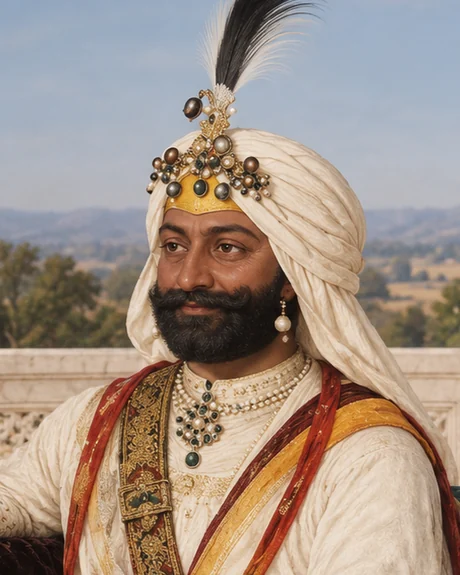
Lehna Singh Sandhanwalia

Raja Sansi  ·  d. 16 September 1843
Lehna Singh Sandhanwalia in a white turban with a gold band, jewelled sarpech and black plume, wearing pearl strands and an emerald pendant
Reconstruction after a Sikh-school portrait type. Digital work created for this site.
Excluded  ·  Anti-Dogra, not pro-British

The senior man of the faction and Ajit Singh's uncle, long established at the court of Ranjit Singh. While his nephew was killing the Maharaja at the baradari, he killed the heir apparent in a garden close by — Tikka Partap Singh, who was twelve years old. The two heads were carried into the fort together.

He was killed there the following day when the army came in. The estates were confiscated afterwards and the ancestral village at Raja Sansi ordered to be ploughed up, which was done. It is worth registering what that tells you about the period: a faction could destroy the sovereign, the heir and the wazir in a single afternoon and be extinguished by the next, and the state carried on. Six years of that preceded the war, and it explains rather more about the outcome than any single act of treachery does.

Diwan Mulraj

Governor of Multan 1844 – 1848  ·  d. 1851
Diwan Mulraj of Multan in a dark blue turban with a gold ornament, a dark robe and a long greying beard
Reconstruction after a contemporary likeness. Digital work created for this site.
Excluded  ·  The other side of the ledger

The rising at Multan in April 1848 that began the Second Anglo-Sikh War was a rebellion against the British administration, not for it. He had governed one of the empire's richest provinces since 1844, competently and through the worst of the succession crisis, and resigned when the financial terms imposed after the first war would have stripped him of most of his revenue.

The two political officers sent to take over from him were attacked outside the city on 19 April 1848 and were dead within two days. Whether Mulraj ordered the killings, or knew of them, has never been established, and the inquiry that followed was perfunctory. Once accused he had no choice but to hold the city, and he held it for eight months against a siege. He surrendered when the walls were breached on 22 January 1849, was convicted at a trial that had to produce a conviction, was transported for life, and died in captivity in 1851.

His name drifts onto lists like this one with some regularity, which says a good deal about how loosely the word has been used. The man who held a Sikh province against the annexation for eight months is the last that should appear on it. The full account is on the Second Anglo-Sikh War page.

Two men named Ajit Singh appear on this page and they are not related. Ajit Singh Sandhanwalia of Raja Sansi, above, killed the Maharaja in 1843. Raja Ajit Singh of Ladwa, in the section that follows, crossed the Sutlej to fight for Lahore in 1846 and lost his state for it. The names are close enough that the two are occasionally conflated in the secondary literature.

VI  ·  The Other Column

The Men Who Were Not for Sale

A page that lists only the sellers implies there was nobody left to sell out, which is the opposite of what happened. The Khalsa fought four engagements in fifty-six days under commanders who did not want it to win, and fought them well enough that the outcome was in doubt at three of them. Four men make the point that the failure was of a court and not of a people — and the last of them was still fighting three years after the state had ceased to exist.

Sardar Sham Singh Attariwala

c. 1785 – 10 February 1846
Sham Singh Attariwala, an elderly sardar seated in plain white robes with a white turban and long white beard
Reconstruction after a Sikh-school portrait type. Digital work created for this site.
Counterweight  ·  Sobraon

A veteran of every major campaign of the empire, long retired to Attari, and about sixty years old when the Sikh lines began to break at Sobraon. He came back because the army had no general. He rode in wearing white — white dress, white beard, a white horse — having said what he intended to do, and did not come off the field.

He is the exact measure of the men beside him. The same battle contains a commander who is said to have weakened the bridge behind his own army and a commander who chose not to survive the day, and they were nominally on the same side. The martyrdom is treated at length on the First Anglo-Sikh War page.

Raja Ajit Singh of Ladwa

Ladwa State  ·  Confiscated 1846
Raja Ajit Singh of Ladwa mounted on a black horse in the courtyard of his fort, in patterned robes and a gold turban
Reconstruction after a Company-school equestrian portrait type. Digital work created for this site.
Counterweight  ·  The wrong direction

The single most useful name on this page, because he inverts the whole arrangement. Ladwa was a Cis-Sutlej state around Thanesar and Karnal, under British protection like Patiala and Jind, and its Raja held his title from a British Governor-General. In 1845 he was already under surveillance at Saharanpur as a suspected troublemaker. He got out, joined Ranjodh Singh Majithia, crossed the Sutlej at Phillaur — the wrong way, from the Company's point of view — took Fatehgarh, Dharamkot and Baddowal, and burned part of the Ludhiana cantonment. He was in the action at Baddowal on 21 January 1846 and was beaten at Aliwal a week later.

The Governor-General's despatch of 17 November 1846 records that the Raja of Ladwa had almost openly avowed his treason and gone over with his troops and guns. Treason, in that sentence, means loyalty to Lahore. His state was confiscated in 1846, his house at Haridwar granted away to Patiala the following year, and he was imprisoned in the fort at Allahabad, from which he escaped; the accounts have him dying in the hills, in Kashmir, some years later.

Every other Cis-Sutlej chief chose the protectorate and kept a mint. He chose Lahore and his state struck nothing, was confiscated, and disappeared from the map. The ledger in section IV works in both directions, and Ladwa is the entry that proves it.

Baba Hanuman Singh

Jathedar, Buddha Dal  ·  d. 1846, Sohana
Baba Hanuman Singh, an elderly Nihang in blue bana and a tall dumala, seated in a camp with a spear in his hand and standards behind him
Reconstruction after the Nihang portrait tradition. Digital work created for this site.
Counterweight  ·  Sohana

Successor to Akali Phula Singh at the head of the Buddha Dal, and the last Jathedar to command the Nihangs as a standing force in the field. He was killed at Sohana in the aftermath of the first war, in an action the Nihang tradition treats as the end of the Dal's existence as an army rather than as a body of men.

He is here because the Buddha Dal had nothing to gain and no terms to seek. It had no territory to be confiscated and no mint to lose, which is precisely why it does not appear in the ledger above and precisely why it kept fighting after the parties that did appear had all settled. The account of his death and of what became of the Dal afterwards is on the Akali Phula Singh page.

Bhai Maharaj Singh

b. Nihal Singh, Rabbon, Ludhiana  ·  d. 5 July 1856
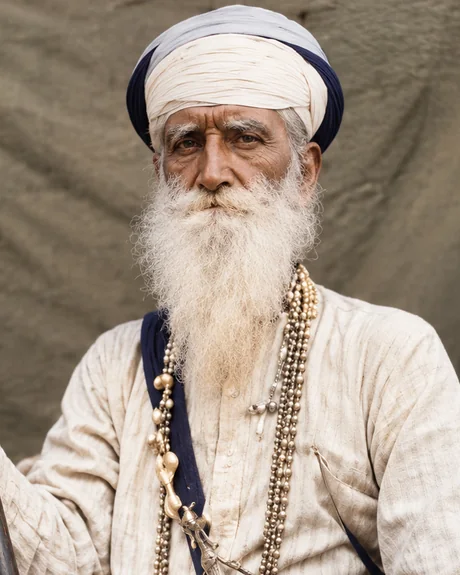
Bhai Maharaj Singh seated cross-legged in plain white with a white turban, long white beard and a staff
After the photograph taken in captivity at Singapore. Digital work created for this site.
Counterweight  ·  After the state

Born Nihal Singh in the village of Rabbon in the Ludhiana district, he took amrit at the hands of Bhai Bir Singh of Naurangabad and succeeded to the Naurangabad dera in 1844. From 1847 he carried on an organised resistance to the Residency and then to the annexation itself — through the Second Anglo-Sikh War, into Jammu, and back into the Doab — with a price of ten thousand rupees on his head. He was taken with twenty-one unarmed followers near Adampur on 28 December 1849.

The British would not risk a trial. Henry Vansittart, the Jalandhar deputy commissioner who arrested him, reported that the Guru is no ordinary man, and recommended he be treated accordingly; the Government of India took the point and drew the opposite conclusion. On 23 March 1850 the Governor-General ordered him deported to Singapore for life, and rules were bent so that his companion Kharak Singh could go with him. They sailed from Calcutta on the Mohamed Shah and were put into the new jail on Outram Road.

He was held in solitary confinement in a cell of about fourteen feet by fifteen, its windows bricked up. Cataracts blinded him by 1853. He developed a cancer of the tongue and throat, and the Government of India refused the civil surgeon's request that he be let out to walk. He died there on 5 July 1856. Kharak Singh, who is recorded in the files as a servant and was in fact his disciple, performed the cremation on ground outside the prison, was released in January 1857, and lived out his life in Singapore under police surveillance. Tamil, Malay and Sikh residents kept the cremation ground; the Gurdwara on Silat Road stands there now.

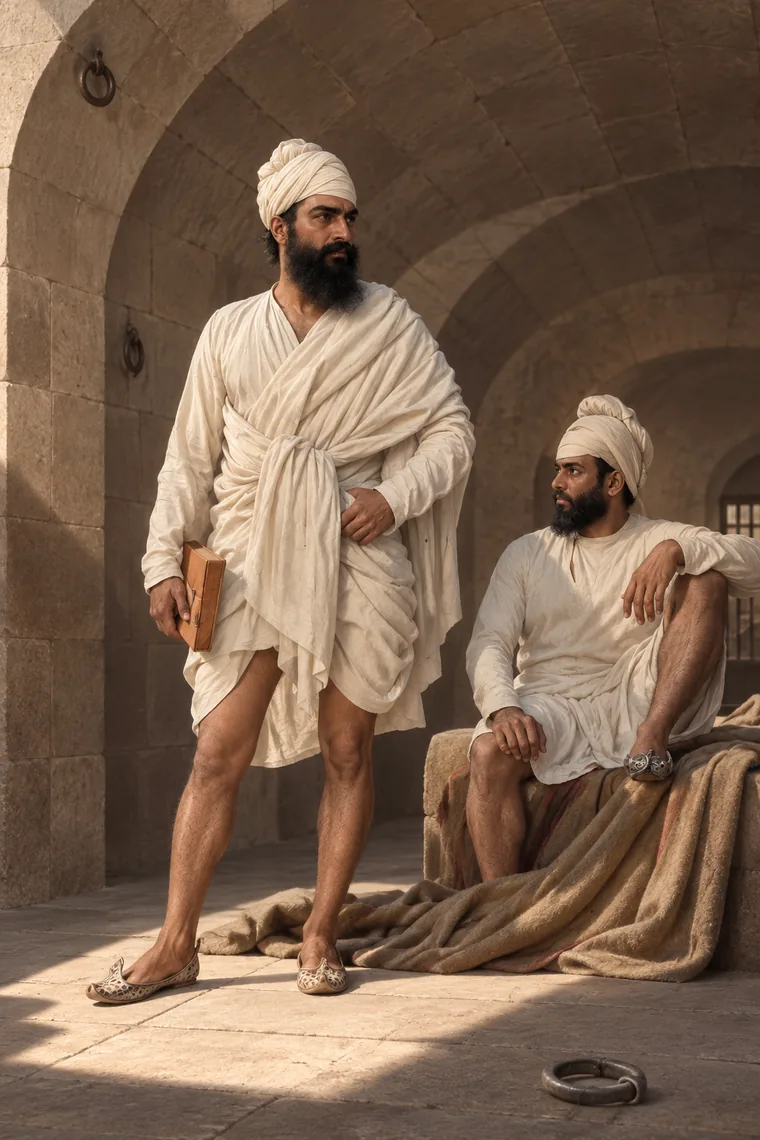
Two Sikh prisoners in white in the vaulted stone corridor of a colonial jail, one standing with a book, one seated

Outram Road, SingaporeBhai Maharaj Singh and his companion Kharak Singh, deported for life in 1850. Reconstruction created for this site, after the photograph made of Bhai Maharaj Singh in captivity. The Kharak Singh here is the disciple who went with him into exile — not Maharaja Kharak Singh, Ranjit Singh's son, who had died at Lahore ten years earlier.

VII  ·  Limits

What the Evidence Will Not Carry

Four claims recur in the literature and on parts of this site, and each is weaker than the argument it is used to support. Stating the limits here is not a retreat from the charge. It is what allows the charge to be pressed hard everywhere else.

The sand in the ammunition boxes. That the Khalsa's artillery failed at Sobraon after devastating the British at Mudki and Ferozeshah is agreed. That the boxes had been packed with sand on Tej Singh's personal order comes through the tradition consolidated by Sohan Singh Seetal rather than from a contemporary file. It may well be true. It is not the same kind of fact as Lal Singh's correspondence, and this site should stop presenting the two in the same register.

The bridge at Sobraon. Likewise. The bridge failed and thousands drowned; that much is in the British accounts of the field. The deliberate weakening of the central section is the traditional explanation, and a plausible one. It is not documentary.

Jind Kaur. The charge that the regent was party to the betrayal reaches her by way of rumour about a personal relationship with Lal Singh, and by no evidence at all that she knew of the correspondence. Eleven weeks before the war the same army had speared her brother to death in front of her. The Maharani Jind Kaur page sets out the audit in full; the conclusion there is that failing to control a catastrophe is not the same offence as designing one.

The Dogras at Jamrud, 1837. The claim that Dhian Singh's faction engineered the death of Hari Singh Nalwa by withholding reinforcements is repeated confidently and rests on a chronology that does not hold up well under pressure. It is not used on this page.

What survives all four qualifications is still severe, and it is worth restating plainly. The wazir of the Punjab was in written communication with the enemy before the first engagement. The commander-in-chief withdrew a fresh division at the moment the British army was closest to destruction. Both were rewarded by the victors within eighteen months. A third man declined to fight on either side and was sold a kingdom. None of that requires Seetal, or tradition, or inference. It is in the record of the people who benefited.

Sources

Sources and Further Reading

  1. Sohan Singh Seetal. Sikh Raj kiven Gia and the associated volumes on the fall of the kingdom. The fullest account in the tradition, and the source of the Nicholson correspondence as quoted, of the bridge and ammunition claims, and of the Sobraon narrative used throughout this site.
  2. Ganda Singh. Some New Light on the Treaty of Bhairowal: Private Letters of Sir Henry Hardinge. Punjabi University, Patiala, 1970. For the settlement and the machinery by which the rewards of 1846–47 were distributed.
  3. Treaty of Lahore, 9 March 1846, and Treaty of Amritsar, 16 March 1846. The two instruments that transferred Kashmir; the second names the sum of seventy-five lakh.
  4. Lepel H. Griffin. The Rajas of the Punjab. Lahore, 1870. Compiled from Company records; the standard source for the Cis-Sutlej chiefs, the Ladwa confiscation and the grants made after 1846.
  5. Despatch of the Governor-General to London, 17 November 1846, on the conduct of the Raja of Ladwa. Quoted in the Ladwa literature and summarised in the Tribune, 17 November 2018.
  6. Harbans Singh (ed.). The Encyclopaedia of Sikhism. Punjabi University, Patiala. Entries for Lal Singh, Tej Singh, Ajit Singh of Ladwa and Bhai Maharaj Singh.
  7. Secret Consultation Papers, Government of India, 28 February 1851, nos. 52–57 — the file on the condition of Bhai Maharaj Singh's cell at Outram Road, including the walling-up of the windows.
  8. M. L. Ahluwalia. Bhai Maharaj Singh. The standard study of the resistance of 1847–49, the arrest at Adampur and the Singapore imprisonment.
  9. Nahar Singh (ed.), documents on Bhai Maharaj Singh in the Punjab Government Records; and the Singapore Sikh community's own published account of the Silat Road memorial. Note that the date of arrival at Singapore is given variously as 9 June and 9 July 1850 in the secondary literature.
  10. Sohan Lal Suri. Umdat-ut-Tawarikh, Daftars III–V. The Darbar's own chronicle for the wazirates of Dhian Singh, Hira Singh and Jawahar Singh; discussed on this site's Umdat-ut-Tawarikh page.
  11. Herrli, Hans. The Coins of the Sikhs. 2nd revised edition, New Delhi, 2004; and Sidhu & Sidhu, Coins of the Sikh Empire, Punjab and the Cis-Sutlej States, Spink, 2022. For the mint outcomes tabulated in section IV.
  12. Lahore Political Diaries, 1846–1849. For the Nanakshahi recoinage order and the approach to Gulab Singh over the Kashmir mint.
Portraits. No photograph or contemporary likeness taken from life is known for most of the men on this page. The images here are digital reconstructions created for this site, worked up from the Pahari, Sikh and Company-school portrait traditions in which these figures were painted. The single exception is Bhai Maharaj Singh, whose image derives from the photograph made of him in captivity at Singapore. Each caption states which case applies.