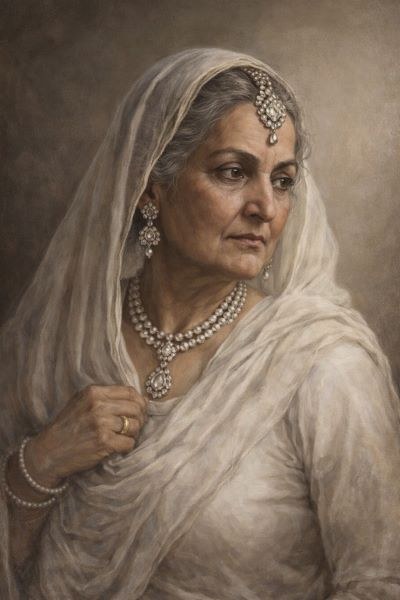
Sardarni Sada Kaur
She married her only daughter to the son of the man whose army had killed her husband, and by doing so built the Sikh Empire. Then she led half the assault that took Lahore — and died in confinement, dispossessed by the state she had made possible.
Chief of the Kanhaiya Misl · Eight Thousand Horsec. 1762 – December 1832
I · Introduction
The Leaf on Every Coin
Every coin struck by the Sikh Empire between 1799 and 1849 carries a small leaf. It appears on the rupees of Lahore from VS 1856 and on the Amritsar Nanakshahis shortly after; it identifies the uniform Khalsa coinage that Ranjit Singh re-established; and it was inherited by all four of his successors without alteration until the mints closed. It is the single most recognisable feature of the imperial series — the thing that tells you, at a glance, which side of 1799 a coin belongs to.
VS 1856 is AD 1799, and the reason the mark begins in that year is that Lahore was taken on 7 July 1799. That assault was made under joint command. Ranjit Singh, then eighteen, entered the city by the Lohari gate. Sada Kaur, chief of the Kanhaiya misl and his mother-in-law, entered by the Delhi gate at the head of her own troops.
This series admits a figure when something in the coinage changed and that person is a documented part of the reason. Sada Kaur passes that test more directly than almost anyone in it. She did not design a coin or authorise a legend. She commanded half the force that captured the city whose conquest the mark commemorates.
II · Origins
Achal, February 1785
Sardarni Sada Kaur
b. c. 1762 · d. December 1832, in confinement at Lahore
- Father
- Sardar Dasaundha Singh — Gill in some sources, Dhaliwal in others
- Birthplace
- Usually given as Rauke Kalan, in the Moga tract
- Married
- Gurbaksh Singh Kanhaiya, 1768, as a child
- Widowed
- February 1785, at Achal near Batala
- Daughter
- Mehtab Kaur, b. 1782 — her only child
- Chief of the misl
- From 1789, on the death of Jai Singh Kanhaiya
- Force
- Some 8,000 cavalry
- Seats
- Sohian, then Batala
- Grandsons
- Sher Singh and Tara Singh, twins, b. 4 December 1807 at Batala
- Dispossessed
- 1821; the Kanhaiya territories absorbed by Lahore
She was born about 1762 and married into the Kanhaiyas as a child, in 1768. Her husband Gurbaksh Singh was the heir of Jai Singh Kanhaiya, chief of what was then arguably the strongest misl in the Punjab — the house that had displaced the Bhangis at the head of the confederacy.
In February 1785 that position collapsed. Maha Singh Sukerchakia, allied with Jassa Singh Ramgarhia and Sansar Chand Katoch, attacked the Kanhaiyas at Achal, some six kilometres south of Batala. Jai Singh was defeated. Gurbaksh Singh was killed. Sada Kaur, by the account preserved in the tradition, escaped capture only by getting away in disguise to the fort at Sohian.
She was about twenty-three, a widow with one daughter and no son, in a confederacy where authority rested on force and reputation and where a defeated house was expected to be eaten by its neighbours. What she did next is the reason this page exists.
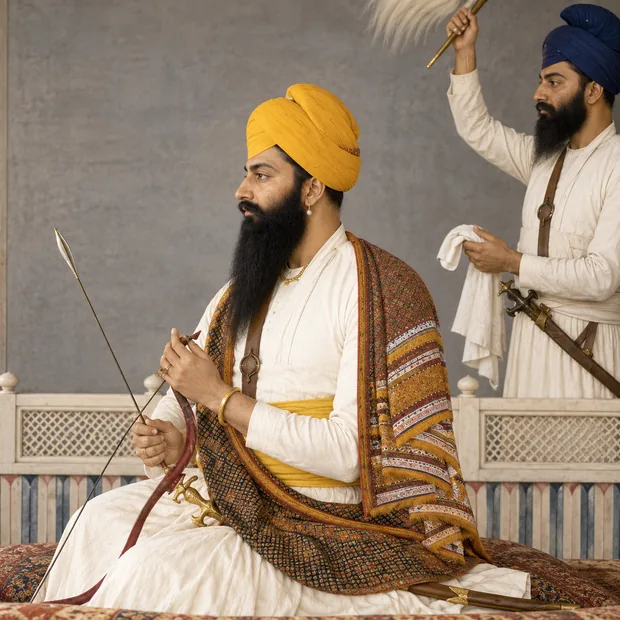
Gurbaksh Singh KanhaiyaHer husband, heir of the Kanhaiya misl, killed at Achal in February 1785 — by an arrow, according to the account of the engagement. Digital art created for this site, following the composition of the miniature of him made in the family atelier of Purkhu of Kangra about the year he died.
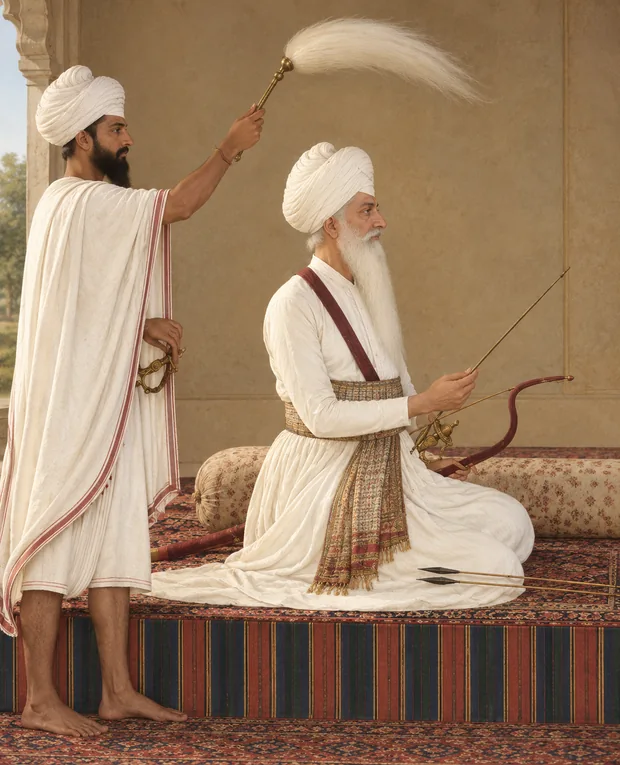
Jai Singh KanhaiyaHer father-in-law, founder of the misl and the man she had to persuade. He was wounded at Achal, survived his son by four years, and died in 1789 — leaving the confederacy to his widowed daughter-in-law. Digital art in the same tradition.
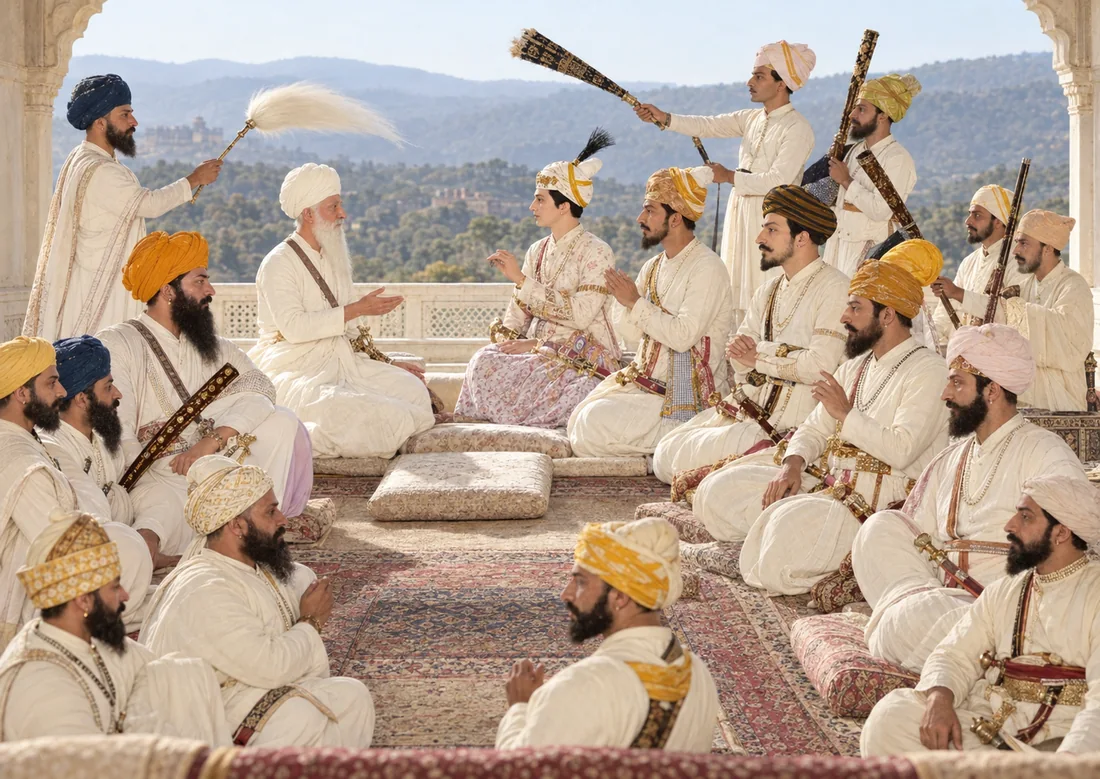
Plate · The Kanhaiya sardar and the hill chiefsJai Singh Kanhaiya in council with the hill rajas under Sansar Chand Katoch of Kangra. The alliance behind this scene is what destroyed him. In 1782 Sansar Chand asked Kanhaiya help to recover Kangra fort from its Mughal garrison; Jai Singh sent Gurbaksh Singh, who took the fort — and then kept it for the Kanhaiyas rather than handing it to the Raja. Within three years Sansar Chand had joined Maha Singh Sukerchakia and Jassa Singh Ramgarhia, and the coalition marched on Batala. Digital art created for this site.
III · The Decision
A Marriage Into the Family That Killed Her Husband
The conventional response to Achal was a blood feud. The Kanhaiyas had the men for one, and the whole logic of misl politics pointed that way.
Sada Kaur went to her father-in-law and proposed the opposite. Her daughter Mehtab Kaur, then a small child, should be betrothed to Ranjit Singh — the son of Maha Singh Sukerchakia, the commander whose army had just killed her husband. Jai Singh refused. She persuaded him. The betrothal was made, and the marriage followed; the muklawa, when the bride actually joined her husband’s household, took place in 1796.
Reduce it to its parts and the calculation is cold and completely correct. A feud with the Sukerchakias would consume the Kanhaiya misl’s strength against the one rival capable of matching it. An alliance would convert that rival into a partner, and would place a Kanhaiya woman — her own daughter — at the centre of whatever the Sukerchakias became. She had no son to inherit and no husband to fight for her. She had a daughter, eight thousand horse, and an eye for where power was going to sit.
It is worth pausing on how unusual that is. The misl period produced no other woman who commanded a confederacy in her own name for three decades. She did it from a position of defeat, having been widowed by the very alliance she then joined.
IV · Lahore
7 July 1799, and Two Gates
By the late 1790s Lahore was held by the Bhangi sardars and badly governed, and a body of its citizens appealed to the Sukerchakia chief to relieve them of it. The tradition credits Sada Kaur with the strategic judgement that settled the matter — that whoever held Lahore held the Punjab. Ranjit Singh was eighteen and had never taken a capital.
The city fell on 7 July 1799 to a joint force. The detail preserved in the accounts is the one worth keeping: the two commanders went in through different gates, Ranjit Singh at the Lohari and Sada Kaur at the Delhi. It was not a case of an ally lending troops. It was two chiefs dividing an assault between them.
Lahore had been a mint town since the Ghaznavids. From VS 1856 — the year of the conquest — Ranjit Singh introduced the leaf mark that identifies the resumed uniform Khalsa coinage, first on the Lahore rupees and shortly afterwards on the Amritsar Nanakshahis. Every one of his successors inherited it unchanged, down to the last issues before annexation. Fifty years of imperial coinage carry a mark dated from a city taken by two commanders, one of whom was Sada Kaur. See The Sikh Empire for the mints and the mark.
Two years later, on 11 April 1801, Ranjit Singh assumed the title of Maharaja. The Kanhaiya misl is conventionally dated as merging into the Sikh Empire in that same year — though Sada Kaur in fact retained most of her estates and her independent command for another two decades, which is one of several places where the tidy chronology and the actual position diverge.
V · The Campaigns
Twenty Years in the Field
The alliance did not end at Lahore. The sources place her with the army, at the head of her own contingent, through the campaigns that turned a captured capital into a state: Amritsar, Chiniot, Kasur, Kangra, and the expeditions against Attock and into Hazara. She stood with Ranjit Singh at the confrontation at Bhasin in 1800, where her cavalry decided a difficult engagement.
Amritsar matters most for this site. When the city passed out of Bhangi hands and into Ranjit Singh’s, the empire acquired the mint that would strike the Nanakshahi rupee — the central coinage of the whole Sikh series, and the one whose weight standard held from VS 1856 to the end. Between Lahore and Amritsar, the two mints that carried the empire’s money were both taken in campaigns she fought in.
What she never acquired was a coinage of her own. The Kanhaiya misl struck no coins in its own name; almost none of the misls did, because the Sikh convention gave the legend to the Gurus and left no room for a chief’s name. Her military weight is therefore invisible in the metal in the ordinary way, and legible only in the way this page has traced — through what the campaigns produced.
VI · The Break
Dispossession, 1821
The alliance decayed slowly and then all at once. The accounts offer several causes and they are not mutually exclusive: her disapproval of the Maharaja’s later marriages; the cooling of his interest in Mehtab Kaur, who bore him three sons but whose marriage the chronicles never describe as a warm one; and, underneath all of it, the simple arithmetic that an independent misl commanding eight thousand horse inside a consolidating empire is an anomaly the empire will eventually resolve.
Mehtab Kaur died in 1813, and with her went the personal thread that had held the arrangement together. Sada Kaur’s standing at Lahore thinned through the following years. In 1821 the break was complete: her territories were taken into the Lahore administration and she was placed under restraint. She spent the last decade of her life in confinement and died there in December 1832, aged about seventy.
VII · The Grandsons
What She Was Playing For
Her project in the last two decades was dynastic, and it is usually missed because it did not succeed in her lifetime. Mehtab Kaur bore Ranjit Singh two sons who survived, Sher Singh and Tara Singh, twins, born on 4 December 1807 — at Batala, the Kanhaiya seat, not at Lahore. They were Kanhaiya on their mother’s side, and they were Sada Kaur’s grandsons. Placing one of them in the succession would have made the alliance of 1786 permanent, and the Kanhaiya line the line of the empire.
She died in 1832 having failed. Nine years later, in 1841, Sher Singh became Maharaja of the Punjab.
Tara Singh got nothing. He was kept from the court, given no office of profit or honour, and dismissed in the British accounts in terms that say more about their authors than about him; he lived until 1859 and died at Dasuya in the Hoshiarpur tract. Both twins were also the subject of persistent rumours at Lahore that they were not Ranjit Singh’s sons at all. Those stories are unprovable and were useful to people who wanted them true — but they are worth recording, because a whisper of that kind was itself a weapon against exactly the succession Sada Kaur was working for.
Sher Singh is one of the few figures in this series whose personal policy is legible in a coin’s weight. As governor of Kashmir he struck the VS 1889 issue calibrated not to the Lahore standard but to the Afghan trade weight — a deliberate choice about which corridor the province’s silver was meant to serve. He reigned for two years and was murdered in September 1843. See Coin, Commerce & Control and The Fall of the Sikh Empire.
So the arc closes with an irony she did not live to see. The woman dispossessed in 1821 for being an inconvenient survivor of the misl era had a grandson on the throne within a decade of her death — and he held it for two years before the same court politics that had consumed her killed him.
VIII · What She Left
The Misl That Vanished Into the Empire It Built
Set her beside the other figures published in this series and the shape of her case is unusual. Fateh Singh Ahluwalia got his house named on a coin and his state survived to 1948. Hari Singh Nalwa got a province’s currency named after him in the bazaar. Sada Kaur got neither, and the difference is not a measure of her importance. It is a measure of how completely the thing she built absorbed the thing she came from.
The Kanhaiya misl merged into the Sikh Empire and left no coinage, no separate weight standard, no mint mark of its own. What it left instead is the mark on everybody else’s coins — the leaf that dates from the capture of Lahore, and that a numismatist uses every day to sort an imperial rupee from a misl-period one. The line that divides the two eras in a coin tray was drawn on 7 July 1799 by two commanders entering a city through two gates, and only one of them is usually named.
She is treated at greater length among the other women of the court in Women of the Lahore Darbar, from which this study is expanded.
Sources
Sources and Further Reading
- Harbans Singh (ed.). The Encyclopaedia of Sikhism. Punjabi University, Patiala. The standard entry, and the source for Achal, the betrothal, the joint capture of Lahore and the death in confinement in December 1832.
- Sohan Lal Suri. Umdat-ut-Tawarikh. Lahore, 1885–89. The Darbar’s own chronicle; discussed on this site at Umdat-ut-Tawarikh.
- Lepel H. Griffin. Ranjit Singh. Oxford, 1905.
- Khushwant Singh. A History of the Sikhs, vol. I. Princeton, 1963.
- Priya Atwal. Royals and Rebels: The Rise and Fall of the Sikh Empire. Hurst, 2020. The most useful recent reassessment of the women of the Sikh court and of the dynastic politics behind the succession.
- On the coinage see this site’s pages on the Sikh Empire, the misl period and coin, commerce and control.