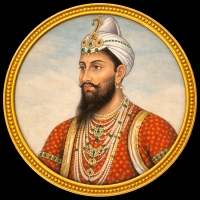
Maharaja Kharak Singh
The armies that took Multan and Kashmir marched in his name, and two mints entered the empire with them. Twenty years later he succeeded his father, watched his favourite killed in front of him within four months, and spent the rest of a sixteen-month reign as a sovereign in name, while the coins went on recording his years.
Tikka Kanwar · Multan VS 1875 · Kashmir VS 1876 · Maharaja VS 1896–189722 February 1801 – 5 November 1840
I · The Premise
A Name at the Head of the Army
He is usually remembered by one sentence, the one The Fall of the Sikh Empire gives him: mild, pious, and unsuited to the role his father had created. That sentence describes the sixteen months of his reign. It leaves out the twenty years before them, when the heir apparent’s name stood at the head of the expeditions that made the empire’s frontier, and two of those expeditions brought mints.
That is his claim under the first test of this series, set out on the Personalities index. Multan fell in 1818 to an army under his command, and the Sikh rupee of Dar-ul-Aman Multan begins in VS 1875. Kashmir fell in 1819 to a campaign in which he led a division, and the Kashmir rupee begins in VS 1876. Who actually directed those campaigns is a fair question, and it is answered below. The second question is the one the index asks of his reign: what, if anything, changed at the mints while the nominal ruler was under restraint, and who was authorising the dies.
Maharaja Kharak Singh
b. 22 February 1801, Lahore · d. 5 November 1840, Lahore
- Father
- Maharaja Ranjit Singh; eldest son
- Mother
- Datar Kaur, the Nakain, of the Nakai misl; principal wife
- Rank
- Tikka Kanwar, heir apparent, from childhood
- Married
- Chand Kaur, of the Kanhaiya family, 1812
- Son
- Kanwar Nau Nihal Singh, b. 1821
- Commands
- Sheikhupura 1807; the hills, Bhimber and Rajauri, c. 1812; Multan 1818; Kashmir 1819
- Succeeded
- 27 June 1839; installed 1 September 1839, VS 1896
- Wazir
- Raja Dhian Singh
- Reign
- VS 1896–1897
- Died
- 5 November 1840, Lahore, aged thirty-nine
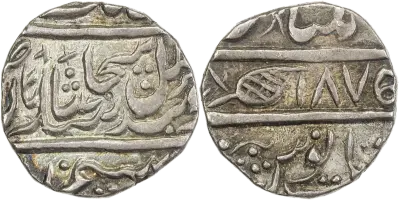
The rupee beside this paragraph was struck at Multan in the year the city fell. Its legend names Guru Nanak and Guru Gobind Singh; its reverse names the city, “the Abode of Peace”. It does not name the prince whose army took it, any more than it names his father. That is the Sikh rule, and it is why a commander’s place in numismatic history has to be argued from dates and campaigns, not read off the coin.
The page runs in order: the heir and his first commands, Multan, Kashmir, the long gap, the taking of the throne, the coins of his reign, and its end.
II · 1801 – 1812
The Heir and His First Commands
He was born at Lahore on 22 February 1801, seven weeks before his father was proclaimed Maharaja at the Baisakhi of that year. His mother was Datar Kaur, the Nakain, daughter of the Nakai chief and the wife who held the highest rank in the zenana throughout the reign. He was the Tikka, the heir apparent, from the start, and was given commands as soon as he could sit a horse.
The first was nominal. In 1807, at the age of six, he was placed at the head of the force that took the fort of Sheikhupura, and the place was afterwards held in his name. Around 1812 he was sent with a force into the hills against Bhimber and Rajauri, the approaches to Kashmir that would matter seven years later, and Jammu was assigned to him in jagir before it passed to the Dogra brothers.
In 1812 he married Chand Kaur, daughter of Sardar Jaimal Singh of the Kanhaiya family. The wedding was the great state occasion of those years. The chiefs and troops of the procession were ordered out in rich dress and plumes; it carried a moving throne and a model of the Shalimar Gardens borne by about a hundred men, and the groom’s mother rode in a jewelled chariot under a crown. Invitations went to the Governor-General; the Cis-Sutlej rajas of Patiala, Nabha, Jind and Kaithal came, and so did Raja Sansar Chand of Kangra. Chand Kaur bore his only son, Nau Nihal Singh, in 1821.
III · VS 1875 · 1818
Multan
Multan had resisted the Lahore Darbar for more than a decade. Its Afghan governor, Nawab Muzaffar Khan, had bought off one expedition after another with tribute, and the citadel had defeated six attempts on it. In early 1818 Ranjit Singh sent a seventh, and put his son at its head. The army was commanded in the field by Misr Diwan Chand, the artillery officer who had risen from a clerk’s post to be the Darbar’s best general, and it brought up the great Durrani gun, the Zamzama, for the siege.
The city fell first. The citadel held out for weeks under bombardment, and on 2 June 1818 it was stormed. Muzaffar Khan was killed in the gateway with his sons. Multan passed to the Sikh state for good, and from 1821 was governed by Diwan Sawan Mal for nearly a quarter of a century.
The Sikh mint of Multan struck its first rupees in VS 1875, the year of the conquest, on the Nanakshahi couplet of Lahore and Amritsar, with Zarb Dar-ul-Aman Multan on the reverse. It was not a frontier coinage on a foreign standard but the Punjab’s own rupee, struck on the trade route to Sindh. The mint’s last Sikh coins were Diwan Mulraj’s gold, struck inside the same citadel under siege thirty years later, in VS 1905; they are at The Second Anglo-Sikh War.
IV · VS 1876 · 1819
Kashmir
A year later the same partnership went into the mountains. The Kashmir expedition of 1819 moved in divisions through the Pir Panjal passes: Misr Diwan Chand led the vanguard, Kharak Singh commanded the second division behind it, and Ranjit Singh held the reserve on the plains with the supplies. The road ran through Bhimber and Rajauri, the country Kharak Singh had campaigned in as a boy.
The Afghan governor, Jabbar Khan, met the vanguard at Supin on 3 July 1819 and was beaten. Srinagar was entered on 5 July. The valley had been Durrani since 1752; it now became the Sikh state’s richest province, for its shawls and its saffron.
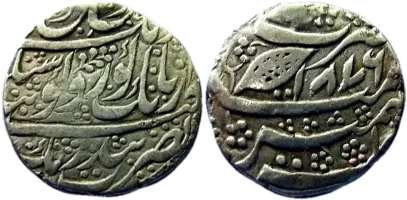
The Sikh Kashmir rupee begins in VS 1876. Unlike Multan’s, it carried the Gobindshahi couplet, Deg o Tegh o Fateh, and became a series of its own, on which each of the valley’s twelve Sikh governors left a mark. Its later history, including Hari Singh Nalwa’s rupee and Sher Singh’s light issue of VS 1889, is told on their pages.
After Kashmir he held no comparable command. The frontier campaigns of the 1820s and 1830s went to Hari Singh Nalwa, Ventura and the Fauj-i-Ain, and when Peshawar was taken in 1834 the army went out in the name of the next heir, Kharak Singh’s own son. Whatever the court thought of the father, the pattern of the commands says what Ranjit Singh thought of the grandson.
V · June – October 1839
Taking the Throne, and Losing It
His succession was obvious and was never formally settled until the end. Ranjit Singh named him only on his deathbed, and confirmed Raja Dhian Singh as wazir to the new Maharaja. On 27 June 1839 his father died, and on 1 September 1839, the 18th of Bhadon VS 1896, he was installed as Maharaja at Lahore.
He did not want Dhian Singh. The man he trusted was his old companion Sardar Chet Singh Bajwa, and within weeks Chet Singh was the real power at court. Stories spread, put about by those who wanted him gone, that Chet Singh meant to dismiss the Dogra ministers and place the Punjab under British protection. Nau Nihal Singh, back from the Peshawar frontier, was drawn to the Dogras’ side.
Before dawn on 9 October 1839 Dhian Singh, with his brothers and a party of sardars, and with the prince’s agreement, entered the palace in the Lahore Fort. The Maharaja tried to shield his favourite; Chet Singh was cut down in his presence. From that morning Kharak Singh was Maharaja in name. His son governed, and he was kept under watch in his own palace.
The killing of Chet Singh, its place, the men who did it and the Maharaja’s presence are in every account. The charge that Kharak Singh and Chet Singh were about to hand the state to the Company is not: it is the case his enemies made for removing him, and no document from the British side shows such an offer. The charge sheet against the Dogra ministers, graded charge by charge, is at Betrayal and Reward.
VI · VS 1896 – 1897
The Coins of His Reign
The coins of his reign are dated to his years and look exactly like his father’s. Lahore and Amritsar went on striking the Nanakshahi couplet with the leaf; Multan, Kashmir, Peshawar and the Derajat went on with their own standards and couplets. A rupee of VS 1897 is indistinguishable in kind from a rupee of VS 1890, and none of them carries his name. Nothing in the legends records the killing in the palace, the change of government, or that the Maharaja whose years they counted no longer ruled.
One small thing did change. In the Amritsar mint’s fourth series a new mark appears in VS 1896, which in the Kartik reckoning began on 7 November 1839, a month after Chet Singh’s death: the Devnagri Om. It runs on into VS 1897, and so begins under Kharak Singh and his son, not under Sher Singh, to whom it is usually given. Confined to one series, and common to every Hindu tradition, it reads most simply as an invocation chosen at the mint. Whether anyone at court chose it is not recorded. The mark is set out with Herrli’s tables at Marks on the Mint.
VII · 5 November 1840
The End of the Reign
He declined through 1840. Several accounts attribute the illness to slow poisoning, and name the poisons; none of them demonstrates it, and this page does not treat it as established. He died at Lahore on the morning of 5 November 1840, aged thirty-nine. His son attended the cremation and, walking back into the fort, was struck by the falling masonry of the Roshnai Gate and died the same day. That death is examined at Kunwar Nau Nihal Singh.
His widow did not accept the result. Chand Kaur was proclaimed Maharani on 2 December 1840, and held the Lahore Fort against Sher Singh until the siege of January 1841, told at Maharaja Sher Singh. She was killed in her palace in June 1842. Kharak Singh’s samadhi stands beside his father’s at Lahore.
Sources
Sources and Further Reading
- Sohan Lal Suri. Umdat-ut-Tawarikh, Daftars II and IV. Trans. V. S. Suri. GNDU, Amritsar, 2002. The court chronicle for the campaigns of 1818–19 and for the reign of 1839–40. Discussed at Umdat-ut-Tawarikh.
- Diwan Amar Nath. Zafarnama-i-Ranjit Singh. Ed. Sita Ram Kohli. Punjab University, Lahore, 1928. For the Multan and Kashmir expeditions, by a court official.
- The Encyclopaedia of Sikhism, ed. Harbans Singh. Punjabi University, Patiala. Entries on Kharak Singh, Chet Singh Bajwa and Misr Diwan Chand.
- Ganda Singh (ed.). The Panjab in 1839–40. The Punjab Akhbarat for the first months of the reign.
- G. Carmichael Smyth. A History of the Reigning Family of Lahore. Calcutta, 1847. The fullest early English narrative of 1839–40, written by a hostile author between the wars.
- Khushwant Singh. Ranjit Singh: Maharaja of the Punjab. London, 1962; and A History of the Sikhs, vol. 2. For the Multan and Kashmir campaigns and the Chet Singh affair.
- Nadhra Shahbaz Naeem. “Life at the Lahore Darbār: 1799–1839.” South Asian Studies 25:2 (2010), pp. 283–301. For the wedding procession of 1812, from Suri.
- Patwant Singh and Jyoti M. Rai. Empire of the Sikhs. London, 2008. For the guests at the wedding.
- Hans Herrli. The Coins of the Sikhs. 2nd ed. Munshiram Manoharlal, New Delhi, 2004. For the Multan and Kashmir series and the Amritsar marks of VS 1896–1897.
- On this site: Maharaja Ranjit Singh, Kunwar Nau Nihal Singh, Maharaja Sher Singh, The Sikh Empire, The Fall of the Sikh Empire, Betrayal and Reward and Marks on the Mint.