Maharaja Sher Singh
He is the one successor whose policy can be read in the metal. As governor of Kashmir he struck a rupee at the Afghan trade weight instead of the Lahore standard; as Maharaja he took the throne by laying siege to his own capital, held it for two years and eight months, and lost it to a rifle offered for inspection at a review of troops.
Governor of Kashmir · VS 1888–1891 · Maharaja · VS 1898–19004 December 1807 – 15 September 1843
I · The Premise
A Policy You Can Weigh
The rule of admission to this series, set out on the Personalities index, is that something in the coinage changed and the subject is a documented part of the reason. The study of Nau Nihal Singh had to argue the opposite case: a ruler who leaves no mark on any coin. Sher Singh is the case that needs no such argument, and it is the reason he is here.
Before he held any throne, he governed a province, and the province’s mint recorded what he did with it. The Kashmir rupees of VS 1889 weigh between 8.38 and 8.40 grams. The Lahore standard is about eleven. On the reading set out at Coin, Commerce & Control, that gap is neither wear nor fraud. It is the weight of the Peshawar trade corridor, and a governor chose it.
The rest of his life is the usual material of this decade: a succession won by force, a throne held for under three years, and a coinage that names nobody throughout. It is also, of the three succession deaths, the one with the clearest record, and the one most often folded into a charge against the wrong men. Both matters are taken in turn below, after the coin.
Maharaja Sher Singh
b. 4 December 1807, Batala · d. 15 September 1843, Lahore
- Father
- Maharaja Ranjit Singh
- Mother
- Maharani Mehtab Kaur of the Kanhaiya misl, daughter of Sada Kaur
- Birth
- Batala, the Kanhaiya seat, a twin with Tara Singh
- Kashmir
- Governor, VS 1888–1891 (to AD 1834)
- Frontier
- Campaigned on the Peshawar frontier under Hari Singh Nalwa
- Proclaimed
- 18 January 1841, after a siege of the Lahore Fort; anointed on 27 January
- Wazir
- Raja Dhian Singh, killed the same afternoon
- Reign
- VS 1898–1900
- Killed
- 15 September 1843, at the Shah Bilawal baradari, aged thirty-five
- Heir
- Tikka Partap Singh, killed with him at twelve
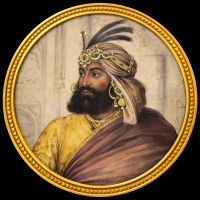
He is remembered for how he took the throne and how he lost it. The part of his life that can be put on a scale is earlier: a rupee struck in Kashmir in VS 1889, nine years before he was Maharaja, at a weight that says which road he thought the valley’s silver should travel.
The page runs in the order of the evidence rather than of his life: the coin first, then the birth that explains the politics, the siege that made him Maharaja, the two years he held the throne, and the afternoon it ended.
II · 1807
Born at Batala
Mehtab Kaur bore Ranjit Singh two sons who survived, Sher Singh and Tara Singh, twins, born on 4 December 1807 at Batala, the Kanhaiya seat, not at Lahore. They were Kanhaiya on their mother’s side and Sada Kaur’s grandsons. That fact explains more of the early story than any of his own acts does.
Sada Kaur’s project in her last two decades was dynastic. Placing one of the twins in the succession would have made the alliance of 1786 permanent, and the Kanhaiya line the line of the empire. She was dispossessed in 1821 and died in 1832, having failed. Nine years later, in 1841, her grandson became Maharaja of the Punjab. Tara Singh got nothing: he was kept from the court, given no office, and lived until 1859, dying at Dasuya. Her story is at Sada Kaur, and her daughter’s at The Women of the Lahore Darbar.
Both twins were also the subject of persistent rumours at Lahore that they were not Ranjit Singh’s sons at all. Those stories are unprovable, and were useful to people who wanted them true. They are recorded here because a whisper of that kind was itself a weapon against exactly the succession Sada Kaur was working for.
III · VS 1888 – 1891
Kashmir: A Governor’s Rupee
Kashmir was conquered in 1819 and struck on the Nanakshahi standard of Amritsar. Ranjit Singh appointed twelve governors at Srinagar over the twenty-seven years of Sikh rule, and each left a personal mark on the locally struck coin, which makes Kashmir numismatics a kind of biographical record of its administrators. Sher Singh’s mark is a tiger on the reverse: sher, in Persian, a lion or a tiger, a direct heraldic signature. The device is described at The Sikh Empire.
He governed from VS 1888 to VS 1891. The weights of the valley’s rupees under successive governors are these:
| Governor | Period | Weight | Reading |
|---|---|---|---|
| Diwan Moti Ram, Diwan Chuni Lal | VS 1881–1883 | 11.07 g | Amritsar standard |
| Kunwar Sher Singh | VS 1888–1891 (VS 1889 issue) | 8.38–8.40 g | Afghan trade weight; deliberate alignment |
| Mihan Singh Kumedan | VS 1892–1898 | 11.00 g | Standard restored |
| Bhima Singh | Later issues | 10.95–10.98 g | Within the Amritsar range |
The VS 1889 rupees are not merely light. They sit exactly on the Peshawar and Afghan commercial standard, which the Peshawar series itself settles into at 8.34 to 8.49 grams in VS 1892–1893. On the reading at Coin, Commerce & Control the coincidence is too exact to be accidental, and the identity of the governor is the interpretive key.
He had campaigned on the Peshawar frontier under Hari Singh Nalwa. His governorship ended in VS 1891, which is AD 1834, the very year the Sikh army under Nalwa and Prince Nau Nihal Singh annexed Peshawar, the city whose commercial weight his Kashmir coins had been reproducing for the two years before. He was minting to the standard of precisely the trade corridor the empire was about to absorb.
At Peshawar in VS 1894 three simultaneous standards reveal a mint under contested policy. At Kashmir in VS 1889 there is no contest: one weight, struck throughout the issue, exactly the Afghan commercial standard. As a statement of monetary policy the VS 1889 Kashmir rupee is more coherent than anything in the VS 1894 Peshawar sequence. And because Kashmir coins are not habitually found in hoards with Amritsar and other Punjab mint coins, an issue at the Afghan weight would have had a still stronger tendency to travel west.
The valley already had a tradition of below-standard rupees with recognised commercial identities. Baron Karl von Hügel, visiting Kashmir in 1835–36, in the immediate aftermath of Sher Singh’s governorship, found the Hari Singhee rupee still circulating at about ten mashas, itself in the eight to nine gram range. The VS 1889 issue fits within that tradition, and its precise weight gives it a more exact commercial logic than any earlier one.
IV · December 1840 – January 1841
The Siege of Lahore
When Nau Nihal Singh died on 5 November 1840 there was no adult heir in the direct line. His mother, Chand Kaur, was proclaimed Maharani on 2 December, and the next day Sher Singh left Lahore for his estate at Batala. Dhian Singh backed Sher Singh. Chand Kaur sent for Gulab Singh from Jammu to balance him. A compromise followed, under which she would act as regent for the child Nau Nihal Singh’s widow was expecting, and Sher Singh would act as vice-regent. Within a month it had collapsed, and Dhian Singh had been obliged to leave the capital.
Sher Singh still had the army. Most of the crack regiments had gone over to him, and so had the European officers. He arrived at Lahore at the head of a large force on 13 January 1841, and the Fort, held for the dowager, was besieged. The Spanish engineer officer the records call the Signor Colonel was first into the assaults; his career is at Foreign Officers. After two days of fighting, Dhian Singh arrived on the evening of 17 January and arranged a ceasefire. Chand Kaur accepted a pension and gave up her claim. Sher Singh was proclaimed Maharaja on 18 January 1841 and formally anointed on the 27th.
The last uncertainty went in July, when Nau Nihal Singh’s widow, Sahib Kaur, was delivered of a stillborn child. The Fall of the Sikh Empire calls him the Reluctant Maharaja. Whatever his temper, the siege shows a man prepared to fight for the throne, with a minister who decided the outcome.
That is the numismatic point of the episode, and it is the same as the last study’s. The Lahore and Amritsar legends continue unchanged under the new ruler; the dates move on through VS 1898, 1899 and 1900; the Gurus’ names stay where they were. A throne taken by siege and a throne inherited look identical in silver.
V · 1841 – 1843
Two Years and Eight Months
By the standard of the decade the reign was relatively stable until the end. The traces that survive of what the government actually did are few, and two of them matter here.
The first is diplomatic. In February 1843 a treaty with Dost Muhammad Khan was drawn up by Sher Singh with the advice of Raja Dhian Singh, Diwan Dina Nath, Fakir Aziz-ud-din and Sardar Sultan Muhammad Khan. The British Envoy, Mr Clerk, forwarded a copy sent to him “by a person about the Court of Lahore”, believed it genuine, and observed that it bound the two governments by a rope of sand.
The second is numismatic. Mehan Singh Kumedan, whose sword-and-shield mark identifies his Kashmir coins, held the province from 1834 until his death in 1841, and is described at The Sikh Empire as the best of the Sikh administrators there. The first Muslim governor of Kashmir, Shaikh Ghulam Muhyi-ud-Din, held it from about 1841 to 1845, which puts his appointment inside this reign. His coins carry the Persian letter shin. It is one of the few changes in the Kashmir series that falls within these years.
One event of the reign is argued over, and it belongs here because it concerns the man himself. Chand Kaur was killed in her own palace on 11 June 1842. Dhian Singh is the man widely held responsible. At least one modern account puts the instigation with Sher Singh. This page records the disagreement. Nothing in the sources it draws on resolves it.
VI · 15 September 1843
The Shah Bilawal Baradari: What the Accounts Record
On 15 September 1843 Sher Singh was reviewing troops at the Shah Bilawal baradari. Ajit Singh Sandhanwalia, of the Raja Sansi family and a kinsman of Ranjit Singh through the senior collateral branch, offered him an English rifle for his inspection, shot him with it, and took his head. Ajit Singh’s uncle, Lehna Singh, killed the heir apparent, Tikka Partap Singh, who was twelve, in a garden close by. The two heads were carried into the Fort together.
Inside the Fort the same afternoon, while the office of wazir was being divided up, Ajit Singh shot Dhian Singh. The Maharaja, his heir and his prime minister died in a single afternoon.
What the sources agree on. The date; the place; the killers, Ajit Singh and Lehna Singh Sandhanwalia; the three deaths; and what followed on the 16th. Hira Singh and Suchet Singh raised a part of the army, brought up Avitabile’s battalions and stormed the Fort. Both Sandhanwalias were dead within a day. Their bodies were quartered and displayed on the city gates, their estates confiscated, and the ancestral village at Raja Sansi ordered ploughed up, which was done. The same day Misr Beli Ram, keeper of the Toshakhana keys, and his brother Ram Kishan were put to death.
What they do not agree on. The motive, and how much of it was private. The Sandhanwalias were the faction that had backed Chand Kaur against Sher Singh, and Dhian Singh was the man who backed Sher Singh and who was widely held responsible for her murder the year before. That makes it, on the reading at Betrayal and Reward, a blood feud inside the Punjab about who should hold the Punjab.
What no source establishes. A British hand. The Sandhanwalias had earlier taken refuge in Company territory and returned under amnesty, and anyone building the case should say so. But a refuge is not an instruction, and nothing in the events of that afternoon served a British purpose that the Dogra ministry was not already serving better.
Of the three succession deaths, this is the one that is routinely folded into the indictment of the Dogra ministers, and it is the one they were victims of. Dhian Singh was killed by the same men, within hours, in the Fort. The charge sheet that grades each accusation separately is at Betrayal and Reward. Nau Nihal Singh’s death, which that ministry did benefit from, is treated at its own page.
VII · The Consequence
What Followed
Within days the five-year-old Duleep Singh was proclaimed, Hira Singh took the wazirate, and in the weeks after, Jind Kaur made herself regent by going to the regimental committees. The afternoon of 15 September shows what the decade had become. A faction could destroy a sovereign, his heir and his wazir in one afternoon, be extinguished itself the next, and the state went on. That, more than any single betrayal, is what explains the war.
For the mints the consequence is as quiet as it was in 1840. The rupees continue to be dated, to the Gurus’ couplet, under whichever name the regnal year belongs to, until the Lahore mints closed. The one thing Sher Singh did that changed what a coin was, he did nine years before he was Maharaja, in a province, at a weight. That is why this study begins there.
To follow in this strand: Maharaja Kharak Singh, sovereign for a year and a prisoner for most of it.
Sources
Sources and Further Reading
- Sohan Lal Suri. Umdat-ut-Tawarikh, Daftar IV. Trans. V. S. Suri. GNDU, Amritsar, 2002. The Darbar’s own chronicle for 1839–45, written by a man present at Lahore; the primary witness for the succession of 1841 and the death of 1843. Discussed at Umdat-ut-Tawarikh.
- Press Lists of Old Records in the Punjab Secretariat, Vol. VII. The abstracts for February–March 1843 concerning the treaty with Dost Muhammad Khan and Mr Clerk’s despatches.
- Baron Karl von Hügel. Travels in Kashmir and the Panjab. London, 1845. The traveller who saw the valley’s currency in 1835–36.
- B. J. Hasrat. “Sher Singh, Maharaja.” The Encyclopaedia of Sikhism. Punjabi University, Patiala. For the sequence of December 1840 to January 1841.
- Sohan Singh Seetal. On the assassination of 1843; cited at The Fall of the Sikh Empire.
- Hans Herrli. The Coins of the Sikhs. The standard catalogue, including the Kashmir series.
- On this site: Coin, Commerce & Control, The Sikh Empire, Sada Kaur, Foreign Officers, Betrayal and Reward, Kunwar Nau Nihal Singh and The Fall of the Sikh Empire.