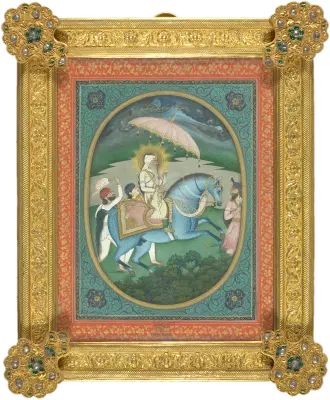
Maharaja Ranjit Singh
He ruled the Punjab for forty years, took its mints one by one from the Sutlej to the Khyber, and never put his name on a coin. The rupee he left was struck in the Gurus’ name to the end, and the few places where the man himself shows through the metal are the subject of this study.
Lahore · VS 1856 · Maharaja · VS 1858–189613 November 1780 – 27 June 1839
I · The Premise
In Whose Name Are the Coins Struck?
When Raja Dhian Singh once remonstrated with the Maharaja for dressing like a servant, Ranjit Singh answered with a question: in whose name were the coins struck? Dhian Singh named Guru Nanak. Then, said the Maharaja, the Guru was the ruler, and he was the Guru’s servant. The story is told by Bhagat Singh and repeated at The Sikh Empire, and whatever its exact words it states the rule his coinage kept.
That rule is the difficulty with putting him in this series. The test of admission, set out on the Personalities index, is that something in the coinage changed and the subject is a documented part of the reason. For most of the people here the change is one coin. For Ranjit Singh it is the coinage itself: the uniform Khalsa rupee he restored at Lahore, the leaf that marked it, the mints he took over and the standards he chose to leave alone at each. And against that, three places where the rule bent: a peacock, a portrait, and a canopy.
Maharaja Ranjit Singh
b. 13 November 1780 · d. 27 June 1839, Lahore
- Father
- Sardar Maha Singh, chief of the Sukerchakia misl (d. 1792)
- Mother
- Raj Kaur, daughter of Raja Gajpat Singh of Jind
- Lahore
- Taken 7 July 1799, VS 1856, with Sada Kaur
- Proclaimed
- 12 April 1801, Baisakhi, VS 1858
- Government
- Sarkar Khalsa; seal Akal Sahai Ranjit Singh
- Treaty
- Amritsar, 25 April 1809, with the East India Company
- Mints taken
- Lahore 1799, Amritsar 1805, Multan 1818, Kashmir 1819, the Derajat 1819–21, Peshawar 1834
- Sons
- Kharak Singh; Sher Singh and Tara Singh; Kashmira, Pashaura and Multana Singh; Duleep Singh
- Died
- 27 June 1839, Lahore, aged fifty-eight
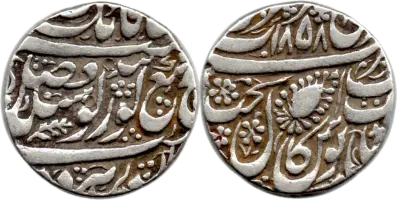
The coin beside this paragraph is the best short introduction to him. It is dated VS 1858, the year he was proclaimed Maharaja at Lahore, and it was struck at Amritsar, which was not yet his. The legend is the one his own mint used: Sikka zad bar Har do Alam, Tegh-i-Nanak wahib ast. Rival chiefs and the new Maharaja struck the same words, because the words belonged to neither.
The page follows the coinage through his life: the misl he inherited, the leaf at Lahore, the peacock at Amritsar, the mints of the frontier, the portrait that was struck and set aside, and the canopy that was held over him and later stood in for his heir.
II · 1780 – 1799
A Misl Chief at Twelve
He was born on 13 November 1780, the son of Maha Singh, chief of the Sukerchakia misl, whose lands lay between the Ravi and the Chenab with Gujranwala at their centre. Gujranwala is the usual birthplace given; a tradition places the birth at Budrukhan, his mother’s home in Jind. Smallpox in childhood cost him the sight of his left eye, which is why the court painters show him in profile from the right.
Maha Singh died in 1792. His widow, Raj Kaur, held the misl for a boy of twelve, and the decisive alliance of these years came from outside it. Sada Kaur, widow of the Kanhaiya heir Gurbakhsh Singh, had betrothed her daughter Mehtab Kaur to Ranjit Singh in 1786, joining the two strongest misls of the Bari Doab. Her cavalry, and her judgment, carried him to Lahore.
On 7 July 1799 the Sukerchakia and Kanhaiya forces entered Lahore and the Bhangi sardars who held it fled. The city had been a Sikh mint town since 1765. With the city came its mint.
III · VS 1856 – 1858
The Leaf, the Tilak and the Chair
From VS 1856, the year Lahore was taken, the Lahore rupees carry a small leaf in the field. It is the only mark that can be called his. It identified the uniform Khalsa coinage he resumed at the capital, it spread to the Amritsar Nanakshahis a little later, and every successor kept it unchanged. It bears no name and no title. As a personal signature it could hardly be more modest, and that is its point.
On 12 April 1801, the Baisakhi of VS 1858, Baba Sahib Singh Bedi marked his forehead with the tilak and he was proclaimed Maharaja of the Punjab. No crown was placed on his head. The government took the name Sarkar Khalsa, the court became the Darbar Khalsa, and the seal that authorised its orders read Akal Sahai Ranjit Singh, “the Timeless One is Ranjit Singh’s help”, in Gurmukhi.
He also refused the throne. The marble seat of the Mughal Diwan-i-Aam stood in the fort he now occupied; he would not use it, and sat instead on chairs of gold or silver, often cross-legged, as Emily Eden drew him. The gold chair now in the Victoria and Albert Museum is one of them.
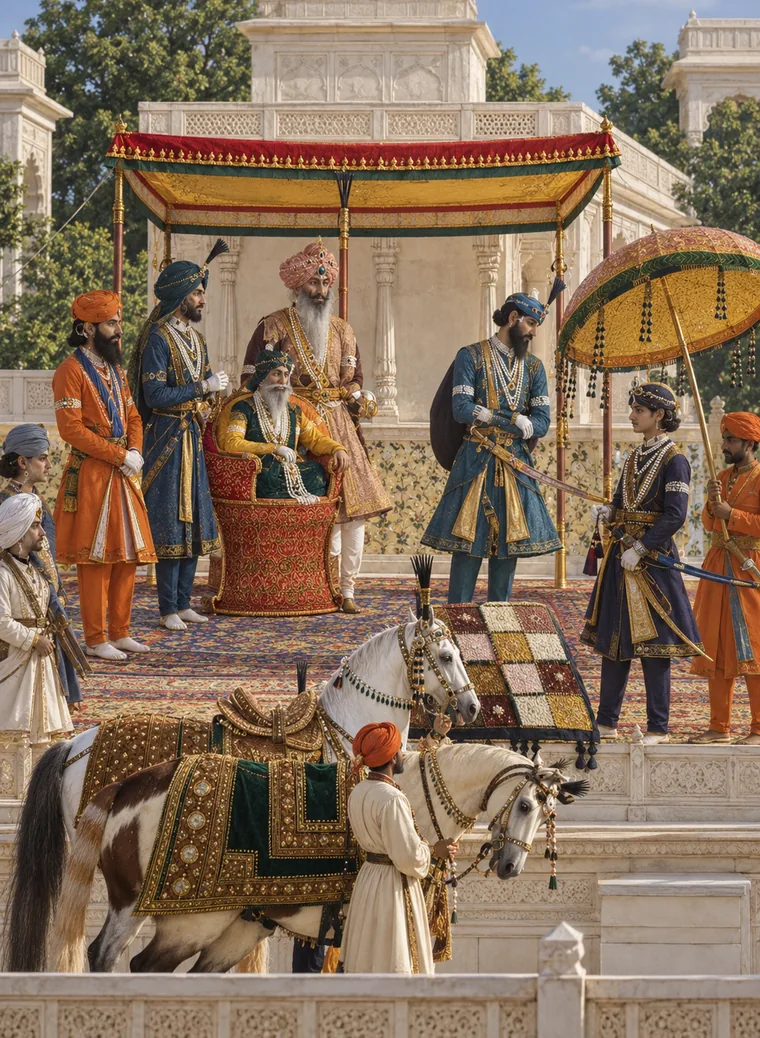
What he did not refuse was the canopy. The court chronicle records the chiefs of the darbar standing near the Maharaja’s canopy in order of rank, and the portrait at the head of this page, which he chose to give the Governor-General, shows a parasol held over him on horseback. The chattra was the one emblem of sovereignty he kept in the room. Four years after his death it appeared on the Amritsar rupee, set over the throne of his youngest son; that reading is graded and argued at Marks on the Mint.
IV · VS 1861 – 1868
The Peacock and the Akal Takht
The rule was broken once, and quietly. Between VS 1861 and VS 1868 the Amritsar mint set a peacock into the calligraphy of the Nanakshahi rupee, hidden in the letterforms where only those who knew would see it. Mor is the peacock; Moran was the Muslim dancer from Batala whom the Maharaja loved and married. The coins are the Morashahi rupees, and they are the only Sikh coins that commemorate a private person.
C. J. Rodgers made the connection in 1881. It has been disputed ever since: the sprig has been read as a Ber spray of the Harmandir precinct and as a mark inherited from the Bhangis. The case for the peacock, with the specimens, is set out at The Moranshahi Rupee, including a VS 1868 piece in which the peacock reappears beneath the name of Guru Gobind Singh in the year Moran left Lahore.
The marriage, and what the coins were taken to say, brought him before the Akal Takht. Its jathedar, Akali Phula Singh, called the Maharaja of the Punjab to account, and the Maharaja submitted. It is the one recorded occasion on which an authority within his own state judged his conduct and was obeyed, and the coins were part of what it judged.
V · 1805 – 1834
An Empire of Mints
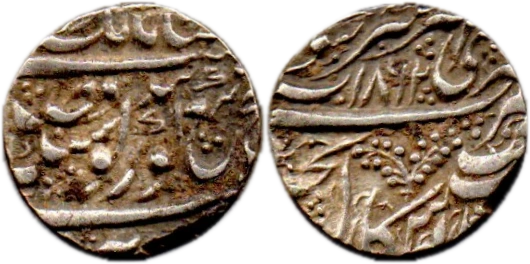
The Treaty of Amritsar of 25 April 1809 fixed the Sutlej as the limit of his ambitions to the east and left him free to the north and west. Every conquest after it brought a mint, and the way he treated those mints is the clearest evidence of his monetary policy. He did not make them uniform. Where a mint served the Punjab, it struck the Nanakshahi couplet to the Amritsar standard. Where it served a trade that ran west, it kept the Gobindshahi couplet and often a weight of its own.
| Mint | Taken | Couplet | Standard |
|---|---|---|---|
| Lahore | 1799 | Nanakshahi | The capital’s mint; the leaf from VS 1856 |
| Amritsar | 1805 | Nanakshahi | The standard rupee of the empire, about 11 g; Herrli estimates a million rupees a year |
| Multan | 1818 | Nanakshahi | The Nanakshahi rupee on the Sindh trade route |
| Kashmir | 1819 | Gobindshahi | A separate valley series, each governor’s mark on it; the Hari Singhee rupee |
| The Derajat | 1819–21 | Gobindshahi | The Indus crossings |
| Peshawar | 1834 | Gobindshahi | Settling to the Afghan trade weight, 8.34–8.49 g by VS 1892–93 |
The light rupees were not neglect. A Kashmir or Peshawar rupee at the Kabul weight bought silver into the empire from the west on terms the traders already used; an Amritsar rupee at eleven grams held the centre. The governors made their own contributions to this. Hari Singh Nalwa gave his name, in common speech, to a Kashmir rupee, and Sher Singh struck one at the Afghan weight in VS 1889. The analysis of the weights is at Coin, Commerce & Control.
Behind the mints stood the accounts. When Diwan Bhawani Das arrived from Kabul service in 1808 he found no regular treasury at Lahore. The twelve daftars he built recorded every rupee the state took in and paid out, and from about AD 1827 the Amritsar and Lahore rupees began to carry frozen reverse years, VS 1884 and 1885, with the real year in small numerals on the obverse. Herrli reads that as the visible sign of a mint reform. It came in the middle of the reign, and it outlived it by twenty years.
VI · The Exception That Was Set Aside
A Likeness, and a Disciple
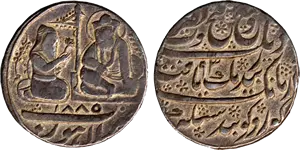
Twice the mints came close to putting a likeness on a Sikh rupee. Pattern rupees catalogued by Herrli as 08.12 and 08.13 show the ruler seated as a disciple before Guru Nanak. And for the wedding of his grandson Nau Nihal Singh in March 1837 the Lahore mint struck a presentation rupee with two seated figures on the obverse, catalogued at this site as VS 1885/93: one of very few Sikh rupees to carry a likeness.
On the patterns he is not the sovereign of the coin. He is the man before the Guru. And neither type entered the regular coinage. The patterns stayed patterns, and the wedding rupee was a gift for an occasion. What the mint did with the idea is as telling as the idea: it tried it, and set it aside.
VII · 1809 – 1838
The Court, the Company and the Diamond
The rest of the reign belongs to other pages on this site, and is summarised here only so that the coinage can be placed in it. In 1813 he took the Koh-i-Noor from Shah Shuja. From 1822 Allard and Ventura, and after them Court and Avitabile, drilled the Fauj-i-Ain in French. His court was multi-religious from the top: the Fakir brothers in diplomacy and the fort, the Dogras in the wazirate, Hindu and Khatri munshis in the daftars, Sikh sardars in the field.
He met two Governors-General. At Ropar in October 1831 he brought a silver bungalow drawn by elephants and seventy-one garments in pashmina wrappers for Lord William Bentinck. He met Lord Auckland at Ferozepur in November 1838, and on 30 December gave him the equestrian portrait at the head of this page. Both meetings are at Gifts & Diplomacy. For his grandson’s wedding in 1837 he instituted the empire’s highest honour, the Kaukab-i-Iqbal-i-Punjab, with his own portrait at its centre, the likeness he would not put on a rupee. It is at The Medal and the Sword. His queens, and Moran, are at The Women of the Lahore Darbar.
VIII · 27 June 1839
The Last Sankalp
He had suffered a series of strokes from 1834, and by the summer of 1839 had lost his speech. In his last days the Brahmins at his bedside declared that he had willed the Koh-i-Noor to the temple of Jagannath at Puri. Misr Beli Ram, the chief toshakhania, refused to release it, on the ground that the treasury now belonged to Kharak Singh. In its place two diamond armlets worth two lakh rupees, two elephants with gold howdahs and five lakh in cash were given away in sankalp, and Misr Ram Kishan prepared a gold chair, a bedstead, plate and other alms worth twenty-one lakh. The court chronicle records that the Maharaja then put on all his jewels and took them off one by one, and made a sign that he had done so for the last time.
He died at Lahore on 27 June 1839. Four of his queens and seven slave girls were burned with him. His samadhi stands beside the Lahore Fort, between the Badshahi mosque and the gurdwara of Guru Arjan.
That is the measure of what he built. Kharak Singh, Nau Nihal Singh, Sher Singh and Duleep Singh followed in ten years, and the legend, the leaf and the standard went on unchanged under all of them. Only the small marks of the Amritsar mint began to move, and the run had already started in his lifetime, with a Nagri Sri in VS 1893 and Ram in VS 1894. Who chose those marks, and what they say about the men who held power after him, is the subject of Marks on the Mint.
Sources
Sources and Further Reading
- Sohan Lal Suri. Umdat-ut-Tawarikh, Daftars II and III. Trans. V. S. Suri. GNDU, Amritsar, 2002. The court chronicle of the reign; the source for the darbar’s ceremonial and the last days. Discussed at Umdat-ut-Tawarikh.
- Diwan Amar Nath. Zafarnama-i-Ranjit Singh. Ed. Sita Ram Kohli. Punjab University, Lahore, 1928. Written at the Maharaja’s request by a court official, to 1837.
- Fakir Syed Waheeduddin. The Real Ranjit Singh. Karachi, 1965. From the papers of the Fakir family; for the refusal of the Mughal throne and the court’s daily life.
- Nadhra Shahbaz Naeem. “Life at the Lahore Darbār: 1799–1839.” South Asian Studies 25:2 (2010), pp. 283–301. For the canopy, the chairs, Ropar, and the sankalp of June 1839, from Suri and the European visitors.
- Lepel Griffin. Ranjit Singh. Rulers of India. Oxford, 1892.
- Khushwant Singh. Ranjit Singh: Maharaja of the Punjab. London, 1962.
- Emily Eden. Up the Country. London, 1866; and W. G. Osborne, The Court and Camp of Runjeet Sing, London, 1840. Eyewitnesses of the Ferozepur meeting and the court of 1838–39.
- Hans Herrli. The Coins of the Sikhs. 2nd ed. Munshiram Manoharlal, New Delhi, 2004. For the leaf, the mints, the frozen dates and the pattern rupees 08.12–08.13.
- C. J. Rodgers. “On the Coins of the Sikhs.” Journal of the Asiatic Society of Bengal, 1881. The first identification of the Morashahi device with Moran.
- Paramdip Kaur Khera. Catalogue of Sikh Coins in the British Museum. London, 2011.
- On this site: The Sikh Empire, The Moranshahi Rupee, Coin, Commerce & Control, Diwan Bhawani Das, Sada Kaur, Akali Phula Singh, The Women of the Lahore Darbar, Gifts & Diplomacy and Marks on the Mint.