Kunwar Nau Nihal Singh
He governed the Punjab for about a year without ever being its Maharaja, and he died on the day his father was cremated, when the Roshnai Gate fell on him as he walked back to the fort from the cremation. The coinage of that year names nobody — it never did — which is why the question of who was authorising the dies has to be answered from the accounts and the newswriters rather than from the coins.
Effective ruler in his father’s name · VS 1896–18971821 – 5 November 1840
I · The Premise
A Reign That Leaves No Mark on a Coin
The rule of admission to this series, set out on the Personalities index, is that something in the coinage changed and the subject is a documented part of the reason. Nau Nihal Singh presents the opposite case, and it is worth stating plainly at the outset.
Nothing on a Sikh coin changes when the ruler changes. The Nanakshahi and Gobindshahi couplets name the Gurus. They do not name Ranjit Singh, and they do not name his successors. A rupee of VS 1897 carries the same legend as a rupee of VS 1890; the date moves, the mint mark and the symbol vocabulary evolve on their own schedule, and the death of a Maharaja leaves the die-cutter’s work untouched. This is the consequence of the decision taken at the Gurmatta of 1765, described on the Misl Period page, and it held until the mints closed.
So the numismatic question about the years 1839 to 1849 is not what the coins say about who ruled. It is the reverse: given that the coinage is silent about the succession, how do we establish who was actually authorising the dies while the men whose regnal years the mints notionally recorded were dying at intervals of months? For this page the question narrows further. Between the autumn of 1839 and November 1840 the nominal Maharaja was under restraint and his son was governing. The coins of that year are indistinguishable from the coins of any other. The authority behind them is recoverable only from the daftars, the court diary and the newswriters’ reports.
There is a second reason for the page, and it is the one the index states: the manner of his death. It is the most consequential accident in the history of the Punjab, and it has never stopped attracting the other explanation. What follows sets out what the contemporary accounts record, what they disagree about, and what no source establishes at all.
Kunwar Nau Nihal Singh
b. 1821, Lahore · d. 5 November 1840, Lahore Fort
- Father
- Maharaja Kharak Singh, eldest son of Ranjit Singh
- Grandfather
- Maharaja Ranjit Singh
- First command
- Nominal commander of the army that took Peshawar, 6 May 1834; the campaign was Hari Singh Nalwa’s
- Marriage
- March 1837, at Lahore — the state occasion of the reign
- Honour
- First recipient of the Kaukab-i-Iqbal-i-Punjab, instituted to mark his wedding
- Authority
- Effective ruler in his father’s name from late 1839
- Title
- Kunwar. He was never enthroned and never formally reigned
- Age at death
- Nineteen
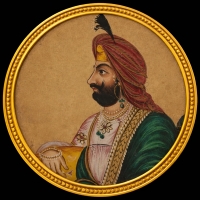
He is the only figure in the succession strand whose numismatic footprint is clearer before he held power than during it. A presentation rupee was struck for his wedding; the empire’s highest honour was created for the same occasion; the frontier campaign that added Peshawar to the empire was conducted in his name at thirteen. Then he governed, and the record goes quiet, because a coinage that names nobody has nothing to say about a ruler who was never proclaimed.
II · The Heir
Peshawar, 1834 — A Command in Name
He was born in 1821, the son of Kharak Singh and the grandson of the Maharaja, and was brought up as the heir the court preferred to the heir it had. That judgement is worth handling carefully — it is repeated in every account, including hostile ones, but it rests on a very short adult life and on the contrast with a father whom the same sources describe as incapable.
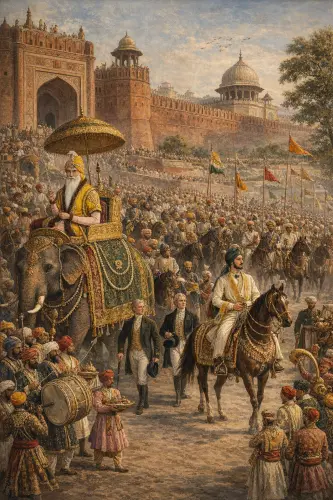
His first public role was military. On 6 May 1834 Peshawar was taken definitively, by an army nominally commanded by the thirteen-year-old prince and actually commanded by Sardar Hari Singh Nalwa, who became its first governor. The conquest matters to this site for a reason that has nothing to do with the prince: Peshawar brought with it a mint, and that mint struck to the Kabul standard of about 8.4 grams rather than the Amritsar standard of 11.1, a divergence examined at Coin, Commerce & Control. Nau Nihal Singh’s name is on the campaign. The monetary consequence belongs to the city.
III · March 1837
The Wedding, and the Coin Struck For It
His marriage in March 1837 was the largest state occasion of Ranjit Singh’s later reign, and the most thoroughly documented, because the British were invited to it. Sir Henry Fane, the Commander-in-Chief, attended and presented eleven thousand rupees, an elephant, eight horses and a double-barrelled gun; Dhian Singh gave one lakh and twenty-five thousand; Gulab Singh, Suchet Singh and Misr Rup Lal fifty-one thousand each. The gift exchange is set out in full at Gifts & Diplomacy. It was at this wedding that British officers first saw the Koh-i-Noor worn openly on the Maharaja’s arm.
Two objects came out of the occasion, and both belong to this site rather than to a biography.
The first is the Kaukab-i-Iqbal-i-Punjab, the Order of the Propitious Star of the Punjab, instituted that month to mark the wedding and reportedly at Fane’s suggestion. It was the supreme decoration of the Sikh Empire, conferred in three classes distinguished by their stones, and its first recipient was the bridegroom. It is described at The Medal and the Sword.
The second is a coin. The Lahore portrait rupee, catalogued at this site as VS 1885/93, with the flag in the background, was struck for this wedding. The date on the coin itself reads 1885. That is the documented presentation coinage of the occasion, and it is Lahore work: the mint of record for royal presentation pieces was Lahore, not a frontier garrison mint. The point is not incidental. It is the ground on which this site rejected the claim that a certain heavy-flan Peshawar piece was a wedding presentation coin — an argument set out at The Counterfeit Coin.
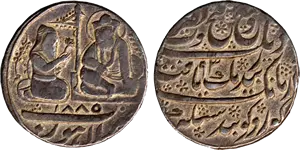
A royal occasion in the Sikh Empire produced presentation coin without producing a new legend. The portrait rupee carries a portrait — which the circulating coinage never did — but the event it marks is not named on it, and neither is the prince it was struck for. Sikh coinage records occasions in its fabric, its weight and its imagery, never in its words.
Seven weeks after the wedding, on 30 April 1837, Hari Singh Nalwa was mortally wounded at Jamrud. The court was occupied with the celebrations, and relief did not reach the fort in time. Whether that was the friction of a distracted capital or something deliberate is one of the charges gathered in the Dogra study listed on the Personalities index. It is set out, and left open, at Hari Singh Nalwa. This page does not settle it either.
IV · 1839 – 1840
Ruling in His Father’s Name
Ranjit Singh died on 27 June 1839. Kharak Singh succeeded, and within weeks was a prisoner of his own court in everything but name. The pattern is set out at The Fall of the Sikh Empire: Chet Singh Bajwa, the new Maharaja’s favourite, was killed in the citadel in October 1839 before his eyes; the shock broke him; his son took the government.
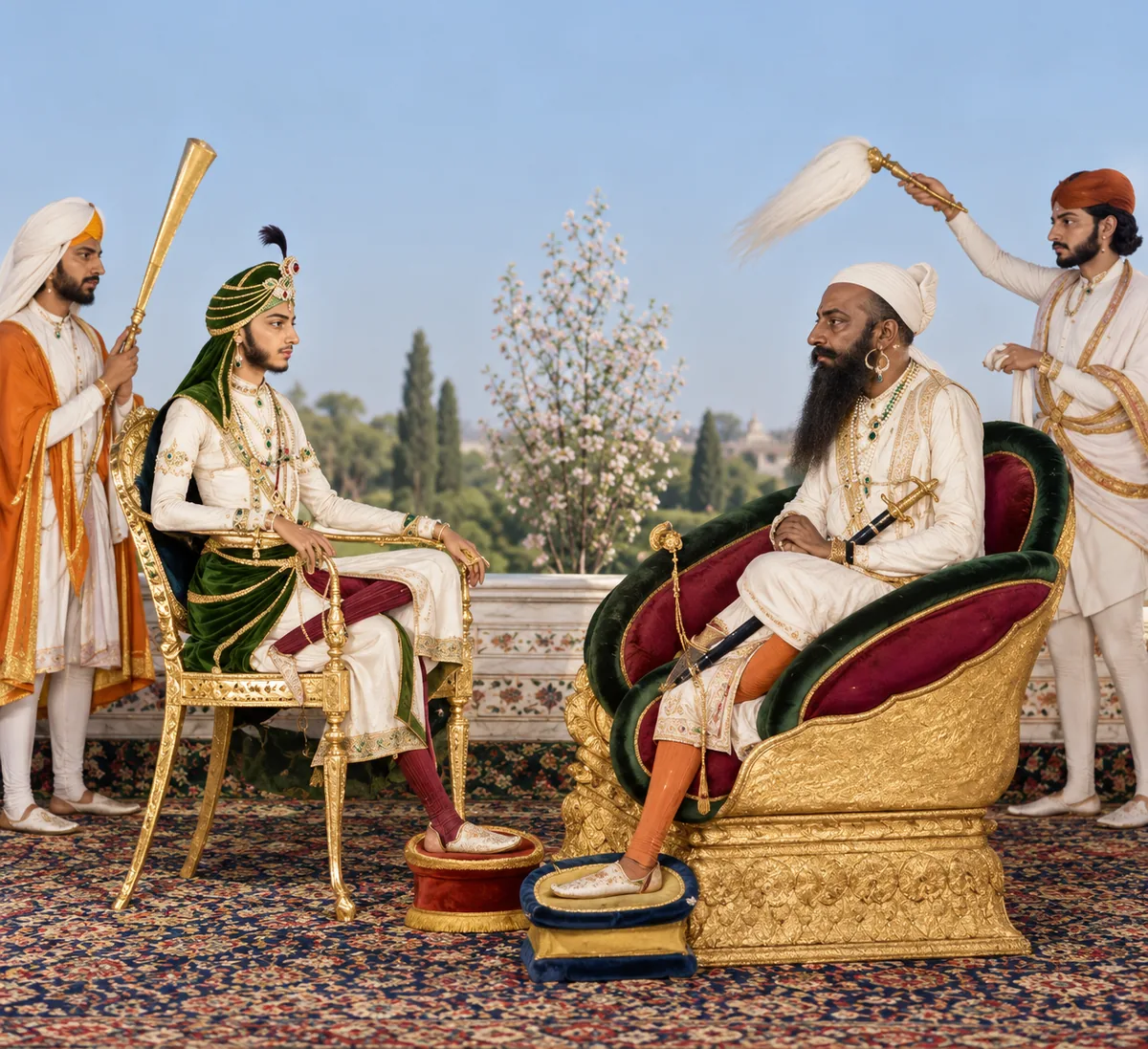
The arrangement that followed had no constitutional name. Kharak Singh remained Maharaja and the coins remained dated to his julus. Nau Nihal Singh governed. He never took the title, was never enthroned, and the court dated its documents accordingly — which is why the summary table at The Sikh Empire can list him among the five Maharajas and note, in the same line, that he never formally reigned.
What the mints did in that year is, at present, the least documented part of the story. The Lahore and Amritsar dies continued; the frontier mints continued; no type is known to begin or end on his authority. Sohan Lal Suri’s Umdat-ut-Tawarikh, Daftar IV, covers exactly these months and is the obvious place to look for the treasury and mint entries that would settle it. That work has not been done for this site, and it is stated here as an open question rather than filled in.
V · 5 November 1840
The Roshnai Gate: What the Accounts Record
Kharak Singh died on 5 November 1840, after a long decline that several accounts attribute to slow poisoning and none of them demonstrates. His son attended the cremation outside the fort. Walking back to the fort afterwards, he passed under the Roshnai Gate, and the gate fell on him. He was carried inside. He died the same day, at nineteen.
That much is common to every account. Almost everything else about the event is disputed, and the disputes are worth separating from one another, because they are not all of the same kind.
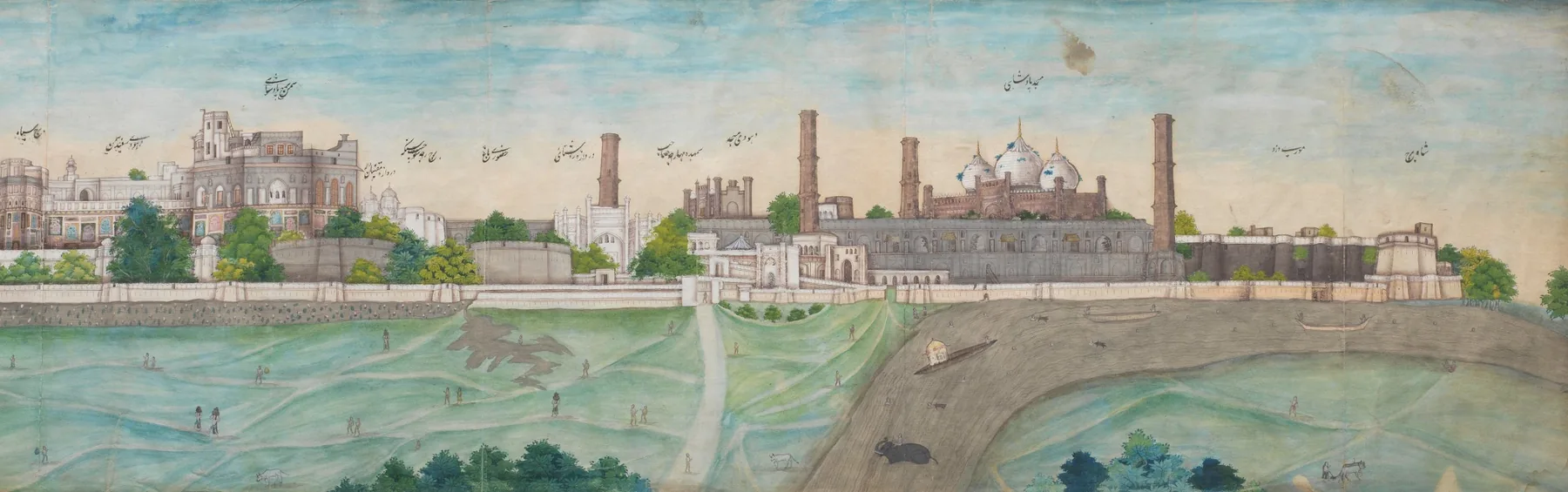
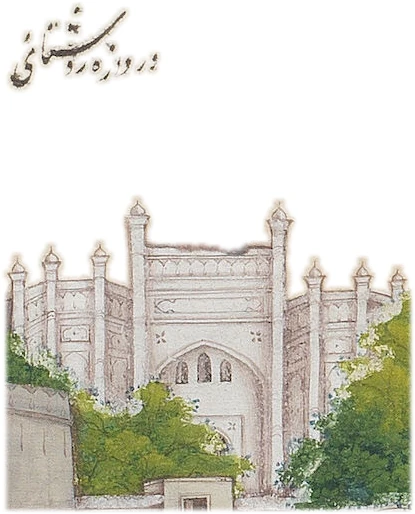
The gate stands on the river front of the fort, beside the Hazuri Bagh. It is the gate that fell on him on 5 November 1840, as he walked back to the fort from his father’s cremation.
What the sources agree on. The date; the occasion; the gate; that a companion walking with him was also struck, named in the accounts as Udham Singh, son of Raja Gulab Singh; that Raja Dhian Singh was present and took charge of the injured prince and of the fort; and that Nau Nihal Singh did not survive the day.
What they do not agree on. Whether the injuries at the gate were in themselves fatal. Whether he was conscious when carried in, and for how long. Who was admitted to him afterwards, and whether his mother, Maharani Chand Kaur, was among them. Whether the death was announced at once or held back for some hours while the succession was arranged. Each of these is asserted with confidence in one account and contradicted in another, and the confidence generally rises the further the writer sits from November 1840.
What no source establishes. There was no inquiry. No medical report was published; the court’s European physician left no account that settles it. The gate itself was never examined in any way that has come down to us. There is no document in which anyone instructs anyone else to bring the gate down on the prince, and there is no confession. The case for murder rests entirely on cui bono and on the pattern of the deaths around it — which is a real argument, but it is an argument from circumstance, not evidence of an act.
Within fourteen months of Ranjit Singh’s death, Chet Singh Bajwa had been killed in the citadel, Kharak Singh had been confined and was dead, and Nau Nihal Singh had died when the Roshnai Gate fell on him. Dhian Singh’s faction was the beneficiary of each of those deaths in turn. That sequence is set out at Betrayal and Reward, which also makes the necessary distinction: the Dogra ministry was a dynastic interest, not an agent of the Company. Dhian Singh was himself shot in September 1843.
The historiography of the death is worth naming, because it explains why the murder version travels so much better than the accident. The fullest early narratives in English were written after the fact and for a purpose: G. Carmichael Smyth’s History of the Reigning Family of Lahore appeared in 1847, in the interval between the two wars, when a picture of the Lahore court as an abattoir of intriguers was politically useful. The Darbar’s own chronicle, Sohan Lal Suri’s Daftar IV, was written by a man who was there and had to go on living in the city. Neither is disinterested. A page that quotes only one of them, in either direction, is choosing its conclusion first.
The honest position is the uncomfortable one. A nineteen-year-old who had just taken the government of the Punjab died when a gate of the fort he had grown up in fell on him as he walked back from his father’s cremation, in the presence of the minister who gained most by it, and the circumstances were never satisfactorily explained. That is not the same as knowing he was murdered, and it is not the same as knowing he was not.
VI · The Consequence
The Succession He Was Supposed to End
His death left no adult heir in the direct line. His mother, Maharani Chand Kaur, claimed the government on the ground that his widow was pregnant; the claim failed, and Sher Singh was on the throne by 18 January 1841. Sher Singh was shot with his wazir in September 1843. The five-year-old Duleep Singh was proclaimed three days later, and Jind Kaur made herself regent by going directly to the army. Inside six years the Sarkar Khalsa had four sovereigns, and the mints kept striking through all of it, dating each rupee to a julus whose holder might be dead before the dies wore out.
That is the numismatic significance of 5 November 1840, and it is worth stating exactly. The death does not change a coin type. It changes who is in a position to authorise one — and it starts the sequence that ends with the Lahore mints under a British Resident’s countersignature, and then with the recoinage campaign of 1847–49 described at The Nimak Mint.
To follow in this strand: Maharaja Kharak Singh, sovereign for a year and a prisoner for most of it; and Maharaja Sher Singh, who as governor of Kashmir struck the VS 1889 issue at the Afghan trade weight rather than the Lahore standard, and then held the throne for two years.
Sources
Sources and Further Reading
- Sohan Lal Suri. Umdat-ut-Tawarikh, Daftar IV. Trans. V. S. Suri. GNDU, Amritsar, 2002. The Darbar’s own chronicle for 1839–45, written by a man present at Lahore; the primary witness for the months treated here, and the obvious source for the mint and treasury entries this page leaves open. Discussed at Umdat-ut-Tawarikh.
- Press Lists of Old Records in the Punjab Secretariat and the Ludhiana Agency papers.
- G. Carmichael Smyth. A History of the Reigning Family of Lahore. Calcutta, 1847. The fullest early English narrative of the succession deaths, and a hostile one written between the wars; used here as evidence of how the story was transmitted rather than as evidence of what happened.
- B. R. Chopra. Kingdom of the Punjab. For the Punjab Akhbarat and the meeting of the officers during Ranjit Singh’s last illness.
- Sohan Singh Seetal. On the immediate suspicion of a Dogra conspiracy in November 1840; cited at The Fall of the Empire.
- Syad Muhammad Latif. History of the Panjab. Delhi, 1964.
- Hans Herrli. The Coins of the Sikhs. The standard catalogue for the Lahore and Amritsar series of VS 1896–1897.
- On this site: The Sikh Empire, The Fall of the Empire, Medals, Gifts & Diplomacy, Fakes & Forgeries and Betrayal and Reward.