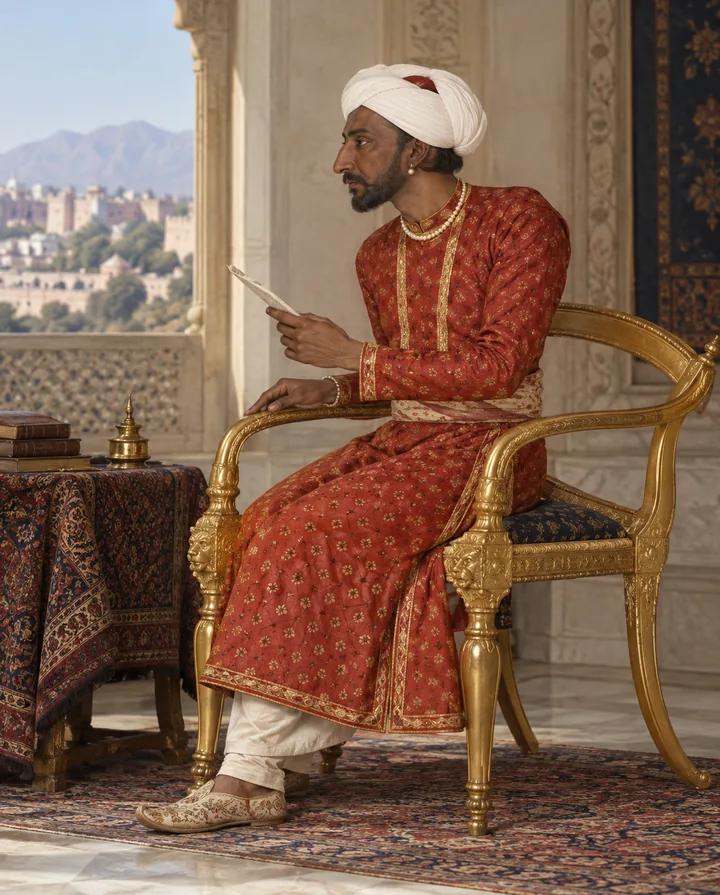
Diwan Bhawani Das
He never governed a mint, and no coin type was struck or withdrawn on his order. What he built was the accounting system that recorded where the silver came from and where it went — and very nearly everything the monetary history of the Punjab can be checked against is a document his office caused to exist.
Finance Minister of the Lahore Darbar · The Twelve Daftarsc. 1770 – 1834
I · The Premise
The Test This Page Does Not Pass
The rule of admission to this series, set out on the Personalities index, is that something in the coinage changed and the subject is a documented part of the reason. A type appears or stops appearing. A weight standard moves. A mint opens, or closes, and a named person is why.
Bhawani Das does not clear that test, and this page is not going to pretend otherwise. No Nanakshahi type was withdrawn on his objection. No rupee was recalibrated at his instruction. Search the catalogues for his name and it is not there, because the Sikh coinage does not name anybody — not the Maharaja, and certainly not his finance minister.
But there is a second kind of connection between a person and a coinage, and it is the one this page is built on. A currency is not only struck; it is also counted. Revenue is assessed in rupees, jagirs are valued in rupees, garrison pay is issued in rupees, customs are taken in rupees at the frontier posts, and every one of those transactions either does or does not leave a piece of paper behind. Whether it does is an administrative decision, taken once, by somebody. In the Lahore state that decision was taken between 1808 and 1811, and the man who took it was Bhawani Das.
The consequence is not abstract. The working monetary history of the Sikh Empire — what a rupee actually bought, what a district actually yielded, how much silver actually reached a mint town and in whose coin — is not recoverable from the coins. Coins give weight, fineness, mint name and a date, and then they stop. Everything else comes from the accounts, and the accounts survive as a corpus of Persian revenue paper produced by a filing system that did not exist in Lahore before he arrived.
This is the opening of a different arc within the series, and it needs a different rule, stated openly rather than smuggled in. The subjects admitted to it are not figures who changed the coinage. They are the figures who determined what can now be known about it — the account keepers, the seal holders, the treasurers. The claim made for them is narrower than Test One and, I think, harder to dismiss: without this office there is no record, and without the record the numismatics is a catalogue of objects with no economy attached.
II · Origins
Kabul, and a Revenue Office Inherited
Diwan Bhawani Das
b. c. 1770 · d. 1834, in the service of the Lahore Darbar
- Father
- Diwan Thakur Das, revenue and finance minister to Ahmad Shah Durrani
- Community
- Khatri; Hindu
- Durrani service
- Succeeded to his father’s office; served Shah Zaman, Shah Mahmud and Shah Shuja
- Durrani posting
- Chiefly the customs duties of Multan and the Derajat
- To Lahore
- 1808
- Finance Minister
- From 1811, until his death
- Created
- Twelve daftars; district treasuries across the subahs
- In the field
- Commanded a division in the Multan expeditions of 1816 and 1817; also Peshawar and the Yusufzai country
- Disgrace
- Accused of misappropriating state revenue; expelled to the Kangra hills; recalled and reinstated
- Succeeded by
- Diwan Dina Nath, 1834
He was born about 1770, the second son of Diwan Thakur Das, who was revenue and finance minister to Ahmad Shah Durrani. The office was, in effect, the family trade: on his father’s death Bhawani Das succeeded to it, and served in turn under Shah Zaman, Shah Mahmud and Shah Shuja.
What he did in that service matters more than the sequence of kings he did it under. He was employed chiefly in collecting the customs duties of Multan and the Derajat — which is to say that his entire professional formation was in the taxation of the corridor running between the Punjab and Kabul, at the crossings of the Indus and on the caravan traffic moving through them.
That corridor is the subject of this site’s Coin, Commerce & Control: two monetary zones meeting at the frontier, a Punjab rupee of around 11 grams on one side and an Afghan standard of roughly 8.3 to 8.5 grams on the other, and the money-changers taking their discount from anyone crossing between them. Bhawani Das spent his first career assessing revenue inside that system, from the Afghan side of it. He spent his second career running the treasury of the state that conquered it.
III · The Arrival
Lahore, 1808 — No Treasury, No Accounts
He left Kabul service in 1808. The reason given in the encyclopaedia tradition is personal: he had been badly treated at the Kabul court and went to Lahore in disgust. A second version has Ranjit Singh hearing of his reputation and inviting him to take charge of the state’s finances. These are not incompatible — a senior revenue officer who is known to be available and known to be good is exactly the sort of man a court sends for — but they are different emphases, and the page keeps both rather than choosing.
What he found on arrival is the part that should interest anyone reading the coinage. Ranjit Singh had been Maharaja for seven years. He held Lahore and, since 1805, Amritsar. He was striking rupees at two mints. And he had no regular treasury and no departmental accounts. The revenue of an expanding state was coming in and going out through the hands of individual officers, with no central record of the flow.
Bhawani Das organised both within a decade. He was formally appointed finance minister in 1811, at which point the total state income stood at something in the order of thirty lakh rupees. By the time he died in 1834 the secretariat he had built — the Darbar-i-Mulla — was the most sophisticated administrative machine between Delhi and Kabul. The structure is set out on this site’s page on the Sikh Empire, under the civil administration.
IV · The System
An Office for Every Kind of Money
The reorganisation had three parts, and each of them generates paper.
Twelve daftars — record offices — covering every category of state income and expenditure, civil and military. District treasuries established across the subahs, each keeping regular accounts of what came in and what went out. And settlement officers appointed in newly conquered territory to regulate revenue and finance there, which meant that conquest itself now produced an assessment rather than simply a tribute.
The departmental names that come down through the administrative-history tradition give a fair sense of the grain of the thing: a daftar for nazrana, the offerings and presentations made to the Darbar; a daftar for abkari, the excise on bhang, opium and spirits; a daftar for the chaukiyat, the transit posts where goods were taxed on the move; a daftar for wajuhat-i-sairat, the octroi and miscellaneous receipts; and the jama kharch registers of income and expenditure for each pargana and taluqa. The exact number and titles vary between accounts, and the list should be read as indicative of the categories rather than as a fixed establishment.
What made the system bind was not the filing but the sequence. An order from the Maharaja was given verbally, in Punjabi. A munshi transcribed it into Persian. It was sealed twice — once with the Akal Sahai Ranjit Singh seal in Gurmukhi, once with Mulahiza Shud in Persian — and then passed in fixed order through the Sarishta-i-Hazur, the Daftar-i-Devi Das, the Daftar-i-Bhawani Das, the General Secretariat, and finally the copying office. Not a single pie could leave the state treasury without completing that chain.
A finance ministry that can be bypassed records what it is shown. One that sits inside the disbursement chain records everything that moves. That is the difference between an office and an archive, and it is the whole of Bhawani Das’s claim on a numismatic site.
Every payment made out of the Lahore treasury in Nanakshahi rupees now generated a document. So did every revenue receipt, every jagir assessment, every frontier customs collection. The daftars were not a mint department and never pretended to be — but they were the only place in the Sikh state where coin was counted in bulk and the count was written down. The mints tell us what was struck. The daftars are the only witness to what was used.
One limit has to be stated here rather than left for a reader to discover. There is no Daftar-i-Zarb — no mint department — in the published catalogues of the surviving records. The mints of the Sikh Empire sat under the revenue and treasury administration rather than in an office of their own, and no separate series of mint accounts has been catalogued. Anyone hoping that this bureaucracy produced a register of dies, or annual output figures by mint, will not find one. What it produced was the fiscal context: prices, assessments, payments, receipts, and the coin those were denominated in.
V · The Frontier
The Corridor He Had Already Taxed
Finance ministers do not normally appear in the order of battle. This one does. Twice, in 1816 and 1817, Bhawani Das commanded a division of the Lahore army in the Multan expeditions, and he took part in the expeditions to Peshawar and into the Yusufzai country as well. He also served the Darbar diplomatically: he was among the Maharaja’s counsellors at the negotiations with the British envoy Charles Metcalfe, the negotiations that produced the Treaty of Amritsar of 25 April 1809 and fixed the Sutlej as the limit of Lahore’s expansion eastward — the subject of this site’s Cis-Sutlej pages.
The Multan service is the striking one, because of where he had been before. Multan and the Derajat were the districts whose Durrani customs revenue he had spent years assessing. When the Lahore army went there in 1816 and again in 1817, it went with a divisional commander who knew, to the rupee, what that country yielded and how its trade was taxed. The citadel finally fell on 2 June 1818, after six previous campaigns, with the Afghan governor Muzaffar Khan killed in the storming; Diwan Sawan Mal was installed to govern it.
Multan gave the empire the caravan routes to Sindh and the Indus delta, and a Nanakshahi coinage followed the conquest into the city. The Derajat was absorbed between 1819 and 1821, and the Derajat and Mankera mints belong to that absorption — small, scarce issues carrying the Gobindshahi couplet rather than the Nanakshahi one. The mint geography of the south-western frontier is, almost exactly, the revenue geography Bhawani Das had administered for the Durranis. See The Sikh Empire for the mints and Coin, Commerce & Control for the two weight zones they sat between.
The temptation at this point is to close the loop and say that he directed the monetary settlement of the conquered frontier. There is no evidence for that, and this page does not say it. No document known to me connects Bhawani Das to the opening of the Multan mint, to the choice of couplet at Derajat and Mankera, or to any decision about the standard those issues were struck on. What can be said is narrower and still worth saying: the Lahore state absorbed a frontier revenue system it did not build, at a moment when its finance ministry was headed by the man who had run that system for its previous owners. Whether that shaped what was struck there is an open question. It is the sort of question the accounts, rather than the coins, would have to answer.
VI · The Charge
Kangra, and a Return
At some point in his tenure the career broke. He was accused of misappropriating state revenues and expelled from Lahore into the hills of Kangra. He was recalled before long and reinstated in his position, the charges against him having failed to be proved, and he remained in the Maharaja’s service until his death in 1834.
The episode is reported consistently but thinly. The tradition does not give a firm date for it, does not describe the substance of the allegation, and does not say who brought it. Given what a Lahore disgrace usually was — a faction moving against a man whose office made him worth removing — the absence of detail is itself informative, and the page notes the gap rather than filling it.
It is worth registering what the outcome implies. A revenue minister accused of theft, in a court not otherwise noted for restraint, was exiled and then brought back because the case could not be made. Whatever else that says about the politics of the Darbar, it says that by this date there was a body of accounts against which such a claim had to be tested — and that the test was capable of coming back negative. A state without records disposes of such a man on suspicion. This one apparently could not.
VII · The Afterlife
What the Daftars Became
The Punjab was annexed in 1849 and the paper of the Lahore state passed with everything else to the British, who put it into storage in the vernacular office of the Civil Secretariat and left it there. What happened next is the reason this page exists.
Sita Ram Kohli, then lecturing in history at Government College, Lahore, worked through the surviving mass — on the order of three hundred thousand documents, dated between 1811 and 1849, tied up in red-cloth bundles at the Tomb of Anarkali. He catalogued them in two volumes: the first, in 1919, covering the military department, the Daftar-i-Fauj; the second, in 1927, covering the revenue, jagir and toshakhana departments. Those two volumes are the door through which almost everyone since has entered the fiscal history of the Sikh Empire.
Note where the surviving series begins. 1811 — the year Bhawani Das was made finance minister. The catalogue itself does not explain the date, and there is more than one possible reason for it: it may reflect the point at which systematic record-keeping started, or simply the point from which paper happened to survive. The honest position is that the coincidence is striking and unproved. But it is at least consistent with the obvious explanation, which is that a bureaucracy cannot leave an archive before it exists.
Hans Herrli’s The Coins of the Sikhs — the standard catalogue of the series, and the reference behind a great deal of this site — carries Kohli’s 1927 revenue volume in its bibliography. The line from the daftar clerk’s register to the modern coin catalogue is that short. When a numismatist wants to know what a Nanakshahi rupee meant to the state that issued it rather than merely what it weighed, this is the material that answers.
It is worth being exact about what that catalogue does and does not cover, because the limits define what this arc can claim. Kohli’s own introductory note describes the record as consisting of a set number of bundles — and those bundles are accounts. He mentions, separately and in passing, a small group of leather-bound volumes holding retained copies of orders issued outward to government officials, which he found decayed past use, and a voluminous correspondence between Ranjit Singh and the British agencies at Ludhiana and Ambala. Neither was catalogued. The political and diplomatic paper of the Sikh state was never brought into the catalogue at all, and what has been worked on for a century is the fiscal series and almost nothing else.
Which is the point. This is not a mint archive and it is not a chancery archive. It is the fiscal and mercantile traffic within which the coinage circulated — and that traffic is precisely the material from which the working value of a currency is recovered. A catalogue of accounts is a poor substitute for a history of the Darbar. It is the best evidence there is for the money.
What such records actually yield, when you get at them, is concrete and small-grained: a dated grain price expressed against the Lahore rupee; a revenue payment made in the coinage of a named foreign mint; an allowance, an assessment, a platoon’s pay. None of it is dramatic on its own. Collectively it is the only evidence there is for what the coinage did between leaving the mint and reaching the cabinet.
VIII · What He Left
The Office That Outlived the State
He recruited his own succession, which is the surest sign that he understood what he had built. In 1813 he brought in Diwan Ganga Ram and placed him over the military accounts; Ganga Ram also became keeper of the royal seal, the office through which every pay order passed, simplified the record-keeping, and organised the excise. In 1815, on Ganga Ram’s own recommendation, a young writer named Dina Nath entered the department of military accounts as a mutsaddi.
Ganga Ram died in 1826 and Dina Nath took both his offices. Bhawani Das died in 1834 and Dina Nath took the finance ministry as well, so that by the last years of the reign one man held the accounts, the military finance and the privy seal together. He was the single most indispensable figure in Lahore, and he survived everything that followed — the succession killings, two wars, the annexation. The British kept him on after 1849 for the plainest of reasons: he was the only man who understood the accounts.
That is the arc this page opens. Four men, one office, and a continuity of paper running from a Kabul revenue clerk arriving in 1808 to a British administration in 1850 unable to govern the province without the last of his successors. The coinage of the Sikh Empire is anonymous by design — it names no ruler, no minister, no mint master. The ledger is where the names are.
To follow: Diwan Ganga Ram and the keeper’s seal; Diwan Dina Nath, who outlived the state he accounted for; and Misr Beli Ram and the toshakhana that needed three keys turned at once before it would open.
Sources
Sources and Further Reading
- Harbans Singh (ed.). The Encyclopaedia of Sikhism. Punjabi University, Patiala. The standard entry, and the source for the Durrani service, the twelve daftars, the district treasuries, the Multan commands of 1816 and 1817, the Kangra episode and the date of death.
- Sita Ram Kohli. Catalogue of Khalsa Darbar Records, vol. I (1919) and vol. II (1927). Punjab Government Publications, Lahore. Volume I covers the military department; volume II the revenue, jagir and toshakhana departments. Both volumes are in the public domain and available in digital facsimile.
- Sohan Lal Suri. Umdat-ut-Tawarikh. Lahore, 1885–89. The Darbar’s own chronicle, and a primary witness for the administration; discussed on this site at Umdat-ut-Tawarikh.
- Lepel H. Griffin and C. F. Massy. Chiefs and Families of Note in the Punjab. Lahore, 1909.
- H. L. O. Garrett and G. L. Chopra (eds.). Events at the Court of Ranjit Singh. Delhi, 1986.
- Syad Muhammad Latif. History of the Panjab. Delhi, 1964.
- Bhagat Singh. Maharaja Ranjit Singh and His Times. Delhi, 1990.
- Rajinder Kaur. Thesis on the administrative personnel of the Lahore Darbar, Punjabi University, 2011 — the basis for the account of the Darbar-i-Mulla used on this site.
- Hans Herrli. The Coins of the Sikhs. The standard catalogue, which carries Kohli’s revenue volume in its bibliography.
- On this site: The Sikh Empire, Coin, Commerce & Control, The Lahore Sales and Cis-Sutlej.