Sikh Tokens Devotional, Legendary & Commemorative
A survey of guru-portrait pieces in gold and silver, Gurmukhi and Nagri legend tokens, numerological yantras, and the newly attributed Bikramjit folk-tale series
Section I
What Are Sikh Tokens?
To study Sikh tokens is to enter a world that official numismatic catalogues have long left in shadow. Unlike the rupees and half-rupees of the Sikh Empire — whose mints, dates, and legends are now well mapped — the tokens that circulated alongside them occupy an awkward borderland between religion, commerce, and private enterprise. They were not legal tender, not government-issued, and not recorded in state accounts. That is precisely why they are so revealing.
In the late eighteenth and nineteenth centuries, private silversmiths and goldsmiths working in and around the great pilgrimage centres of Punjab produced these pieces in quantity. The principal centres were the Har Mandir Sahib and Akal Takht in Amritsar; Takht Keshgarh Sahib at Anandpur; Takht Hazur Sahib at Nander; Takht Patna Sahib in Bihar; and Takht Damdama Sahib in Talwandi Sabo. To these must be added a cluster of historic gurdwaras stretching from Nankana Sahib in what is now Pakistan to Sis Ganj in Chandni Chowk, Delhi.
The tokens were sold to pilgrims at the gates of the gurdwaras, graded by metal and weight to suit every purse — base metal and brass for those of modest means; silver and gold for the more affluent. Devotees presented them as offerings (ardas) before the Sri Guru Granth Sahib Ji; at close of day the gurdwara authorities collected the offerings and returned them to authorised silversmiths in exchange for cash, while the merchants retained a small commission. The cycle was practical as well as devotional.
— Maurice M. Gould, foreword to Brotman, A Guide to the Temple Tokens of India (1970)
The scholarly literature has been slow to catch up. The first published scholarship on Sikh coins appears in C. J. Rodgers's 1881 article in the Journal of the Asiatic Society of Bengal — which touches on tokens alongside regular coinage — but it was Brotman's survey of 1970 that provided the first systematic treatment of the token material specifically; Herrli incorporated Sikh tokens into The Coins of the Sikhs (2nd ed., 2004); Mitchiner's Indian Tokens (1998) gave broader all-India context; and Sardar Surinder Singh Sidhu's catalogue, published by Spink in 2022, is currently the most comprehensive reference available. Yet large portions of the material remain unpublished, unread, or tentatively attributed. The British Museum's Whitehead collection — acquired by the Museum in 1922 — is the most significant institutional holding and an indispensable benchmark for any serious study.
Section II
Devotional Tokens — Guru Portraits
The largest and most visually striking group of Sikh tokens are those bearing portraits of the Gurus. These were emphatically devotional objects — purchased as auspicious keepsakes, presented as offerings, carried as talismans, or given as gifts to relatives returning from pilgrimage. They carry no denominational value; their currency was spiritual.
The Core Types
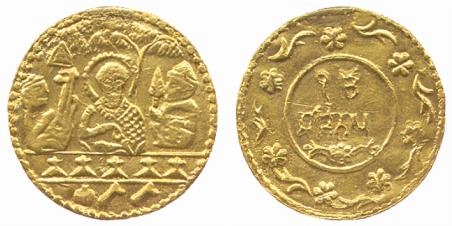
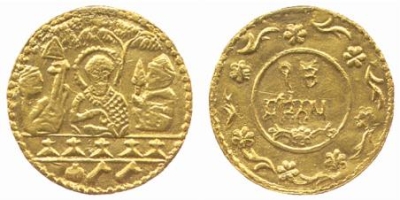
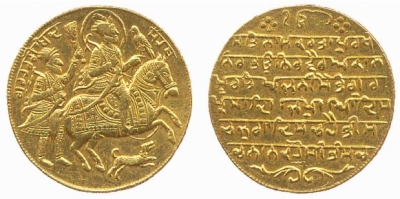
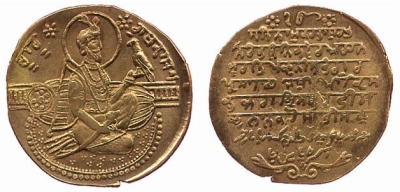
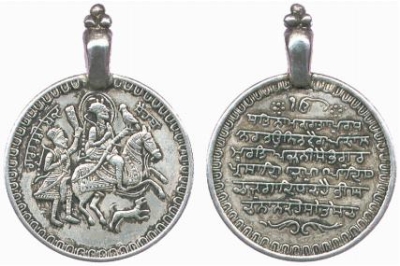
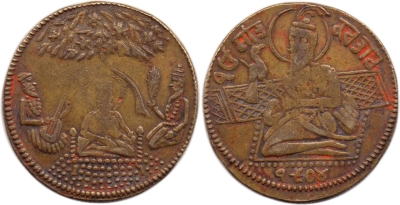
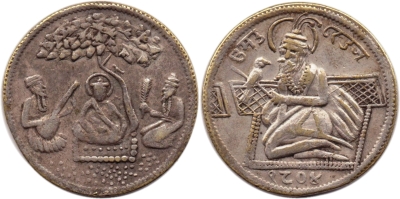
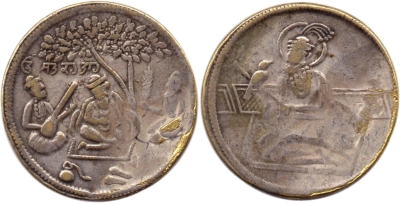
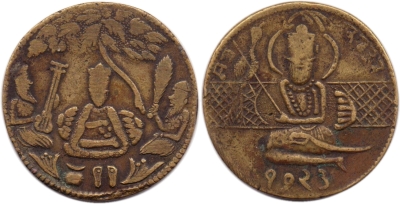
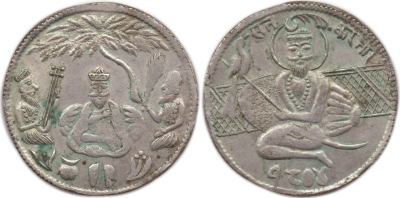
The most common portrait subjects are Guru Nanak Dev Ji, Guru Hargobind Ji, and Guru Gobind Singh Ji. The iconographic conventions are remarkably consistent. Guru Nanak Dev Ji is almost always shown seated beneath a tree, attended by Bhai Mardana playing the rebab and Bhai Bala waving a chauri flywhisk; Guru Hargobind Ji and Guru Gobind Singh Ji are typically mounted or seated with a falcon on a wand. Reverses carry the Mool Mantar, the Waheguru mantra, or opening verses of the Sri Guru Granth Sahib Ji.

Dating and the Samvat Convention
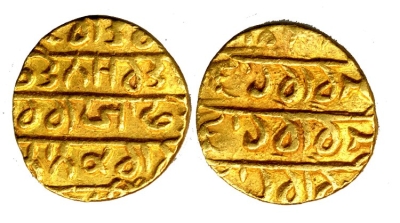
Many Sikh religious tokens carry a Samvat year date, most commonly VS 1804 (= 1747–48 CE), which became a persistent convention repeated on re-issues for nearly seventy years — functioning less as an accurate strike date than as a fixed commemorative anchor. Why VS 1804? Sidhu and Spink propose the date may have been chosen to mark the formation of the Dal Khalsa — the supreme deliberative body of the Sikhs — at the Akal Takht in Amritsar on Vaisakhi day, 1 Vaisakh VS 1804 (29 March 1748 CE). No contemporary record has yet surfaced to confirm this, but the coincidence is precise. A notable variant bears the numeral 400, commemorating the four-hundredth anniversary of the birth of Guru Nanak Dev Ji, which fell in 1869 CE. A third date category carries VS 1723 (= 1666 CE) — the birth year of Guru Gobind Singh Ji in Patna, Bihar — with the inscription Sat Kartār (The True Creator) in Gurmukhi on the reverse. These were almost certainly struck in the late nineteenth century as birthday anniversary commemoratives, the frozen birth year serving the same anchoring function as VS 1804. The Vikrama Samvat year runs approximately one year ahead of the Gregorian calendar, a detail of some significance when assigning CE equivalents.
The Heaton Mint Tokens — VS 1955 (1898)
One category stands apart from all others in its production context: silver tokens struck in VS 1955 (= 1898 CE) at the Heaton Mint in Birmingham, England. Diameter 31.2 mm, weight 12.40 grammes. The obverse carries the standard Guru Nanak Dev Ji seated beneath a tree, attended by Bhai Mardana and Bhai Bala; the reverse the Mool Mantar in Gurmukhi script. That industrial-era Sikh devotional tokens were produced at a major English commercial mint — the same establishment that struck coins for dozens of British colonial territories — speaks to the scale of demand in the Sikh diaspora and pilgrimage economy at the close of the nineteenth century.
The Whitehead Collection — British Museum
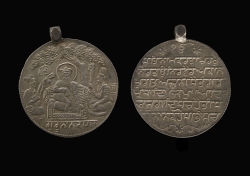
The most significant institutional assemblage of Sikh tokens is the collection formed by Richard Bertram Whitehead (1879–1967), acquired by the British Museum in 1922. Whitehead served in the Indian Civil Service in the Punjab and assembled his numismatic material with exceptional care over many years. He is the author of the Catalogue of Coins in the Punjab Museum, Lahore (1914), the first major institutional catalogue of Punjab coinage, which remains an essential primary reference alongside his British Museum holding. His Sikh token specimens are the essential benchmark series for die comparisons and attribution, and are cited by subsequent scholars including Herrli and Sidhu/Spink wherever a type standard is needed.
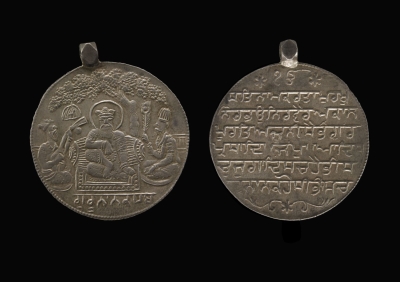
AN00479038
Section III
Tokens with Gurmukhi and Nagri Legends — and the Numerological Yantra
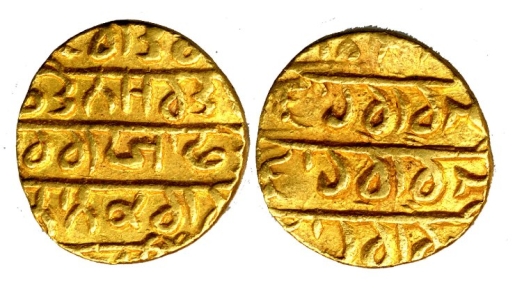
Alongside the guru-portrait pieces, a distinct family of tokens carries Gurmukhi or Nagri script as its primary design field — text rather than figural imagery as the dominant visual element. These 'legend tokens' represent at least two different traditions: devotional script pieces bearing sacred verses, and numerological yantra tokens whose protective function draws on a different conceptual register altogether.
Gurmukhi Legend Tokens
The dominant textual sources are the Mool Mantar — the opening declaration of the Sri Guru Granth Sahib Ji, beginning Ik Oṅkār Satnām — and other short sacred formulae. A distinction worth noting for collectors: the Mool Mantar in its SGPC-approved form ends with Gurprasād II (as confirmed in the Sikh Reht Maryada, Article XXIV, paragraph O). The Maha Mantar — a longer form ending with hōsī bhī sach 1 — was introduced by the Sant Samaj and appears on a distinct category of later tokens. Tokens bearing the longer Maha Mantar version are generally of more recent production. One variety carries the Ik Oṅkār symbol on the reverse within a circle surrounded by a floral border, paired with a guru-portrait obverse; a sub-type incorporates the phrase Nanak Naam Charhdi Kala, Tere Bhaane Sarbat Ka Bhala — the closing line of the Ardas — in the field.
A further curiosity carries on its reverse the opening verses of the Akal Ustat — a composition written in the hand of Guru Gobind Singh Ji — with the annotation Utaar Khaase Dastkhat ka Patshahi 10, indicating the text is copied verbatim from the hand of the Tenth Guru. Whether this represents an authentic early transcription or a later pious claim by the silversmith is impossible to determine without metallurgical analysis; but the ambition of the inscription is remarkable.


Nagri Legend Tokens
Two tokens in the album carry legends in Nagari rather than Gurmukhi script. This is not unusual: Nagari was the literary and religious script of the Hindu population of Punjab, and the boundaries between Sikh and Hindu devotional tokens were permeable. One particularly striking example carries a Gurmukhi inscription on the obverse paired with the Islamic Kalima in Arabic script on the reverse — a three-community statement whose precise provenance and purpose remain open questions.
The Numerological Yantra
The Yantra token occupies a category of its own. A yantra — from the Sanskrit for 'instrument' or 'device' — is a mystical numerical grid, typically a magic square in which the numbers in every row, column, and diagonal sum to the same total. In South Asian folk religion, yantras are protective objects: carrying or contemplating one was believed to ward off malign influences. The Sikh yantra tokens adapt this pan-Indian tradition by substituting Gurmukhi numerals and, in some cases, incorporating sacred Gurmukhi text on the reverse. According to the late Dr Surinder Singh of Chandigarh, these tokens were issued by or for the Udasis — the religious sect founded by Sri Chand, the elder son of Guru Nanak Dev Ji. The Sidhu/Spink catalogue records two principal configurations used on tokens: a 3×3 magic square totalling 15 in every direction, and a 4×4 square totalling 20 in every direction.

Section IV
The Bikramjit Token — A New Attribution
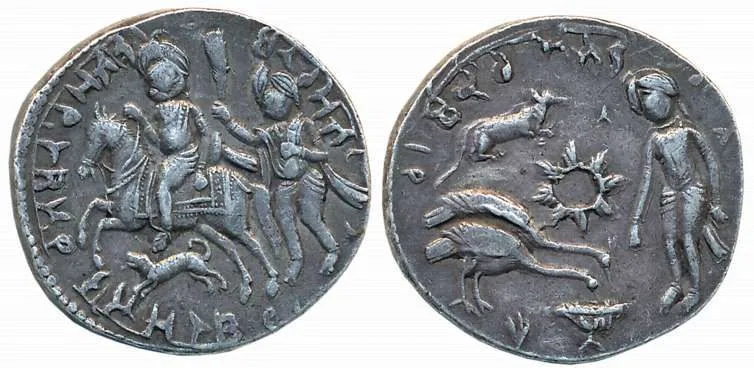
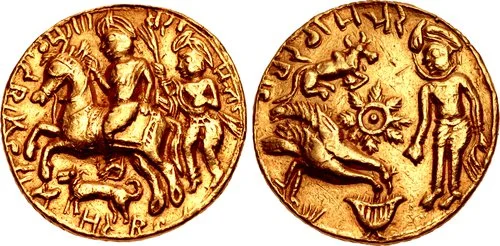
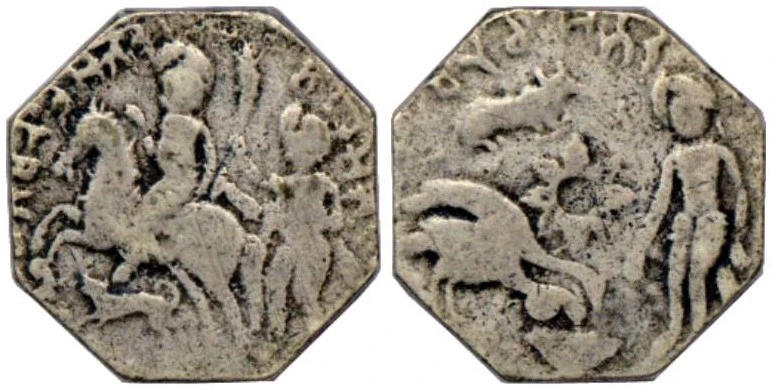
Among all tokens associated with the Sikh numismatic tradition, none has proved more persistently enigmatic than the piece first published by Irwin Brotman as 'miscellaneous token no. 1'. Known in gold (11.56 g, 24 mm), silver (11.55 g), and debased silver on an octagonal flan, it attracted successive attempts at attribution from four different scholars over five decades — none of them fully convincing. A new reading proposed by Jeevandeep Singh in the Journal of the Oriental Numismatic Society (JONS 261, Autumn 2025) resolves the mystery through careful legend-reading and identification of the reverse iconographic programme with a well-known Punjabi folk tale.
Oswal Auction 98, Mumbai
1 April 2023, lot 778
CNG Electronic Auction 366
13 January 2016, lot 332
Classical Numismatic Gallery Auction 22
Ahmedabad, 8 August 2015, lot 497
Obverse and Reverse
Obverse
A hunting scene: King Bikramjit on horseback, followed by an attendant and a hound. The Gurmukhi legend raja bikramjit is arranged around the edge, repeated three times.
Reverse
The king's effigy stands at centre. A pair of swans feed on pearls from a bowl. Above, a seated Nandi bull. At the centre, a fire disc — the Mahakaleshwar Jyotirlinga, the swayambhu form of Shiva at Ujjain. The legend raja bikramjit is repeated twice around the edge.
A History of Misreadings
The legends, in a somewhat crude Gurmukhi hand, had been variously described as 'illegible, probably Gurmukhi' (Brotman) or as possibly meaningless (Herrli). Without a correct reading, the iconography was left to float free of any narrative anchor, producing a series of plausible-sounding but ultimately unsatisfying attributions:
Brotman / Niyogi (1970 / 1989)
Identified the mounted figure as Guru Gobind Singh Ji with an attendant and a running dog. The reverse was declared unidentifiable.
Singh (1992)
Argued against a Sikh attribution: the figure wears a dhoti and bears none of the five Ks. Suggested the obverse might instead depict Dattatreya or Namdev — the first step towards a non-Sikh reading.
Mitchiner (1998)
Proposed Yudhishthira on horseback with the war-god Skanda behind him; the reverse depicts Skanda feeding his peacocks above Nandi. The fire disc was left completely unexplained.
Herrli (2012)
Concluded candidly that the iconography had 'never found a satisfactory explanation' and the inscriptions had not been read, and might even be meaningless.
The New Reading — Raja Bikramjit
The key was the legend itself. A careful reading of the silver specimen (Fig. 1) reveals the Gurmukhi text to read raja bikramjit, repeated five times across obverse and reverse combined. Once the legend is correctly read, the iconographic programme falls into place with striking completeness.
The Identification — Reverse Programme
The reverse illustrates a well-known Punjabi folk tale: King Bikramjit of Ujjain fed pearls to a pair of swans from the legendary Mānsarovar lake. The tale is preserved in Flora Annie Steel's Tales of the Punjab: Told by the People (London, 1894) under the title 'The King Who Was Fried'. The fire disc at the centre is the Mahakaleshwar Jyotirlinga — the great Shaiva temple at Ujjain in which the lingam manifests as fire, making it one of the twelve most sacred Jyotirlinga shrines in India. The seated Nandi bull anchors the whole composition in the Ujjain/Shaiva cultic world of Vikramaditya's legendary capital.
The Vikrama Era Year 2000 Hypothesis
The Vikrama Era — still in widespread use across northern India — is held in mythology to have been founded by Vikramaditya, a king of Ujjain, in 57 BCE. One of the most detailed accounts is the Kalakacharya Kathanaka, composed by the Jain sage Mahesarasuri. It relates that Gandharvasena, the powerful king of Ujjain, abducted Sarasvati — a Jain nun and sister of the monk Kalakacharya. The outraged monk sought help from the Śaka ruler King Sahi of Sistan; aided by miraculous intervention, Sahi defeated Gandharvasena and freed Sarasvati. The defeated king retreated to the forest and was killed by a tiger. His son Vikramaditya — raised in the forest, compelled initially to rule from Pratishthana (modern Paithan in Maharashtra) — later invaded Ujjain, expelled the Śakas, and established the Vikrama Era to commemorate his victory.
In Punjabi folklore, Vikramaditya is rendered as King Bikramjit, ruler of Ujjain. The millennial threshold of Vikrama Samvat 2000 falls in 1943 CE. Jeevandeep Singh proposes that this undated but evidently commemorative token was struck to mark the opening of the third Vikrama Era millennium — depicting Bikramjit at precisely the moment his era completed two thousand years. The choice of Punjab as the locus of issue is unsurprising: the Vikrama Samvat system was the dominant civil calendar across the region, and Ujjain retained its position as pan-Indian sacred geography across all communities.
The three metal variants — gold, silver, and debased silver on an octagonal flan — are consistent with a commemorative issue calibrated for different economic levels of the purchasing public, in precisely the same tiered structure as the guru-portrait devotional tokens discussed in Section II.
Editor's Note — JONS 261
By a coincidence noted by Joe Cribb, a further example of this token was published simultaneously in Marg magazine, vol. 76 no. 2 (2024), p. 64, no. 8. This independent appearance in a major art-historical periodical underscores the significance of the attribution proposed in JONS 261.
Section V
Scholarship and the Road Ahead
Rodgers (1881)
Charles James Rodgers published the first scholarly article on Sikh coins in the Journal of the Asiatic Society of Bengal in 1881 — the earliest systematic treatment of the subject in print. Rodgers had set up a teacher training college in Amritsar in 1863 and spent twenty-two years in the Punjab, accumulating a deep personal knowledge of the material. His coins, sold to the British Museum in 1897, form part of the institutional reference series. He is the first to note that Ranjit Singh placed his name on nothing — a remark that has defined the interpretation of Sikh anonymous coinage ever since.
Brotman (1970)
The founding survey. Listed the major types, provided the first systematic photographs, and established the basic vocabulary of description. Attribution was tentative and legends sometimes misread, but the pioneering importance cannot be overstated.
Niyogi (1989)
Expanded Brotman's corpus in Money of the People, adding further varieties. The most puzzling pieces — including the Bikramjit token — were not advanced beyond Brotman's original descriptions.
Mitchiner (1998)
Indian Tokens set the Sikh material in its wider all-India context for the first time. His mythological readings — even where incorrect — demonstrated the importance of consulting non-Sikh traditions when approaching this material.
Herrli (2012)
The Coins of the Sikhs incorporated a dedicated token section, making it the standard numismatic reference for collectors. Herrli was admirably candid where attributions were uncertain.
Singh / JONS (2025)
The Bikramjit attribution in JONS 261 is the first fully convincing identification of a previously unread Sikh token type, demonstrating the potential of combining careful legend-reading with cross-disciplinary folk narrative analysis.
Nazarana — The Toshakhana Connection
The broader context of Sikh token production is inseparable from the Toshakhana system that governed the exchange of gifts, tribute and presents at the Lahore Darbar. Nazarana — tribute paid on occasions of appointment, conquest or diplomatic visit — moved through the Toshakhana in both directions: received from subordinate chiefs and visiting dignitaries, redistributed as khillat (robes of honour) and gifts to loyal servants. The Khalsa Darbar Records document specific figures: the Sultan of Bahawalpur paid 80,000 rupees; the Multan Vakil the same amount plus horses; Jahadad Khan 25,000 rupees and sixteen cannons; the Kabul Vakil Damodar 50,000 rupees and horses. The Toshakhana-i-Khas itself required three keys applied simultaneously — one held by Misr Beli Ram the Chief Toshakhania, one by Fakir Nur-ud-Din incharge of the fort, one by Sardar Hukam Singh Thanedar of Lahore — a tripartite custody system that reveals the political and financial weight assigned to the institution. The devotional tokens documented on this page belong to the same gift economy: portable, silver, carrying religious authority, suited equally to private devotion and to presentation as a mark of status or occasion. The boundary between a temple token offered at the Har Mandir Sahib and a nazarana piece presented at the Darbar is, in some cases, a question of context rather than object.
What Remains Unresolved
Several significant problems persist. The Nagari-legend tokens have not been fully contextualised within either the Hindu temple token tradition or the specifically Punjabi devotional economy. The three-community token combining Gurmukhi, Nagari, and Arabic script remains without a satisfying provenance. The weight ranges and alloy compositions of the guru-portrait series have not been systematically tabulated and compared across the Brotman/Niyogi/Herrli listings. And the question of which specific gurdwara centres produced which types — suggested by inscriptions such as Hazoor Saheb on some reverses, and by the Amritsar goldsmith's attribution on the piece issued by Raja Darya Mal Devi Dayal of Chonk Darbar, Amritsar — a court near the Manji Saheb area of the Harmandir Sahib, whose reverse carries the anomalous Urdu inscription Astria mei bena (Made in Austria), a claim inconsistent with the workmanship, which is characteristic of Amritsar jewellery craft — has not been systematically investigated. — has not been systematically investigated.
— Jeevandeep Singh, JONS 261 (Autumn 2025)
Key References
Brotman, I. F. (1970) A Guide to the Temple Tokens of India. Los Angeles. [M#1]
Herrli, H. (2012) The Coins of the Sikhs, 2nd edn. New Delhi. [T45]
Khera, P. K. (2011) Catalogue of Sikh Coins in the British Museum. British Museum Research Publication No. 190. London. [Source for Whitehead acquisition date and Rodgers biography]
Mitchiner, M. (1998) Indian Tokens: Popular Religious and Secular Art. Sanderstead. [#4738–39]
Niyogi, R. (1989) Money of the People. Calcutta. [B81–82]
Rodgers, C. J. (1881) 'On the coins of the Sikhs'. Journal of the Asiatic Society of Bengal 50, pp. 71–93. [First published scholarship on Sikh coins]
Sidhu, Saran & Dalwinder Singh (2022) Coins of the Sikh Empire, Punjab and the Cis-Sutlej States: Sikh Religious Tokens. London: Spink.
Singh, J. P. (1982) Observations on Sikh Tokens.
Singh, Dr. S. (1992) Sikh Religious Tokens. [#13]
Singh, Jeevandeep (2025) 'A token featuring a folk story from Punjab'. JONS 261, pp. 25–26.
Steel, F. A. (1894) Tales of the Punjab: Told by the People. London.
SikhCoins.in
About This Page
The SikhCoins.in token gallery brings together high-resolution images of fifteen tokens from the principal type families, including pieces from the British Museum Whitehead collection. The scholarly survey above draws on the Sidhu/Spink catalogue, Herrli's typology, and original published research to provide the most current state of attribution for each documented type.
SikhCoins.in invites collectors, scholars, and institutions to contribute images, weights, and comparative material to advance the documentation of this important and still under-studied field.
Sikh Religious Tokens
Select specimens from the SikhCoins.in collection. Click any image or title to browse the full album.