The Khanda That Wasn't A Misread Symbol on Mughal Coins
An examination of the claim that a Khanda-like symbol on Mughal coins represents evidence of Sikh influence during the late Mughal period
The Argument
Three Claims
From time to time the claim is made that a Khanda-like symbol appearing on certain Mughal coins represents a sign of Sikh influence during the late Mughal period. This interpretation has circulated among collectors and was most notably advanced in an article published in Gullak magazine by Gurprit Singh.
The argument rests on three observations:
- The symbol resembles the Khanda and therefore represents a Sikh emblem.
- The symbol appears only on coins of the Lahore mint.
- The symbol occurs only in years connected with Sikh historical events.
When examined against the broader numismatic record, however, none of these observations withstand scrutiny.
The Evidence
The Shah Alam Coins Behind the Claim
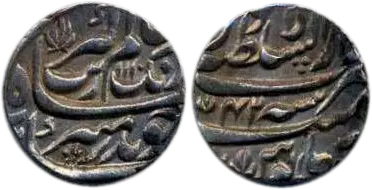
Particular attention is often given to coins of Shah Alam Bahadur dated AH 1122–1123, which have been cited as evidence of Sikh influence near Lahore during the campaigns of Banda Singh Bahadur. The coins are shown below.
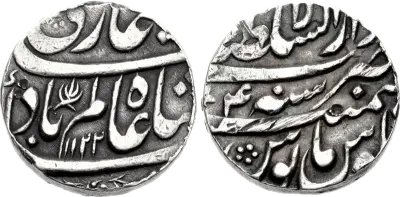
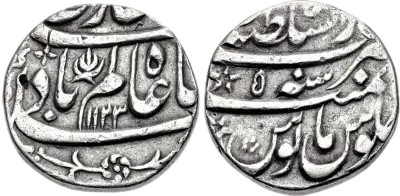
These are regular Mughal issues. The motif appearing on them is entirely consistent with ornamental devices found across a broad range of Mughal coinage from the period. Their presence does not support the interpretation of a Sikh Khanda symbol — they are instead representative of the decorative vocabulary standard to Mughal mint work.
Counter-Evidence
The Same Symbol Across Multiple Reigns & Mints
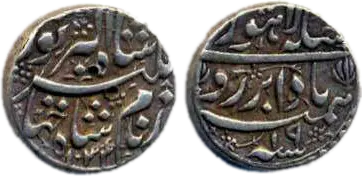
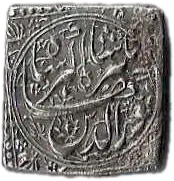
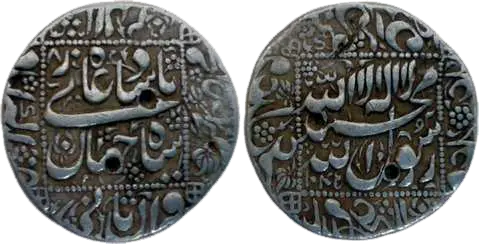
Comparable motifs appear on coins of Jahangir, Shah Jahan and Aurangzeb — spanning over a century of Mughal rule — from several mints including Lahore, Akbarabad and Agra. This breadth of occurrence directly refutes the claim that the symbol is confined to the Lahore mint or to years of Sikh significance.
The design belongs to the decorative vocabulary of Mughal coinage, not to any sectarian emblem.
The Argument from Sovereignty
When Sikhs Ruled, Their Coins Said So Openly
The deeper logical flaw in the claim is its assumption that Sikh sovereignty, when it existed, would have been expressed through hidden marks on Mughal coinage — through a concealed symbol rather than an open declaration.
History provides the rebuttal directly. When Jassa Singh Ahluwalia and the Dal Khalsa captured Lahore in November 1761, they struck coins in their own name — openly, in the name of the Sikh Gurus, declaring sovereignty in the legends of the coin itself. The contemporary chronicler Ghulam Ali Azad records the moment within months: "They raised Jassa Singh to the status of a king and blackened the face of the coin with his name."
When the Sikhs expressed sovereignty, they did so in the clearest possible numismatic language — the full Nanakshahi-Gobindshahi couplet struck openly at Lahore, Amritsar, Multan and Anandghar. There was no need, no precedent, and no practice of encoding a Sikh emblem covertly on a Mughal coin.
Anachronism
The Khanda as a Modern Symbol
The Khanda as a composite emblem — the double-edged sword flanked by two kirpans encircled by a chakkar — is a modern symbol. It was formalised and adopted as the emblem of the Shiromani Gurdwara Parbandhak Committee (SGPC) in the twentieth century. It does not appear in this composite form in Mughal-era sources, coins, hukamnamas or paintings.
Projecting the modern Khanda back onto coins struck between AH 1100 and AH 1125 is an anachronism. The decorative motif visible on these Mughal coins predates the modern emblem by over two hundred years. Its visual resemblance to the Khanda is superficial — the result of reading a familiar modern symbol into an older, unrelated ornamental form.
Conclusion
A Numismatic Misreading
The supposed Khanda symbol on Mughal coins results from a misreading of decorative motifs common in Mughal art, architecture and coinage. The design appears across multiple reigns and mints — Jahangir, Shah Jahan, Aurangzeb, Shah Alam Bahadur — and predates the modern composite Khanda emblem by many decades.
The claim that the symbol appears only at Lahore and only in years of Sikh historical significance is contradicted by the numismatic record: identical or closely related motifs appear at Agra and Akbarabad under emperors who ruled a century before Banda Singh Bahadur's campaigns.
The alleged Khanda on Mughal coins is therefore best understood as a numismatic misinterpretation — the projection of a modern emblem onto an unrelated Mughal decorative device — rather than as evidence of Sikh influence on imperial coinage.
This page documents honest misreading. For deliberate forgery — faked dies, cast copies, and tooled coins — see the companion guide.
Fakes & Forgeries Guide →