Philately
Sikh Stamps
Princely States, British India & Worldwide
AD 1878 – present · 94 items · 12 issuing countries


Overview
Stamps as Historical Record
The stamp, like the coin, is a small sovereign statement — an object of official issue that carries on its face the political and cultural priorities of the authority that struck it. The stamps catalogued here span four distinct categories of issuance: the feudatory stamps of the Sikh princely states under British paramountcy; British India issues depicting the sacred shrines of the Punjab; Republic of India commemoratives honouring the Sikh Gurus, martyrs and national figures; and issues from twelve countries worldwide — from Canada and Uganda to Pakistan and Singapore — that have acknowledged the Sikh community and its heritage on their postal releases.
The collection currently documents 94 items across five centuries of Sikh history, from an 1878 Faridkot State feudatory issue to a 2022 commemorative for the 400th birth anniversary of Guru Tegh Bahadur ji.
Feudatory Issues
The Princely States
The four principal Sikh princely states that came under British paramountcy after the Treaty of Amritsar in 1809 — Patiala, Nabha and Jind — issued their own stamps as Convention States, while Faridkot — issued its own stamps as a Feudatory State under the British Indian postal system. These issues, spanning roughly 1878 to the states' merger into independent India in 1948, are among the most historically significant items in the collection. The stamps mirror the political status of their issuing states: nominally sovereign principalities that retained their own postal administration while operating within the British imperial system — much as their coins had maintained distinctive local types while acknowledging British suzerainty.
The Jind State Indian Postal Note of the 1880s is the earliest philatelic item in the collection, pre-dating the formal Convention States stamp issues. It documents the fiscal administration of a princely state at its most mundane and revealing: money orders and postal notes are instruments of everyday governance, not ceremony.
Faridkot State
 1878 – 1886
Patiala State
 1884
1884
 1885
1885
 1935 – 37
 1937 – 38
 1941
1941
 1942 – 45
Nabha State
 1885 — May issue
 1885 — November issue
 1936 – 37
 1938
1938
 1942
1942
 1942 – 45
Jind State
 c. AD 188x
 1885 – 86
1937 – 38
1885 – 86
1937 – 38
 1937 – 38
 1942 – 43
 1941
1941
 1941 – 43
British India
The Harmandir Sahib on Imperial Stamps
The Sri Harmandir Sahib — the Golden Temple of Amritsar — appeared on British India stamps as part of the series depicting the sacred monuments of the subcontinent. The 1935 issue, produced under the reign of King George V, was among the first stamps to feature a Sikh shrine on an imperial postal release. A second issue followed in 1949, by which point India had achieved independence — making it technically a Republic of India stamp, though continuing the same subject tradition.
1935
 1949
1949
 1987
1987
Republic of India
The Gurus & Sikh Anniversaries
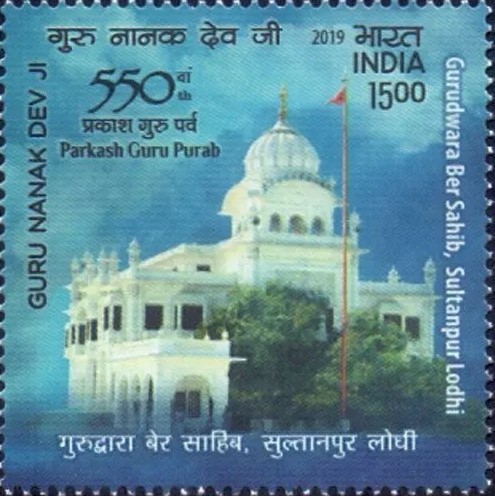
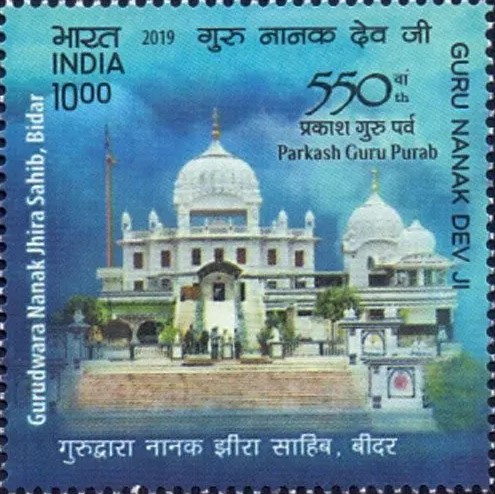
The Republic of India has issued commemorative stamps honouring the Sikh Gurus on their major anniversaries with considerable regularity. The most extensively celebrated has been Guru Nanak Dev ji, whose 400th, 500th and 550th birth anniversaries each produced substantial stamp releases — the 2019 series for the 550th anniversary alone comprised five individual stamps and a miniature sheet. The 300th year of the Khalsa in 1999 — marking the foundation of the Khalsa Panth by Guru Gobind Singh ji at Anandpur Sahib in 1699 — produced its own commemorative. Also issued are stamps marking Maharaja Ranjit Singh (1966) and the 400th birth anniversary of Guru Tegh Bahadur ji (2022).
1966
 1967
1967
 1969
1969
 1975
1975
 1979
1979
 1999
1999
 2019
2019
 2019
2019
 2019
2019
 2019
2019
 2019
2019
 2019
2019
 2022
2022
Republic of India
Sikh Personalities
India's commemorative stamp programme has honoured a wide range of Sikh figures — soldiers, statesmen, freedom fighters, humanitarians and spiritual leaders. Bhagat Singh (1968) and Udham Singh (1992) represent the revolutionary strand of Sikh participation in the independence movement. Hari Singh Nalwa (2013), the greatest general of the Sikh Empire's armies and conqueror of Peshawar and Kashmir, received a stamp over 160 years after his death. The statesman Pratap Singh Kairon, first Chief Minister of Punjab after independence, and Giani Zail Singh, seventh President of India, are among the political figures commemorated. Bhai Kanhaiya ji (1998), the 17th-century Sikh who served water to wounded soldiers of all sides on the battlefield — a founding figure of what might today be called humanitarian service — received his stamp on the 300th anniversary of the Khalsa year.
 1968
1968
 1987
1987
 1988
1988
 1992
1992
 1995
1995
 1998
1998
 1998
1998
 2004
2004
 2005
2005
 2012
2012
 2013
2013
 2019
2019
International Issues
Worldwide
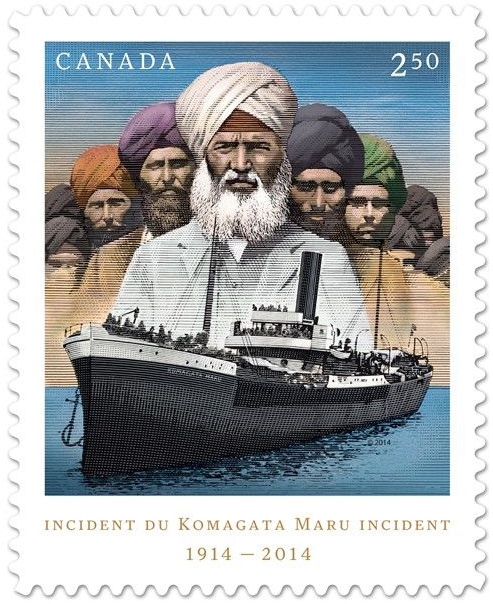
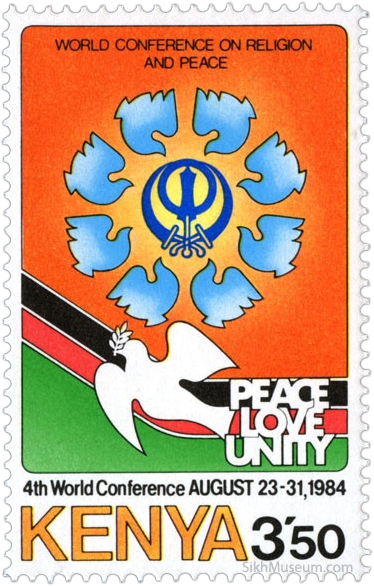
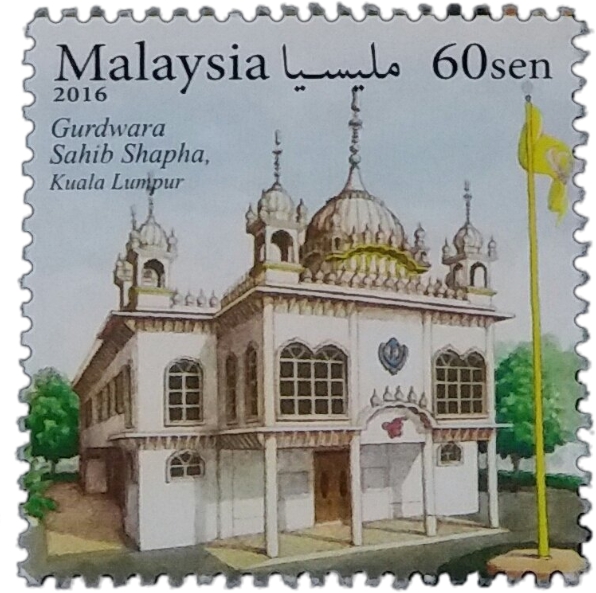
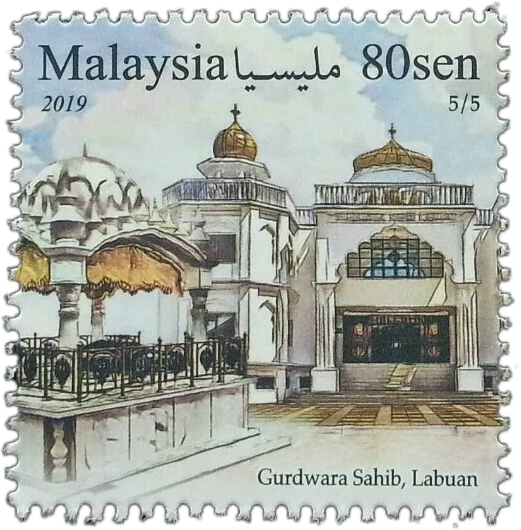
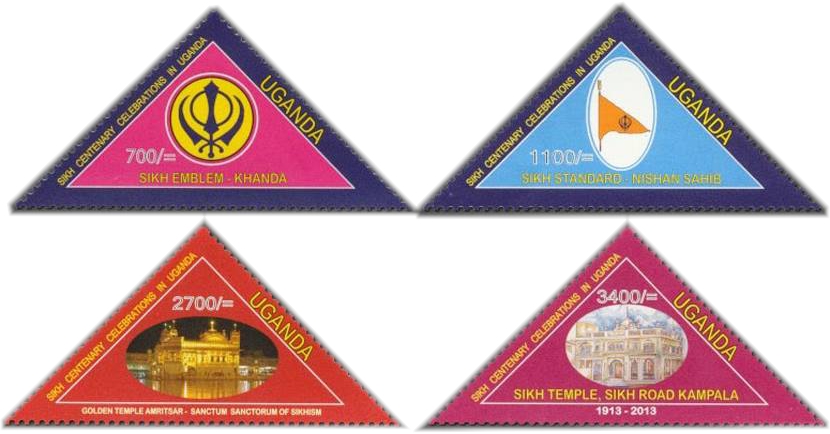
Twelve countries outside India have issued stamps with Sikh themes, reflecting the global reach of the Sikh diaspora and the international significance of Sikh history. Canada has issued two notable stamps — one in 1999 acknowledging the Canadian Sikh community, and one in 2014 marking the centenary of the Komagata Maru incident, in which 376 mostly Sikh passengers were turned away from Vancouver harbour in an episode that became a landmark in the history of racial discrimination in Canadian immigration law. Pakistan has issued commemoratives for Guru Arjan Dev ji's martyrdom anniversary and Guru Nanak Dev ji's 550th birth anniversary — acknowledgments of the Sikh heritage of territory that was once the heartland of the Sikh Empire. Malaysia has honoured individual gurdwaras; Uganda commemorated a century of Sikh presence in East Africa; Singapore featured the Sikh community in its Old Trades series. Even Rwanda issued a stamp featuring a Sikh figure as part of its 1976 Montreal Olympics series.
 1999
1999
 2014
2014
 1984
1984
 2016
2016
 2019
2019
 2006
2006
 2019
2019
 1976
1976
 2018
2018
 2014
2014