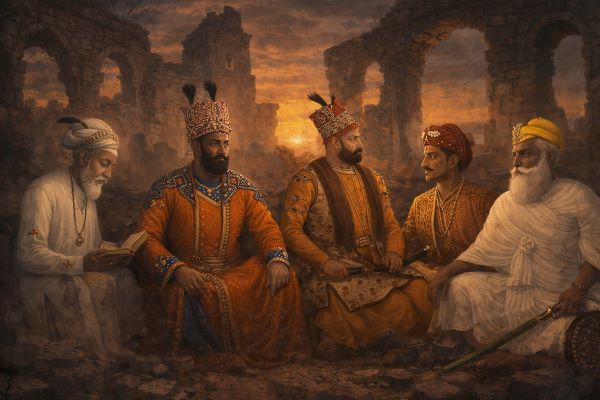
Historical scene at the ruins of Sarhind — AD 1761

AD 1556 – 1948  ·  Punjab  ·  Twelve Dynasties

The Sarhind Mint

A city that outlived every empire — Mughal, Afsharid, Durrani, Khalsa and British — recording four centuries of Punjab history coin by coin

Artist's reconstruction · Ahmad Shah Durrani grants Sarhind to Ala Singh of Patiala, AD 1761

Geography & Significance

Sar-i-Hind — The Head of India

Sirhind — in its Mughal and later Sikh spelling Sarhind, from the Persian Sar-i-Hind, the Head of India — occupied a position of unique strategic importance on the Punjab plains, equidistant between the Sutlej to the south and the Ghaggar to the north, astride the great trunk road between Delhi and Lahore. Every army moving between the Mughal capital and the northwest passed through or near it. Every new power establishing itself in the Punjab felt the need to hold it.

The city was the seat of the Nawab-Governor of the Sirhind Suba — one of the principal administrative divisions of Mughal Punjab. It had been a royal mint town at least since Akbar's early years. The mint building, as with all Mughal provincial mints, was part of the administrative compound. It struck coins for the imperial treasury and the local revenue economy simultaneously. When power changed, the mint changed its dies; the building was occupied by whoever held the city, and the output of silver rupees resumed bearing the new sovereign's name and regnal year.

The Sarhind mint is thus an unusually complete record of Punjab's political history across four centuries. No fewer than twelve distinct dynasties or political authorities are documented as having issued coins here — from the great Mughal emperors down to the Patiala state's last Rajashahi rupees. That the mint name survived every convulsion — carved onto new dies in the name of Nadir Shah, of the Khalsa, of the Afghan Durranis, and finally of the Phulkian Sikh chiefs — is itself a statement about the permanence of Sarhind's administrative role even as its political masters changed with remarkable frequency.

01 · The First Coins

Akbar — The Mughal Mint Established

The Sarhind mint began operating as an imperial Mughal mint during the reign of Akbar (AH 963–1014 / AD 1556–1605). The coins struck here in this period were copper — the dam, the workhorse of the Mughal small-denomination economy — reflecting the mint's provincial character. Gold and silver were struck primarily at the great central mints; copper dams, which served the retail economy and local revenue, were produced at provincial centres across the empire.

Akbar's monetary reforms were among the most consequential of the Mughal period. He standardised the silver rupee at approximately 11.5 grams and fixed the dam at a set ratio to it, creating an integrated bimetallic currency system that would endure, in its essentials, for over three centuries. The Sarhind copper coinage participates in this imperial framework — struck to imperial weight, with the mint name identifying its provincial origin. The output was brief; Sarhind was not among the great Mughal coin-producing centres of the sixteenth century, and the Akbari copper series here was modest by comparison with mints such as Lahore, Agra, or Delhi.

02 · The Great Revival

Aurangzeb Alamgir — Silver Begins at Sarhind

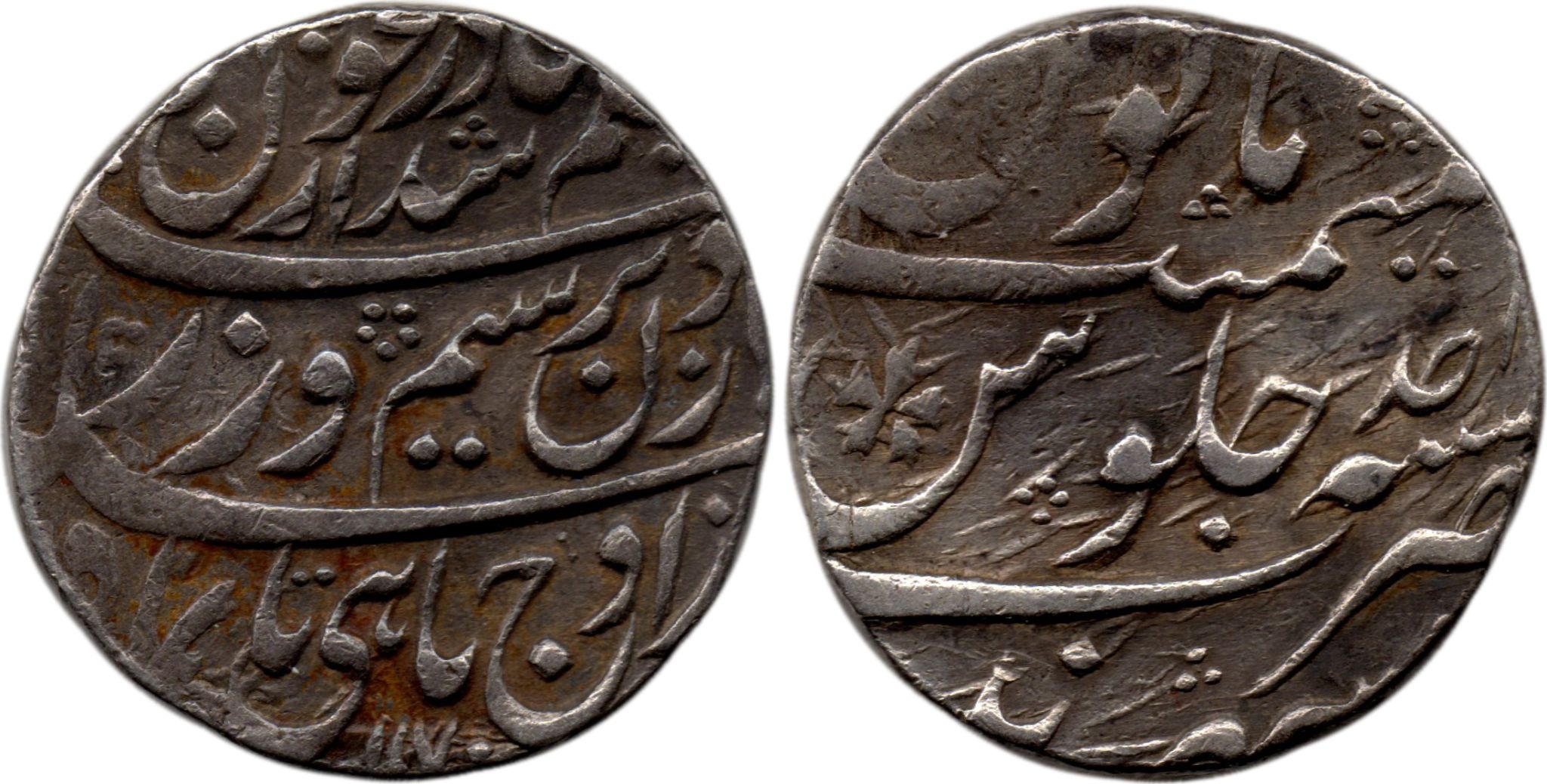
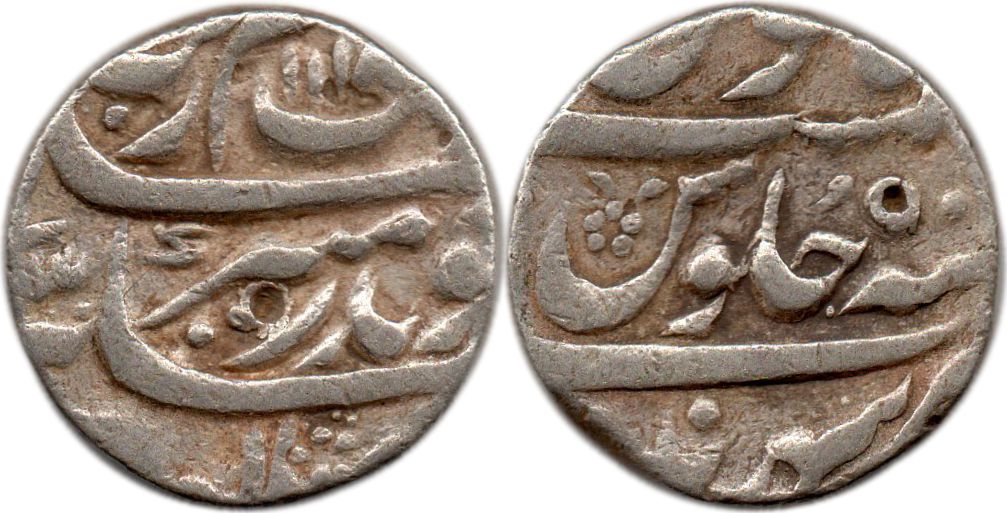
It is under Aurangzeb Alamgir (AH 1068–1118 / AD 1658–1707) that the Sarhind mint's extended silver rupee series begins. The earliest documented rupees from Sarhind in this collection date to AH 1098 / Regnal Year 30 — the thirtieth year of Aurangzeb's reign, approximately AD 1686–87 — and the series continues without apparent break through the remaining years of his fifty-year reign, to AH 1118 / RY 50.

Aurangzeb had early in his reign removed the Islamic declaration of faith — the Kalima — from coin dies, on the grounds that coin-handling was desecrating a sacred text. In its place, an imperial Persian couplet carried the sovereign's name and titles. The Sarhind rupees follow this standard type: the obverse couplet names the Emperor as Alamgir, World-Seizer; the reverse carries the mint name Sarhind with the Hijri date and regnal year. The long unbroken series running from RY 30 through RY 50 suggests the mint operated continuously, restruck with fresh dies as each year turned.

Aurangzeb died on 3rd March 1707, having reigned nearly fifty years. His death set in motion a succession crisis of remarkable destructive force. Six emperors occupied the Mughal throne in the twelve years that followed. The Sarhind mint recorded every one of them.

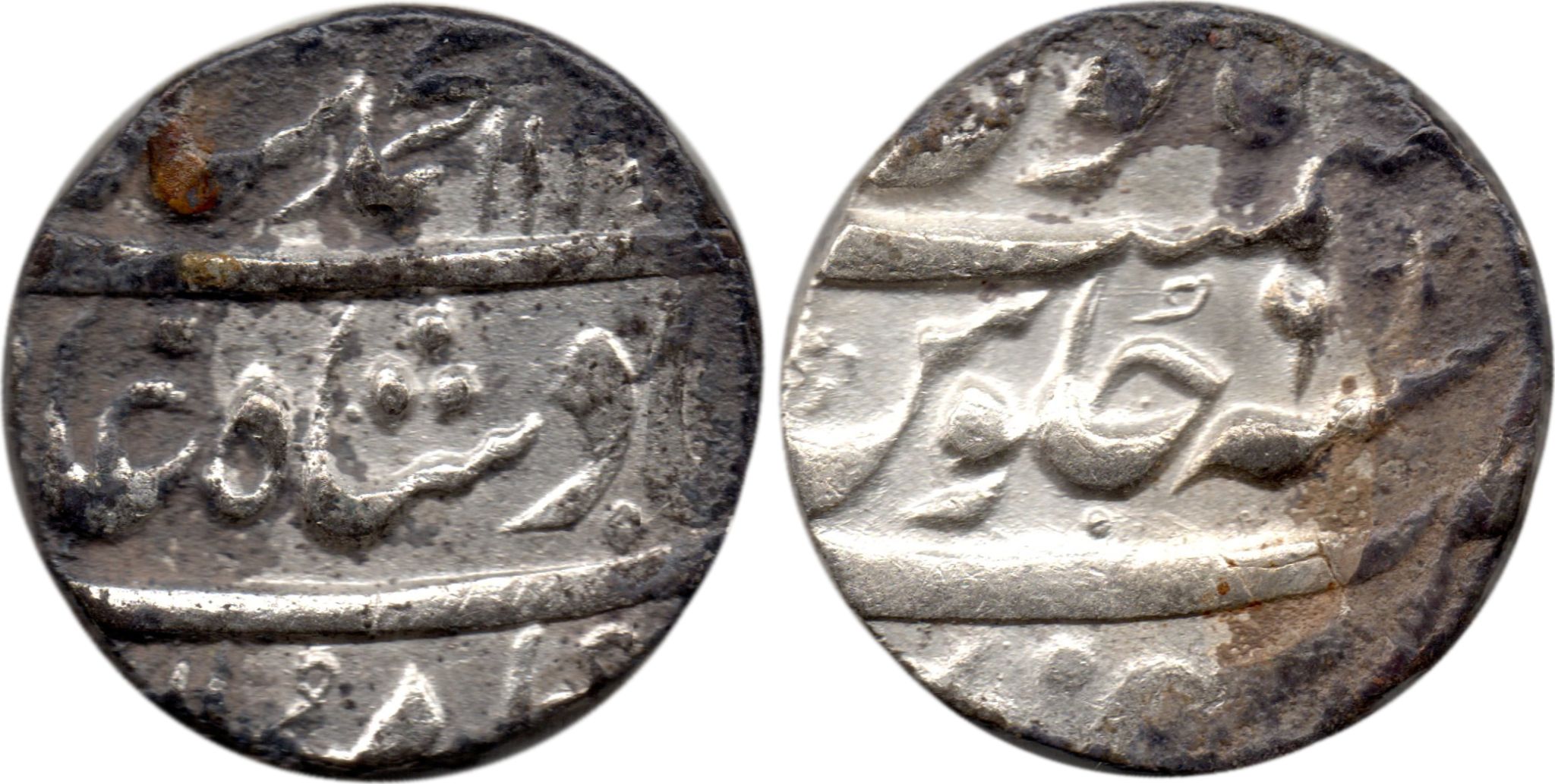
Rupee of Aurangzeb Alamgir — AH 1098 / RY 30

Aurangzeb Alamgir rupee, AH1098/RY30, Sarhind Mint

Earliest documented Sarhind rupee in the collection

Mint

Zarb Sarhind (ضرب سرهند)

Metal & Type

Silver Rupee — AR, c. 11.4 g

Date

AH 1098 / Regnal Year 30 (AD 1686–87)

Significance

Opens the extended Sarhind silver series; documents the revival of the mint under Aurangzeb after the initial Akbari copper issues

03 – 07 · The Collapse of the Centre

Six Emperors in Twelve Years

The numismatic record at Sarhind provides one of the clearest provincial mirrors of the Mughal imperial collapse after Aurangzeb. The collection documents coins in the names of each successive emperor without interruption — a testament to the administrative continuity of the provincial mint system even as central authority disintegrated. Each change of emperor brought new dies to Sarhind regardless of the brevity of that emperor's tenure.

AH 1119–1124
AD 1707–1712

03 · Bahadur Shah I — Shah Alam Bahadur

Aurangzeb's eldest surviving son prevailed over his brothers as Bahadur Shah I. The Sarhind mint struck rupees from AH 1119 / RY 1 through AH 1124 / RY 5. This was precisely the period of Banda Singh Bahadur's rising in the Punjab — his forces captured Sirhind in May 1710 — making these rupees among the most politically complex of the entire series: struck at a city that briefly fell to the Khalsa before being retaken by Mughal forces.

5 Coins in Collection
AH 1124–1125
AD 1712–1713

04 · Jahandar Shah

Following Bahadur Shah I's death at Lahore in February 1712, his four sons went to war for succession. Jahandar Shah prevailed — briefly. His reign lasted barely eleven months before Farrukhsiyar, backed by the Sayyid Brothers, overthrew and strangled him. Yet even in those eleven months Sarhind struck rupees in his name. These are the coins described in the gallery with the prefix 4. — a numismatic footnote to one of the most ephemeral reigns in Mughal history.

Documented in Gallery · Prefix 4
AH 1124–1131
AD 1713–1719

05 · Farrukhsiyar

The longest reign of the post-Aurangzeb succession crisis, yet it ended in violence: deposed, blinded, and killed by the Sayyid Brothers in 1719. The Sarhind mint was productive during his reign — the collection holds specimens from AH 1125 / RY 1 through AH 1130 / RY 7 and beyond. It was during Farrukhsiyar's reign that Banda Singh Bahadur was captured (1715) and executed at Delhi (1716), ending the Khalsa's first challenge to Mughal authority in the Punjab.

8+ Coins in Collection
AH 1131
AD Feb–Jun 1719

06 · Rafi ud-Darjat — The Year of Four Emperors begins

Following Farrukhsiyar's murder, two of Bahadur Shah I's grandsons were placed on the throne in rapid succession by the Sayyid Brothers. Rafi ud-Darjat ruled from February to June 1719, dying of tuberculosis. The Sarhind mint struck silver rupees in his name, documented at AH 1131 / RY 1.

1 Coin in Collection · AH 1131 / RY 01
AH 1131
AD Jun–Sep 1719

07 · Rafi ud-Daulah (Shah Jahan II) — The briefest reign documented

Rafi ud-Daulah — who took the regnal title Shah Jahan II — survived his elder brother by only four months, dying in September 1719. His reign was long considered too brief to have produced Sarhind rupees in any number, and a coin here was not previously recorded. The collection now holds a specimen of his rupee from this mint — the only known example of this ruler at Sarhind, making it among the rarest issues in the entire collection. The Sayyid Brothers then installed Muhammad Shah, who would reign for nearly three decades.

1 Coin in Collection — Newly Added · Rare

The Khalsa Interlude

Banda Singh Bahadur — The Mint That Shook an Empire

On 22nd May 1710, Baba Banda Singh Bahadur defeated Nawab Wazir Khan — the man responsible for the execution of Guru Gobind Singh's two younger sons — at the Battle of Chappar Chiri, six kilometres from Sirhind. The city fell the same day. Wazir Khan was killed on the battlefield. For the first time in history a Sikh sovereign authority occupied the Punjab's great administrative city.

Sirhind had a working mint issuing Mughal silver rupees when Banda's forces entered it. The sikhcoins.in page on Banda Singh Bahadur states directly: "Sarhind had a working mint, issuing Mughal silver rupees, and that the same mint was used to strike the very first Khalsa rupees is highly probable." The coins of Banda's sovereignty — bearing the Gobindshahi couplet and naming the mint as Maswarat Shahr (the Walled City) or simply as the Khalsa — survive in two known types, dated Year 2 and Year 3 of his brief reign.

Banda's six-year rebellion — fought across the Punjab from the Yamuna to the Beas — cracked the foundations of Mughal provincial authority in a way from which it never fully recovered. He was captured in December 1715 at Gurdas Nangal and executed at Delhi in June 1716. But the coins he struck, and the memory of the city he briefly held, would resonate across Sikh history for generations. Within fifty years the city would fall to the Khalsa permanently — never to revert to Mughal or Afghan authority again.

"Sarhind had a working mint, issuing Mughal silver rupees, and that the same mint was used to strike the very first Khalsa rupees is highly probable."
— sikhcoins.in, Coinage of Banda Singh Bahadur

08 · The Long Reign

Muhammad Shah — Thirty Years, Two Invasions

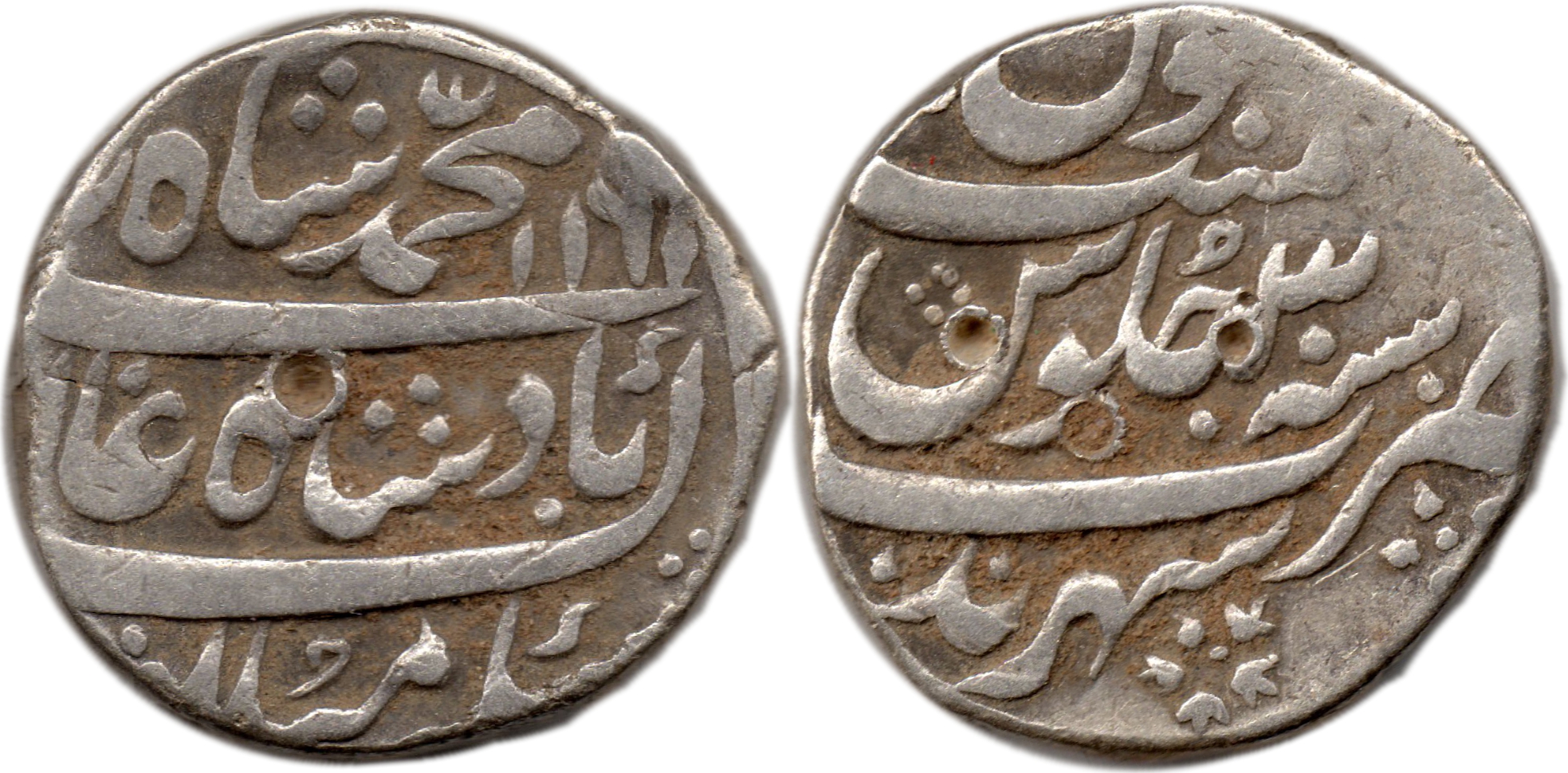
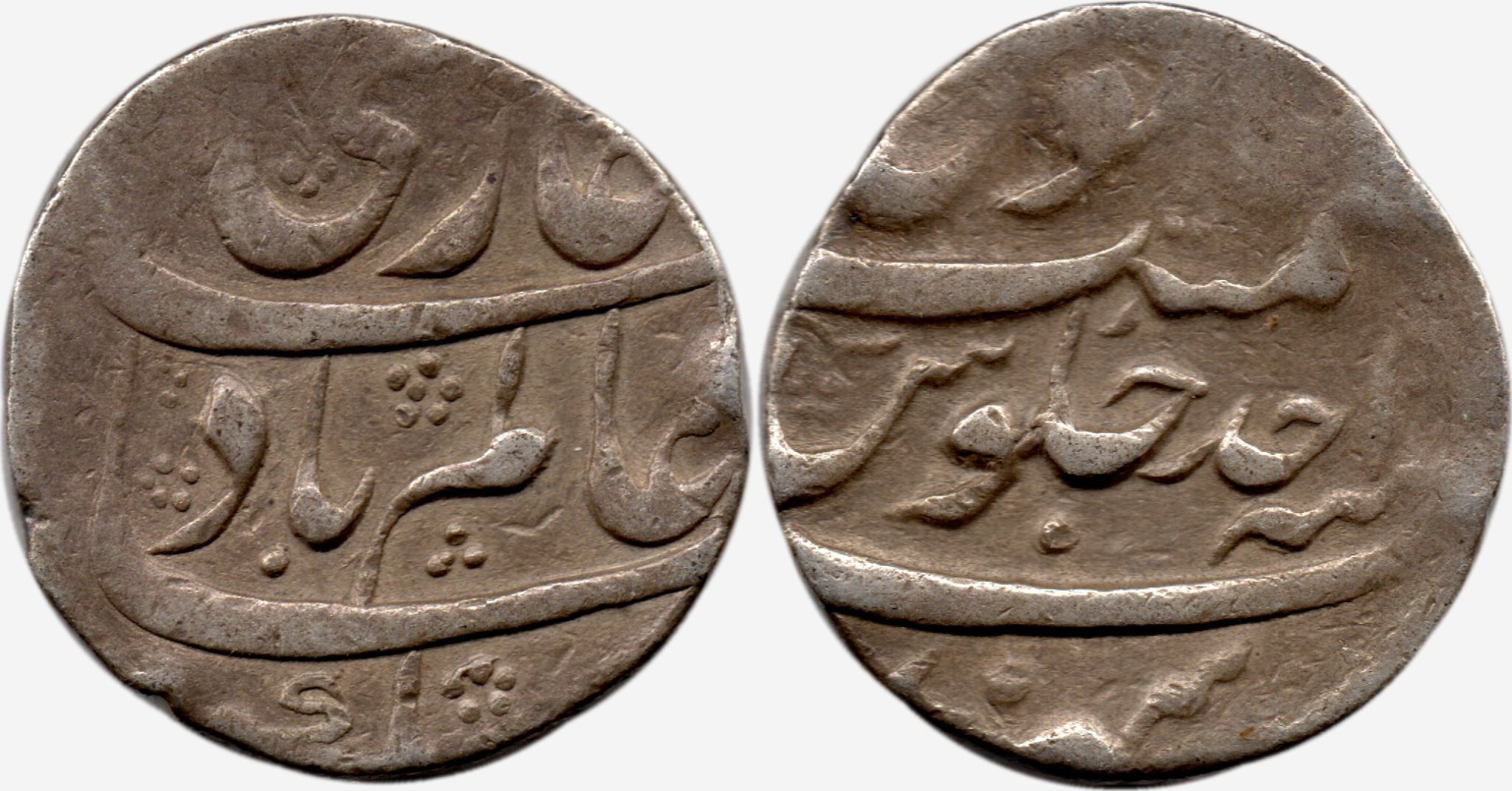
Muhammad Shah (AH 1131–1161 / AD 1719–1748), nicknamed Rangeela — the Colourful — ruled the Mughal empire for nearly three decades. His reign saw the definitive collapse of Mughal central authority into regional successor states, and two traumatic foreign invasions that stripped away what remained of imperial prestige. For the Sarhind mint it was the most productive single reign in the collection: specimens run from AH 1132 / RY 2 through AH 1161 / RY 31, documenting virtually every year without significant gap.

While the mint struck silver rupees year after year in the conventional Mughal style, the Punjab was being transformed around it. The Sikh Misls were forming. Mughal provincial governors were becoming effectively independent. And in 1739, Nadir Shah's army marched from Persia, shattered the Mughal forces at Karnal, occupied Delhi for fifty-seven days — and in doing so fatally demonstrated the empire's military helplessness before the world.

Rupee of Muhammad Shah — AH 1161 / RY 30

Muhammad Shah rupee AH1161/RY30, Sarhind Mint

Date

AH 1161 / Regnal Year 30 (AD 1747–48)

Context

Among the last of Muhammad Shah's long reign; by this date Ahmad Shah Durrani had already conducted his first invasion of the Punjab

09 · The Persian Conqueror

Nadir Shah — Struck in the Shadow of the Peacock Throne

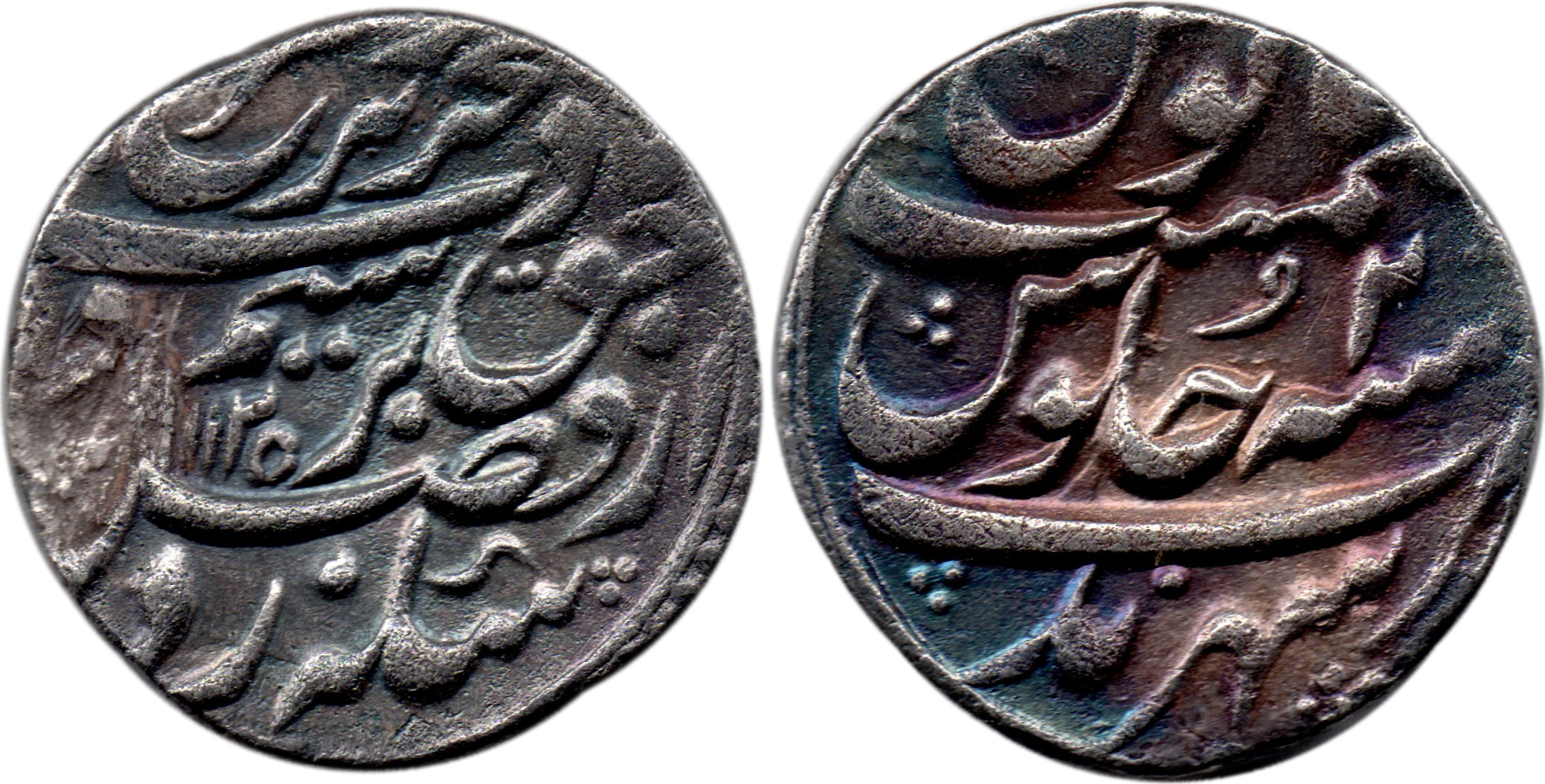
In AH 1151–52 / AD 1738–39, Nadir Shah Afshar, the warrior-king of Persia, crossed the Indus and marched on Delhi. He annihilated the Mughal army at the Battle of Karnal on 13 February 1739. Emperor Muhammad Shah was taken captive in his own camp and compelled to attend a durbar at which Nadir Shah sat upon the Mughal throne and received obeisance as suzerain of Hindustan. For fifty-seven days Nadir Shah held the capital — during which an estimated 20,000–30,000 residents were massacred — before withdrawing with the Peacock Throne, the Koh-i-Noor diamond, and the entire Mughal treasury.

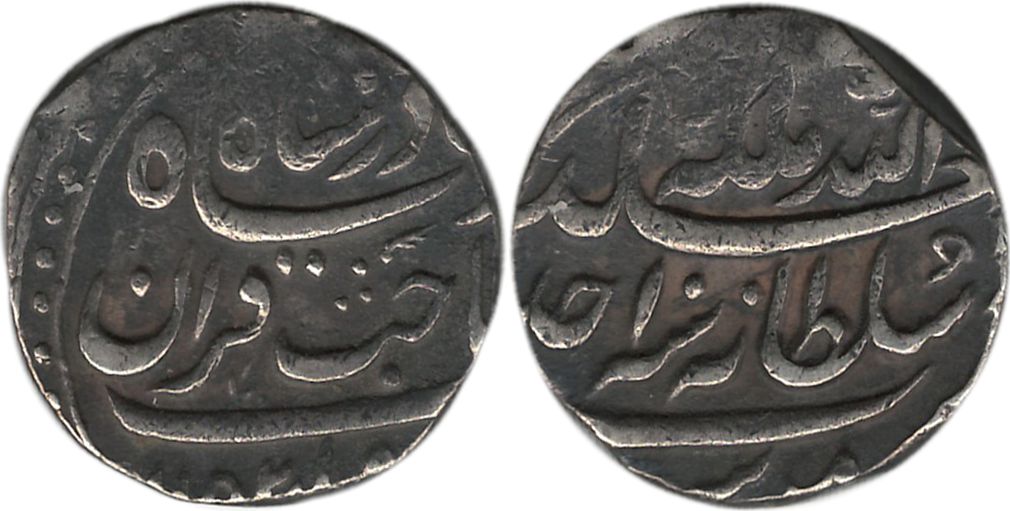
During this period of Persian suzerainty, the Sarhind mint struck rupees in the name of Nadir Shah. These are among the most historically remarkable coins in the collection: the only documented occasion on which a non-Mughal foreign conqueror's name appeared on the dies of this Punjab provincial mint while the Mughal emperor was still nominally alive. The collection holds a specimen dated AH 1152 / RY 01 — the first regnal year of Nadir Shah's acknowledged suzerainty over Hindustan.

Rupee of Nadir Shah — AH 1152 / RY 01

Nadir Shah rupee AH1152/RY01, Sarhind Mint

Issuer

Nadir Shah Afshar — Afsharid Dynasty

Date

AH 1152 / Regnal Year 01 (AD 1739–40)

Metal & Type

Silver Rupee

Significance

One of the rarest types of the Sarhind mint — a foreign conqueror's name on Punjab dies while the Mughal emperor was still alive. Currently carried in the gallery under prefix 9; see gallery note below.

Gallery note In the current album, Nadir Shah and Ahmad Shah Bahadur are both listed under prefix 9 — a numbering error to be corrected in a future update. After correction, Nadir Shah will retain position 9 and Ahmad Shah Bahadur will move to position 10.

09 → 10 · The Last Effective Mughal

Ahmad Shah Bahadur — The Mint Under a Weakened Throne

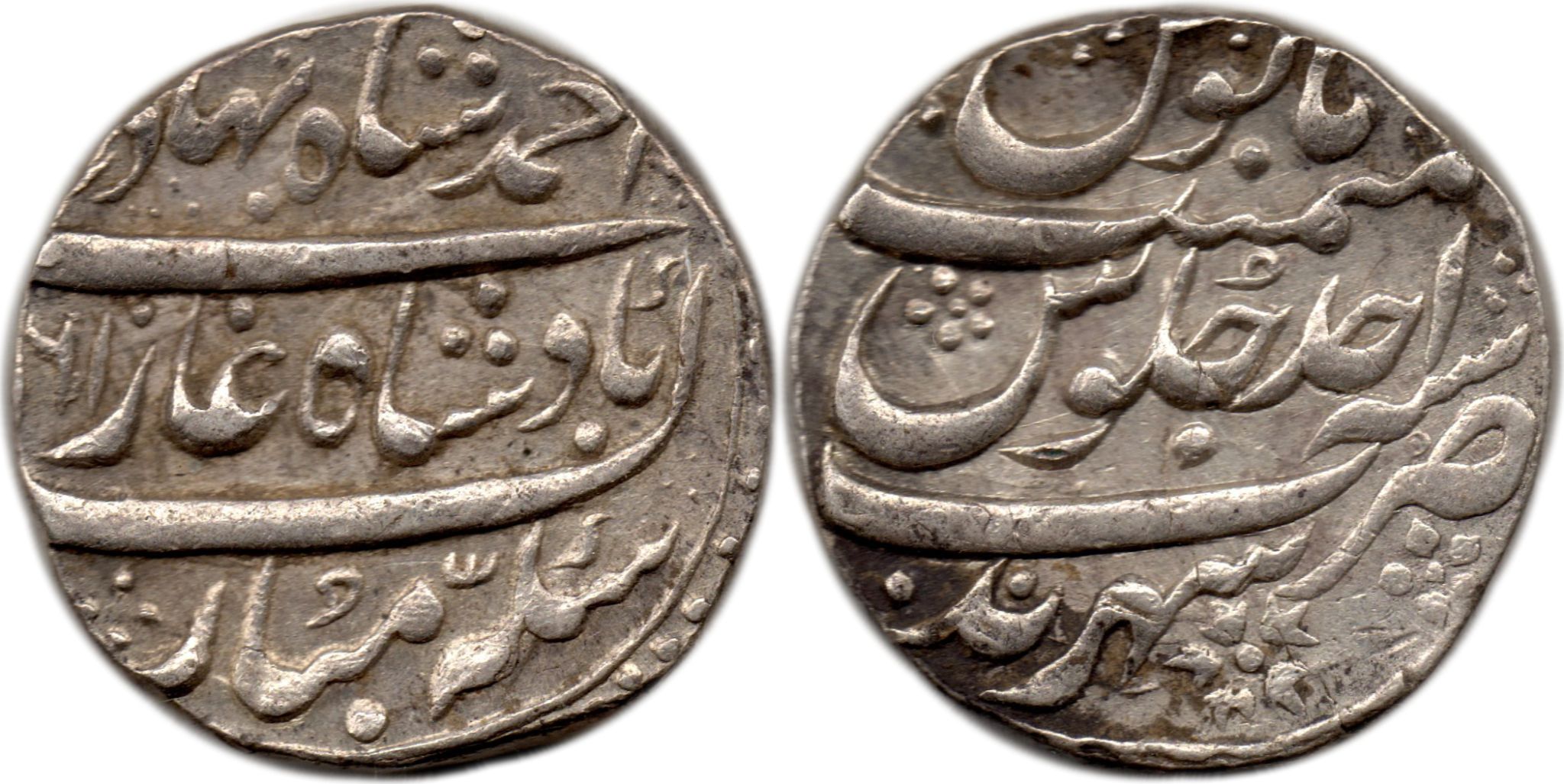
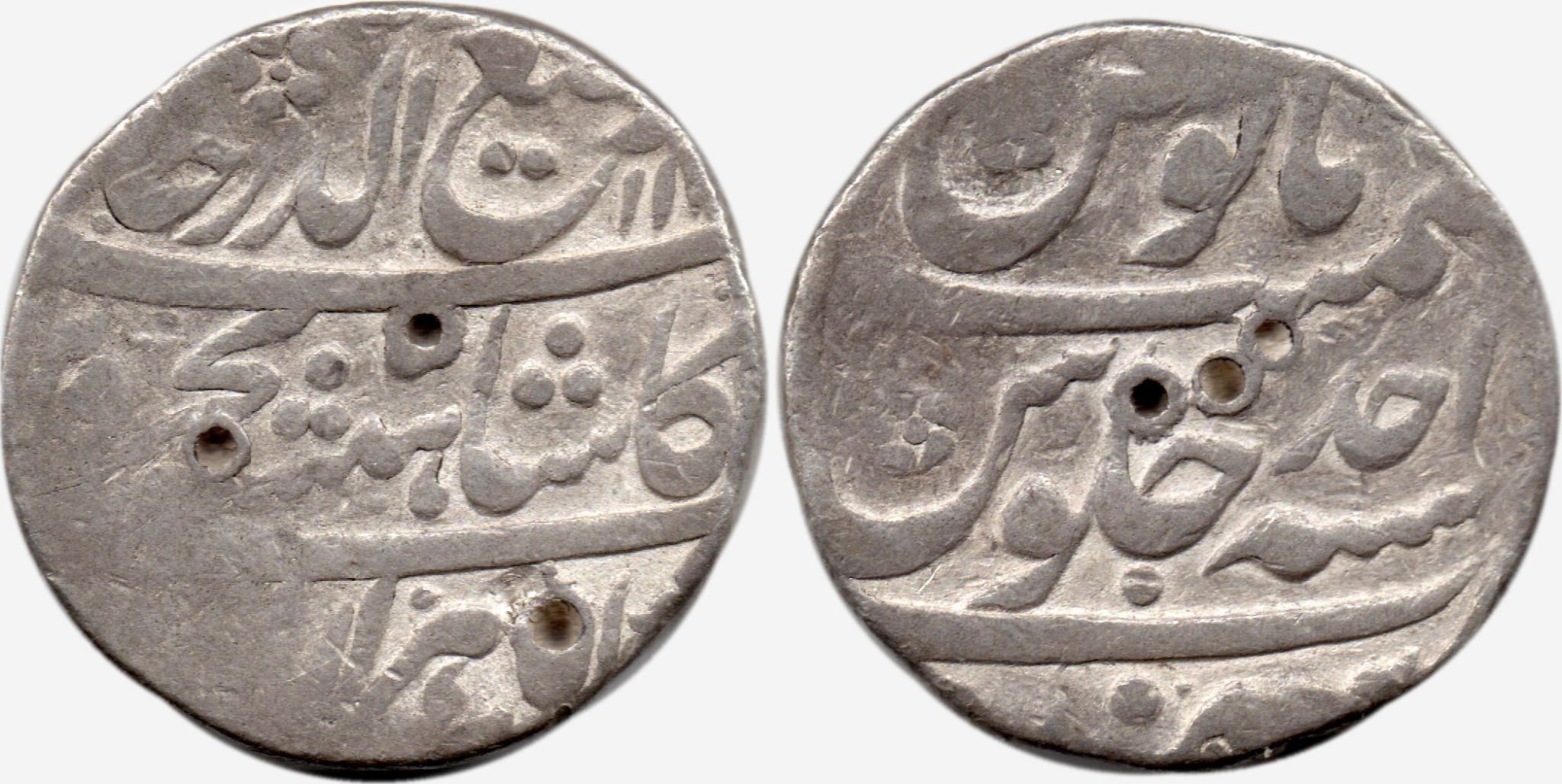
Muhammad Shah died in April 1748. His son Ahmad Shah Bahadur (AH 1161–1167 / AD 1748–1754) succeeded him. The collection holds specimens from AH 1161 / RY 1 through AH 1167 / RY 7 — virtually his entire short reign. Ahmad Shah Bahadur's tenure coincided with the opening phase of Ahmad Shah Durrani's repeated invasions. The Durrani invaded for the first time in 1747–48, and again in 1748 — the very year of Muhammad Shah's death — defeating a Mughal force at Manupur near Sirhind. Ahmad Shah Bahadur was himself blinded and deposed in 1754 by the Wazir Imad ul-Mulk, who had him replaced by a puppet of the Marathas' choosing.

Rupee of Ahmad Shah Bahadur — AH 1161 / RY 01

Ahmad Shah Bahadur rupee AH1161/RY01, Sarhind Mint

Date

AH 1161 / Regnal Year 01 (AD 1748) — accession year

Context

Ahmad Shah Durrani invaded the Punjab for the first time in the same year as this coin was struck

10 → 11 · Maratha Ascendancy & Durrani Return

Alamgir II — The Punjab in the Storm

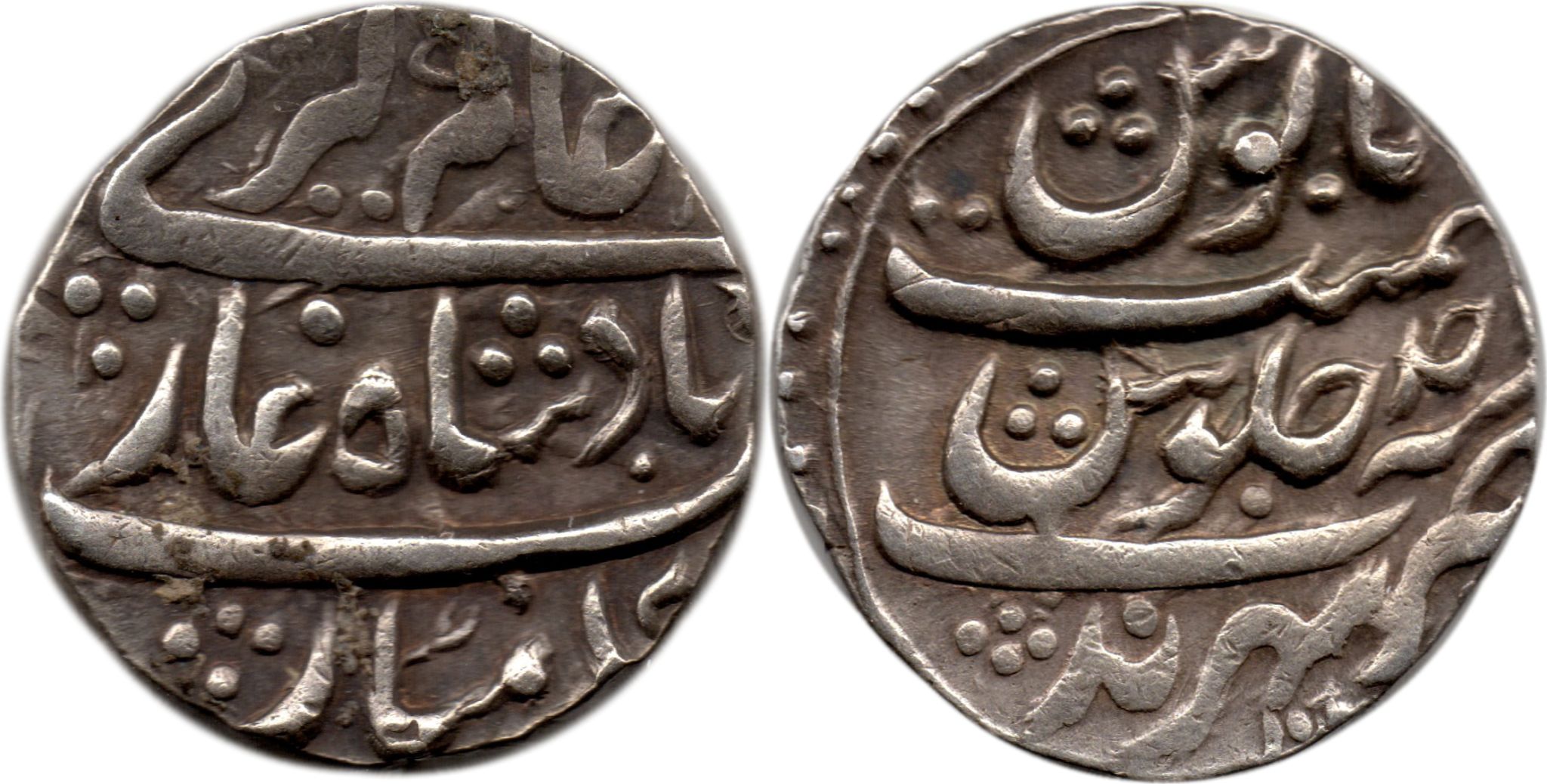
Aziz ud-Din Alamgir II (AH 1167–1173 / AD 1754–1759) was placed on the throne by Imad ul-Mulk after the deposition of Ahmad Shah Bahadur. His reign coincided with one of the most turbulent periods in Punjab history — the simultaneous struggle between Maratha power, Durrani power, and the rising Sikh Misls. The Sarhind mint struck silver rupees throughout, with specimens in the collection from AH 1167 / RY 1 through multiple years of his reign.

In 1758, the Marathas — acting through their shrewd agent Adina Beg Khan, the Afghan-appointed governor of Jalandhar who had changed sides — swept through the Punjab in a lightning campaign under Raghunath Rao (Raghoba). Maratha forces took Lahore, pushed west and briefly occupied Peshawar, and extended their influence as far south as Multan, driving the Durrani garrison entirely out of the Punjab. Ahmad Shah Durrani was engaged in Afghanistan; the Punjab appeared to have passed to Maratha control.

It was a brief triumph. Adina Beg died in September 1758, and without his administrative genius the Maratha position in the Punjab became untenable. The collection includes a rupee struck in the name of Shah Alam II and dated AH 1174 / Ahd (accession year) — a coin of the Maratha-backed regime struck somewhere in the theatre of the Third Panipat campaign. Attributing it to the Sarhind mint itself requires caution: by this date Ala Singh of Patiala was already in effective control of Sirhind, operating as the Durrani's own ally in the region. The Maratha forces — encamped at Panipat for three months before the battle of 14 January 1761 — had no practical means of reaching or operating the Sarhind mint. The coin is more likely a field-mint or camp-mint issue struck in the Panipat area during the Maratha encampment, in the name of the nominal Mughal emperor whose cause they had come to defend, bearing the local regional mint attribution. Alamgir II was murdered by Imad ul-Mulk in November 1759.

Rupee of Alamgir II — AH 1167 / RY 01

Alamgir II rupee AH1167/RY01, Sarhind Mint

Issuer

Aziz ud-Din Alamgir II — Mughal

Date

AH 1167 / Regnal Year 01 (AD 1754) — accession year

Rupee in name of Shah Alam II — AH 1174 / Ahd · Panipat Campaign Issue

Shah Alam II rupee AH1174/Ahd, Panipat campaign issue Panipat campaign issue — Maratha field mint, in the name of Shah Alam II

Political Authority

Maratha confederacy — struck in the name of the nominal Mughal emperor Shah Alam II (Ali Gauhar), whose restoration the Marathas were fighting to secure

Date

AH 1174 / Ahd — Accession Year (AD 1760–61)

Attribution Note

Likely struck at a Maratha field or camp mint in the Panipat area during the pre-battle encampment (Oct 1760 – Jan 1761). Sarhind city was under Ala Singh of Patiala — a Durrani ally — and was not accessible to Maratha forces at this date.

Metal & Type

Silver Rupee

11 → 12 · The Afghan Suzerainty & the Battle of Panipat

Ahmad Shah Durrani — Panipat and the Grant of Sarhind

Ahmad Shah Durrani returned with overwhelming force in late 1759, determined to drive out the Marathas and reassert Durrani authority over the Punjab. He allied with the Nawab of Awadh, Shuja ud-Daulah, and the Rohilla chief Najib ud-Daulah, forging a coalition against the Maratha confederacy. The two sides met at the Third Battle of Panipat on 14 January 1761 — one of the largest and most consequential battles in Indian history. The Maratha army under Vishwasrao and the Peshwa's cousin Sadashivrao Bhau was comprehensively destroyed. Sadashivrao Bhau and Vishwasrao both fell on the battlefield; the Maratha threat to the north was extinguished for a generation.

With the Punjab secured, Ahmad Shah turned his attention to the administrative arrangements of the region. He recognised the pragmatic value of the Phulkian chiefs south of the Sutlej, who had maintained their positions through the successive crises without fully committing to any single side. Ala Singh, the chief of the Phulkian Jat Sikh clan of Patiala, had carefully cultivated a relationship with the Durrani court. Ahmad Shah confirmed Ala Singh in possession of Sirhind itself — the very city whose Mughal governor the Khalsa had killed half a century before — granted him the exalted title Raja-i-Rajagan (King of Kings), and with these honours conferred the right to strike coin.

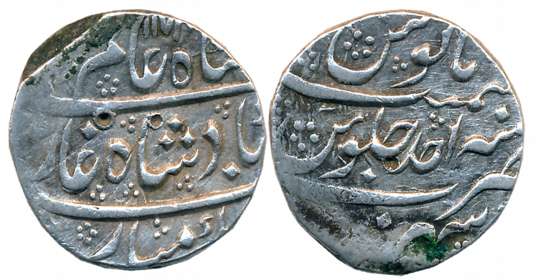
Ahmad Shah's own coins at Sarhind carry his celebrated Persian couplet — Hukm shud az Qadir-i-bechun ba Ahmad Badshah / Sikka zan bar sim-o-zar az ouj-i-mahi ta ba Mah — "The command came from the Powerful, who has none like Him, to Ahmad the Emperor: strike coins on silver and gold from the heights of the Fish to the Moon." This legend, struck on dies bearing the Sarhind mint name, would continue to appear on Phulkian coins for nearly two centuries after Ahmad Shah's own death. His son Taimur Shah Durrani, who succeeded him in 1772, continued to issue rupees at Sarhind on the same type.

Rupee of Ahmad Shah Durrani — AH 1178 / RY 19

Ahmad Shah Durrani rupee AH1178, Sarhind Mint

Issuer

Ahmad Shah Durrani — Durrani Dynasty, Afghanistan

Date

AH 1178 (AD 1764–65)

Obverse Couplet

Hukm shud az Qadir-i-bechun ba Ahmad Badshah
Sikka zan bar sim-o-zar az ouj-i-mahi ta ba Mah

Translation

"The command came from the Powerful, who has none like Him, to Ahmad the Emperor — strike coins on silver and gold from the heights of the Fish to the Moon"

Rupee of Taimur Shah Durrani — AH 1170 / RY 01

Taimur Shah Durrani rupee AH1170/RY01, Sarhind Mint

Issuer

Taimur Shah Durrani — son and successor of Ahmad Shah

Date

AH 1170 / Regnal Year 01 (AD 1772–73) — accession year

12 → 13 · The Phulkian Legacy

Patiala & the Cis-Sutlej States — A Name That Outlasted Every Empire

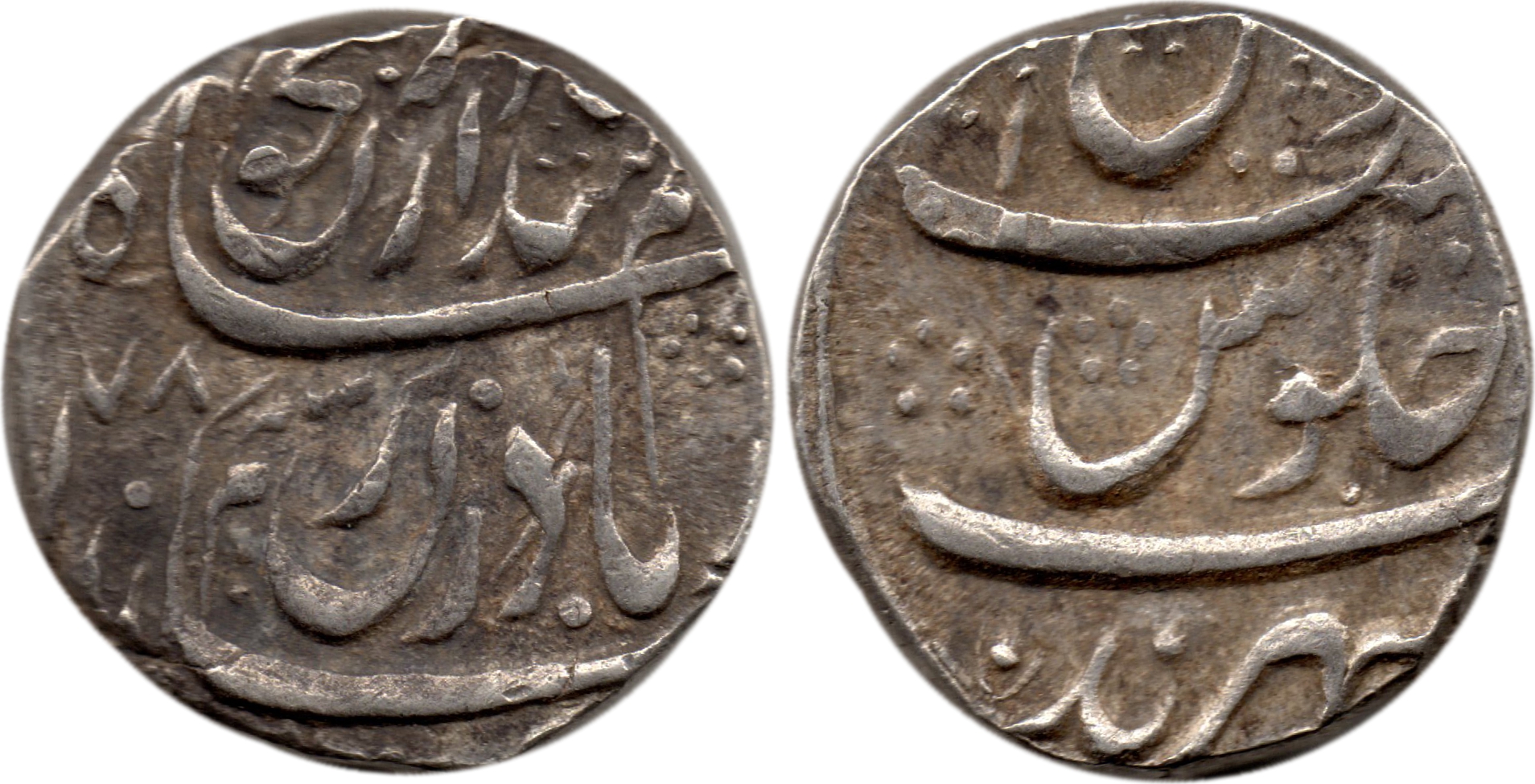
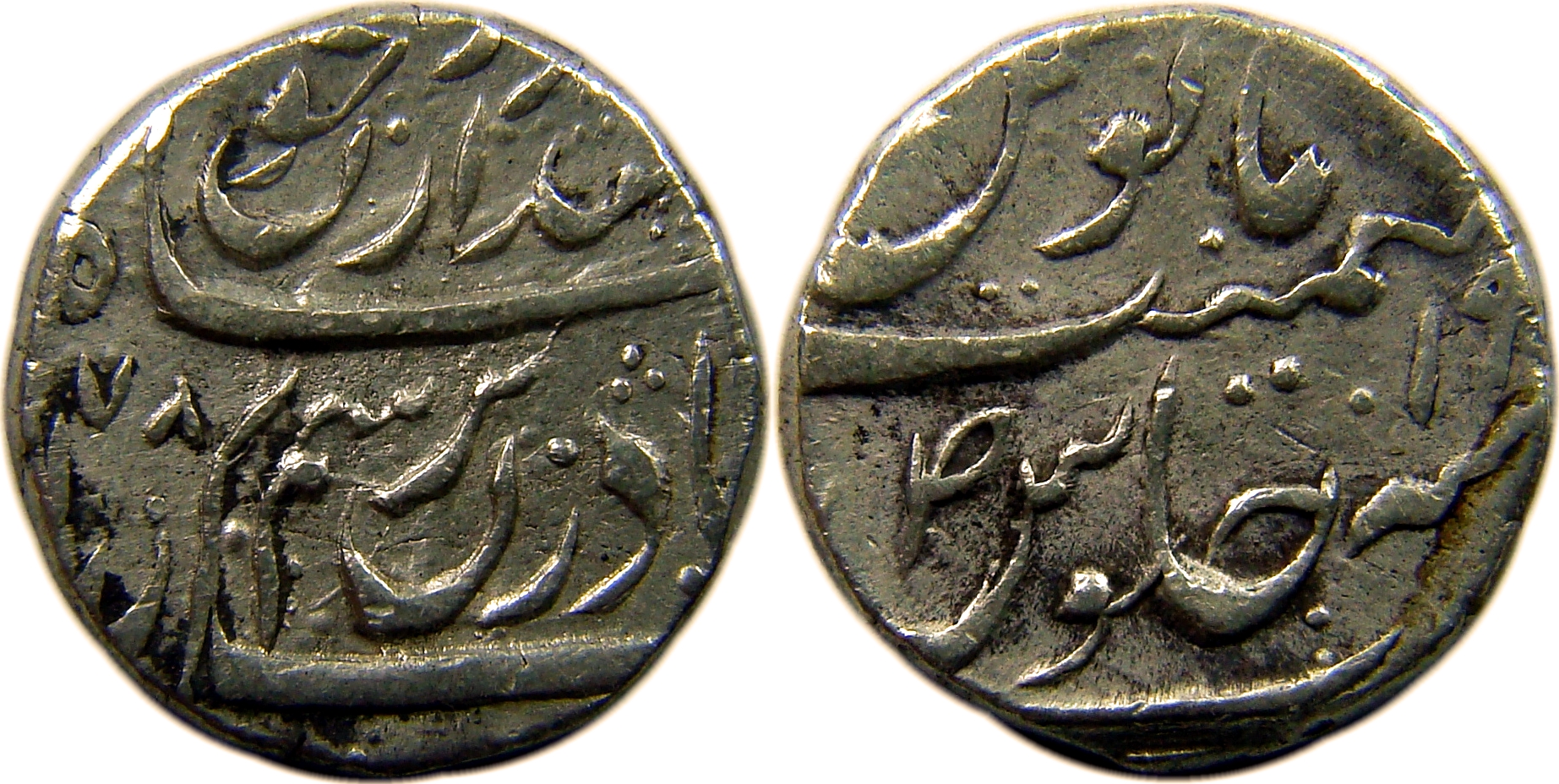
The conferral of Sarhind upon Ala Singh of Patiala by Ahmad Shah Durrani after Panipat inaugurated the longest single chapter in the Sarhind mint's history. For nearly two centuries — from approximately AH 1178 / AD 1764, when the earliest known Patiala Rajashahi rupee appears, until the merger of the state into PEPSU on 20 August 1948 — the mint name Sarhind appeared on the coins of the Phulkian states. No other name in the entire numismatic history of the Punjab exhibits comparable continuity across such a span of political change.

The Patiala coins — the Rajashahi or Royal rupees — carried Ahmad Shah's couplet unchanged from the Durrani original, with the mint name on the reverse alongside the regnal year and a small personal device that alone distinguished one reign from another. Ala Singh (d. 1765) carried no mark. His successor Amar Singh (1765–1781) added three dots. Each subsequent ruler introduced his own device — swords, flowers, khandas, katar daggers, spearheads — creating a layered authentication record across nine reigns extending over nearly two centuries.

The other Cis-Sutlej states struck their own variants at the same mint. Jind used the Sirhind spelling with its own personal marks, its coins valued at 12 annas against Patiala's 16-anna rupee. Kaithal closely copied the Patiala type with a distinctive six-dotted rosette in the nun of bechun. Nabha used its own mint attribution and from VS 1893 (1836) replaced the Durrani couplet with the Gobindshahi couplet of the Sikh Gurus — a generation before Patiala followed suit. The Patiala Gobindshahi nazaranas — struck in small numbers before Dussehra for religious gifts and temple offerings — continued to be produced through the reigns of Narendra Singh, Mohinder Singh, Rajinder Singh, Bhupindra Singh, and finally Yadavindra Singh.

Major-General R.G. Taylor, reporting on the Phulkian mints in 1869, found the Patiala mint staffed by a Superintendent, a Mohurria, Testers, a Weigher (Wasankash), Blacksmiths, Coiners, Refiners of Silver and Gold, and Engravers — a structure that directly descended from the Mughal imperial mint organisation that had first established the Sarhind mint under Akbar three centuries earlier. The mint name Sarhind last appeared on a coin when Patiala and the other Cis-Sutlej states merged into PEPSU in 1948. The city that had recorded on silver the names of Akbar and Aurangzeb, of Nadir Shah and Banda Singh Bahadur, of Ahmad Shah Durrani and the Khalsa, had struck its last coin.

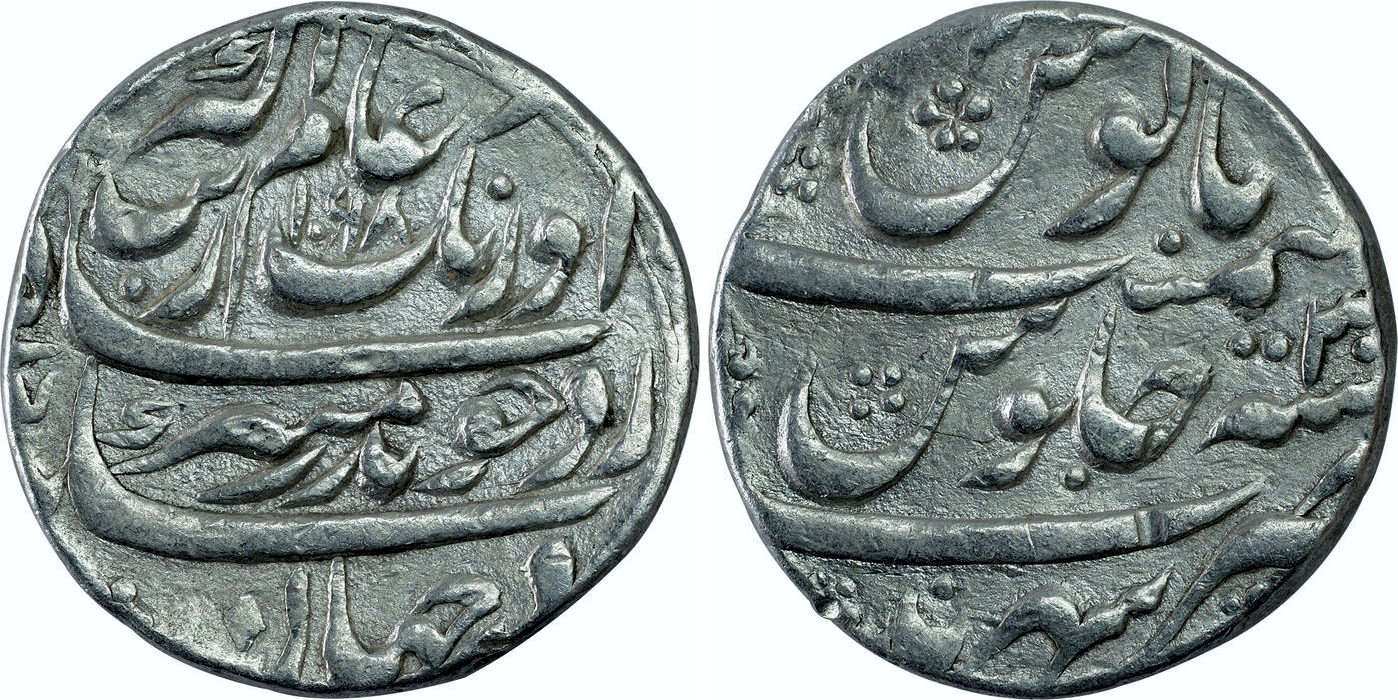
Patiala Rajashahi Rupee · Ala Singh · AH 1178 / RY 19

Patiala Ala Singh Rajashahi rupee AH1178/RY19, Sarhind Mint

First Patiala Rajashahi rupee — Ala Singh, no personal mark

Issuer

Ala Singh of Patiala — first Phulkian issuer at the Sarhind mint

Mint

Zarb Sarhind (ضرب سرهند) — Patiala spelling

Date

AH 1178 / Regnal Year 19 [of Ahmad Shah Durrani] (AD 1764–65)

Ruler Mark

None — Ala Singh carried no personal mark; his coins are identified by the absence of any additional symbol

Significance

The earliest known Patiala Rajashahi rupee. Establishes the connection between Ahmad Shah Durrani's grant of minting rights and Ala Singh's assumption of the Sarhind mint. The same couplet, obverse type and mint name would continue for nearly 200 years.

Obverse Couplet

Hukm shud az Qadir-i-bechun ba Ahmad Badshah
Sikka zan bar sim-o-zar az ouj-i-mahi ta ba Mah

For a complete history of the Phulkian states and their coinage — including full attribution tables for all Cis-Sutlej rulers, the Rajashahi and Gobindshahi couplets, state symbols and mint marks — see the dedicated Cis-Sutlej States page.
Summary

Twelve Dynasties — One Mint Name

The table below summarises the documented issuers of the Sarhind mint in chronological sequence, as catalogued in the Sarhind Mint gallery. Gallery prefix numbers are shown in their post-correction numbering.

# Issuer Dynasty Approx. Dates (AH) Metal
01AkbarMughalAH 963–1014Copper (dam)
02Aurangzeb AlamgirMughalAH 1098–1118 (RY 30–50)Silver Rupee
03Bahadur Shah I (Shah Alam Bahadur)MughalAH 1119–1124Silver Rupee
04Jahandar ShahMughalAH 1124–1125Silver Rupee
05FarrukhsiyarMughalAH 1125–1131 (RY 1–8)Silver Rupee
06Rafi ud-DarjatMughalAH 1131 (RY 1)Silver Rupee
07Rafi ud-DaulahMughalAH 1131 — not yet in gallerySilver Rupee
08Muhammad ShahMughalAH 1132–1161 (RY 2–31)Silver Rupee
09Nadir ShahAfsharid / PersianAH 1152 (RY 1)Silver Rupee
10Ahmad Shah BahadurMughalAH 1161–1167 (RY 1–7)Silver Rupee
11Alamgir II; Shah Alam II (Panipat field-mint issue)Mughal / Maratha field mintAH 1167–1174Silver Rupee
12Ahmad Shah Durrani · Taimur ShahDurrani / AfghanAH 1170–1178+Silver Rupee
13Patiala State (Ala Singh → Yadavindra Singh)Phulkian SikhAH 1178 – AD 1948Silver Rupee (Rajashahi + Gobindshahi)
Specimens in the Collection

Sarhind Mint Coinage

Select representative specimens from each issuer period. Click any image or title to view the full album.

02 · Aurangzeb Alamgir Multiple specimens · AH 1098–1118 RY 30–50 · Full reign series
SpecimenIssuerDate
Aurangzeb AH1098/RY30 Aurangzeb Alamgir, Rupee, AH 1098 / RY 30Earliest Sarhind silver in collection Mughal AH 1098 · RY 30
Aurangzeb AH1118/RY50 Aurangzeb Alamgir, Rupee, AH 1118 / RY 50Last year of reign Mughal AH 1118 · RY 50
03–07 · Succession Emperors Bahadur Shah I · Jahandar Shah · Farrukhsiyar · Rafi ud-Darjat · Rafi ud-Daulah (Shah Jahan II)
SpecimenIssuerDate
Shah Alam Bahadur Shah Alam Bahadur, Rupee, AH 1119 / RY 01 Bahadur Shah I AH 1119
Farrukhsiyar Farrukhsiyar, Rupee, AH 1125 / RY 02 Farrukhsiyar AH 1125
Rafi ud-Darjat AH1131/RY01 Rafi ud-Darjat, Rupee, AH 1131 / RY 01Year of Four Emperors Rafi ud-Darjat AH 1131
Rafi ud-Daulah Shah Jahan II Rafi ud-Daulah (Shah Jahan II), Rupee, AH 1131Newly added · Only known Sarhind example of this reign Shah Jahan II AH 1131
08 · Muhammad Shah 20+ specimens · AH 1132–1161 Most extensive reign series
SpecimenIssuerDate
Muhammad Shah Muhammad Shah, Rupee, AH 1137 / RY 06 Muhammad Shah AH 1137
Muhammad Shah RY30 Muhammad Shah, Rupee, AH 1161 / RY 30Penultimate year of reign Muhammad Shah AH 1161
09 · Nadir Shah 1 specimen · AH 1152 Rare — single year of suzerainty
SpecimenIssuerDate
Nadir Shah AH1152/RY01 Nadir Shah, Rupee, AH 1152 / RY 01Afsharid — only foreign conqueror's name on Sarhind dies Nadir Shah AH 1152
10–11 · Ahmad Shah Bahadur · Alamgir II · Maratha AH 1161–1174 · Multiple specimens
SpecimenIssuerDate
Ahmad Shah Bahadur Ahmad Shah Bahadur, Rupee, AH 1161 / RY 01 Mughal AH 1161
Alamgir II Alamgir II, Rupee, AH 1167 / RY 01 Mughal AH 1167
Shah Alam II Panipat issue Shah Alam II, Rupee, AH 1174 / Ahd — Panipat campaign issueMaratha field mint · Panipat area · not attributed to Sarhind city Maratha AH 1174
12 · Ahmad Shah Durrani & Taimur Shah Multiple specimens
SpecimenIssuerDate
Ahmad Shah Durrani Ahmad Shah Durrani, Rupee, AH 1178 Durrani AH 1178
Taimur Shah Taimur Shah Durrani, Rupee, AH 1170 / RY 01 Durrani AH 1170
13 · Patiala — Rajashahi Rupees Multiple specimens · AH 1178 – AD 1948 Nearly two centuries of continuous striking
SpecimenIssuerDate
Patiala Ala Singh Patiala, Ala Singh, Rajashahi Rupee, AH 1178 / RY 19Earliest known Patiala Rajashahi rupee Patiala AH 1178

Scholarship

References & Bibliography